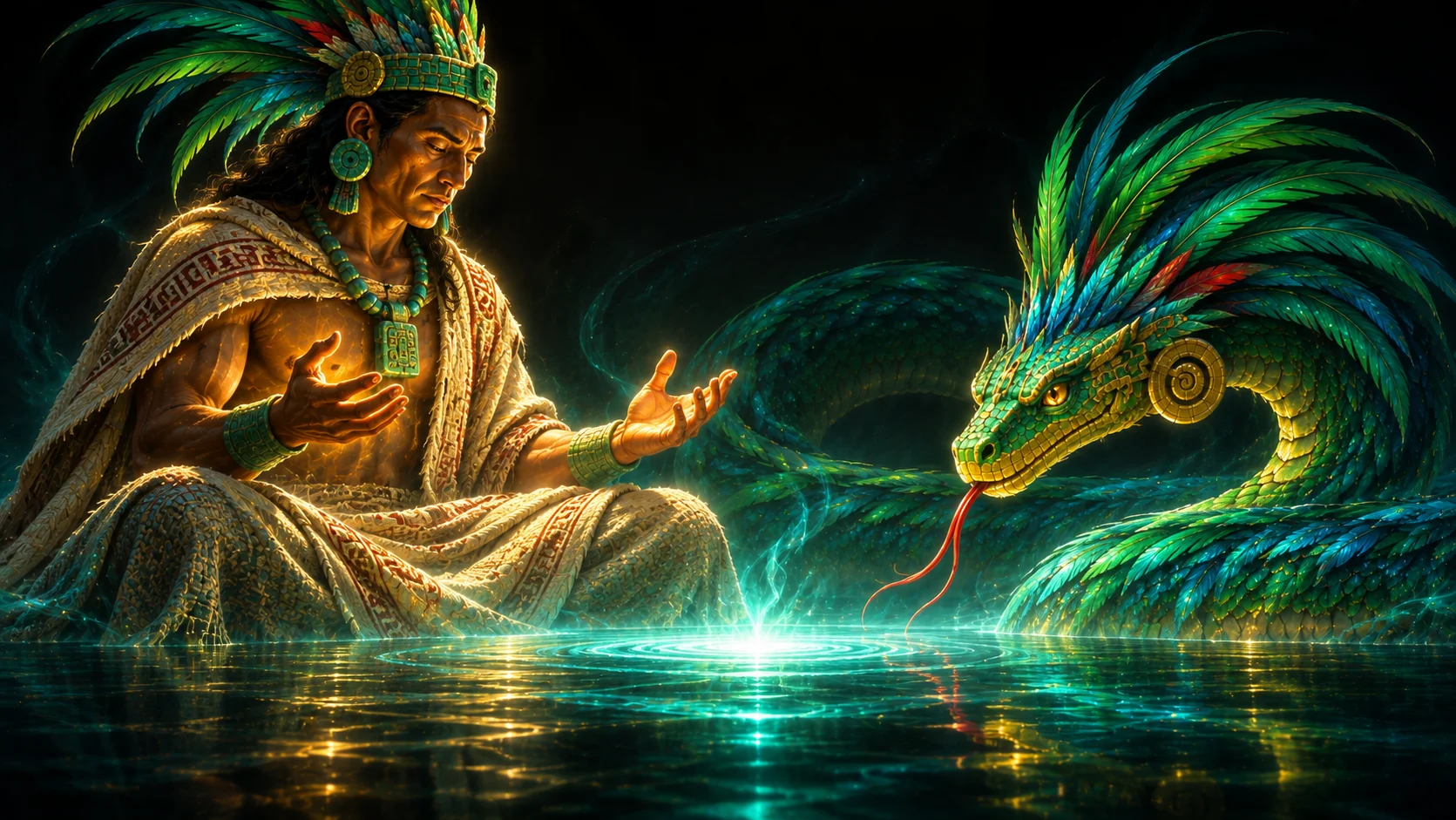
Tepeu, whose K’iche’ Mayan name is generally translated “Sovereign,” “Conqueror,” or “the Victorious One,” is one of the principal creator deities of the K’iche’ Maya, appearing throughout the Popol Vuh in inseparable partnership with the feathered-serpent god Gukumatz. Where Gukumatz supplies the serpent-and-quetzal imagery that links him to the broader Mesoamerican feathered-serpent tradition, Tepeu supplies the title of rulership and authority under which the pair jointly govern the act of creation.
Source: The Popol Vuh
Tepeu appears in the Popol Vuh, the K’iche’ Maya sacred narrative first set down alphabetically in the K’iche’ language in the 1550s, later copied and rendered into Spanish in the early eighteenth century by the Dominican friar Francisco Ximénez, whose manuscript (the earliest surviving version of the text, now held at the Newberry Library in Chicago) underlies all subsequent translations. The text so consistently pairs Tepeu with Gukumatz that the two are frequently referred to together as a single compound name, Tepeu Q’uq’umatz, functioning almost as one deity with two aspects — sovereignty and feathered-serpent power — rather than as two fully separate personalities.
Role in Creation
At the Popol Vuh's opening, before the existence of earth, sky, or any living thing, Tepeu and Gukumatz lie together in the primordial water, deliberating in darkness alongside the triune storm god Huracan, collectively called the Heart of Sky. Their method of creation is conversational and consensual: they talk, think, and agree together, and their spoken agreement itself brings the physical world into being — when they declare that earth must appear, the earth rises from the water, and mountains, valleys, rivers, and forests take shape in response to their collective word. This model of creation through deliberative divine speech, rather than the unilateral act of a single omnipotent creator, is one of the Popol Vuh's most distinctive theological features, and Tepeu's role as the “Sovereign” among the creators underscores that this deliberation has the character of a ruling council reaching a binding decision.
Tepeu, again working with Gukumatz and Huracan, subsequently oversees the repeated attempts to create beings capable of proper speech, memory, and worship — first the animals, who cannot speak the gods' names and are condemned to be eaten and hunted; then humans made of mud, who dissolve, crumble, and cannot hold their shape or move properly; then humans carved from wood, who can speak and multiply but lack hearts, minds, and any memory of their makers, and are ultimately destroyed in a flood sent by Huracan. Each failure prompts renewed deliberation among Tepeu, Gukumatz, and Huracan, together with the elderly diviners Xmucane and Xpiacoc, until the fourth and successful attempt: humans formed from ground white and yellow maize, mixed with water to form flesh, whose speech, gratitude, and capacity for proper worship finally satisfy the creators. These maize people become, in the Popol Vuh's account, the direct ancestors of the K’iche’ Maya themselves.
Meaning and Character
The title Tepeu carries strong connotations of rulership, conquest, and majesty rather than the more elemental, feathered-serpent imagery of Gukumatz. Some scholars have suggested this vocabulary of sovereignty may itself reflect language and political concepts absorbed from broader Mesoamerican, possibly even ultimately Nahua-influenced, sources that entered highland Guatemalan K’iche’ culture during the Postclassic period, a time of significant cultural and political contact across the region; the underlying idea is that "Tepeu" functions almost as an honorific or royal title applied to the creator role, akin to how human K’iche’ rulers themselves were addressed. Whether or not this etymological connection is precise, the effect within the text is clear: Tepeu's presence frames the creators as a legitimate, authoritative ruling body whose decisions about the shape of the world and the nature of humanity carry the force of sovereign decree.
Relationship to Other Deities in This Group
Tepeu's closest and most constant partner is Gukumatz, with whom he is named so often as a single unit that separating the two analytically can feel almost artificial; nonetheless, the Popol Vuh does distinguish them by name and by the specific qualities each contributes to the shared work of creation. Huracan, as the third member of the deliberating trio, supplies the elemental force — lightning, storm, and sudden intervention — that turns Tepeu and Gukumatz's spoken decisions into physical reality. Xmucane and Xpiacoc, the aged diviner-grandparents, join the narrative at key later moments, particularly in refining the process that eventually produces successful maize-based humanity, and afterward as ancestral figures connected to the Hero Twins Hunahpu and Xbalanque. Tepeu, unlike Kukulkan or Gukumatz, has no direct feathered-serpent iconography of his own and is not typically discussed as part of the wider Mesoamerican feathered-serpent religious complex; his identity is bound specifically and almost entirely to his role within the Popol Vuh's creation narrative.
Continuing Significance
The Popol Vuh was recognized by UNESCO in 2012 as part of Guatemala's Intangible Cultural Heritage, a formal acknowledgment of its continuing importance to K’iche’ Maya communities, who do not regard the text or its account of Tepeu's role in creation as a closed historical document but as a living account of origin still read, taught, and drawn upon today. Understanding Tepeu accurately therefore means reading him within this specific, well-documented K’iche’ textual tradition, rather than treating him as an interchangeable stand-in for other Mesoamerican creator gods whose names and stories, while related in broad outline, differ in their specific details and cultural context.
The Trials of Creation as Moral Narrative
The repeated failures Tepeu presides over — the animals who cannot speak, the mud people who dissolve, the wooden people who lack heart and memory — are not simply mechanical obstacles on the way to a technical solution; the Popol Vuh frames each failure in explicitly moral and relational terms. What the gods want, again and again, is not merely a functional being but one capable of genuine gratitude, memory, and proper worship — beings who can “keep the days,” invoke the gods by name, and sustain them through devotion. Tepeu's role as “Sovereign” is therefore bound up with a distinctly relational model of rulership: sovereignty in the Popol Vuh is not raw power exercised over passive subjects but a partnership requiring the created beings' willing recognition and praise, a theological structure that scholars have noted resonates with the broader Mesoamerican understanding of reciprocal obligation between gods and humans, in which ritual offering and remembrance sustain the gods just as the gods sustain the world.
Maker and Modeler, Bearer and Begetter
The Popol Vuh refers to its creator beings by a string of descriptive titles rather than only by names. Tepeu and Gukumatz are called the Maker and the Modeler, and they are paired with another set of titles, the Bearer and the Begetter, usually understood as the grandparent couple of creation.
The use of titles shows the poetic and ritual character of the text. A reader is invited to think of divinity in terms of actions, making, shaping, bearing and begetting, and the named figures can be seen as several faces of a single creative process.
Creation by Speech
The text's account of creation emphasizes speaking. The creators consult together, say a word, and the earth rises from the water, mountains appear and the first beings are shaped. The pattern fits the name of Tepeu, whose title of sovereign suggests the authority to command.
Many readers have compared this to creation by word in other traditions. The comparison should be made with care, since each tradition has its own context, but it is clear that in the Popol Vuh speech is the instrument by which the divine will takes form.
The Opening Silence
The Popol Vuh begins with a description of the world before creation, a time when everything was still and calm, with only the sky and the sea. The text emphasizes the absence of people, animals and any visible thing, and presents the creators as being present in the water, surrounded by light.
This passage has been admired for its beauty and restraint. It sets the stage for the sequence of attempts to create beings who can honor their makers, and Tepeu is one of the figures who stand at the center of that scene.
A Name That May Have Traveled
The name Tepeu has been compared by some scholars with a Nahuatl word meaning conqueror or lord, which would reflect the contact between K'iche' and Nahua-speaking peoples in Postclassic Mesoamerica. Other scholars prefer to explain it from within the Mayan languages.
The question remains open, and it is a reminder of the many layers of influence in the highlands before the conquest. The K'iche' absorbed ideas, titles and political forms from neighbors while keeping a distinct identity.
Why the Gods Work as a Council
A striking feature of the K'iche' account is that creation is not the act of a single will. The Popol Vuh shows the divine figures talking to one another, weighing options, waiting for results and trying again when an attempt fails. Tepeu belongs to this circle of deliberation, and the text gives him a share in every decision.
This collaborative picture suggests a society in which authority was exercised through consultation among elders and lineage heads. Scholars often point out that the divine council mirrors the human councils of the K'iche' nobility, so that the structure of the heavens and the structure of government echo one another.
It also makes the story more dramatic. Because the creators must agree and because their first creations fail, the narrative has suspense and humor, and the final success with maize feels earned rather than inevitable.
Distinguishing Tepeu from Related Figures
Because Tepeu is so tightly bound to Gukumatz in the text, and because the wider feathered-serpent tradition connects Gukumatz to Kukulkan and Quetzalcoatl, readers sometimes mistakenly extend that same web of equivalence to Tepeu himself, treating him as though he had direct counterparts in Yucatec or central Mexican tradition under different names. The available evidence does not support this: Tepeu's identity as a sovereignty title bound specifically to the K’iche’ creation narrative has no clearly identified one-to-one equivalent deity documented among the Yucatec Maya or the Aztec, distinguishing him from Gukumatz, whose feathered-serpent identity is explicitly part of a shared, cross-cultural Mesoamerican religious complex.
Sources & traditions
- EncyclopediaWikipedia — Tepeu
- TraditionMaya texts, oral tradition and village tellings (Mesoamerica)
Myths change from area to area and from time to time. This chronicle follows the most widely told versions; tellings in other villages, regions and eras may differ.