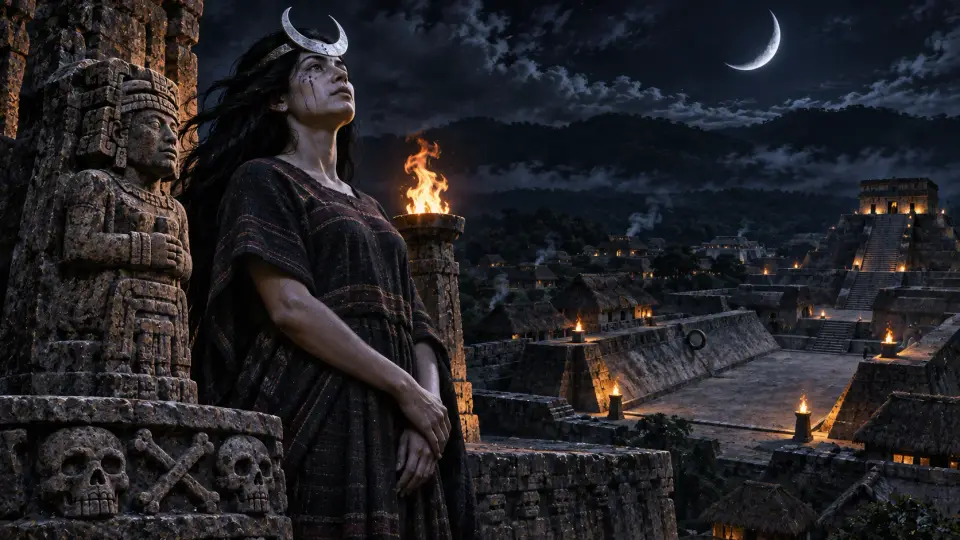
Cizin, whose name is generally translated "the stinking one" or "the flatulent one," was a Yucatec Maya death god closely associated with earthquakes, decomposition, and rulership over the subterranean land of the dead. He is one of the most historically tangled figures in the Maya pantheon: colonial sources, twentieth-century ethnography, and the pre-conquest codices do not speak with a single voice about whether he is his own distinct god or another name for the death lord known elsewhere as Ah Puch.
Domain and Character
Cizin ruled over the land of the dead beneath the earth, a realm the Yucatec Maya and their neighbors called by various names, most famously Xibalba, "place of fear," as recorded in the K'iche' Maya Popol Vuh. His defining trait, embedded directly in his name, was the smell of death itself: the root ciz refers to flatulence or foul odor, and Cizin was understood quite literally as an embodiment of the stench of bodily decay, a sensory detail that grounded an abstract concept — death — in something immediate and visceral that any Maya farmer or fisherman would recognize without needing it explained.
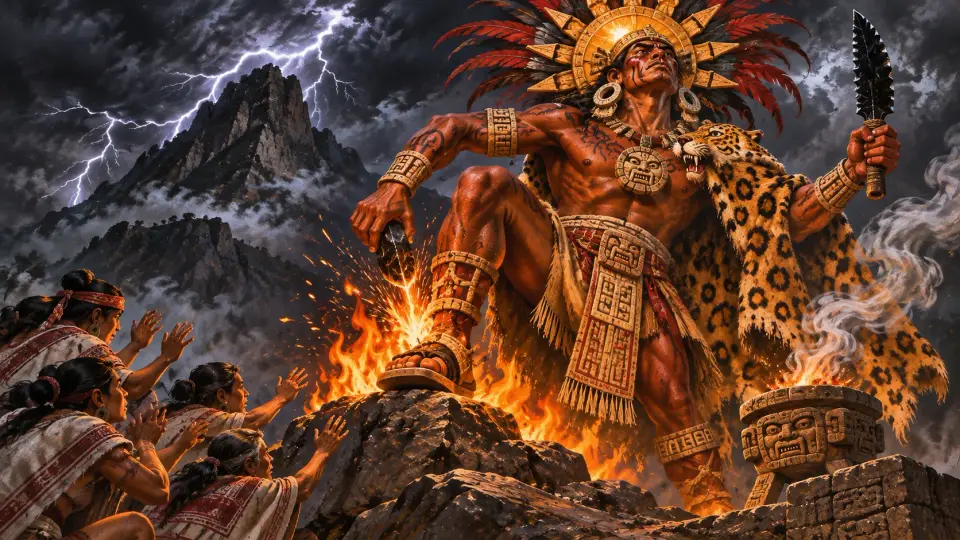
He was also, distinctively among Maya death figures, an earthquake god. Maya oral tradition recorded among later communities describes him growing angry and kicking at the pillars that were believed to hold up the surface of the earth, causing the ground above to shake. This detail is one of the clearest points of continuity linking Cizin to the parallel figure of Kisin among the Lacandon Maya, discussed further below, and it marks a functional domain — the destructive power of the earth itself — that is emphasized far more consistently for Cizin than for the broader, more generalized death-lord figure of Ah Puch.
Cizin and Ah Puch: A Genuine Scholarly Ambiguity
Whether Cizin is simply another name for Ah Puch, or a related but separate death deity, is not a settled question, and this article will not pretend otherwise. The most defensible scholarly position, reflected across multiple modern treatments of Maya religion, is that "Cizin" functioned as one of several names, titles, or regional epithets under which a broader, multivalent Maya death-god concept was known — alongside Ah Puch, Hun Ahau, Yum Cimil, Cum Hau, and Ah Pukuh. Some sources state this plainly: that the underworld death lord "manifested himself under several names and guises," treating Ah Puch and Cizin as facets of one theological idea rather than two separate biographies. The Yucatec Maya themselves are recorded referring to this death lord as Yum Kimil ("Lord of Death") interchangeably with both Cizin and, in Lacandon-influenced sources, Kisin.
At the same time, the name Cizin carries its own distinct etymological identity (the stench root, absent from "Ah Puch") and its own distinct functional emphasis (earthquakes, absent as a core Ah Puch trait in most sources), which is enough for many scholars to treat him as at least a separately nameable aspect, even while acknowledging that pre-conquest Maya religion did not necessarily draw the same hard lines between "one god" and "another" that modern classification instinctively reaches for. The honest position: the sources support treating Cizin as heavily overlapping with, and very possibly identical in origin to, Ah Puch, while also supporting the observation that "Cizin" picked up a specific regional and functional identity — the reeking, earth-shaking aspect of death — that later became especially associated with the Lacandon Maya's Kisin.
Iconography
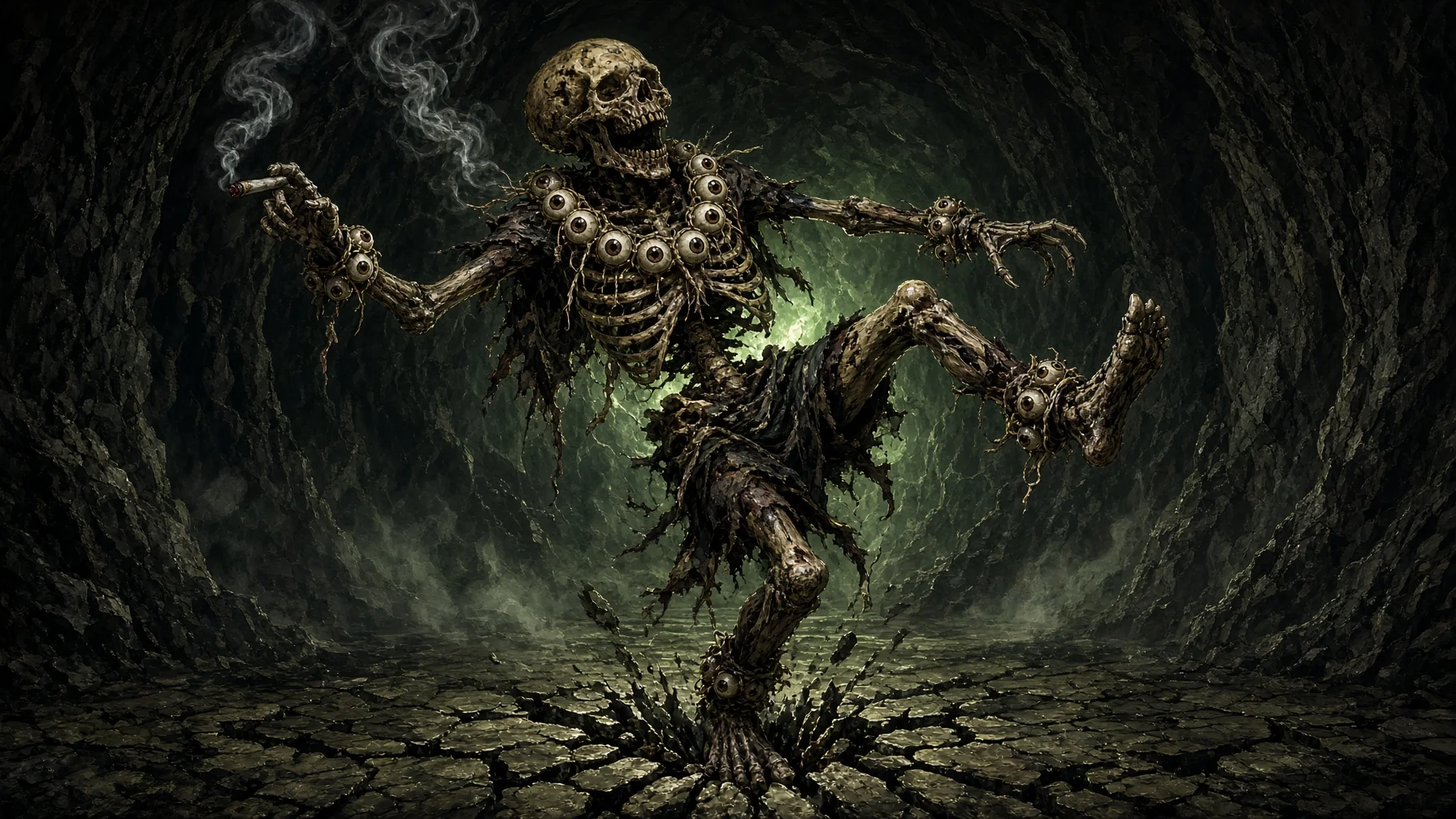
Descriptions of Cizin recorded from later Yucatec and Lacandon oral tradition depict him as a dancing human skeleton, sometimes shown smoking a cigarette, and wearing a necklace strung with human eyes dangling from their optic nerves — a detail shared with the codex depictions of God A/Ah Puch, reinforcing the visual continuity between the names. This grim, almost carnivalesque image — a skeleton that dances and smokes even as it embodies the stink of the grave — captures a certain dark humor that runs through Maya (and broader Mesoamerican) engagement with death: mockery and intimacy with mortality rather than only dread of it, a sensibility later visible in the Day of the Dead traditions of the wider region.
Textual Sources
Much of what is documented about Cizin by name comes from colonial-era ethnographic compilation and from later folklore collection among Yucatec-speaking communities, rather than from a single labeled figure in the pre-conquest codices (where the relevant imagery is generally classified under the generic "God A" rubric shared with Ah Puch). Encyclopedic sources such as Britannica describe him specifically as "a Mayan earthquake god and god of death, ruler of the subterranean land of the dead," known to the Yucatec Maya as Yum Kimil.
Ritual and Belief
As with Ah Puch, devotion to Cizin took the form of avoidance and propitiation rather than celebratory worship. Earthquakes, when they occurred, were read as evidence of his anger or restlessness, and the dead were understood to pass into his keeping, where the deserving suffered continued torment. Some accounts describe him as taking specifically "the souls of the particularly evil" into the underworld for punishment, a detail that introduces a moral dimension — reward and punishment sorted by conduct in life — into what in earlier, more austere reconstructions of Maya afterlife belief was sometimes presented as a purely fate-based, birth-and-manner-of-death-determined system. This may reflect later syncretism with Christian ideas of hell after the conquest, and readers should hold that possibility in mind when weighing how far back this specific moral framing extends.
Position Within the Maya Death-God Cluster
It is worth stepping back and placing Cizin within the fuller cast of Maya death figures to see how the naming works as a system rather than in isolation. The Popol Vuh, recorded among the K'iche' Maya of the Guatemalan highlands rather than the Yucatec lowlands, names two senior lords of the underworld court of Xibalba, Hun Came ("One Death") and Vucub Came ("Seven Death"), alongside ten lesser lords each assigned a specific form of human misery — sickness, starvation, fear, destitution, and so on. This highland tradition does not use the name Cizin at all, which is itself instructive: it shows that "the death god" was not a single pan-Maya figure with one universal name, but a role that different Maya linguistic and cultural groups populated with their own locally developed names, numbers, and narrative detail. Cizin belongs specifically to the Yucatec lowland naming tradition, sitting alongside Ah Puch, Yum Cimil, and the other epithets discussed above, while the K'iche' highland tradition developed its own separate, numerically named lords entirely. Comparing the two traditions side by side makes the Ah Puch/Cizin overlap easier to understand: it is not that Maya religion failed to distinguish gods clearly, but that a broadly shared underworld-lord concept was independently elaborated, named, and multiplied differently in different regions and different eras, sometimes into many named lords (the highland pattern) and sometimes into many names for what may be substantially one lord (the lowland pattern most relevant to Cizin).
Moral Judgment and the Underworld
Later ethnographic material describing Cizin as claiming specifically "the particularly evil" for punishment introduces a moral sorting mechanism into the afterlife that is worth examining critically rather than accepting at face value as pure pre-conquest belief. Reconstructions of earlier, less Christian-influenced Maya afterlife cosmology — the kind reflected in the favored-death categories associated with the goddess Ixtab, for instance, where warriors, sacrificial victims, and those who died in childbirth received a pleasant fate regardless of personal moral conduct — suggest a system organized more around the circumstances and manner of death than around a ledger of good and bad deeds in life. The moralized, sin-and-punishment flavor found in some later descriptions of Cizin's realm may well represent centuries of contact with, and partial absorption of, Christian ideas about hell following the Spanish conquest, layered onto an older substrate that worked on different principles. Responsible treatment of Cizin should flag this rather than presenting the moral-judgment framing as certainly original to pre-conquest belief.
Living Continuity
The name and concept of Cizin remain part of the living oral tradition of Yucatec Maya communities today, and the figure continues to appear in folklore, in regional storytelling, and in scholarly ethnography conducted among contemporary Maya-speaking populations in Yucatan, Campeche, and Quintana Roo. His close relative or alternate self among the Lacandon Maya of Chiapas, Kisin, remains part of a still-practiced, if now minority, traditional religious worldview among a small living indigenous community — a genuine, unbroken thread connecting the pre-conquest pantheon to people alive today.
Sources & traditions
- EncyclopediaWikipedia — Cizin
- TraditionMaya texts, oral tradition and village tellings (Mesoamerica)
Myths change from area to area and from time to time. This chronicle follows the most widely told versions; tellings in other villages, regions and eras may differ.