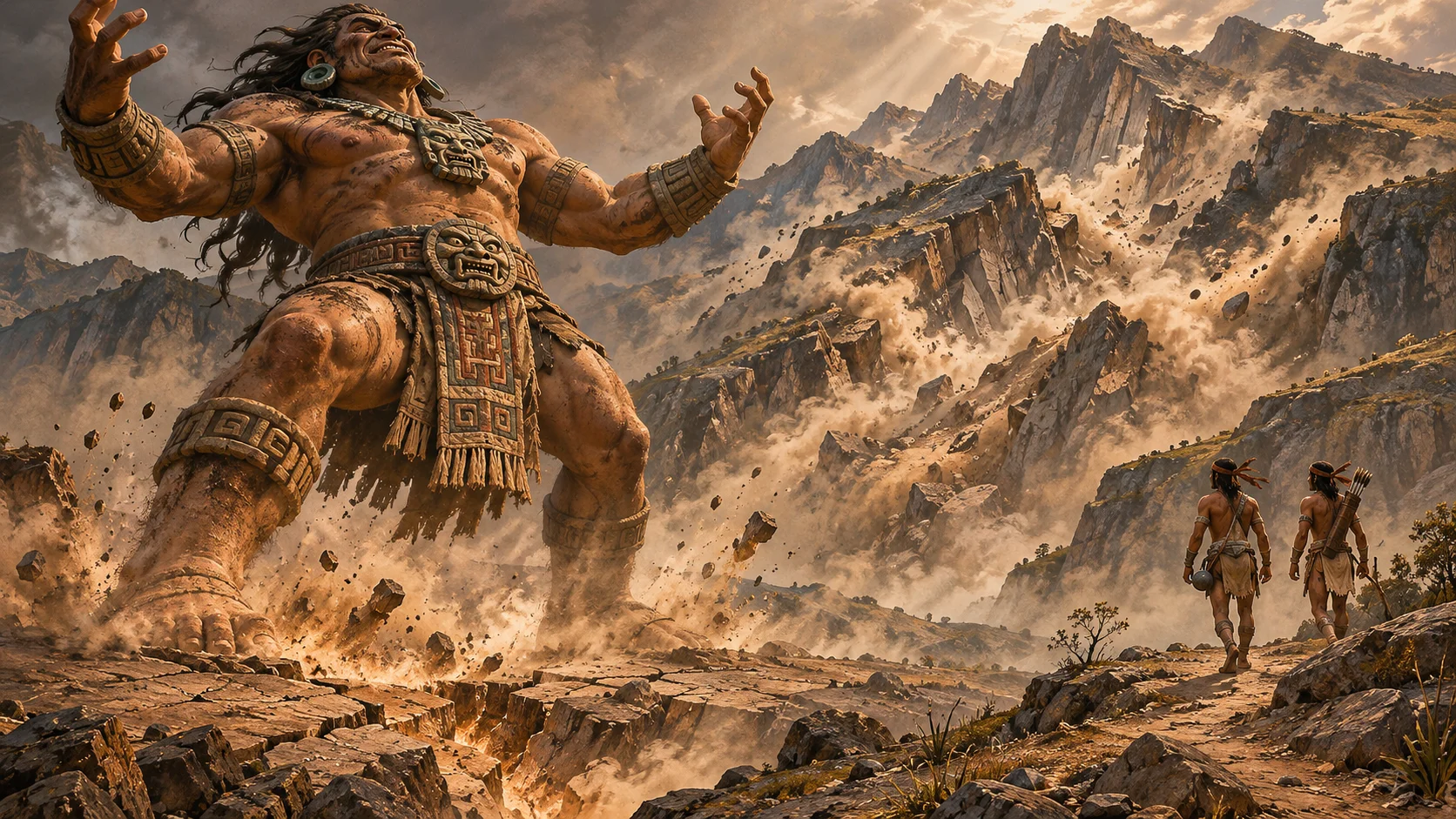
Cabrakan, whose name is generally rendered as “Earthquake,” is the younger son of the false sun-god Vucub Caquix in the Popol Vuh, a giant who boasts of the power to overturn and level mountains with his bare strength. Like his father and his brother Zipacna before him, Cabrakan is undone not by force but by a carefully laid trick — in his case, a meal of poisoned bird meat that saps his strength at the critical moment he needs it most.
The Third of a Prideful Line
Cabrakan is introduced in the Popol Vuh as the second son of Vucub Caquix and his wife Chimalmat, brother to the mountain-making Zipacna, and inheritor of the family’s signature vice: an inflated, unearned claim to command over the natural world. Where Zipacna boasts of having created the mountains, Cabrakan boasts of the power to destroy them, shaking the earth and toppling the highest peaks merely by stamping his feet or pushing against them with his hands. The text presents him, in effect, as the last and most directly destructive of the three cosmic pretenders whose claims the Hero Twins must dismantle before the present, properly ordered age of the world can proceed — a boastful god of tectonic violence whose power, if left unchecked, threatens the very stability of the earth’s surface.
A Family Pattern of Boasting
Cabrakan’s downfall is best understood alongside those of his father and brother as three variations played on a single mythic theme: a being declares dominion over some vast domain of the natural world — the sky, the mountains, the trembling earth — based purely on self-assertion rather than any sanction from the true order of creation, and is in each case undone not by a stronger opponent but by a cleverer one. The repetition across three successive episodes, each aimed at a different member of the same family, gives the Popol Vuh’s early chapters a rhythmic, almost ritual structure, methodically working through every register of prideful overreach — celestial, geological, and seismic — before the twins turn to the far graver task of confronting Xibalba’s lords over the deaths of their own father and uncle.
The Twins’ Approach
Having already destroyed Vucub Caquix and Zipacna, Hunahpu and Xbalanque turn their attention to Cabrakan. Rather than confronting him with force — an approach that would be futile against a being whose whole nature is destructive physical power — the twins again rely on deception. They approach Cabrakan and flatter his vanity by describing an enormous mountain to the east, one so tall and magnificent that they claim even his strength might not be equal to toppling it. Predictably prideful, Cabrakan cannot resist the challenge and insists on being taken to see — and topple — this mountain immediately, eager to prove that no peak on earth can withstand him.
Strength, Hunger, and Vulnerability
The specific mechanism of Cabrakan’s undoing — tainted food rather than a weapon or a direct blow — is worth dwelling on, since it locates his vulnerability not in any external armor or defense but in an entirely ordinary bodily need shared by every living creature, however immense. A being who can level mountains still has to eat, and it is precisely that unglamorous necessity, exploited without his knowledge, that brings him down where no direct assault could have. The Popol Vuh returns to this same logic elsewhere — Zipacna is undone through his hunger for crabs, and Vucub Caquix through his vanity about his appearance — suggesting a consistent narrative principle in which the twins’ victories depend on correctly identifying the specific, mundane weakness hidden beneath each opponent’s spectacular boast.
The Poisoned Bird
As they travel toward the mountain, the twins shoot down a bird with their blowguns and prepare it as food, but before cooking it they coat the bird in a mixture including earth or a paste made partly of soil, tainting the meat without altering its appearance. They offer the prepared bird to Cabrakan, who, hungry from the journey, eats it without suspicion. The poisoned meal begins to work on him immediately, draining his renowned strength even as he continues onward, boastful and unaware of what is happening to his own body.
By the time they reach the great mountain the twins had described, Cabrakan’s vitality has been thoroughly sapped. He attempts to fulfill his boast and topple the peak as he has done to countless others, but his weakened strength fails him utterly — the mountain will not move. Humiliated and depleted, he is easily overcome by the Hero Twins, who bind him and, in most tellings of the episode, bury him in the earth, the very domain over which he had claimed total destructive mastery.
Symbolic and Cosmological Significance
Cabrakan’s defeat completes the destruction of Vucub Caquix’s family line and, with it, the elimination of an entire cluster of false claimants to authority over sky, mountain, and earth’s stability. His downfall follows the same moral logic that governs his father’s and brother’s: a being who asserts dominion over some fundamental aspect of the natural world through boastful self-proclamation, rather than through legitimate sanction from the true order of creation, is inevitably humbled by wit rather than matched in raw power. That the instrument of his defeat is something as ordinary as tainted food, rather than a weapon or a direct physical contest, reinforces a recurring value of the Hero Twins cycle: cleverness and patient trickery consistently triumph over brute strength and vanity, a pattern that will recur, at far higher stakes, in the twins’ subsequent contest of wits against the lords of Xibalba itself.
Cabrakan’s specific association with earthquakes also situates him within a broader Mesoamerican concern with the instability of the earth’s surface and the mythic explanations offered for seismic activity, a preoccupation shared across many Mesoamerican traditions in regions where earthquakes and volcanic activity are a persistent feature of the landscape. His burial at the story’s end — pinned beneath or within the earth he once threatened to unmake — parallels his brother Zipacna’s petrification beneath a collapsed mountain, giving both siblings a fate in which the very domain of their boasted power becomes the site and instrument of their permanent containment.
Textual Sourcing
Cabrakan’s episode appears in the first part of the Popol Vuh, the K’iche’ Maya sacred-historical text composed in alphabetic K’iche’ script in the mid-sixteenth century and preserved through the early eighteenth-century transcription and Spanish translation of the Dominican friar Francisco Ximénez, now held at the Newberry Library in Chicago. As with the related episodes of Vucub Caquix and Zipacna, the fullest accessible English renderings come from the modern scholarly translations of Dennis Tedlock and Allen J. Christenson, both of whom annotate the episode’s place within the broader cycle establishing the Hero Twins as legitimate agents of cosmic order before their descent into Xibalba.
Earthquakes as Mythic Explanation
The choice of earthquake as Cabrakan’s domain is unlikely to be incidental for a highland Guatemalan society situated along one of the most seismically and volcanically active zones in the Americas. Mesoamerican peoples in this region lived, and still live, with the regular experience of tremors and the visible presence of active volcanoes throughout the highlands, and mythic figures embodying and ultimately taming or containing such forces appear in various forms across the region’s traditions. Cabrakan’s narrative arc — a colossal, destructive force that is powerful but not, in the end, undefeatable, and whose defeat depends on exploiting an ordinary vulnerability like hunger — offers a mythic reassurance that even the most literally world-shaking forces are subject to a larger order the twins are able to enforce on the world’s behalf.
Living Legacy
Cabrakan’s name and story continue to circulate widely wherever the Popol Vuh is taught and discussed, both within scholarly Mesoamerican studies and among the K’iche’ Maya communities of the Guatemalan highlands, where the text remains a living spiritual and historical document rather than a mere literary curiosity. Traditional daykeepers, or ajq’ij, continue to draw on the Popol Vuh’s full narrative arc — including the humbling of prideful figures like Cabrakan — as part of a moral and cosmological inheritance recognized in 2012 by UNESCO as part of Guatemala’s Intangible Cultural Heritage.
Sources & traditions
- EncyclopediaWikipedia — Cabrakan
- TraditionMaya texts, oral tradition and village tellings (Mesoamerica)
Myths change from area to area and from time to time. This chronicle follows the most widely told versions; tellings in other villages, regions and eras may differ.