Hunahpu is one of the two Hero Twins of the K’iche’ Maya Popol Vuh, son of the slain ballplayer Hun Hunahpu and the underworld maiden Xquic, who together with his twin brother Xbalanque overcomes a succession of monstrous threats and finally defeats the lords of the underworld Xibalba themselves, avenging their father before ascending — in the text’s own telling — to become the sun.
Miraculous Birth and Youth
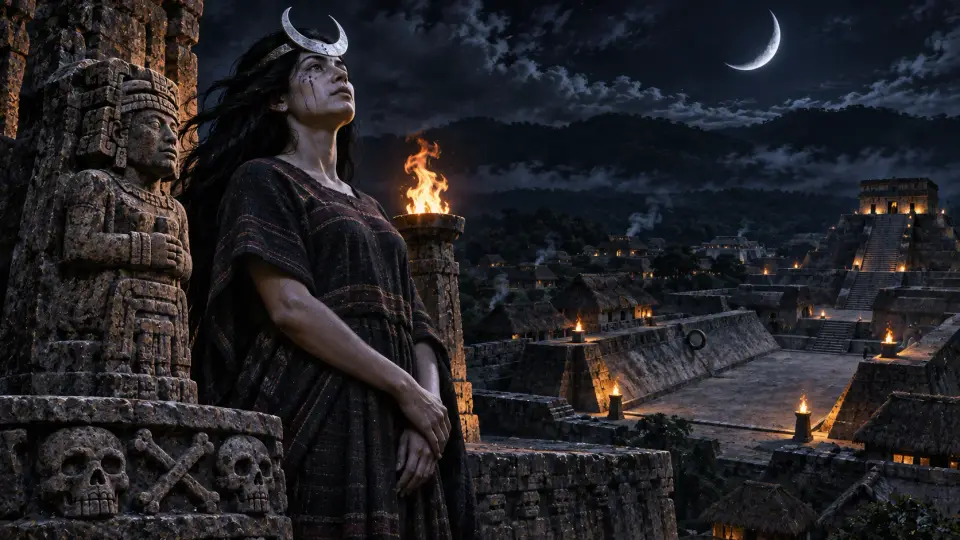
Hunahpu’s origin is itself extraordinary: he and his brother were conceived when their father’s severed head, hanging in a calabash tree in Xibalba, spat into the hand of Xquic, impregnating her without any ordinary union. Fleeing the underworld after the pregnancy was discovered, Xquic made her way to the surface world and the household of Xmucane, grandmother to the unborn twins, where Hunahpu and Xbalanque were eventually born. Their early years were marked by mistreatment: Xmucane, angered by their crying, is described as expelling the infant twins from the house, after which they grew up largely on their own, becoming, in the text’s words, skilled hunters expert with their blowguns.
Their youth also brought them into direct rivalry with their older half-brothers, One Monkey and One Artisan, the sons of Hun Hunahpu by an earlier wife, who mistreated the twins out of jealousy over their hunting skill. In one of the Popol Vuh’s most frequently retold episodes, Hunahpu and Xbalanque tricked their half-brothers into climbing a tree after birds, caused the tree to grow impossibly tall so they could not climb down, and transformed the pair into monkeys as punishment — an origin story, within the text’s own logic, for the appearance and behavior of monkeys, and a foundational display of the twins’ capacity for combining trickery with real consequence.
Twinship and Shared Heroism
It is worth stressing that almost nothing Hunahpu accomplishes in the Popol Vuh is achieved wholly alone: from the earliest hunting expeditions of their boyhood through the final contest with the lords of death, the text presents Hunahpu and Xbalanque as a functionally inseparable pair, acting in concert, speaking with something close to a single voice, and sharing credit for nearly every triumph. Where individual initiative is highlighted — Hunahpu’s blowgun shot against Vucub Caquix, Xbalanque’s quick thinking after the decapitation in the Bat House — the narrative treats these as moments within a larger partnership rather than as evidence of one twin’s superiority over the other, a structural choice that scholars have connected to broader Mesoamerican patterns of paired, complementary deities and culture heroes.
Confronting the False Powers
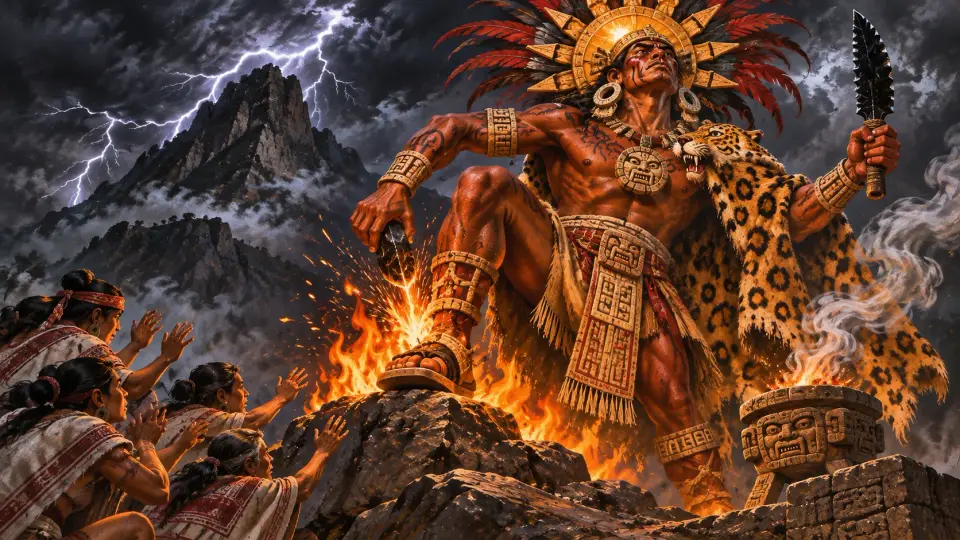
Before their climactic contest with Xibalba, Hunahpu and Xbalanque undertake a campaign against a family of prideful earth- and sky-monsters. Hunahpu personally fires the blowgun shot that wounds Vucub Caquix, the boastful bird-demon who falsely claims to be sun and moon, in his jaw as he feeds in a nance tree — a shot that provokes Vucub Caquix into tearing off Hunahpu’s arm in retaliation before the twins, aided by their grandparents Xpiacoc and Xmucane disguised as healers, trick the demon into surrendering his jeweled teeth and eyes and recover Hunahpu’s severed limb, restoring him whole. The twins go on together to destroy Vucub Caquix’s sons, the mountain-boasting Zipacna and the earthquake-giant Cabrakan, using an artificial crab and poisoned bird meat respectively, clearing the world of an entire lineage of false, self-glorifying powers before turning to the deeper task their father’s death had left unfinished.
The Descent into Xibalba
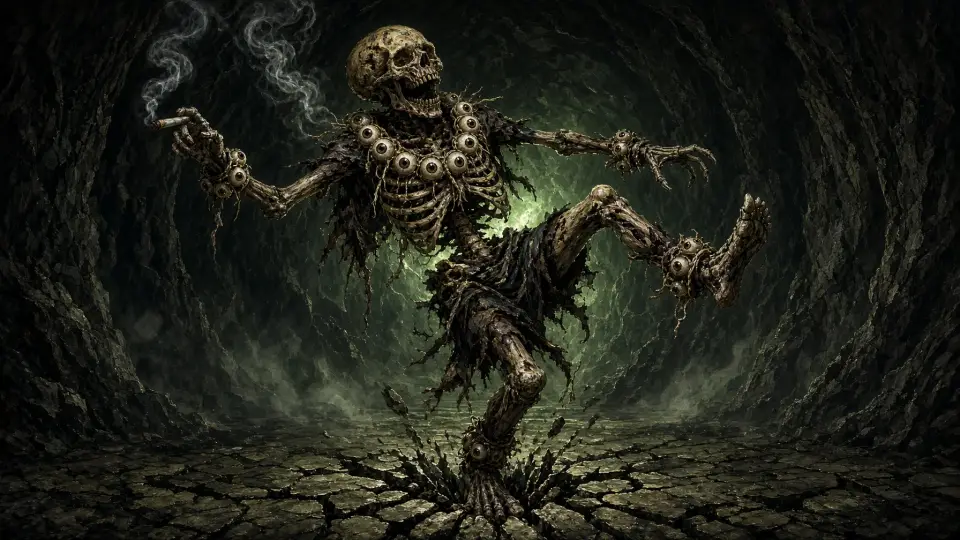
Learning at last of their father’s and uncle’s fate — and recovering the hidden ball-game equipment that their grandmother had concealed since Hun Hunahpu’s death — Hunahpu and Xbalanque are summoned to Xibalba in turn by the same lords, One Death and Seven Death, who had destroyed their forebears. Forewarned this time, the twins outwit every trap set for them: they send a mosquito ahead to bite each of the assembled lords in turn, forcing them to say each other’s names aloud and so revealing which figures were the true rulers of Xibalba and which the wooden decoys their father had failed to distinguish; they decline to sit on the burning bench; and they survive each of the underworld’s trial-houses in turn — the Dark House, the Razor House, the Cold House, the Jaguar House, the Fire House — through careful substitutions and clever use of their surroundings.
It is in the House of Bats, Zotzilaha, that Hunahpu suffers his gravest setback. Hiding through the night inside their blowguns to escape the razor-winged death-bat Camazotz, Hunahpu makes the fatal mistake of peering out to check whether dawn has broken, and Camazotz decapitates him in that instant, carrying his head off to be hung above the ballcourt as a trophy for the following day’s game. Xbalanque, working with the animals of the forest — among them a coati and other creatures gathered to help — fashions a substitute head for his brother out of a carved squash, and through the trickery of a ballgame played against the lords the following day, the twins manage to recover Hunahpu’s true head and restore it to his body, undoing what had seemed a fatal blow.
The Final Trial and Triumph
The Popol Vuh’s climax comes when Hunahpu and Xbalanque, having survived every house of Xibalba, submit voluntarily to being burned alive in a great oven, correctly anticipating what the lords intend for them and choosing to control the manner of their own deaths rather than be taken by surprise as their father was. Their bones are ground and scattered into a river, but the twins reconstitute themselves and return in disguise as wandering performers of astonishing magic, eventually revealing their true power by sacrificing and reviving each other before the delighted lords of Xibalba. When One Death and Seven Death, eager to experience this same resurrection, request to be sacrificed in turn, the twins oblige — but do not bring them back to life, ending the rule of death’s lords over humanity and reducing Xibalba’s remaining power considerably.
Apotheosis as the Sun
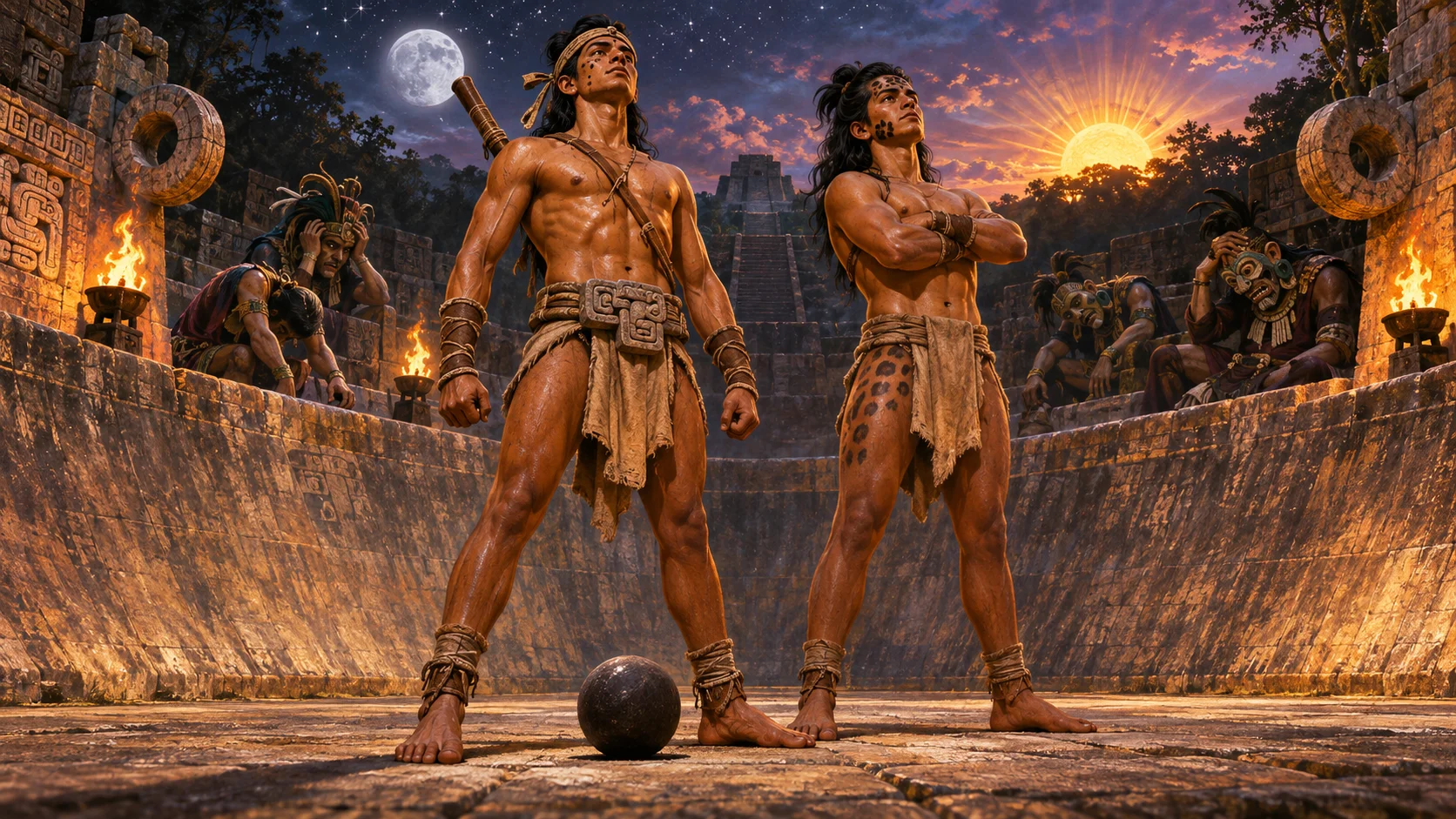
Having avenged their father and broken the absolute power of Xibalba, Hunahpu and Xbalanque ascend from the underworld and rise into the sky, where the Popol Vuh identifies Hunahpu with the sun and his brother Xbalanque with the moon, establishing the two great lights of the present age. Some scholarly discussions note ambiguity and variation in how precisely later Maya astral traditions map the twins onto specific celestial bodies — Xbalanque in particular has occasionally been linked in comparative discussions to Venus or other bodies in broader Mesoamerican thought — but the K’iche’ text’s own resolution, as rendered in the standard modern translations, places Hunahpu as the sun of the world that follows.
The Name and Its Meaning
Hunahpu’s name is generally understood to mean “One Blowgunner” or “One Hunter,” combining the numeral one — a calendrical day-name element common in K’iche’ naming conventions — with a term referring to the hollow blowgun tube used for hunting birds and small game, the same weapon he wields against Vucub Caquix and carries throughout his adventures. The name situates him, from its very syllables, as a hunter and marksman, an identity borne out repeatedly across the narrative: it is Hunahpu’s aim that wounds Vucub Caquix, Hunahpu’s skill that the twins rely on throughout their early trials, and ultimately Hunahpu who is honored with identification as the sun, the single most prominent object in the sky the same way a skilled hunter’s aim is unmatched among his peers.
Sourcing and Legacy
Hunahpu’s full story is preserved in the Popol Vuh, composed in K’iche’ in the mid-sixteenth century and known today through the transcription and Spanish translation made around 1701 by the Dominican friar Francisco Ximénez, whose manuscript is held at the Newberry Library in Chicago; the modern English translations of Dennis Tedlock and Allen J. Christenson remain the standard scholarly references. Among K’iche’ Maya communities in the Guatemalan highlands today, Hunahpu’s triumph over death is understood not as distant legend but as a living account of cosmic order, recognized by UNESCO in 2012 as part of Guatemala’s Intangible Cultural Heritage.
Sources & traditions
- EncyclopediaWikipedia — Maya Hero Twins
- TraditionMaya texts, oral tradition and village tellings (Mesoamerica)
Myths change from area to area and from time to time. This chronicle follows the most widely told versions; tellings in other villages, regions and eras may differ.