Awilix was a moon goddess of the K'iche' Maya of the Guatemalan highlands, one of the four patron deities carried by the founding lineages during their long migration in the origin narrative preserved in the Popol Vuh. Alongside Tohil and Jacawitz, she formed one of the three (sometimes counted as four, together with Nikaj Taqaj) principal tutelary gods around whom K'iche' political and religious identity was organized in the centuries before the Spanish conquest.
Goddess of Night and the Underworld
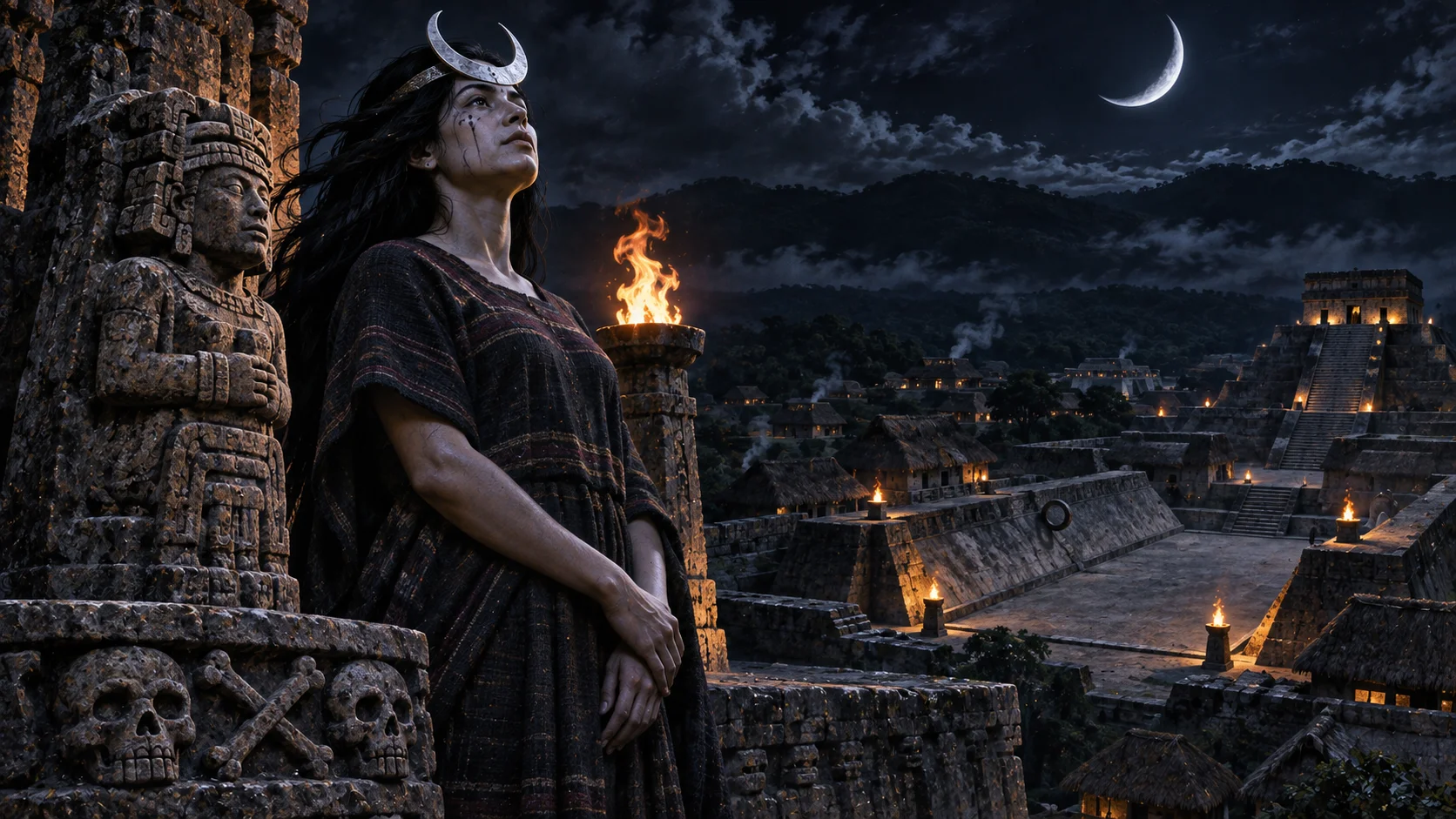
Awilix was associated with the moon, with night, and, in several accounts, with the underworld, sickness, and death — domains that in K'iche' cosmology were closely bound together with the nighttime sky in ways broadly parallel to lunar-underworld associations found elsewhere in Mesoamerican religion. Some specialists note that certain sources describe Awilix in male or ambiguously gendered terms, a reminder that Mesoamerican deity gender was not always fixed or singular in the way post-conquest, Spanish-influenced retellings sometimes present it. She was also recognized as a patroness connected to the Mesoamerican ballgame, tying her into the broader ritual complex surrounding that sport, which across Mesoamerica carried deep cosmological and sometimes sacrificial significance rather than functioning as mere recreation.
Patron of the Nija'ib Lineage
Within the Popol Vuh's account of the K'iche' founding lineages, Awilix is most closely associated with the Nija'ib, one of the major noble houses of the K'iche' confederation. She was worshipped as this lineage's specific patron deity, with her own temple at the K'iche' capital of Q'umarkaj (also known by its Nahuatl-derived name, Utatlán), standing alongside the temples of Tohil and Jacawitz that served the other founding lineages. This structure — one patron god, one temple, one lineage — reflects how tightly Maya highland political organization was woven together with the ritual architecture and mythic genealogy that legitimized each noble house's claim to authority.
The Migration and the Turning to Stone
The Popol Vuh describes Awilix, together with Tohil and Jacawitz, as having spoken directly to the K'iche' ancestors during their migration from the mythical place of origin, guiding them and, in the text's own telling, demanding blood offerings along the way in exchange for their protection and guidance. When the first dawn finally broke over the world, ending the age of darkness that the Popol Vuh describes at length, Awilix and her two companion deities are described as having turned to stone — a transformation the text treats not as a loss of power but as the fixing of their presence permanently into the landscape and into sacred stone effigies that continued to receive worship and offerings at their respective temples afterward.
Gender and the Limits of Certainty
The uncertainty noted by some specialists about whether Awilix should be understood as female, male, or as a figure whose gender was less rigidly fixed than later colonial-period retellings suggest is worth taking seriously rather than resolving prematurely in either direction. Mesoamerican deities more broadly were not infrequently described with fluid, dual, or context-dependent gender in the surviving pre-conquest and early colonial sources, and post-conquest transcriptions filtered through Spanish clerical assumptions about fixed, binary gender roles may well have flattened distinctions or ambiguities present in the original K'iche' oral tradition. A responsible account of Awilix therefore describes her predominant characterization as a moon goddess while acknowledging this genuine scholarly uncertainty rather than treating her gender as a settled, uncomplicated fact. What is not in dispute is her structural role within the founding triad and her enduring association with the moon, night, and the Nija'ib lineage's specific claim to divine patronage, an association attested consistently enough across the surviving sources to anchor every other, more contested detail of her character.
Connection to the Hero Twins
Some traditions and specialist readings identify Awilix as connected to, or incarnated in, Xbalanque, one of the two Hero Twins whose adventures against the underworld lords of Xibalba occupy a central portion of the Popol Vuh's narrative. This linkage, where attested, ties Awilix's lunar and underworld associations directly into the mythic cycle that ultimately explains the origin of the sun and moon as the Twins ascend into the sky at the story's climax — though it is worth noting that the identification of specific Hero Twin with specific patron deity varies somewhat between different scholarly and popular retellings, and should be treated as one interpretive thread among the text's layered symbolism rather than a single settled equation.
Relationship to Tohil and Jacawitz
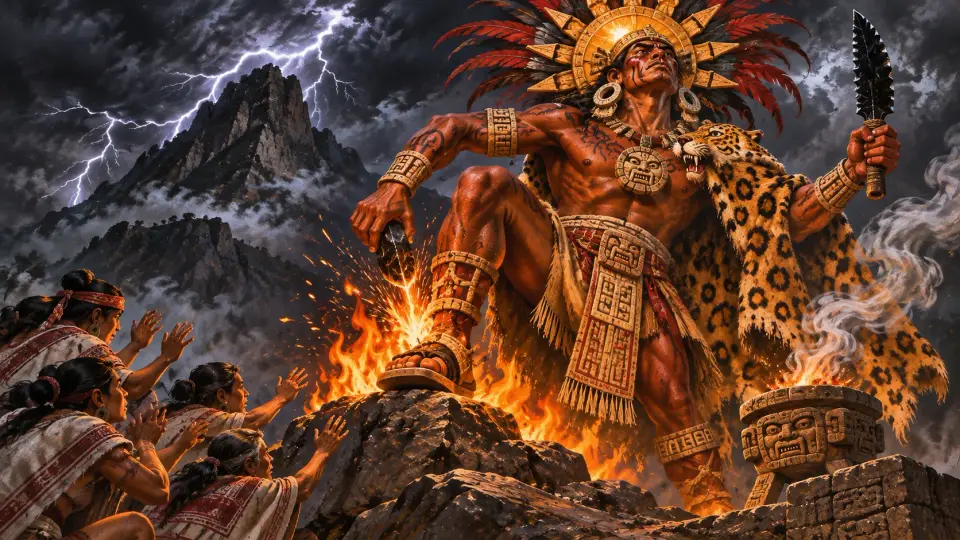
Awilix functioned as part of an interdependent triad with Tohil, the K'iche's primary fire and rain patron, and Jacawitz, the mountain deity associated with the site of the K'iche's first highland settlement. The three are frequently discussed together precisely because the Popol Vuh itself presents them as a linked set, received together by the founding K'iche' lords and honored together in a shared migration narrative, even though each retained a distinct identity, gender association, domain, and lineage-specific cult once the K'iche' confederation was established in the highlands.
A Female Voice Among Fire Gods
What stands out about Awilix within the founding K'iche' triad is that she represents the one clearly lunar, nocturnal presence among gods otherwise dominated by fire, sun, and mountain imagery. Where Tohil and Jacawitz both carry strong solar and igneous associations, Awilix's night-and-moon domain provided the K'iche' pantheon with a necessary structural counterpart, completing a day/night, fire/moon symmetry that mirrors similar pairings found throughout Mesoamerican cosmology. Her association with the underworld and with sickness further extended this counterbalancing role, giving the K'iche' religious system a deity whose domain explicitly encompassed the difficult, nocturnal, and mortal aspects of existence that a purely solar and fire-centered pantheon might otherwise have left unaddressed.
The Migration Narrative in Context
The long migration described in the Popol Vuh, during which Awilix and her companion deities spoke to and guided the K'iche' ancestors, is generally understood by scholars to encode, in mythologized form, the actual historical movement of K'iche'-speaking groups from an origin point, possibly connected to the Gulf Coast lowlands or central Mexican highlands, into the Guatemalan highlands where they eventually settled. Reading the Awilix material with this historical dimension in mind helps explain why the narrative places such heavy emphasis on hardship, demanded sacrifice, and the eventual reward of settlement and legitimacy: the myth is doing double duty, both explaining the cosmic order and justifying the specific territorial and political claims of the historical K'iche' lineages who told it.
Q'umarkaj and Its Sacred Cave
The ruins of Q'umarkaj, the K'iche' capital also known as Utatlán, stand near the modern town of Santa Cruz del Quiché in the Guatemalan highlands. The site preserves platform remains and a ball court, and beneath it is a cave used for ritual.
Maya spiritual guides still visit the site today to perform ceremonies, which means that the place retains religious meaning for descendants of the K'iche'. Visitors should therefore treat it as a living sacred site rather than only an archaeological curiosity.
The Spanish Conquest of 1524
When Pedro de Alvarado marched into the highlands in 1524, the K'iche' were defeated in a series of battles, and the capital was taken and burned. The conquest brought the political power of the patron-god lineages to an end, though the K'iche' people and their language survived.
The deities of the migration story, including Awilix, therefore belong to a world that was violently disrupted. The Popol Vuh preserves their stories because K'iche' authors recorded them soon after the conquest.
Counting the Moon
The Maya were careful observers of the moon. Classic-period inscriptions include a Lunar Series that records the age of the moon, and the Dresden Codex contains a table for predicting eclipses, evidence of long and detailed observation.
A K'iche' moon deity belongs to a culture with a sophisticated astronomical tradition. This background helps explain why a moon goddess could be treated as a serious patron of a lineage rather than as a mere nature figure.
Reading the Migration Story Carefully
The Popol Vuh's story of the founding lineages receiving their patron gods is both mythological and political. It served to explain why certain families held authority and why they honored particular deities.
Scholars note that the narrative reflects the K'iche' view of their own history, and that historical interpretation requires care. The gods function as markers of identity for lineages as much as figures of cosmic belief.
A Goddess Between the Written Page and the Landscape
Awilix is known almost entirely from the Popol Vuh and related K'iche' documents, which means that her figure has reached modern readers through a small number of written sources. No elaborate temple inscriptions or painted scenes of her survive in the way they do for some Classic Maya deities.
This limited evidence invites caution. Scholars describe her as a patron of a lineage and a figure linked with night and the moon, but they acknowledge that many details of her worship are unknown. Even so, the stories that survive preserve something of how the K'iche' thought about the moon, the night and the founding of their lineages.
Her presence also reminds readers that highland Maya religion differed from that of the lowland cities. The patron-god structure of the K'iche' lineages, in which families received and carried their own deities, gave highland belief a distinctive political character.
Temples of Q'umarkaj
Archaeological and ethnohistoric reconstructions of the K'iche' capital Q'umarkaj describe a ceremonial center organized explicitly around the temples of the three great patron gods, positioned so that each lineage's political standing was visibly tied to the prominence and maintenance of its patron deity's shrine. Awilix's temple, serving the Nija'ib lineage, would have been a site of regular ritual activity, offerings, and lineage-specific ceremony, standing as physical testimony to the Nija'ib's claimed descent from the founding migration and their portion of the divine covenant established at Tollan. The destruction of Q'umarkaj by Pedro de Alvarado's forces in 1524 brought an end to this temple system, though the Popol Vuh itself, transcribed from oral and pictographic tradition in the mid-sixteenth century, preserved the memory of Awilix and her companion deities for later generations.
Sources & traditions
- EncyclopediaWikipedia — Awilix
- TraditionMaya texts, oral tradition and village tellings (Mesoamerica)
Myths change from area to area and from time to time. This chronicle follows the most widely told versions; tellings in other villages, regions and eras may differ.