Ixchel was among the most widely worshipped female deities of the pre-Columbian Maya world, a Yucatec Maya goddess governing the moon, medicine, midwifery, and weaving. Her principal pilgrimage shrine stood on the island of Cozumel, off the coast of the Yucatán peninsula, where Maya women from across the region were expected, at least once in their lives, to travel by canoe to seek her blessing for fertility, safe childbirth, and healing.
Goddess of the Moon and of Women's Lives
Ixchel's domains clustered tightly around the concerns of Maya women's daily and ritual lives: she governed the moon's phases, human fertility and conception, pregnancy and childbirth, the practice of herbal medicine, and the craft of backstrap-loom weaving, one of the principal forms of skilled labor and artistic expression available to Maya women. She was patroness of midwives and herbalists, and the oracle priestesses who served her shrine at Cozumel were consulted on matters of health, marriage, and childbearing. Because the moon's own cycle of waxing, fullness, and waning so closely tracked the female reproductive cycle in Maya thought, Ixchel's lunar and reproductive associations were never treated as separate domains but as two expressions of a single underlying rhythm.
The Pilgrimage to Cozumel
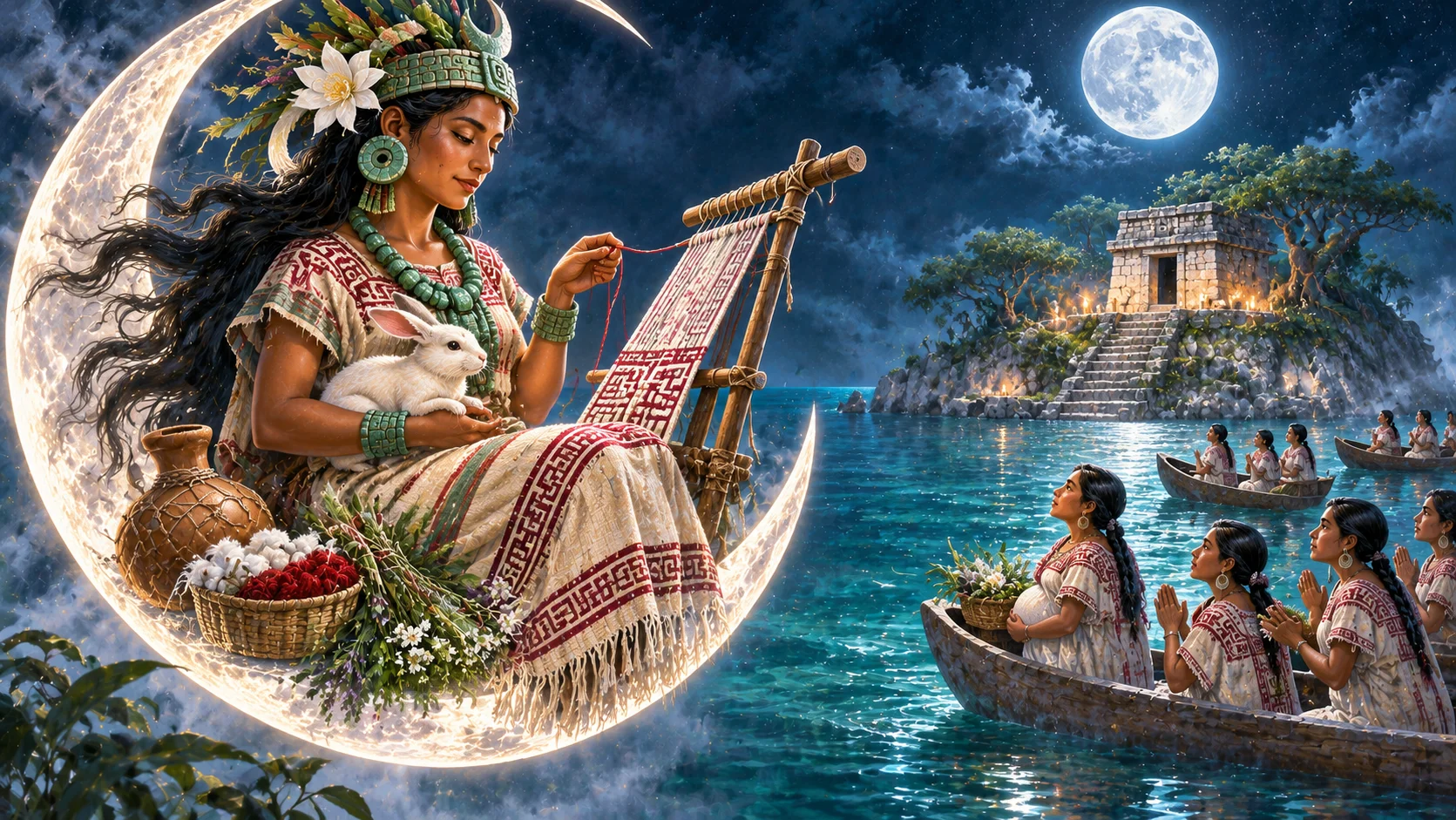
Cozumel functioned as one of the most important religious pilgrimage destinations anywhere in the pre-Columbian Americas specifically because of its association with Ixchel. Maya women crossed the open channel between the mainland and the island by canoe, a journey that was itself understood as dangerous and spiritually significant, in order to consult her oracle, make offerings, and petition for fertility or for a safe delivery. The scale and duration of this pilgrimage tradition, attested from the Postclassic period through early colonial accounts, is one of the clearest pieces of evidence for how central Ixchel's cult was to Maya religious life, comparable in importance to major pilgrimage centers found elsewhere in the ancient world.
Iconography Across the Life Cycle
Maya artists represented Ixchel in ways that tracked the different phases of a woman's life and of the moon itself. As a young woman, she embodied the waxing moon and youthful fertility; as an elderly woman, she embodied the waning moon and the wisdom, and the dangers, associated with old age. She is depicted pouring water from a jug onto the earth, an image tied to both rainfall and to the amniotic waters of childbirth, and also seated at a backstrap loom, actively weaving — an image that ties her directly to the origin of textile-making itself in Maya belief.
Ixchel and Chac Chel: One Complex, Two Faces
Ixchel's relationship to the aged, more fearsome figure known to Mayanists as Chac Chel (or Goddess O in the codex-numbering system used by scholars) is one of the more actively discussed questions in Maya religious studies, and it is important not to flatten it into a false simplicity. The mid-twentieth-century scholar J. Eric S. Thompson conflated Ixchel and Chac Chel into a single, multifaceted moon goddess, drawing partly on modern ethnographic Maya beliefs about the moon that lack clear support in the earlier ethnohistoric and codical record — a reading later Mayanists have criticized as importing outside, Romantic assumptions about a unified "great goddess" onto evidence that does not straightforwardly support one. More recent iconographic and epigraphic analysis instead treats Chac Chel, "Red Rainbow," as a distinct aged deity in her own right, consistently portrayed as an old woman associated with destruction, divination, medicinal water and hydrotherapy, and the invention of backstrap weaving — genuinely separate from the youthful goddess of childbirth and weaving that codex specialists number Goddess I, whom later colonial-period sources most plausibly connect to the name Ixchel. Understood this way, Ixchel (young, fertile, associated with conception and safe delivery) and Chac Chel (aged, destructive, associated with divination, healing, and the far end of the life cycle) are best treated as two related but distinct figures within one broader female-divine complex governing the moon, water, weaving, and the arc of a woman's life from maiden to elder, rather than as simple interchangeable names for an identical goddess. Precisely how the codex-period goddesses map onto the specific colonial-era names recorded by Spanish chroniclers remains genuinely debated among specialists, and any account that claims total certainty on the point is overstating the evidence.
Relationships to Other Deities
Ixchel is frequently described in colonial and ethnohistoric sources as consort to the great creator god Itzamná, and in some tellings as the mother of Kinich Ahau, the sun god — a lunar-solar pairing that mirrors the sun-and-moon relationships found across many other Mesoamerican traditions. Her connection to weaving also ties her thematically to the broader network of craft and fertility goddesses attested in Maya art, while her medicinal and midwifery roles connect her practice directly to the work of living j-meen and traditional healers, who continued to invoke moon-associated female spiritual power long after the Cozumel oracle itself ceased to function as an organized pilgrimage site.
The Oracle and Colonial Destruction
Spanish accounts from the early sixteenth century describe the Cozumel shrine as an active, functioning oracle at the moment of first contact, with a priesthood maintaining the site and interpreting Ixchel's responses to the questions brought by pilgrims. The conquest and subsequent colonial evangelization campaigns targeted such shrines directly and deliberately, and the organized Cozumel cult did not survive as a functioning institution much beyond the mid-sixteenth century. What was lost was not simply a building but a centuries-old infrastructure of pilgrimage, oracle consultation, and ritual specialization built specifically around women's reproductive and medical concerns — one of the more significant, if less frequently emphasized, losses of the conquest period precisely because it served needs that had no direct colonial-era Catholic equivalent.
Herbal Medicine and Practical Healing
Ixchel's medicinal patronage was not merely symbolic; Yucatec Maya herbal medicine constituted a genuinely sophisticated body of practical knowledge concerning plant properties, dosages, and treatment protocols, maintained and transmitted primarily by women healers who worked under her patronage. Midwives in particular combined practical obstetric skill with ritual invocation of Ixchel's protection during childbirth, a moment of significant physical risk in the premodern world for which both technical competence and spiritual support were considered equally necessary. This combination of hands-on medical skill and religious devotion under a single female-associated deity gave Maya women's healthcare practices a coherence and institutional continuity that helped preserve valuable herbal knowledge across generations, some of which survives in modified form among traditional healers in the Yucatán region today.
Isla Mujeres and the Island of Women
The Spanish expedition of 1517 under Francisco Hernández de Córdoba gave the name Isla Mujeres, "Island of Women," to an island off the northeast coast of the Yucatán peninsula, reportedly because it held figurines of female deities. A shrine at the southern tip of the island is often associated with the goddess Ixchel.
The name survives today, and the island is a popular tourist destination. The link with Ixchel is plausible and widely repeated, though the exact attributions of ruined shrines in the region are often uncertain.
The Name in Spanish Sources
Ixchel is known from Spanish colonial writers such as Bishop Diego de Landa, whose account of Yucatán in the sixteenth century names several goddesses. The sources are written by outsiders, many of them hostile to Maya religion, and they have to be read with care.
Modern scholars therefore compare the written accounts with images in the surviving codices and with archaeological evidence. The picture that results is of a goddess with a recognizable identity in the Postclassic period but one whose relation to earlier figures remains debated.
Midwives and Healing Today
Traditional midwives, known in Spanish as parteras, remain important in parts of Yucatán and Guatemala, and some invoke Ixchel as a patron of their work. Herbal knowledge, massage and ritual are combined in the care of pregnancy and childbirth, and the continuity with older practice is a matter of study for ethnographers.
It is best to be cautious about describing this as unchanged pre-Hispanic survival. Colonial Catholic influence and modern medical systems have shaped the practice. The use of her name nonetheless shows how an ancient figure can remain a point of reference.
Museums and Modern Uses of Her Name
Ixchel's name has been adopted by modern institutions in the Maya region. In Guatemala City the Museo Ixchel del Traje Indígena, founded in the late 1970s, is devoted to Maya textiles and dress, a fitting tribute to a goddess associated with weaving.
The use of her name for museums, hotels, clinics and cooperatives shows how deeply she has entered regional identity. Readers should keep in mind that these modern uses draw on a cultural symbol rather than on direct continuity of worship.
Ixchel in Maya Textiles
Weaving remains an active art in Maya communities, and the designs on traditional garments, such as the huipil blouse, can carry symbols that identify a village or a family. The association of Ixchel with weaving makes her a natural patron of this craft.
Visitors to markets in Yucatán and Guatemala can see how patterns are woven and embroidered, and the colors and motifs continue to be a subject of study by anthropologists and textile specialists.
Weaving as Sacred Technology
Ixchel's patronage of backstrap-loom weaving deserves to be understood as more than a craft association in the narrow sense. Textile production in Maya society was labor-intensive, technically sophisticated, and central to both domestic economy and elite gift exchange and tribute; a woman's skill at the loom carried genuine social and economic weight. By placing weaving under the protection of the same goddess who governed conception and childbirth, Maya religious thought treated textile-making not as a separate, secular skill but as another expression of the same generative, creative power that produced new human life — threads brought into being and interlaced much as a child is conceived and formed. This conceptual link between weaving and generation recurs across many Mesoamerican traditions and is one reason Ixchel's iconography so often shows her actively at the loom rather than merely holding woven cloth as a static attribute.
Sources & traditions
- EncyclopediaWikipedia — Ixchel
- TraditionMaya texts, oral tradition and village tellings (Mesoamerica)
Myths change from area to area and from time to time. This chronicle follows the most widely told versions; tellings in other villages, regions and eras may differ.