Itzamna was one of the most important deities of the Yucatec Maya pantheon, widely regarded by scholars as the closest thing the Classic and Postclassic Maya had to a supreme creator god. Associated with the sky, the sun, writing, learning, and healing, Itzamna was imagined as an aged, wise, and fundamentally benevolent figure — a marked contrast to many other Maya deities bound up with sacrifice, war, or the underworld. His cult, or something recognizably like it, persisted from the Classic period well into the era of Spanish contact.
Origin and Role
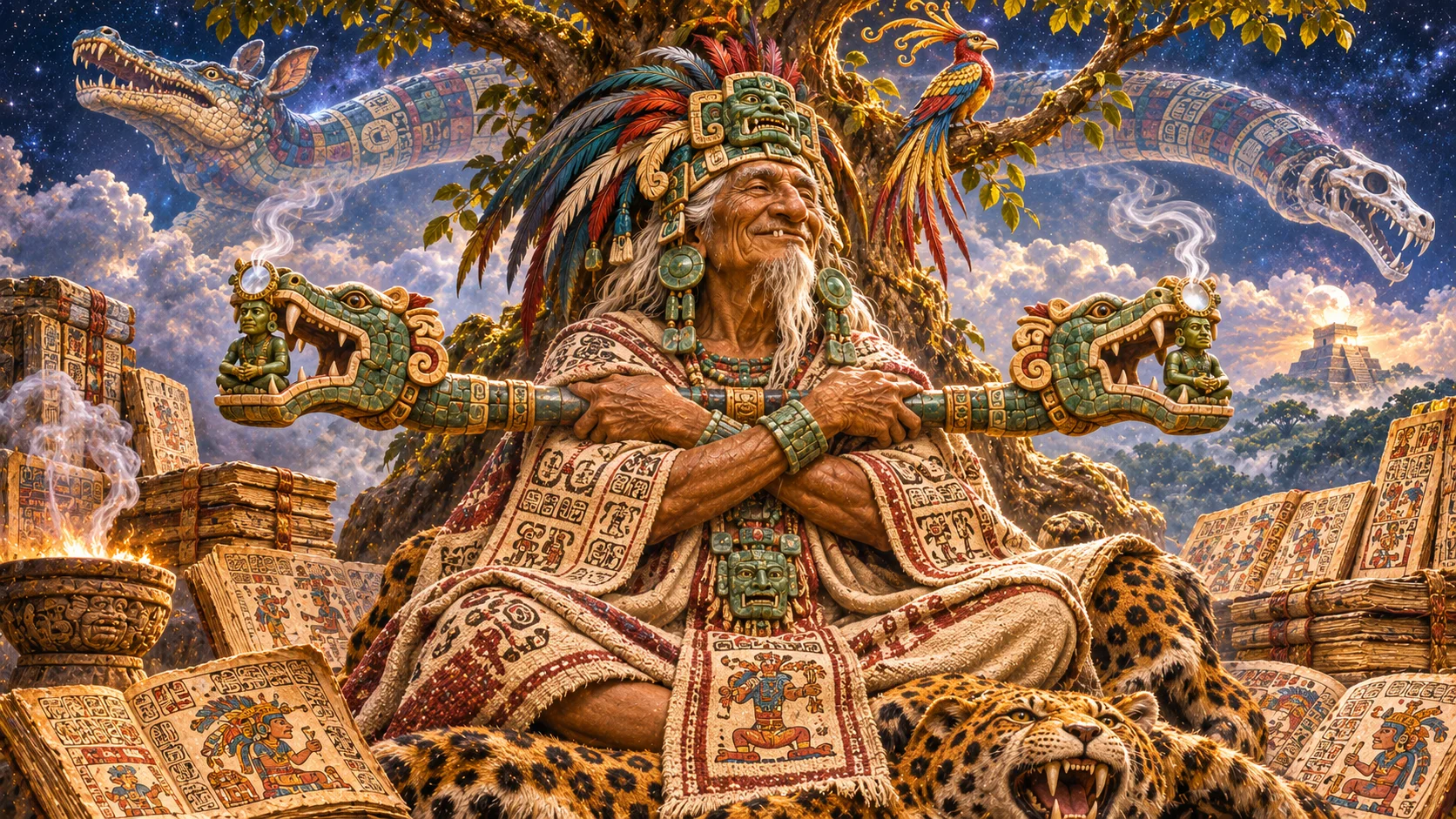
Itzamna's name is generally translated along the lines of “Iguana House” or connected to itz, a word bound up with secretions, dew, and substances of magical or vital potency — sap, milk, semen, and the moisture that sustains life. This etymology fits his broader portfolio: Itzamna was credited with having given the Maya writing, the calendar, and the arts of healing, making him a culture-hero as much as a cosmic creator. Colonial-era sources and Classic inscriptions alike associate him with the sky itself; he was sometimes depicted as a great two-headed cosmic serpent or celestial monster whose body arched across the heavens, from whose mouth or body other gods and celestial phenomena emerged. In this cosmic-serpent form, called the Itzamnaaj sky-serpent or Cosmic Monster by modern epigraphers, he embodies the vault of the sky itself rather than merely dwelling within it.
Unlike deities bound to a single narrow function, Itzamna was described by early colonial chroniclers as effectively supreme within the Yucatec pantheon — not necessarily in the strict monotheistic sense later projected onto Hunab Ku, but as the most powerful, most frequently invoked, and most broadly benevolent of the gods, a First Father figure who set the created order in motion and continued to preside over it.
Iconography and Attributes
In Classic-period art and later codices such as the Madrid and Dresden codices, Itzamna typically appears as an elderly man: toothless or with a single remaining tooth, a hooked or roman nose, sunken cheeks, and often a headdress or elements marking celestial or serpentine associations. This aged appearance sets him apart from youthful gods such as the Maize God and reinforces his role as a primordial, foundational figure — old because he predates the current world and its inhabitants. He was frequently shown seated on a throne, a visual index of his lordly, kingly status among the gods, and Maya rulers invoked him as a patron of legitimate kingship and dynastic authority.
Itzamna is closely linked in Maya cosmology with a female counterpart or consort, Ix Chel, an aged goddess of medicine, midwifery, and weaving, sometimes depicted alongside spindles, snakes, and the crescent moon. Some interpretations treat Ix Chel as Itzamna's wife and complementary opposite; others suggest a closer identity between the two, or view Ix Chel as one of several goddesses paired with him across different regions and periods, an ambiguity that mirrors the genuine complexity and regional variation of Classic Maya religion rather than a simple contradiction to be resolved. Together they were credited with fathering the four Bacabs, sky-bearing deities who stood at the four corners of the world holding up the heavens — a role structurally similar to that of world-corner deities found elsewhere in Mesoamerican cosmology.
Textual and Archaeological Sources
Itzamna appears across a wide span of Maya material: in Classic-period inscriptions at sites across the lowlands, in the Postclassic codices (particularly the Madrid Codex, where he appears repeatedly performing ritual and creative acts), and in colonial ethnographic sources such as Diego de Landa's Relación de las cosas de Yucatán, which records Itzamna's continuing importance to Yucatec Maya religious life at the moment of Spanish contact. This breadth of attestation — monumental, painted, and ethnographic, spanning many centuries — is precisely what distinguishes Itzamna from a figure like Hunab Ku, whose documentary footprint is thin, late, and closely tied to missionary translation work. Itzamna, by contrast, was a genuinely active object of pre-Columbian devotion with a continuous, traceable presence in the archaeological and textual record.
Relationship to Other Deities in This Group
Itzamna belongs to the Yucatec Maya religious tradition, distinct from — though related to — the highland K’iche’ Maya tradition preserved in the Popol Vuh, home to Huracan, Tepeu, Gukumatz, Xmucane, and Xpiacoc. Both traditions share a broadly similar theological structure: an aged, primordial creator pair or figure standing behind the visible world, associated with knowledge, speech, and the ordering of chaos into cosmos. Itzamna is also frequently discussed alongside Kukulkan, the Yucatec feathered serpent deity; while both were major figures of the same regional pantheon and both carry serpent associations, they are understood as separate gods with separate cult histories rather than variant names for a single being — Kukulkan's profile is tied more specifically to wind, rain, Venus, and a documented historical cult centered on Chichen Itza and later Mayapan, while Itzamna's is tied to the sky as a whole, to writing, and to healing.
Later Developments and Scholarly Notes
Some later syncretic and popular treatments — echoing the same impulse that produced the modern Hunab Ku — have tried to fold Itzamna into a single overarching “supreme god” narrative, occasionally even claiming him as a manifestation or son of Hunab Ku. This genealogy has no basis in Classic Maya sources; it is a modern harmonizing move, not an inherited tradition. Scholars instead treat Itzamna on his own well-documented terms: a genuinely central, well-attested Yucatec Maya creator and culture-hero, whose cult can be traced with reasonable confidence from the Classic period through Spanish contact, and whose worship — unlike the abstract, largely modern Hunab Ku — is not in serious scholarly doubt.
A Living Legacy
Maya religious and cultural tradition did not end with the conquest. Descendant Maya communities across the Yucatán Peninsula, Guatemala, and Belize continue to maintain distinctive ritual, agricultural, and calendrical practices with deep roots in the world Itzamna once presided over, even where his name itself has faded from everyday devotion in favor of syncretic Catholic and folk-religious forms. Understanding Itzamna accurately — as a well-attested ancient deity rather than folding him into later inventions — is part of taking that living tradition, and its documented history, seriously.
Itzamna as Patron of Kingship and Knowledge
Classic Maya rulers across the lowlands frequently invoked Itzamna in contexts connected to legitimate authority, learning, and the specialized knowledge that separated trained scribes and priests from the general population. Because writing itself — the elaborate hieroglyphic script used to record dynastic histories, astronomical observations, and religious texts — was considered his gift, scribes and court intellectuals occupied something like a priesthood devoted to his domain, and the act of writing was understood as participating in a sacred, god-given craft rather than a purely administrative skill. This is part of why Itzamna appears so often in association with the accoutrements of rulership: thrones, elaborate headdresses, and the visual language of legitimate, divinely sanctioned power. His portrayal as extremely aged reinforced this authority rather than diminishing it, since advanced age in Maya iconography routinely signals accumulated wisdom, priority in the cosmic order, and closeness to the foundational moment of creation itself.
Regional Variation and the Problem of a Single “Itzamna”
Scholars caution against imagining Itzamna as a perfectly uniform figure worshipped identically across every Maya city and every century. The lowland Maya world spanned an enormous geographic area and a very long time depth, from the Preclassic through the Postclassic periods and into Spanish contact, and deities associated with the sky, creation, and aged wisdom took somewhat different local forms and combinations across this span. What colonial-era sources record under the name Itzamna in sixteenth-century Yucatan likely represents the endpoint of a long process of regional development and synthesis, drawing on related but not perfectly identical Classic-period sky and creator deities known to modern epigraphers under separate technical designations. This regional and historical complexity is normal for a long-lived religious tradition and does not undermine the basic point that Itzamna, however he developed, was a genuinely worshipped, richly attested deity throughout this period — a very different situation from the thin, late, narrowly missionary-context evidence behind Hunab Ku.
Sources & traditions
- EncyclopediaWikipedia — Itzamna
- TraditionMaya texts, oral tradition and village tellings (Mesoamerica)
Myths change from area to area and from time to time. This chronicle follows the most widely told versions; tellings in other villages, regions and eras may differ.