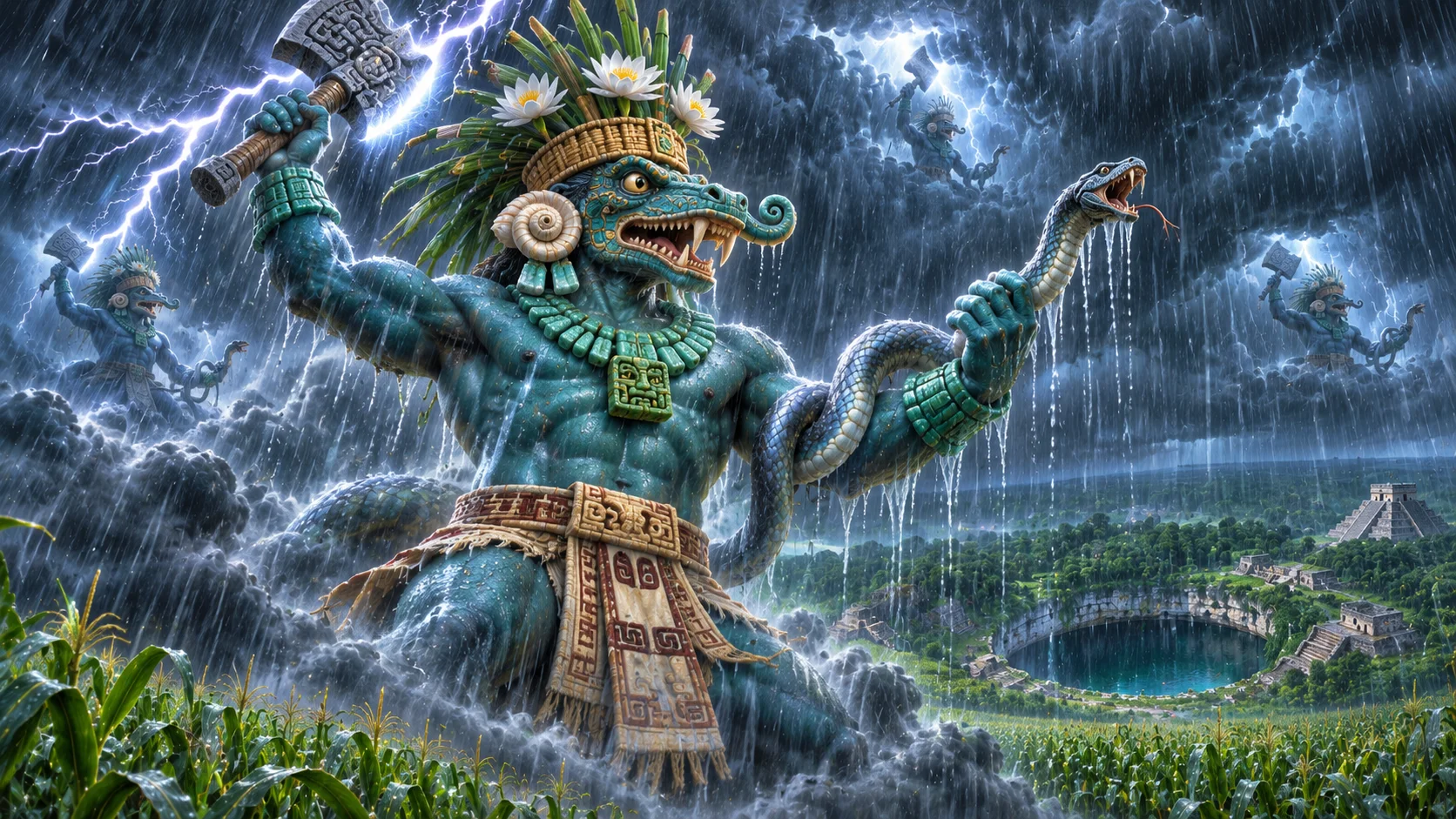
Chaac (also spelled Chac, and rendered Chaahk in Classic-period inscriptions) was the Maya god of rain, thunder, and lightning — one of the most important and most consistently worshipped deities across the entire span of Maya civilization, from the earliest Preclassic temples to living ceremonies performed in Yucatán villages today. He struck the storm clouds with a stone or jade axe to loose the thunder and send down rain, and Maya farmers depended on him, quite literally, for the survival of their maize.
An Axe of Lightning
Chaac's name is generally connected to the sound and force of the thunderbolt itself; several sources gloss it as related to "axe" or "thunderclap," describing the weapon he wields to split the sky. In Classic Maya art he is shown gripping a serpent-legged or reptilian axe — sometimes a writhing snake stands in for the axe entirely — which he swings to crack open the clouds and, in some retellings, to split a mountain and release the maize hidden inside it by other, hostile forces. The axe is the single most diagnostic attribute by which artists and scribes signaled that a figure was Chaac rather than any other rain- or storm-associated being.
Iconography: The Long-Nosed God
Chaac is immediately recognizable on temple facades and in the painted codices by a long, curling, almost trunk-like nose, often interpreted as evoking the flow of falling rain or drifting storm cloud. His mouth is fanged, his face reptilian or serpent-like, and his eyes are frequently rendered as spirals, a visual shorthand for the swirling violence of a storm. Shell ornaments often dangle from his ears, tying him to water and to aquatic and amphibious creatures more broadly. At the Puuc-region city of Uxmal, rows of stacked Chaac masks with jutting noses cover entire building facades, most famously the so-called Nunnery Quadrangle and the Governor's Palace; at Chichén Itzá his image appears on the Temple of the Warriors and elsewhere, underscoring how central his cult was to civic and religious architecture across the Yucatán peninsula.
Because Maya cosmology organized the world by the four cardinal directions, Chaac was frequently understood not as a single undivided god but as a fourfold being — four Chaacs, one presiding over each direction, each wearing that direction's associated color. Colonial-period and modern ethnographic sources go further still: Yucatec Maya farmers have long distinguished a whole hierarchy of specialized rain and cloud spirits under the general Chaac concept, each responsible for a different aspect of a storm's behavior, reflecting how finely observed the rhythms of the rainy season were to people whose harvest depended on them.
Chaac in the Codices and Colonial Sources
Chaac appears repeatedly in the surviving bark-paper codices, especially the Dresden Codex, where he is associated with almanacs governing agricultural timing, rain forecasting, and ritual obligation. Colonial Spanish chroniclers who recorded Yucatec Maya beliefs after the conquest, such as the sources underlying much of what is known about the Cha Chaac ceremony, describe Chaac as approached collectively by community elders and ritual specialists whenever the rains were late or insufficient — a recurring anxiety in a region with thin soils and no permanent rivers, where cenotes and seasonal rainfall were the only reliable water sources.
The Ch'a Cháak Ceremony: A Living Tradition
What sets Chaac apart from many other deities discussed in accounts of Maya religion is that devotion to him did not end with the arrival of Christianity or the collapse of the Classic-period city-states. The Ch'a Cháak ("bring the rain" or "fetch Chaac") ceremony has been documented continuously from the colonial period through to the present day, making it one of the longest continuously practiced religious rituals anywhere in the Americas. In a typical modern Ch'a Cháak, a j-meen (a Yucatec Maya ritual specialist, sometimes translated "shaman" or "priest") oversees the construction of a temporary altar in the milpa, the family cornfield, or a village clearing. The altar is oriented to the four cardinal directions, with a post at each corner representing one of the four directional Chaacs, so that the structure itself becomes a small working model of the four-cornered Maya cosmos. Four young boys are traditionally positioned at the corners, croaking and chanting like frogs — frogs being creatures whose calls, in Maya belief, summon rain — while offerings of ritual foods, balche' (a fermented ceremonial drink), and prayers are presented to petition Chaac for rain sufficient to bring the maize to harvest. This ceremony is still performed today by Maya communities in the Yucatán, Quintana Roo, and Campeche, tied closely to the agricultural calendar and to anxieties over drought that, if anything, have sharpened with modern climate volatility. It represents a direct, unbroken thread of ritual practice connecting contemporary Maya farmers to their Precolumbian ancestors.
Relationships to Other Deities
Chaac's closest mythological ties are to the broader complex of sky and creation deities headed by Itzamná, and to the maize god, whose fortunes are inseparable from Chaac's willingness to send rain at the right moment in the planting cycle. He is sometimes placed in narrative tension with figures associated with drought, the underworld, or death, since a failure of the rains was popularly understood as evidence of Chaac's anger, neglect, or the interference of hostile forces. Among the four Bacabs who hold up the corners of the sky, and among the directional colour-and-cardinal-point framework that also organizes Chaac's own fourfold nature, Chaac occupies a structurally similar position: a deity whose singular identity is, in Maya thought, entirely compatible with being expressed as four separate, direction-bound aspects at once. Scholars continue to debate exactly how the various codex-period, Classic-period, and colonial-through-modern names and depictions of the rain deity relate to one another, but there is little dispute that some form of devotion to a lightning-axe-wielding rain god has persisted, in one guise or another, for well over two thousand years.
Regional Variants and the Fragmentation of Rain
Beyond the fourfold directional Chaacs, colonial and modern ethnographic sources describe an even finer hierarchy of rain- and cloud-related spirits recognized by Yucatec Maya farmers, each responsible for a distinct meteorological phenomenon: gentle rain, driving rain, hail, the first thunderhead of the season, the wind that precedes a storm. This granular attention to the behavior of weather reflects a farming society for whom the exact character of a given storm — not simply whether or not it rained — determined whether a harvest would succeed. Some ethnographers describe these lesser rain spirits as effectively subordinate to Chaac, forming a kind of court or retinue around the principal rain deity, while others treat them as regionally specific elaborations of the same underlying four-part directional model. The overall pattern is consistent with how Maya religious thought handled complexity generally: rather than a single deity with many powers, the tendency was to multiply the deity into as many named, individually addressable aspects as the phenomenon in question required.
Rain in a Land Without Rivers
The northern Yucatán peninsula is a limestone plain with almost no surface rivers. Rain falls and sinks directly into the porous rock, and fresh water is found in cenotes, natural sinkholes that open onto the underground water table, or has to be collected and stored. In the Puuc hills farmers relied on rain collected in cisterns called chultunes.
Under these conditions the arrival of the rains was a matter of survival, not just comfort. A god who brought storms with his axe was bound up with everything a farmer needed, and the long-lasting importance of Chaac in Yucatec life reflects the geography as much as the theology.
The Sacred Cenote at Chichén Itzá
At Chichén Itzá, the Sacred Cenote was a place of offerings, and in the early twentieth century the American consul Edward H. Thompson dredged it and recovered jade, gold, pottery, textiles and human remains. The finds showed that objects were thrown into the water over a long period, a form of devotion tied to rain and water spirits.
Scholars connect such offerings with Chaac and with the broader idea that water sources were openings into the underworld. The excavations were controversial and are now regarded critically, but the objects they produced remain central evidence for Maya ritual.
The Masks of Kabah
At Kabah, in the Puuc region, a building known as the Codz Poop, the "rolled mat," is covered on its façade with hundreds of stacked masks of a long-nosed god identified as Chaac. The repetition, with the curled snouts projecting outward, makes the building an extraordinary architectural statement.
The facade makes clear that the rain god was not only a subject for ritual but a major theme of public architecture. A visitor approaching the building would have been surrounded by his image.
Storm and the Day Sign Kawak
The 260-day sacred calendar contained twenty day names, and one of them, called Kawak in some Maya languages, was linked with storm and rain. It is often connected with Chaac in discussions of the calendar, and the sign's glyph is a stylized representation of a cluster of rounded forms associated with clouds and rain.
Such links show that Chaac belonged not only to the landscape but to the structure of time. Days could be identified with his domain, and ritual specialists consulted the calendar when planning ceremonies for the planting season.
Chaac at Uxmal and the Puuc Rain Cult
The concentration of Chaac imagery at Puuc-region sites such as Uxmal, Kabah, and Sayil is especially striking given that this region, unlike much of the Yucatán, lacks natural cenotes or permanent water sources of any kind. Puuc cities depended entirely on captured rainwater stored in artificial cisterns called chultunes, making the reliability of seasonal rainfall a matter of literal survival rather than agricultural convenience alone. Archaeologists have long connected the extraordinary density of Chaac masks on Puuc facades — entire building exteriors given over to stacked, long-nosed faces — to this acute regional water dependency, reading the architecture itself as a form of continuous, monumental petition to the rain god. This makes the Puuc region something of a natural laboratory for understanding just how far Maya communities were willing to go, architecturally and artistically, to secure a god's favor when the alternative was crop failure and thirst.
Sources & traditions
- EncyclopediaWikipedia — Chaac
- TraditionMaya texts, oral tradition and village tellings (Mesoamerica)
Myths change from area to area and from time to time. This chronicle follows the most widely told versions; tellings in other villages, regions and eras may differ.