Huracan, whose name is conventionally translated “Heart of Sky” or associated with the idea of a single leg or one-legged being, is the K’iche’ Maya god of wind, storm, fire, and the sudden decisive intervention that turns divine deliberation into action. One of the three creator forces named at the opening of the Popol Vuh, Huracan is also, by way of a long and only partly understood linguistic journey through Taino and Spanish, very likely connected to the English word “hurricane” — though the exact chain of borrowing is more layered than a simple direct transfer.
Huracan in the Popol Vuh
The Popol Vuh, the K’iche’ Maya sacred narrative preserved in a K’iche’-language manuscript from the 1550s and later copied and translated into Spanish by the Dominican friar Francisco Ximénez in the early eighteenth century, describes Huracan not as a single unified figure but as a composite of three aspects collectively called the “Heart of Sky”: Caculha Huracan (“Thunderbolt Hurricane,” associated with lightning), Chipi-Caculha (“Small Thunderbolt”), and Raxa-Caculha (“Green” or “Sudden Thunderbolt”). Together with Gukumatz and Tepeu, this triune Huracan deliberates in the primordial darkness over the empty, silent sea, and it is Huracan's aspect as the bringer of lightning and sudden intervention that most directly enacts creation: when the assembled creators agree that the earth must appear, it is Huracan whose thunderbolt-power is credited with the decisive act that brings solid ground up out of the water.
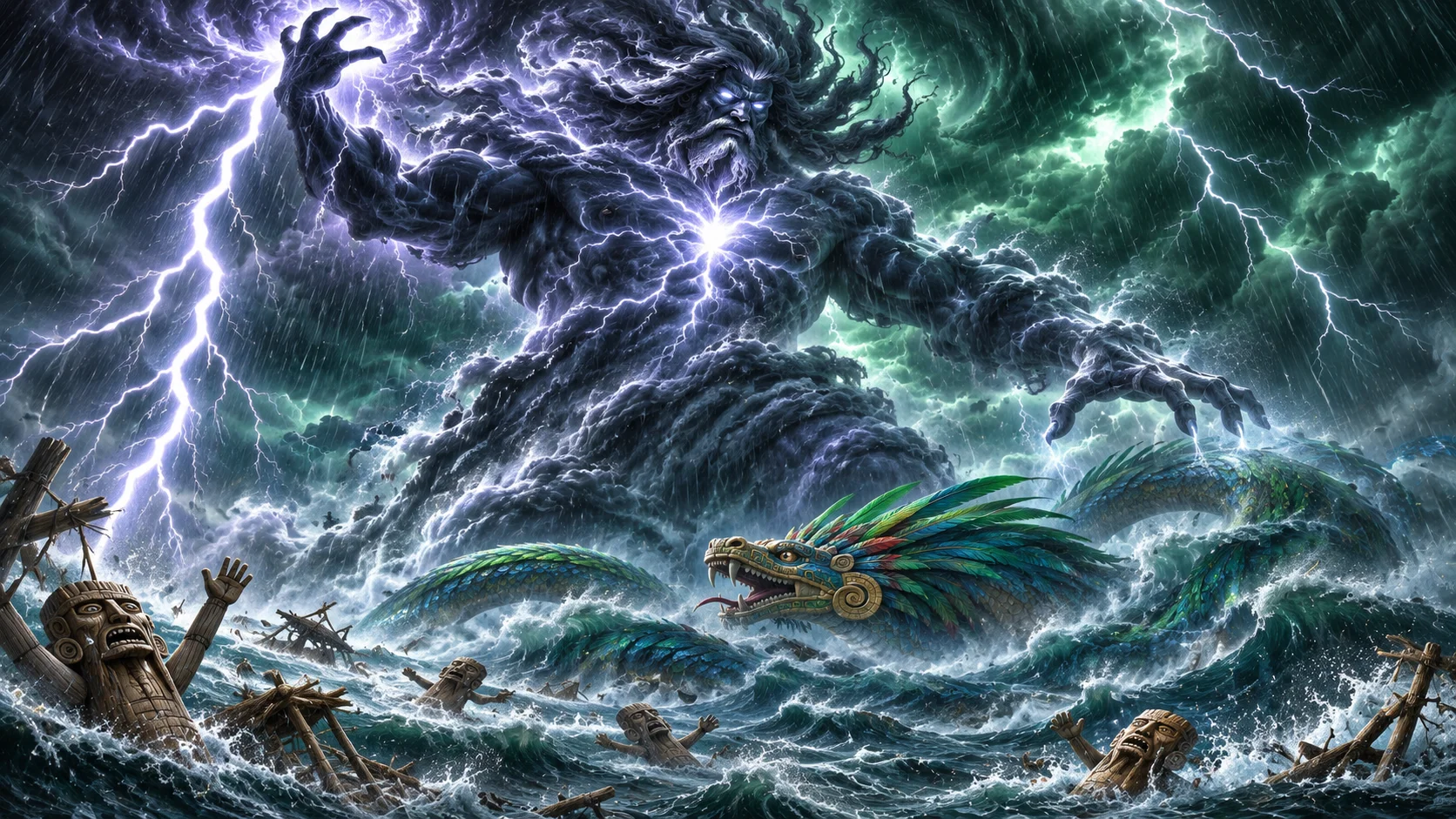
Huracan reappears at a crucial later moment in the narrative: when the second attempt to create humanity, the wooden people, proves to be a failure — the wooden figures can move, speak, and multiply, but have no hearts, no minds, and no memory of or gratitude toward their makers — it is Huracan who sends the great flood, described as a resinous rain falling from the sky, that destroys them, aided by their own household objects, animals, and tools turning against them in revolt. Survivors of this destruction are said to have fled into the forests and become the ancestors of modern monkeys, explained in the text as a punishment for their ingratitude and a visible reminder of the failed attempt.
Wind, Storm, and Fire
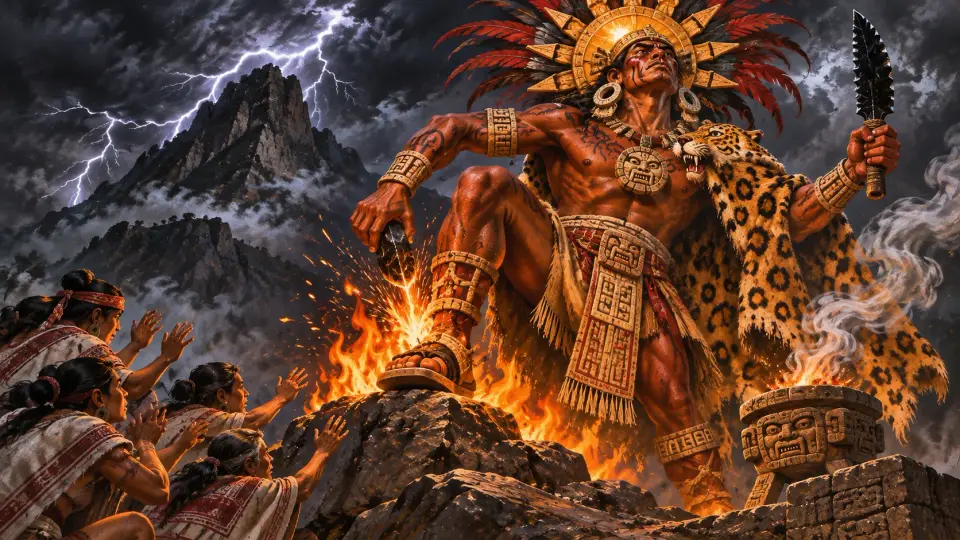
Huracan's domain is elemental and violent: wind, storm, thunder, lightning, and fire, the forces capable of both creating and abruptly destroying. This dual creative-destructive character fits the Popol Vuh's broader theological pattern, in which the gods repeatedly build, judge, and unmake their own creations before finally succeeding with the maize people. Huracan is less an anthropomorphic personality in the narrative than a name for a specific kind of divine power — sudden, forceful, elemental — that intervenes at the decisive turning points of the creation story.
The Etymology of “Hurricane”
The English word “hurricane” does trace back, through a documented linguistic chain, to a storm deity's name in the Americas — but the most direct link runs through the Taino people of the Caribbean rather than straight from the K’iche’ Maya. The Taino, an Arawakan-speaking people of the Greater Antilles encountered by Christopher Columbus and subsequent Spanish explorers, worshipped a storm deity they called Juracan (sometimes associated with, or as an aspect of, the goddess Guabancex, whose anger was said to unleash devastating storms). Spanish explorers adapted this Taino term into huracán, which entered English in a variety of unstable early spellings — “furicano,” “haurachana,” “urican” among them — before settling into its modern form; William Shakespeare himself used the variant “hurricano” in plays such as King Lear. Whether the Taino Juracan and the K’iche’ Maya Huracan are themselves historically connected — through older shared Mesoamerican or circum-Caribbean religious contact, coincidental similarity between unrelated languages, or a genuine common source — is not settled with certainty by linguists; some sources describe the Taino term as possibly influenced by or related to the Maya storm god's name, reflecting long-distance cultural contact across the Caribbean and Mesoamerica, while others treat the resemblance as unproven. What can be said confidently is that the term entering English via Spanish is specifically Taino in its immediate origin, and that any Maya connection, if real, lies further back in a chain that is not fully documented.
Relationship to Other Deities in This Group
Huracan is inseparable, within the Popol Vuh's narrative logic, from Tepeu and Gukumatz; the three act so consistently as a single deliberating unit that some translations render their collective presence simply as “the Maker, Modeler” alongside the “Heart of Sky, Heart of Earth.” Where Gukumatz and Tepeu supply speech, thought, and design, Huracan supplies the sudden elemental force that executes their shared decisions — the lightning-bolt that raises land from water, the flood that erases a failed creation. Xmucane and Xpiacoc, the elderly diviner-grandparents, operate somewhat apart from this trio, entering the story to assist with the more delicate, exacting work of shaping humanity itself, particularly the successful maize people, complementing Huracan's raw power with careful craft and calculation.
Living Memory
Huracan's name endures worldwide, if largely unrecognized, every time an Atlantic storm is called a hurricane — a quiet linguistic afterlife for a god whose central role in the Popol Vuh was to embody the same violent, world-shaping power the word now describes. Within Guatemala, K’iche’ Maya communities continue to treat the Popol Vuh's account of Huracan and his fellow creators as part of a living, actively maintained spiritual heritage rather than a closed chapter of pre-conquest history.
The Three Aspects Reconsidered
Modern translators and epigraphers have paid close attention to the internal structure of Huracan as described in the Popol Vuh — not a single undifferentiated storm god but a named trio, Caculha Huracan, Chipi-Caculha, and Raxa-Caculha, unified under the collective title Heart of Sky. This triadic structure invites comparison with other tripartite or multiplied divine forces elsewhere in Mesoamerican religion, where a single conceptual domain (storm, maize, rain) is often represented not by one deity but by a small cluster of closely related aspects or manifestations, each carrying a slightly different nuance of the same underlying power. Some translators render the three names with an emphasis on escalating intensity, from smaller to greater thunderbolts, which would frame Huracan's triad as a kind of graduated scale of storm violence, moving from initial disturbance to full, decisive destructive or creative force — fitting for a deity whose narrative function is precisely to supply the decisive spark that turns divine intention into physical reality, whether raising land from the sea or bringing down the flood that ends the age of wooden people.
The Flood Sent Against the Wooden People
According to the Popol Vuh, the gods tried more than once to make beings who could honor them. The second attempt produced figures carved from wood, who walked and spoke but had no heart or mind and did not remember their makers. The text says Heart of Sky sent a great flood to destroy them, and that a rain of resin fell as the floodwaters rose.
In the same passage the wooden people's own animals and household objects turn against them, with dogs, turkeys, grinding stones and cooking pots accusing them of mistreatment. The monkeys of the forest are said to descend from the survivors, a story that explains the resemblance of monkeys to people.
Maize Dough and the Clouded Eyes
The successful creation used maize. The text describes yellow and white maize ground and kneaded into dough by the grandmother goddess Ixmucané, from which the first four men were formed. They were so perceptive that they could see everything, near and far, and the creator gods grew concerned that they might become the equals of their makers.
Heart of Sky then clouded their sight, like breath on a mirror, so that they could see only what was close at hand. The episode shows the god acting at a decisive moment to set limits, which fits the character of a deity whose name is tied to sudden, determining action.
Storm Seasons on the Maya Coast
The Caribbean coast of the Maya world lies in a region of tropical storms, and the Atlantic hurricane season runs from roughly June to November. The Yucatán peninsula and the coasts of Belize and Honduras have long been struck by powerful storms, and the memory of destructive winds is part of the cultural landscape.
It is easy to see why a figure linked with storm, wind and thunderbolt held an important place. The relation of his name to the English word hurricane shows that the Spanish and then other Europeans learned the term from Caribbean peoples, who used a word of this kind for the great storm that they feared.
One of Three, Acting Together
Huracan does not act alone in the Popol Vuh. The opening scene presents Tepeu and Gukumatz speaking with Heart of Sky, and creation proceeds by their conversation and agreement. Each of the creator beings contributes something distinct, and no one of them accomplishes the work without the others.
That collaborative picture of creation is one of the features that distinguishes the K'iche' account from stories centered on a single lone creator. It presents the making of the world as a process of deliberation, which is a notable feature of the narrative.
Comparisons Elsewhere in Mesoamerica
Storm and wind deities capable of both nurturing and destroying are common across Mesoamerican religious traditions more broadly, from the central Mexican rain god Tlaloc to the Yucatec Maya Chaac, whose axe-wielding, lightning-bringing rains were considered essential to agricultural fertility even as excessive storms and flooding were feared. Huracan's specific K’iche’ profile, emphasizing creation-through-destruction and the deliberate ending of a failed cosmic experiment via flood, places him within this broader Mesoamerican pattern while retaining features unique to the Popol Vuh's own theological structure, particularly his integration into the deliberating creator trio alongside Tepeu and Gukumatz rather than standing as a separate, unaffiliated weather deity.
Sources & traditions
- EncyclopediaWikipedia — Huracan
- TraditionMaya texts, oral tradition and village tellings (Mesoamerica)
Myths change from area to area and from time to time. This chronicle follows the most widely told versions; tellings in other villages, regions and eras may differ.