Kukulkan, the “Feathered Serpent,” was one of the most powerful and historically influential deities of the Postclassic Yucatec Maya, worshipped above all at the great city of Chichen Itza and later at Mayapan. Combining the body of a serpent with the plumage of the resplendent quetzal, Kukulkan united earth and sky, rain and wind, in a single potent image, and his cult became a unifying religious and political force across a Yucatan otherwise divided among competing city-states.
Name and Iconography
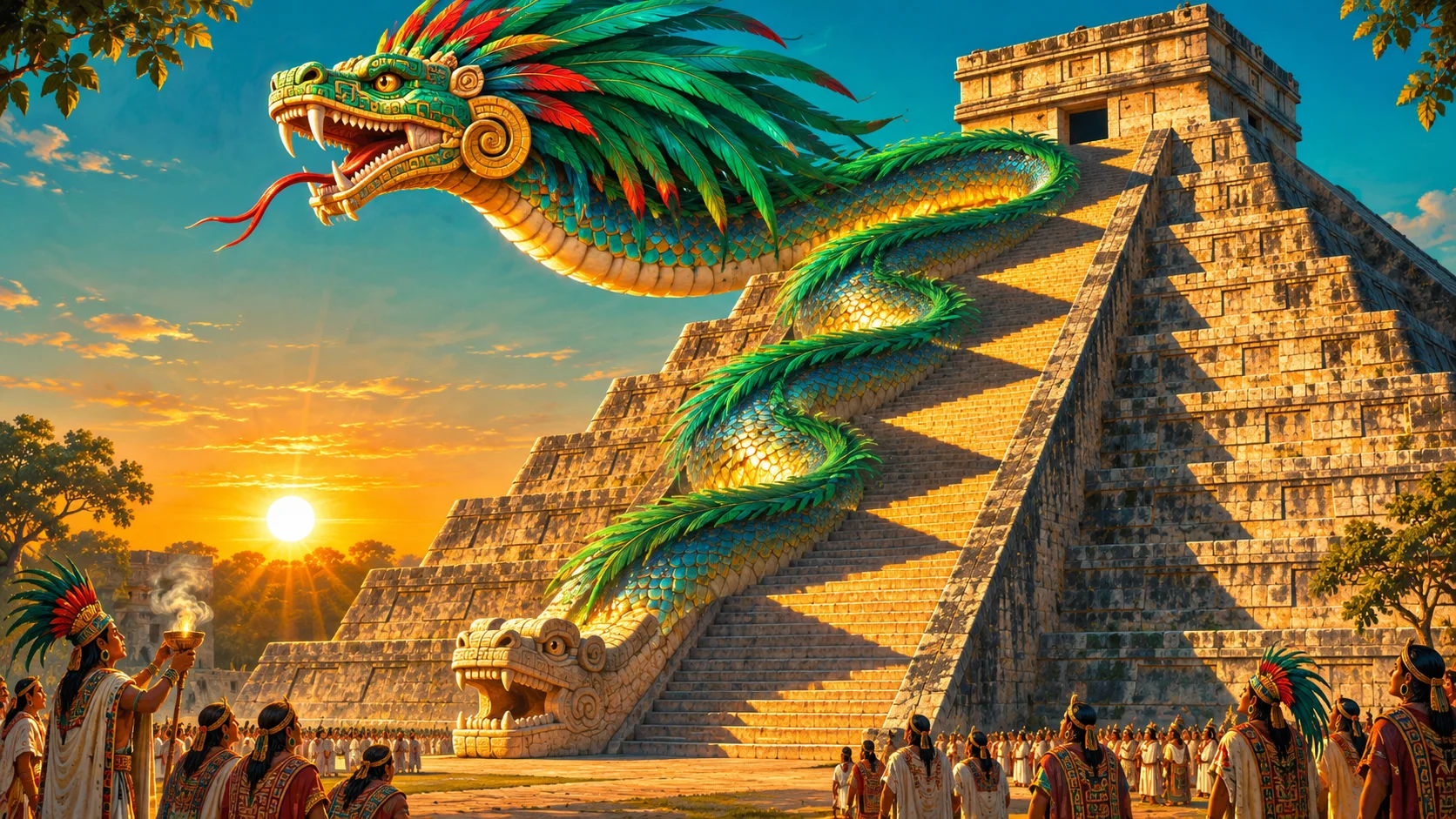
The name Kukulkan derives from Yucatec Maya k'uk', “quetzal feather,” and kan, “serpent.” Depictions typically show a serpent’s body adorned with iridescent feathers, sometimes with an open, fanged mouth from which a human face or figure emerges — a visual grammar shared broadly across Mesoamerica for beings that mediate between the terrestrial and the celestial. The serpent, crawling low and close to the earth, represented the ground and the underworld's proximity; the feathers, associated with the sky-dwelling quetzal, represented the heavens. A being with both was understood to move between these realms, making Kukulkan an especially apt patron for rain, wind, and the fertility that depends on both.
The Chichen Itza Equinox Phenomenon
Kukulkan's most famous modern association is architectural rather than textual: the equinox light-and-shadow display at El Castillo, the great stepped pyramid at Chichen Itza also known as the Temple of Kukulkan. Around the spring and autumn equinoxes, the late-afternoon sun strikes the pyramid's stepped northern balustrade in such a way that seven triangular segments of shadow appear to connect into the undulating body of a serpent, descending the staircase to meet the large carved serpent head permanently fixed at its base. The effect draws large crowds of visitors each year and is one of the best-known examples of Mesoamerican architectural alignment with the solar calendar. Scholars remain divided on how deliberately this effect was engineered into the pyramid's design by its Terminal Classic and Postclassic builders versus how much is a striking, but partly incidental, consequence of the pyramid's geometry and its builders' broader concern with solar and calendrical alignment; either way, the association between Kukulkan and this display was almost certainly intentional at some level, given how precisely it depends on the placement of the carved serpent head.
Kukulkan, Quetzalcoatl, and Gukumatz
Kukulkan is closely related to two other Mesoamerican feathered-serpent deities: Quetzalcoatl of the Aztec (and earlier Toltec and central Mexican) traditions, and Gukumatz (Q’uq’umatz) of the highland K’iche’ Maya, known from the Popol Vuh. Scholars generally treat these as regional and linguistic variants of a shared feathered-serpent religious complex that spread across Mesoamerica over several centuries, rather than as three entirely independent inventions that happened to converge. The precise direction of transmission is debated: some evidence, including architectural parallels between Chichen Itza and the Toltec capital of Tula, points to substantial central Mexican (Toltec/Quetzalcoatl) influence reaching the Yucatec Maya during the Terminal Classic and early Postclassic; the K’iche’ Gukumatz, emerging later among highland Guatemalan Maya, likewise appears to reflect this same widespread feathered-serpent cult, absorbed into K’iche’ cosmology and re-expressed in their own language and origin narrative. What scholars are more cautious about is assuming the underlying mythological narratives — the specific stories told about each figure — were identical across these cultures; the shared name and image do not guarantee identical myths, cult practices, or theological roles in each society.
Kukulkan also appears in colonial Yucatec sources, particularly the Books of Chilam Balam, as a semi-historical culture hero — a ruler or priest said to have arrived in Yucatan and founded or transformed Chichen Itza around the tenth century CE, associated with the K’atun 4 Ahau calendrical period. This blending of a cosmic deity with a remembered historical founder-figure is a recurring pattern in Mesoamerican religious memory and complicates any simple statement about “who Kukulkan was” — a divine principle of wind and rain, a legendary conqueror-priest, or, in the memory of later generations, some fusion of both.
Cult and Political Significance
Kukulkan's cult was not merely a matter of private devotion; it functioned as a unifying religious ideology during the Postclassic period, when Yucatan was politically fragmented among rival polities. Chichen Itza's dominance in the Terminal Classic and early Postclassic periods, and the later rise of Mayapan (roughly 1200–1450 CE) as the peninsula's leading power, both leaned on Kukulkan's cult as shared sacred ground, with Mayapan constructing its own version of the Temple of Kukulkan modeled on Chichen Itza's. This gave the feathered serpent an unusual dual role: a nature deity governing rain and wind, and simultaneously a marker of political legitimacy for whichever center controlled his principal shrine.
Relationship to Other Deities in This Group
Within the Yucatec pantheon, Kukulkan stood alongside Itzamna as one of the most prominent deities, though the two are distinct: Itzamna's domain is the sky as a totality, writing, and healing, while Kukulkan's is more specifically wind, rain, and the fertilizing power that moves between earth and heaven. Kukulkan's closest relatives are found not within the Yucatec tradition itself but across the linguistic and cultural boundary, in the K’iche’ Gukumatz of the Popol Vuh and the Aztec Quetzalcoatl — three expressions of a single widespread Mesoamerican religious idea, the divine feathered serpent, rather than three unrelated gods who happen to look alike.
A Living Site, A Living Symbol
Chichen Itza remains one of the most visited archaeological sites in the Americas, and the equinox descent of the serpent continues to be observed and celebrated by both tourists and, increasingly, by Maya cultural and spiritual practitioners who have reclaimed the site and its symbolism as part of a living heritage rather than a purely archaeological curiosity. Kukulkan's image, carved in stone eight centuries ago, still draws crowds twice a year to watch a shadow become a serpent.
Wind, Rain, and Venus
Beyond his role in the equinox phenomenon and his political significance at Chichen Itza and Mayapan, Kukulkan carried a specific set of natural associations within Yucatec cosmology: he was linked to the winds that precede the rainy season, to rain itself, and, in some interpretations drawn from calendrical and astronomical texts, to the planet Venus, whose heliacal risings were tracked with great precision by Maya astronomer-priests and often associated elsewhere in Mesoamerica with feathered-serpent deities and warfare. This cluster of associations — wind, rain, and Venus — recurs closely enough across the broader feathered-serpent tradition, including the Aztec Quetzalcoatl's own strong Venus associations, that many scholars treat it as a core, shared feature of the wider religious complex rather than a coincidence unique to any one culture's version of the god.
A World Heritage Site and Its Counting Stairs
The pyramid known today as El Castillo at Chichén Itzá has four stairways of ninety-one steps each, which together with the platform at the top are often said to give a total of 365, the number of days in the solar year. Serpent heads carved at the base of the northern balustrade complete the image of the god descending the structure.
Chichén Itzá was inscribed as a UNESCO World Heritage Site in 1988, and in 2007 it was named one of the New Seven Wonders of the World in a popular vote. Both recognitions have brought large numbers of visitors, which has created pressure on the site and has fueled debate about how to protect it.
The Quetzal Chirp
A well-known acoustic effect at El Castillo occurs when a visitor claps at the foot of the stairway. The echo returns from the stepped facade as a chirping sound that resembles the call of the quetzal, a bird central to the feathered serpent's name. The effect was brought to wide attention in studies in the late 1990s by acoustics researchers.
Whether the builders intended the effect remains debated. It is a good example of how modern observations can suggest connections that are plausible but not proved, and visitors should treat the claim as an interesting hypothesis rather than as established fact.
Mayapán, the Later Capital
After the decline of Chichén Itzá, the walled city of Mayapán became the dominant political center of northern Yucatán from about the thirteenth century. Its architecture includes a smaller temple modeled on El Castillo, which shows that the cult of Kukulkan continued in a changed political setting.
Mayapán's authority ended in the fifteenth century amid internal conflict, and the region fragmented into competing provinces. The Spanish found a divided Yucatán, which is part of the reason the later conquest was slow and difficult.
Toltec or Maya? A Changing Debate
Early twentieth-century scholars noticed resemblances between Chichén Itzá and Tula in central Mexico, including feathered serpent imagery and warrior carvings, and proposed that Toltec invaders had brought the cult of Quetzalcoatl to Yucatán. Colonial texts that speak of Kukulkan arriving from the west seemed to support this idea.
More recent research tends to emphasize contact and exchange among Postclassic societies, and some scholars argue that the similarities reflect shared artistic and religious languages rather than conquest. The debate illustrates how interpretations of a deity's origins change as evidence accumulates.
Modern Rediscovery and Misreading
Kukulkan has, like several other prominent Maya deities, been subject to considerable modern reinterpretation, some of it well grounded in the textual and archaeological record and some of it considerably more speculative. Nineteenth- and twentieth-century diffusionist theories occasionally proposed exotic foreign origins for the feathered-serpent cult, including now-discredited claims linking it to transoceanic contact with Old World civilizations; these theories are not supported by mainstream archaeology, which instead documents the feathered-serpent complex as an internally Mesoamerican development traceable through material culture from the Preclassic period onward, well before any plausible outside contact. Contemporary popular writing on Kukulkan sometimes also blurs the line between his role as a nature-and-fertility deity and his role as a semi-historical founder-figure recorded in the colonial Chilam Balam texts, treating the two as a single simple biography; careful readers of the primary sources instead recognize this as a genuine complexity within the tradition itself, reflecting how Maya communities layered cosmological and historical memory together rather than keeping them in separate categories.
Sources & traditions
- EncyclopediaWikipedia — Kukulkan
- TraditionMaya texts, oral tradition and village tellings (Mesoamerica)
Myths change from area to area and from time to time. This chronicle follows the most widely told versions; tellings in other villages, regions and eras may differ.