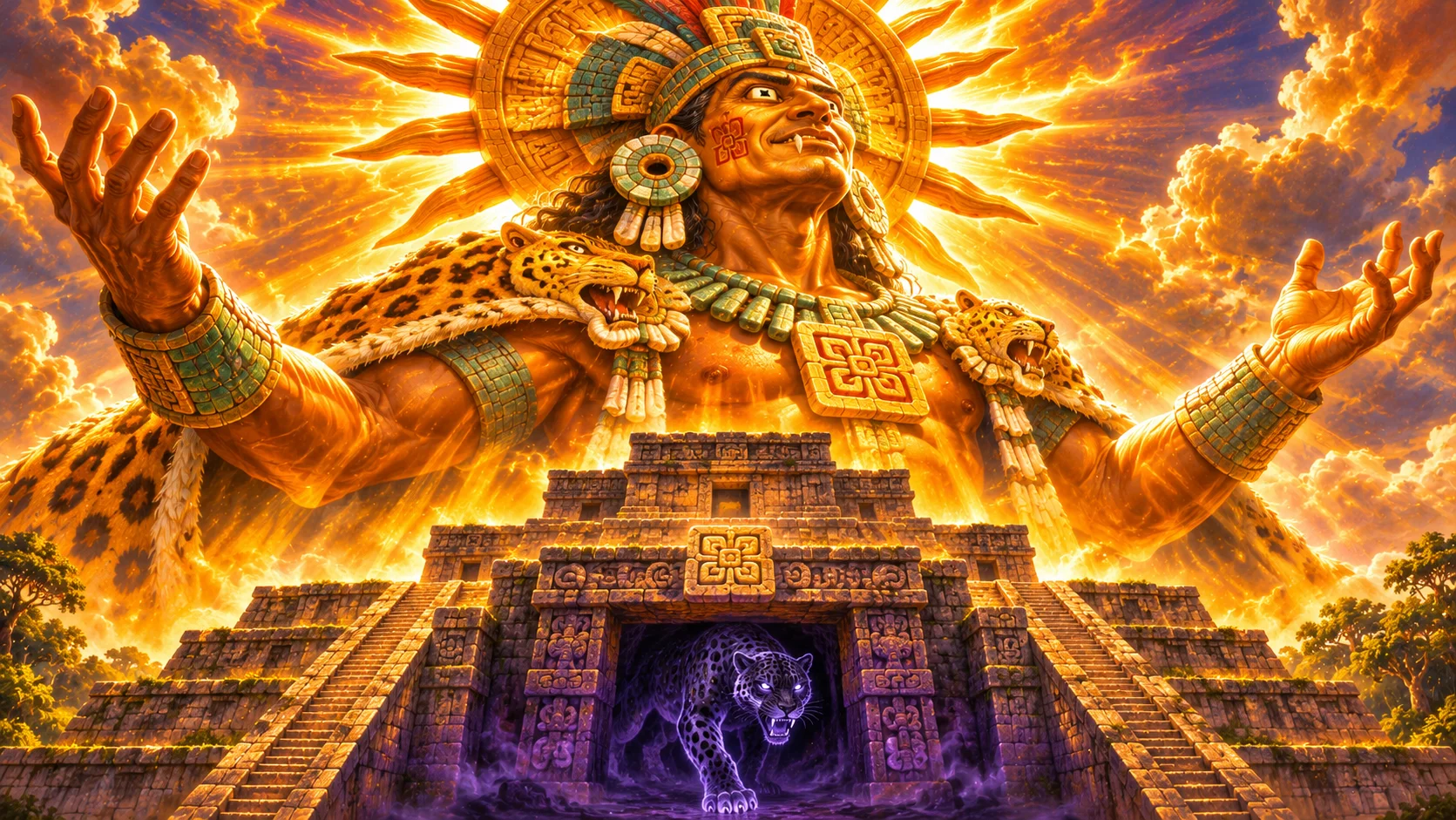
Kinich Ahau, "Sun-Faced Lord," was the Yucatec Maya god of the sun and of daytime itself, one of the most visually distinctive deities in the entire Maya pantheon. Catalogued by scholars as God G in the codices, he is recognizable by crossed, squared eyes, a heavy hooked nose, and filed teeth meeting in a T-shape — features meant to convey both the sun's unbearable brilliance and its divine, ordering power over the daily cycle of light and dark.
Lord of the Daytime Sky
Kinich Ahau presided over the sun's daily transit and, by extension, over the visible order of time itself: the alternation of day and night that structured Maya agricultural, ritual, and calendrical life. His name combines k'in ("sun" or "day") with ahau ("lord" or "ruler"), a title also carried, not coincidentally, by Maya kings, who frequently claimed descent from or close identification with the sun god as part of their own claims to divine authority. Some Classic-period rulers took regnal names incorporating "Kinich" specifically to align themselves with the sun's life-giving, all-seeing power.
Iconography of Overwhelming Brilliance
Kinich Ahau's diagnostic features are unmistakable once learned: large, squared eyes rendered cross-eyed, a prominent curved "Roman" nose, and teeth filed into a distinctive T-shape, sometimes reduced to a single shark-like central tooth. A four-petaled k'in glyph, the standard Maya sign for "sun" or "day," is often infixed somewhere on his face or body, sometimes directly within the eyes themselves, leaving no doubt as to his identity. Maya artists considered crossed eyes a mark of beauty and elevated status more broadly, but for Kinich Ahau specifically the crossed gaze carries an additional layer of meaning: it visually communicates that his own radiance is too intense to look upon directly, even for the god himself.
Relationship to Itzamná
Kinich Ahau's connection to the great creator deity Itzamná is one of the more genuinely unsettled questions in Maya religious scholarship, and different sources resolve it differently. Some colonial and ethnohistoric accounts describe Kinich Ahau as, in effect, Itzamná's daytime aspect or manifestation — the same underlying divine power, understood as taking a solar form while the sun is in the sky. Other traditions describe him instead as Itzamná's son, born of Itzamná and the moon goddess Ixchel, making Kinich Ahau a distinct deity within Itzamná's wider family of related divine beings. Still other scholars, working directly from the epigraphic and iconographic record, argue that Kinich Ahau may not be a fully independent deity at all, but rather a specific aspect of God D (Itzamná himself), who is elsewhere attested carrying the compound name Kinich Ahau Itzamná. No single reading commands universal agreement, and an honest account of Kinich Ahau has to hold all three possibilities — aspect, son, or alternate name — as live options rather than settling on one as if it were established fact.
God G in the Broader Codex Tradition
Within the letter-based system scholars use to catalogue Postclassic Maya deities in the surviving codices, Kinich Ahau's identification as God G places him among a small set of figures whose iconography is consistent enough across different manuscripts and different regions to be confidently identified wherever they appear, in contrast to some other codex deities whose identifications remain more provisional or contested. This consistency has made Kinich Ahau something of an anchor figure for broader work on Maya iconographic method: because his features are so reliably diagnostic, comparisons between his depictions across the Dresden, Madrid, and Paris codices, along with Classic-period monumental art, have helped scholars refine techniques for reading and cross-referencing deity imagery more generally.
Journey Through the Underworld
A recurring theme associated with Kinich Ahau, paralleled by solar deities in many other Mesoamerican traditions, is the belief that the sun, having set in the west each evening, journeys through the underworld during the night before rising again in the east at dawn. Some traditions hold that Kinich Ahau took the form of a jaguar during this nightly underworld passage, jaguars being closely tied throughout Maya iconography to the night sun, to caves, and to the underworld more generally. This nightly transformation and journey linked the sun god conceptually to the underworld lords and to the broader Maya preoccupation with cyclical death and rebirth that also governs the maize god's own mythic arc.
Worship and Later Memory
Kinich Ahau was venerated across the Yucatán peninsula, with particular associations to sites connected in colonial-era accounts to sun worship and royal legitimacy. As with many Maya deities, direct temple-based worship of Kinich Ahau by name did not survive the conquest and the subsequent imposition of Catholicism in any organized, continuous form comparable to the living Ch'a Cháak rain ceremonies still performed for Chaac. What survives instead is his presence in the codices, in temple imagery, and in the historical memory of the Maya solar cult as one of the most iconographically vivid and calendrically central figures in the entire pantheon — a reminder that the sun's daily passage was never, for the Maya, a mere natural fact, but the visible activity of a named and honored lord.
Kingship and the Solar Title
The title element "Kinich," meaning roughly "sun-eyed" or "sun-faced," was adopted by a number of historically attested Maya rulers as part of their royal names, most famously among the kings of Copán and among rulers elsewhere who wished to associate their own authority with the sun's unchallengeable, all-seeing supremacy over the sky. This practice reflects a broader Mesoamerican pattern in which kingship was legitimized not merely through inheritance or conquest but through a claimed intimacy with, or embodiment of, specific cosmic forces. A ruler who took a Kinich-prefixed name was making an explicit public claim: that his own rule mirrored the sun's own unquestioned, cyclical, and life-sustaining authority over the visible world, and that to oppose him was, by implication, to oppose the natural order the sun itself upheld.
The Sun Temple Tradition
Structures interpreted by archaeologists as dedicated, at least in part, to solar observation and to the veneration of the sun god appear at a number of Maya sites, often aligned so that the rising or setting sun on significant calendrical dates — equinoxes, solstices, or dates of particular ritual importance — would strike a specific doorway, stairway, or interior chamber directly. This architectural attention to solar alignment demonstrates that devotion to Kinich Ahau was never a purely abstract or textual matter; it was built directly into the practical, physical infrastructure of Maya ceremonial life, timed to moments when the sun god's presence and power were understood to be at their most concentrated and observable.
The Sun Pyramid at Izamal
The town of Izamal in northern Yucatán is home to several large pre-Hispanic platforms, one of which is known as Kinich Kakmó, a name usually explained as relating to a fiery sun bird. A colonial Spanish convent was built over another of the pyramids, so the site shows layers of religious history.
The pyramids at Izamal are among the largest in the Yucatán peninsula and show that sun worship was linked to monumental architecture. The name, preserved in later tradition, indicates how the sun's identity was tied to specific places.
K'in, the Day and the Sun
In Yucatec and other Mayan languages the word k'in means sun and also day and time. The Maya Long Count calendar uses the k'in as the basic unit, a single day, and the glyph for k'in is a flower-like sign that is closely associated with the sun god's face.
This double meaning shows how closely the sun and time were connected in Maya thought. To count days was in a sense to count suns, and a god of the sun was also a god of the passage of time.
Watching Eclipses
The Dresden Codex includes a table of pages devoted to eclipses, in which Maya scribes recorded intervals at which eclipses might occur. The tables reflect long observation and reveal that the Maya understood the regularity of such events while still treating them as serious omens.
For a solar god, eclipses were a particular concern. Texts and images treat them as a kind of danger to the sun, and the need to track them shows how closely astronomy and religion were joined.
Solar Architecture in the Early Maya World
Early Maya cities contain a distinctive architectural arrangement known as an E-Group, in which a pyramid on the west faces a long platform on the east. At some sites the alignment marks the rising sun at the solstices and equinoxes. An early example is found at Uaxactún in Guatemala.
These buildings show that attention to the sun's annual path was built into the layout of ceremonial centers from early times. They are a physical setting for the kind of worship that later became associated with Kinich Ahau.
The Sun Across the Calendar
Because the solar day was one of the fundamental units of Maya timekeeping, Kinich Ahau's presence extended into the structure of the calendar itself, well beyond his appearances as a discrete narrative figure. The k'in glyph that marks his face is the same glyph used throughout Maya inscriptions to denote "day" as a unit of time, meaning that every dated inscription on every stela and every page of every surviving codex implicitly invoked the sun god's domain simply by recording when an event occurred. This deep entanglement between the sun god and the basic vocabulary of time itself is one of the clearest illustrations of how thoroughly Maya religious and calendrical thought were fused into a single system, rather than existing as separate spheres of "religion" and "science" in the way later Western categories might suggest. Every stela erected to commemorate a king's accession, every recorded eclipse, every almanac page in the surviving codices tracking ritual obligations across the 260-day sacred calendar carried, embedded in its very notation, an implicit acknowledgment of the sun god whose daily passage made the counting of days possible at all.
Sources & traditions
- EncyclopediaWikipedia — Kinich Ahau
- TraditionMaya texts, oral tradition and village tellings (Mesoamerica)
Myths change from area to area and from time to time. This chronicle follows the most widely told versions; tellings in other villages, regions and eras may differ.