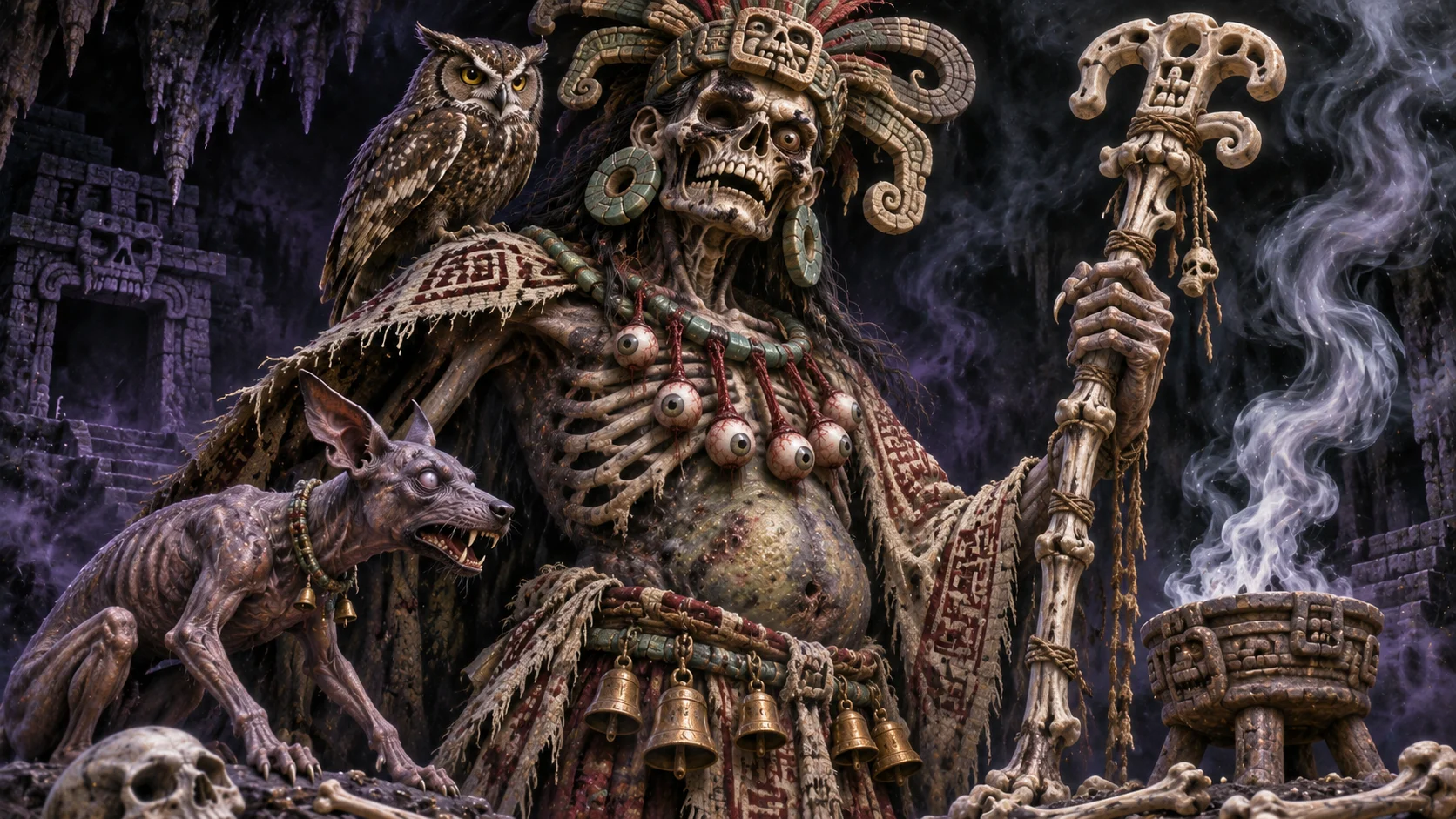
Ah Puch was the principal Yucatec Maya god of death, a skeletal, bloated, and visibly decomposing lord who ruled the lowest and most feared level of the Maya underworld. Known also as Yum Cimil ("Lord of Death"), and identified by many colonial and modern sources with the names Cizin and Kisin, he presided over Metnal, the deepest region of the subterranean realm the Yucatec Maya called Xibalba, "the place of fear." Owls, black dogs, and the Moan bird — a screech-owl associated with ill omen — traveled in his company, announcing death wherever they appeared.
Lord of the Lowest Realm
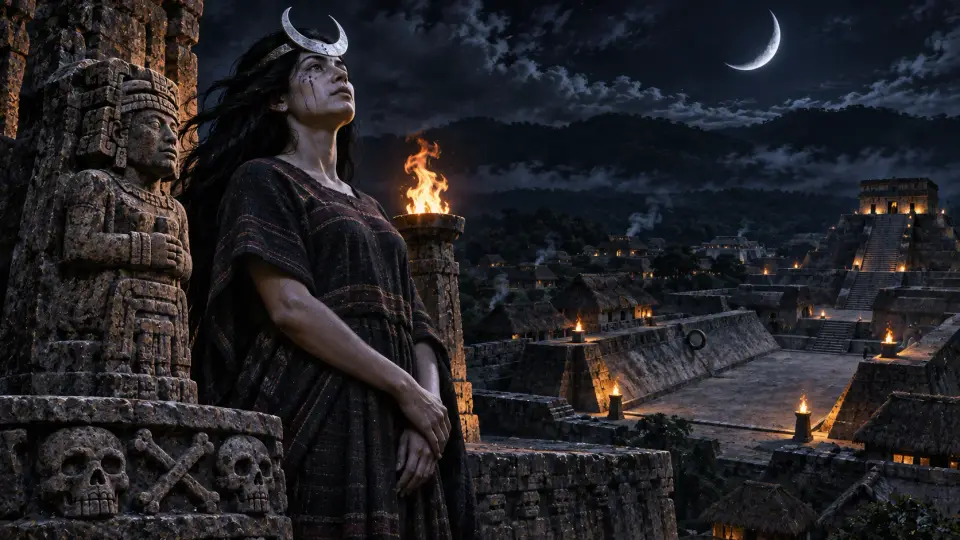
In Maya cosmology the universe was layered: an upper world of thirteen heavens, a middle world of human habitation, and a lower world of nine descending levels, often collectively called Xibalba. Ah Puch's domain, Metnal, occupied the ninth and final level, the destination reserved for souls who had not earned one of the more fortunate afterlives — those, for instance, that awaited warriors, sacrificial victims, mothers who died in childbirth, or those who died by their own hand, all of whom the goddess Ixtab escorted instead to a paradise beneath the shade of the cosmic ceiba tree. For everyone else, the journey led downward, through trials and terrors, to Ah Puch's domain, where suffering was said to continue indefinitely rather than end.
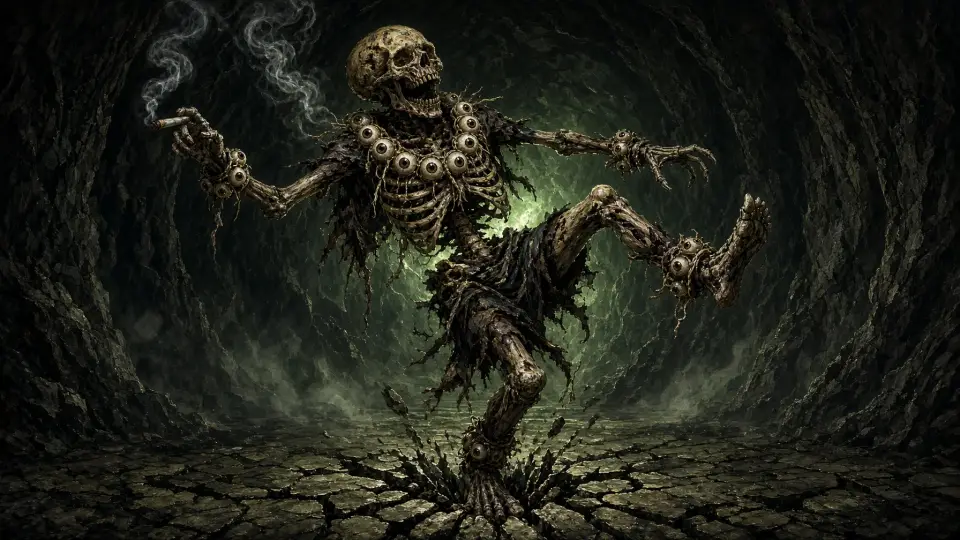
He was not merely death as an abstraction but death as decay and dissolution given a face: bloated flesh, exposed ribs, a body marked with black spots signifying putrefaction. Some accounts also connect him, in certain local traditions, with disaster, war-adjacent violence, and even — paradoxically, in a pattern common to many Mesoamerican death deities — with childbirth and renewal, since the Maya frequently understood death and rebirth as two faces of a single cyclical process rather than as opposites.
Iconography: The Bloated, Bell-Hung Corpse
Epigraphers working with the Postclassic Maya codices — principally the Dresden and Madrid codices — classify this death god under the Schellhas designation "God A." He is rendered with a skeletal head and torso, a distended, bloated belly signifying the swelling of a corpse in decomposition, and dark spots across the body representing decay. He frequently wears a collar or necklace strung with disembodied eyes or with small bells, and his head is sometimes marked with the cimi ("death") glyph, a stylized skull motif that also names the sixth day of the 260-day sacred calendar. God A is one of the most frequently depicted supernatural figures in the surviving codices, appearing in almanacs concerned with sickness, sacrifice, and the darker auguries of the ritual calendar — most dramatically on page 74 of the Dresden Codex, where death gods appear alongside the rain deity Chaac in a flood scene long popularly read as a singular world-ending cataclysm, though current codex scholarship increasingly treats it as tied to the page's preceding rain-prediction tables — a depiction of recurring, seasonal storm-floods rather than a one-time end of the world.
His animal companions reinforced the association: owls, whose nocturnal cries the Maya read as omens of imminent death, and dogs, who in Mesoamerican belief more broadly (a role especially well documented for the hairless xoloitzcuintle among the Aztec, and paralleled in Maya practice of burying dogs with the dead) served as guides for the soul on its journey through the underworld's dangers.
Ah Puch, Cizin, and Kisin: One God or Several?
Untangling Ah Puch from Cizin and Kisin is one of the genuine open questions in Maya studies, and honesty requires saying so plainly rather than forcing a tidy answer. The names are not simply interchangeable synonyms nor are they certainly separate persons; the evidence supports a middle position. Many sources describe Ah Puch as a "principal" or "generic" death god known by a cluster of names and epithets across different Yucatec-speaking communities and historical periods — among them Hun Ahau, Cum Hau, Ah Pukuh, Yum Cimil, and, in some traditions, Cizin. Under this reading, Cizin ("the stinking one") is best understood as an epithet or a localized manifestation of the same underlying death-god concept that colonial writers and modern scholars alike labeled Ah Puch, rather than as an entirely independent deity with a separate mythic biography. Some Mayanists go further and suggest Ah Puch himself "manifested under several names and guises," implicitly treating the underworld's chief death lord as a single multivalent figure rather than a fixed individual with one canonical name.
At the same time, regional distinctions genuinely existed. The name Cizin (or Kisin) carries an etymology distinct from Ah Puch: it derives from a root meaning flatulence or stench, giving the figure the epithet "the Stinking One," a name emphasizing the smell of bodily decomposition rather than skeletal appearance. Because that name and that emphasis recur independently across multiple Yucatec-region sources and are specifically tied to earthquakes in ways Ah Puch generally is not, many scholars treat Cizin as at minimum a distinguishable aspect or a parallel tradition sharing the same conceptual territory as Ah Puch, even where the two are not kept rigidly apart. The honest summary: Ah Puch and Cizin overlap so heavily in domain, iconography, and function that colonial-era and modern writers alike have frequently used the names as if for the same god, but the underlying textual record shows enough independent regional development that treating them as perfectly identical would overstate the certainty of the sources.
Textual and Ethnographic Sources
Most of what is known comes from two kinds of evidence: the pre-conquest painted codices (Dresden and Madrid), which preserve the visual vocabulary of God A across dozens of ritual almanacs, and colonial-era ethnographic accounts, above all Diego de Landa's sixteenth-century Relacion de las cosas de Yucatan, compiled from interviews with Yucatec Maya informants after the Spanish conquest. Landa and later Mayanist scholarship such as that synthesized in modern encyclopedic treatments of Maya death gods describe a lord of the underworld frequently paired with the god of war in sacrificial scenes, reflecting how closely death, warfare, and ritual violence were bound together in Maya thought.
Worship and Ritual Practice
Ah Puch was not worshipped in the sense of being courted for favor so much as he was placated and warded off. Illness, disaster, and the approach of death itself were understood as his doing or his domain, and ritual specialists conducted ceremonies of protection and propitiation intended to delay or soften his attentions rather than invite them. Because death for the Maya was not simply an ending but a transition with real consequences for where the soul would spend eternity, funerary practice — the placement of grave goods, the burial of a guide-animal, offerings meant to ease the passage through Metnal's trials — mattered enormously, and Ah Puch's presence loomed over nearly all of it as the power that had to be reckoned with at the end of every human life.
Companions and Death Omens
Two animals traveled consistently in Ah Puch's retinue and functioned, in Maya belief, as living warnings of his approach: the owl and the dog. The Moan bird, a species of screech-owl, was regarded across the Yucatan as an unambiguous omen of death whenever its call was heard near a household, and it appears repeatedly alongside spiders, centipedes, and scorpions in the cluster of creatures thought to keep company with the death god. The dog held a different, more constructive role: rather than merely warning of death, dogs — especially in the wider Mesoamerican pattern also documented among the neighboring Aztec, where the hairless xoloitzcuintle guided souls to Mictlan — were understood as psychopomps, guiding the newly deceased through the perils of the underworld journey. Maya funerary practice reflects this belief directly: dogs were sometimes buried alongside their owners specifically so that the animal's spirit could perform this guiding function in the world beyond.
Death and Renewal as a Single Cycle
One of the more counterintuitive aspects of Ah Puch's portfolio, when viewed through a modern lens that tends to separate death sharply from birth, is his occasional association — recorded in some regional traditions — with childbirth, rebirth, and new beginnings alongside his primary role as lord of decay. This is not a contradiction within Maya thought so much as a reflection of how thoroughly cyclical Maya cosmology was: agricultural cycles of planting and harvest, calendrical cycles of recurring day-names and year-bearers, and the cycle of human life and death were all understood as expressions of the same underlying pattern of ending-into-beginning. A death god who also touches on birth is, within that framework, not a strange hybrid but a logical consequence of treating decay and renewal as two phases of one continuous process, the same underlying logic that let the Hero Twins of the Popol Vuh die in Xibalba only to be reborn transformed and victorious.
Comparative Context: Death Gods Across Mesoamerica
Ah Puch's basic profile — a skeletal, decay-marked deity ruling the deepest level of a stratified underworld — finds close parallels elsewhere in Mesoamerica, most notably in the Aztec Mictlantecuhtli, lord of Mictlan, who shares the bloated-corpse iconography, the eye-and-bone ornamentation, and the owl associations. Scholars generally do not treat these as the same god borrowed wholesale between cultures, but rather as parallel developments of a widely shared Mesoamerican religious grammar in which death deities are consistently rendered skeletal, adorned with bodily remnants, and paired with nocturnal, ill-omened animals. This comparative pattern is one reason Mayanists are comfortable treating "Ah Puch" less as a single fixed individual and more as a culturally central role or office — lord of the deepest underworld — that different communities, and even different eras of the same community, filled with slightly different names and emphases, Cizin and Kisin very much included.
Living Legacy
The Maya peoples of the Yucatan Peninsula, Chiapas, Guatemala, and Belize are not a vanished civilization but millions of living people across dozens of related language communities, many of whom maintain syncretic religious practices blending Catholic and indigenous elements. Figures descended conceptually from Ah Puch persist in regional folklore and in the Day of the Dead traditions of the broader Mexican south, even where formal veneration of the pre-conquest pantheon has receded. Scholarly interest in Ah Puch endures both for what the codices reveal about Postclassic Maya religious thought and for what his overlapping identities with Cizin and Kisin reveal about how fluid the boundaries between "individual" deities could be in Maya theology — a fluidity that modern classification, built on European assumptions of one god, one name, one story, does not always capture well.
Sources & traditions
- EncyclopediaWikipedia — Maya death gods
- TraditionMaya texts, oral tradition and village tellings (Mesoamerica)
Myths change from area to area and from time to time. This chronicle follows the most widely told versions; tellings in other villages, regions and eras may differ.