Vucub Caquix — K’iche’ Wuqub’ Kaqix, “Seven Macaw” — is the vast, jewel-encrusted bird demon of the Popol Vuh who falsely proclaims himself both sun and moon while the present world is still unfinished. His arrogance and his artificial, metal-and-gemstone brilliance mark him as a false luminary whose defeat by the Hero Twins clears the way for the true sun and moon to eventually take their place in the sky.
A False Light Before the Dawn
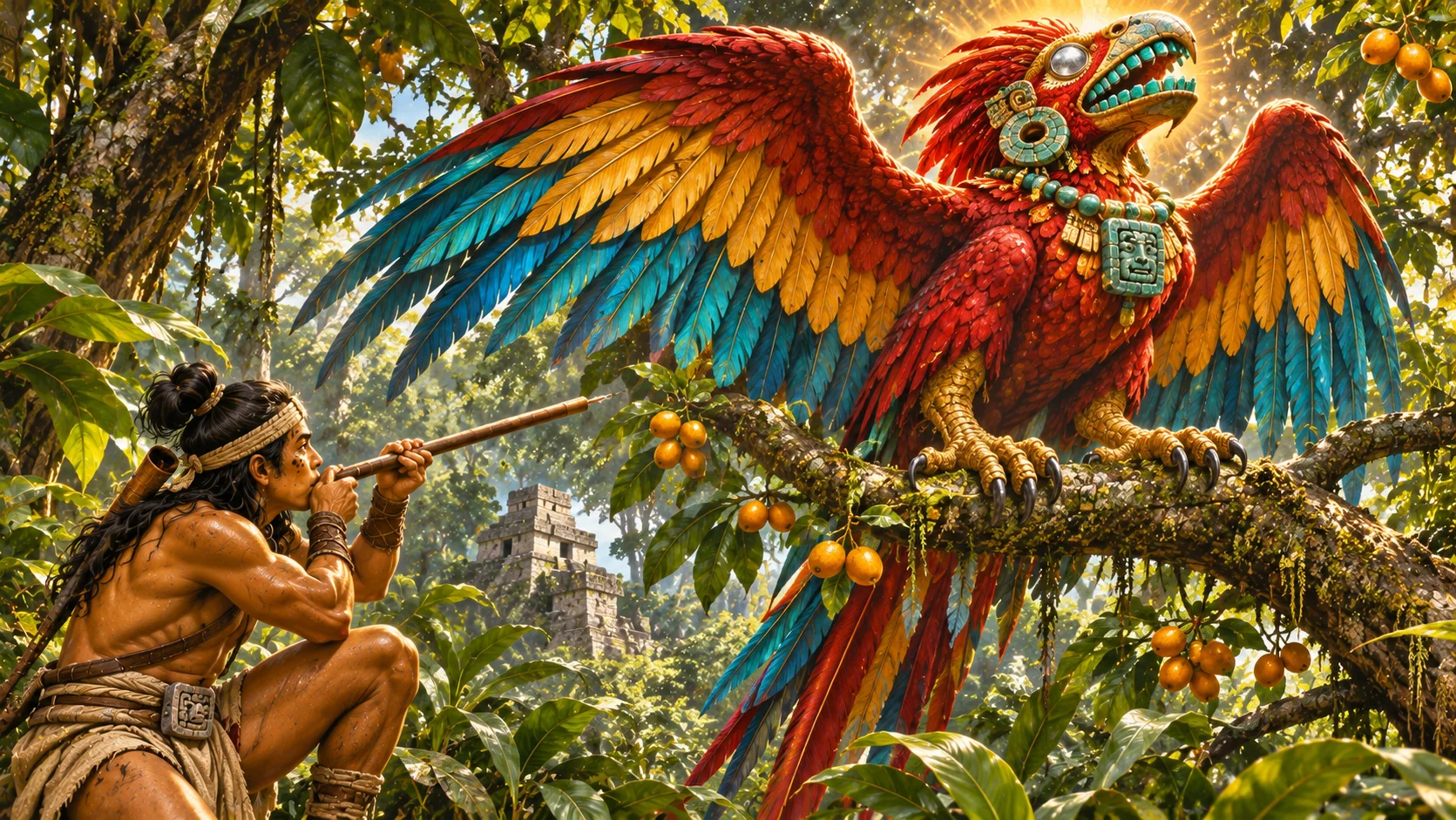
In the sequence of the Popol Vuh, Vucub Caquix’s episode falls in the period after the first attempts at creating humanity have failed and before the present age — and its two true luminaries — have been established. Into this unfinished world Vucub Caquix inserts himself as a self-declared deity of enormous vanity, perching in the branches of a great nance tree to feast on its fruit each day. He proclaims to anyone who will listen: “I am great… I am the sun, I am the light, I am the moon,” boasting that his brilliance illuminates the whole earth and that his eyes shine like precious jade and metal.
The Popol Vuh is explicit that this self-glorification is a lie built on borrowed splendor rather than divine truth: Vucub Caquix’s dazzling appearance comes not from any cosmic authority but from the material riches adorning his body — his teeth were said to be set with jewels, his eyes rimmed with metal, so that he glittered like the sun without possessing the sun’s actual power. He could see, the text notes pointedly, only as far as the horizon, a physical limitation underscoring the smallness of his claim to universal illumination. His pride, in other words, is a category error: he mistakes ornament for divinity, and reflected light for the source of light itself.
Family and Kind
Vucub Caquix is not an isolated figure but the patriarch of a small dynasty of arrogant earth-monsters. He is described as husband to Chimalmat and father of two sons, Zipacna and Cabrakan, each of whom inherits a version of his father’s boastfulness in a different register: Zipacna claims credit for making the mountains, while Cabrakan claims the power to shake and overturn them. The family forms a thematic unit within the Popol Vuh — three successive false claimants to cosmic power, each one confronted and undone in turn by the Hero Twins, so that Vucub Caquix’s downfall is only the first movement in a longer campaign against the same species of prideful excess.
The Hero Twins’ Campaign Against Him
Hunahpu and Xbalanque, still boys but already renowned hunters with their blowguns, resolve that Vucub Caquix’s claim to be sun and moon is an offense that cannot stand while the world awaits its true lights. They lie in wait beneath the nance tree where he feeds each day, and as he settles into the branches to eat, Hunahpu fires a blowgun dart directly into his jaw. The shot knocks Vucub Caquix from the tree, but rather than killing him outright it merely wounds and enrages him: in his thrashing agony he seizes Hunahpu’s arm and tears it from his body, carrying it off to his home as a trophy and hanging it over his hearth fire, boasting of his victory even in defeat.
The twins do not confront him again by force. Instead they enlist the aid of the aged creator couple Xpiacoc and Xmucane — in some readings their own great-grandparents — disguising themselves as a pair of traveling doctors accompanied by two children (the twins in disguise). Vucub Caquix, now in agonizing pain from his wound and rotting teeth, welcomes the strangers, believing their promise to cure his toothache and failing eyesight. Under the pretext of treatment, the false healers extract his jeweled teeth and replace them with ordinary kernels of white maize, and pry the shining metal from around his eyes. Stripped of the ornaments that had constituted his entire claim to brilliance, Vucub Caquix dies from his injuries and loss of his false finery; the twins recover Hunahpu’s severed arm from above the hearth and reattach it, restoring him whole.
Defeat as Cosmic Correction
The destruction of Vucub Caquix functions in the Popol Vuh’s structure as a necessary clearing-away rather than a simple monster-slaying. The present age cannot have its true sun and moon — who will eventually be revealed as Hunahpu and Xbalanque themselves, following their later triumph over the lords of Xibalba — while a fraudulent claimant still occupies that symbolic position. His jeweled teeth and metal-rimmed eyes, the very things that made him glitter like a heavenly body, are shown to be worthless once removed from his living body, reduced to plain adornments with no inherent power. The episode dramatizes a recurring value in the text: legitimate cosmic authority must be earned through right action and sanctioned by the proper order of creation, not simply seized through display and self-assertion.
Scholars have also read Vucub Caquix against earlier Mesoamerican solar and avian imagery, noting that a monstrous bird associated with a prior, failed age of the world appears in other Mesoamerican creation traditions as well; his defeat, read this way, marks the symbolic end of an earlier, disordered cosmic era and the clearing of space for the ordered, twin-governed present.
Textual Sourcing
The episode of Vucub Caquix appears in the first part of the Popol Vuh, the K’iche’ Maya sacred-historical text set down in alphabetic script in the mid-sixteenth century and preserved for posterity through the early eighteenth-century transcription and Spanish translation of the Dominican friar Francisco Ximénez, whose manuscript is now held at the Newberry Library in Chicago. Modern readers most often encounter the story through the widely used English translations of Dennis Tedlock and Allen J. Christenson, both of which render Vucub Caquix’s boasts and eventual humiliation from the original K’iche’ with extensive scholarly annotation on the episode’s cosmological placement.
A Contested but Ancient Figure
Scholars who study the Principal Bird Deity depicted on Preclassic and Classic-period Maya monuments — a great avian figure, sometimes perched atop a world tree, sometimes shown with serpent or jaguar features mixed into its bird form — have long debated the extent to which this much older imagery represents an artistic ancestor of the K’iche’ text’s Vucub Caquix. The visual parallels, particularly the association with a great tree and with claims to celestial authority, are suggestive enough that many popular and some scholarly accounts treat the identification as effectively settled, while more cautious specialists note that a gap of well over a thousand years separates the Preclassic monumental imagery from the mid-sixteenth-century K’iche’ manuscript, and that the specific narrative of a blowgun wound and a trick involving false healers is not directly attested in the earlier iconography. What is not in doubt is that the K’iche’ authors of the Popol Vuh were drawing on a much older Mesoamerican mythic and artistic vocabulary even as they set their own version of the story down in an entirely new medium, the Latin alphabet, in the wake of the Spanish invasion.
Enduring Cultural Presence
Vucub Caquix remains one of the most vividly remembered figures of the Popol Vuh cycle among contemporary readers and among K’iche’ Maya communities in the Guatemalan highlands, where the text continues to be taught, discussed, and drawn upon by traditional daykeepers as part of a living, rather than merely historical, spiritual and literary inheritance — a status affirmed by UNESCO’s 2012 recognition of the Popol Vuh as part of Guatemala’s Intangible Cultural Heritage. His story is frequently cited in discussions of Maya art and iconography as an explanation for imagery of great birds perched in trees found on painted ceramics and carved monuments from the Classic period, centuries before the K’iche’ text was written down, suggesting a mythic tradition of great antiquity behind the version that survives today. For readers encountering the Hero Twins cycle for the first time, Vucub Caquix’s tale is often the entry point into the larger narrative, prized for its clear moral shape and its vivid image of false brilliance stripped away tooth by tooth, jewel by jewel, until nothing of the pretender’s claim remains.
Sources & traditions
- EncyclopediaWikipedia — Vucub Caquix
- TraditionMaya texts, oral tradition and village tellings (Mesoamerica)
Myths change from area to area and from time to time. This chronicle follows the most widely told versions; tellings in other villages, regions and eras may differ.