Zipacna is the elder of Vucub Caquix’s two monstrous sons in the Popol Vuh, a crocodilian earth-giant who boasts of having made the mountains and who crushes anyone who challenges that claim — until the Hero Twins Hunahpu and Xbalanque lure him to his death beneath a mountain of his own making, using nothing more than an artificial crab as bait.
The Mountain-Maker’s Boast
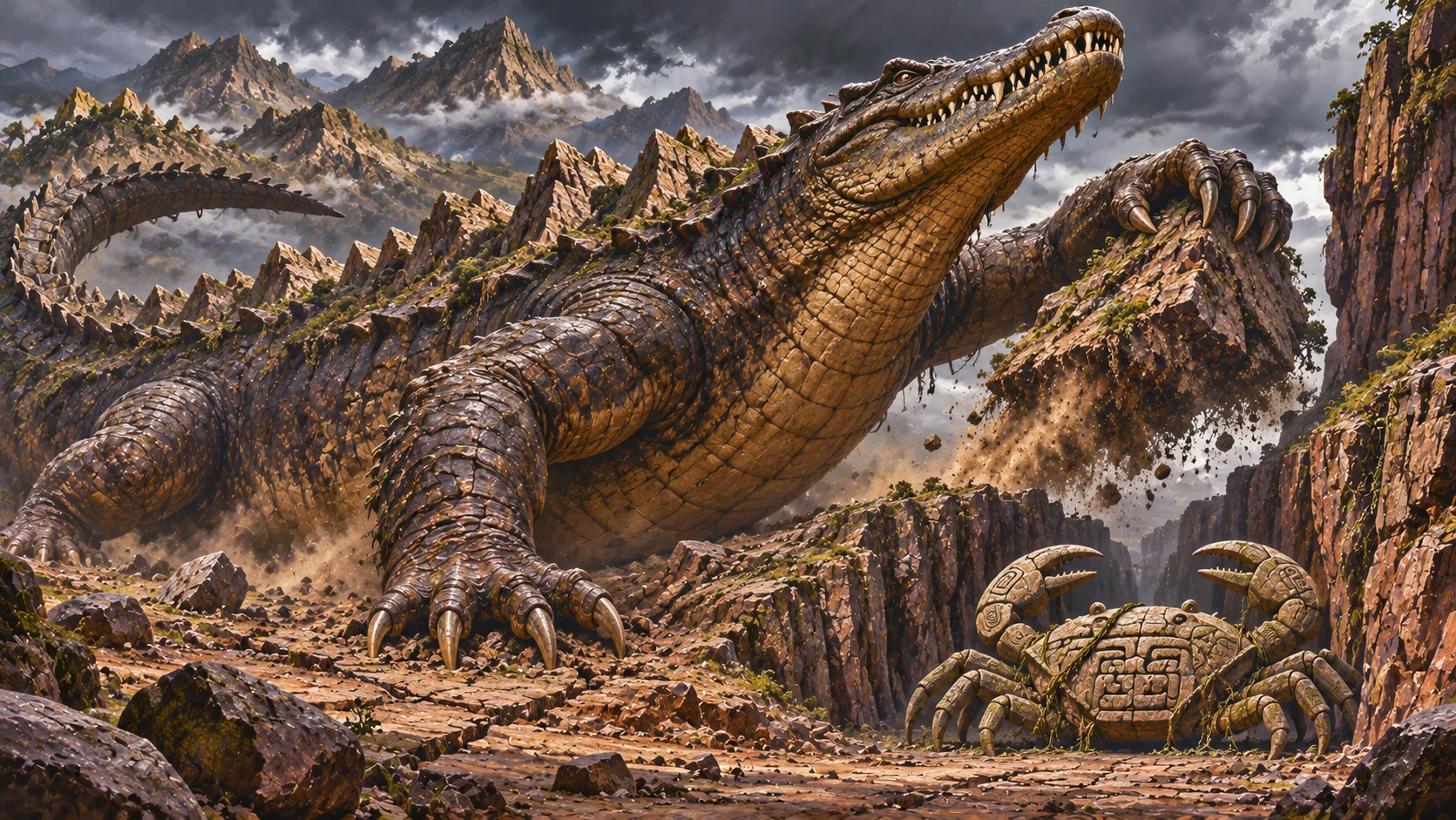
Zipacna is introduced in the Popol Vuh as the son of Vucub Caquix, the false sun-and-moon bird demon, and his wife Chimalmat, inheriting his father’s appetite for self-glorification in a different key: where Vucub Caquix claimed the sky, Zipacna claims the earth itself. He is described as a great, alligator- or crocodile-like being of immense strength who spends his days shaping the landscape, and he boasts openly that he alone is the maker of the mountains — a claim the text treats as another instance of the same prideful overreach that defines his family. He is closely associated in the narrative with his younger brother Cabrakan, the god of earthquakes, and the two are often discussed together as siblings whose destructive arrogance the created order cannot accommodate.
The Slaying of the Four Hundred Boys
Before his confrontation with the Hero Twins, Zipacna is responsible for one of the Popol Vuh’s more haunting episodes. A group of four hundred young men are struggling to haul a huge log meant as the center-post for their house when Zipacna comes upon them and, in a display of casual strength, carries the log for them by himself. Fearing his power, the four hundred boys conspire to kill him by digging a deep pit, inviting him to descend into it under the pretext of continued work, and dropping the log on top of him to crush him. Zipacna, however, anticipates the trap: he digs himself a side tunnel to escape being crushed, and once the boys believe him dead and begin celebrating with drink, he brings the house down on top of them, killing all four hundred. In the Popol Vuh’s own account, the slain youths are transformed into the stars of the Pleiades, ascending to the sky as a memorial to their deaths — establishing Zipacna, even before his final defeat, as a figure whose violence directly disrupts the intended order of the world and whose death the gods will come to regard as necessary.
The Trap of the False Crab
Learning of the deaths of the four hundred boys, the Hero Twins Hunahpu and Xbalanque determine that Zipacna, like his father before him, must be stopped. They construct an elaborate artificial crab — its claws fashioned from the flower of a bromeliad and its shell a hollowed-out stone, to resemble the genuine article — and place it deep within a cave-like crevice at the foot of a mountain called Meauan (Meawan), in the west. They then seek out Zipacna, who is known to hunt along riverbanks and beaches for crabs and fish to eat, and tell him of a magnificent crab waiting to be caught in the canyon. Zipacna, hungry after days without finding food, follows them eagerly to the spot.
Seeing the false crab lodged deep within the narrow opening at the base of the mountain, Zipacna — his hunger overriding his suspicion — crawls in on his back to seize it, wedging himself into the tight space beneath the mountain’s weight. The moment he is fully inside, the Hero Twins bring the mountain crashing down upon him. Unable to escape as he had from the pit dug by the four hundred boys, Zipacna is crushed beneath the collapsing stone and, in the text’s telling, turns to stone himself, forever pinned beneath the very kind of mountain he had boasted of creating.
Symbolic and Cosmological Significance
Zipacna’s defeat completes a symmetry that runs through the Popol Vuh’s early chapters: a being who claims sole authorship of the mountains is destroyed by being buried inside one, his own claimed domain becoming his tomb. As with his father Vucub Caquix and his brother Cabrakan, Zipacna’s downfall punishes not simply violence but a specific kind of cosmic overreach — an unearned claim to have shaped the world single-handedly, made by a being who is not the true creator. His transformation to stone also situates him within a broader Mesoamerican pattern in which defeated giants or monsters of a prior, disordered age are literally petrified, becoming fixed features of the landscape that bear silent testimony to the establishment of the present cosmic order. The Pleiades transformation of the four hundred boys, meanwhile, links Zipacna’s story directly to the night sky, giving his cycle of violence and eventual punishment an enduring astronomical marker distinct from, but parallel to, the solar and lunar transformation later achieved by the Hero Twins themselves.
Together, the destruction of Vucub Caquix, Zipacna, and Cabrakan removes an entire generation of false, self-proclaimed authorities over sky, earth, and mountain, clearing the mythic landscape for the legitimate order that the Hero Twins will establish first through this campaign and later, more fully, through their defeat of the lords of Xibalba itself.
The Meaning of Petrification
The image of a defeated giant turned permanently to stone recurs across Mesoamerican mythic traditions and carries a specific weight in a landscape shaped, quite literally, by volcanic and limestone geology: prominent rock outcroppings, unusually shaped hills, and isolated boulders across the Guatemalan highlands have long attracted explanatory stories identifying them as the petrified remains of monsters or ancestors from an earlier, less orderly age of the world. Zipacna’s fate — crushed and fossilized beneath the very type of landform he boasted of creating — fits this pattern precisely, offering listeners a mythic account not only of why the Hero Twins are heroic but of why the landscape itself looks the way it does, embedding the story permanently into the physical world its audience inhabited.
Textual Sourcing
Zipacna’s story is recounted in the first part of the Popol Vuh, the K’iche’ Maya sacred-historical narrative composed in alphabetic K’iche’ in the mid-sixteenth century and preserved through the transcription and Spanish translation made around 1701 by the Dominican friar Francisco Ximénez, whose manuscript today resides at the Newberry Library in Chicago. The episode is treated in detail in the standard modern English translations by Dennis Tedlock and by Allen J. Christenson, both of which situate the Four Hundred Boys and the false-crab trap within the broader sequence of episodes establishing the Hero Twins’ heroic credentials before their descent into Xibalba.
Comparison with the Ballcourt Trials to Come
The Zipacna episode is frequently read by commentators as a deliberate rehearsal for the far more dangerous trials the Hero Twins will later face in Xibalba itself. In both cases the twins defeat a physically overwhelming opponent not through matched strength but through patient deception — a false crab in Zipacna’s case, mosquito bites and disguised substitutions in the underworld’s trial-houses later on. The earlier, lower-stakes success against Zipacna and his kin establishes the twins’ credentials and their signature method before the narrative raises the stakes to a contest against death itself, giving the Popol Vuh’s middle chapters a clear escalating structure: first family quarrels and local monsters, then the cosmic order of Xibalba.
Living Legacy
Zipacna’s episode remains one of the most frequently retold portions of the Popol Vuh cycle in both popular and scholarly retellings, prized for its vivid trickster logic — a hungry giant undone by his own appetite. Among K’iche’ Maya communities in the Guatemalan highlands today, where the Popol Vuh continues to be read, taught, and drawn upon by traditional daykeepers (ajq’ij) as a living account of the world’s origins, the story is understood not as isolated entertainment but as part of the larger moral and cosmological architecture that culminates in the Hero Twins’ final victory over death itself — a status the text holds as part of Guatemala’s UNESCO-recognized Intangible Cultural Heritage.
Sources & traditions
- EncyclopediaWikipedia — Zipacna
- TraditionMaya texts, oral tradition and village tellings (Mesoamerica)
Myths change from area to area and from time to time. This chronicle follows the most widely told versions; tellings in other villages, regions and eras may differ.