Hun Hunahpu was the elder of a divine pair of ball-playing brothers in the sacred narrative of the K’iche’ Maya, a figure whose death and posthumous fatherhood set the entire second half of the Popol Vuh in motion. Lured into the underworld of Xibalba and put to death by its lords, his severed head hung in a fruiting calabash tree went on to father the Hero Twins, Hunahpu and Xbalanque, through the underworld maiden Xquic — making him, in the text’s own logic, both a defeated ancestor and the hidden seed of the world’s eventual redemption.
A Ballplayer Between Two Worlds
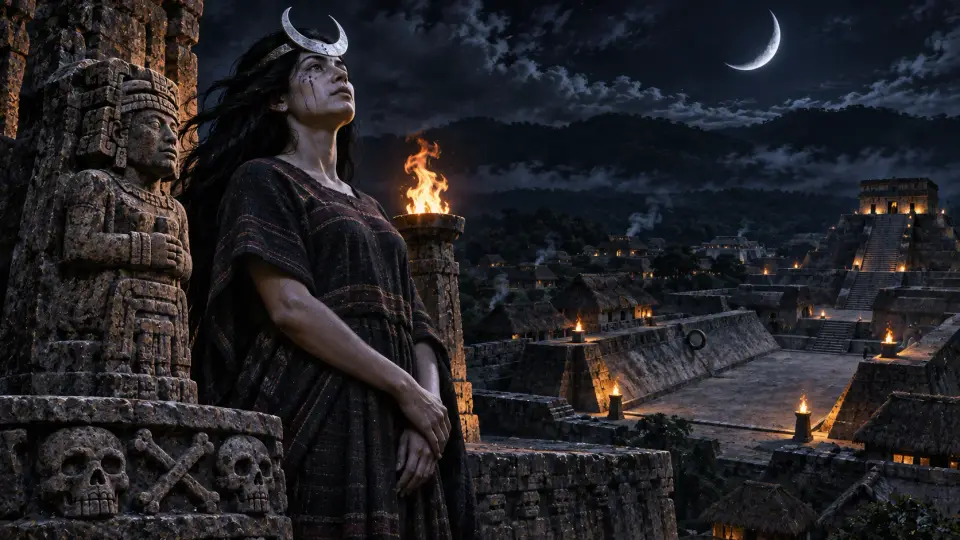
According to the Popol Vuh, the K’iche’ document preserved in the early eighteenth-century transcription of the Dominican friar Francisco Ximénez, Hun Hunahpu and his brother Vucub Hunahpu were sons of the elderly creator pair Xpiacoc and Xmucane. Both brothers were devoted, gifted ballplayers, along with Hun Hunahpu’s two sons by an earlier wife, One Monkey and One Artisan (Hun Batz and Hun Chouen in some transliterations), who would later become patrons of the arts, music, and writing. Hun Hunahpu’s ball court lay, in the text’s cosmology, directly above the road down to Xibalba, so that the brothers’ games — their stamping feet and shouting — carried down into the underworld and disturbed its lords.
This detail is not incidental. The ballgame in Maya thought was never merely sport; it was a ritualized contest bound up with sacrifice, sovereignty, and the boundary between the world of the living and the realm of the dead. That Hun Hunahpu’s recreational games could be heard by One Death and Seven Death, the twin lords who ruled Xibalba, established from the outset that the human and infernal spheres in the Popol Vuh are not sealed off from one another but are acoustically and causally linked.
The Summons to Xibalba
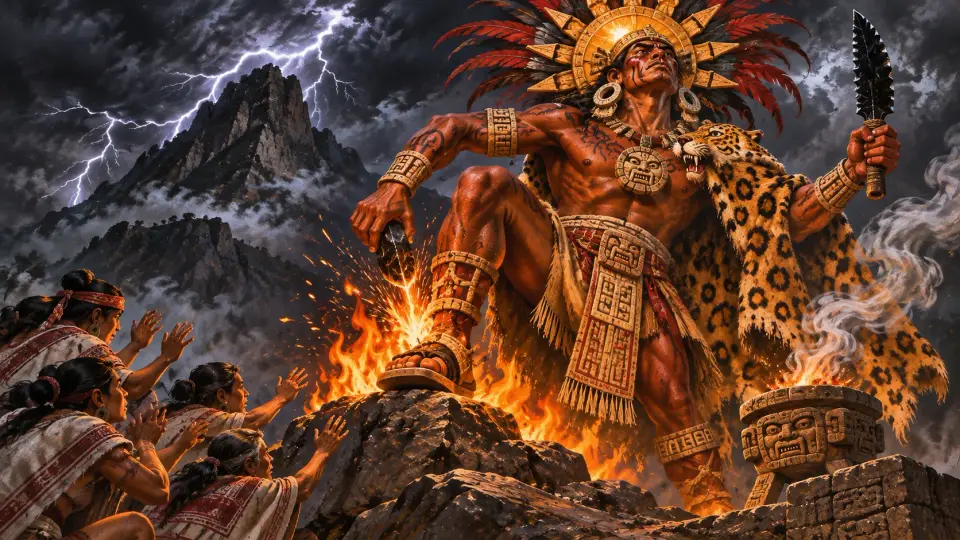
Irritated by the noise, One Death and Seven Death sent owl messengers to summon Hun Hunahpu and Vucub Hunahpu to Xibalba to play ball against them — ostensibly an honor, but in truth a trap. The brothers said farewell to their mother Xmucane and to Hun Hunahpu’s sons, leaving their ball-game equipment behind at the house, and descended the perilous road into the underworld. From the first moment, the text shows the lords of Xibalba as tricksters who win by deceit rather than strength: the brothers greeted a pair of wooden mannequins as if they were the true lords, mistaking a courtesy trap for the real seat of power, and then, told to sit, lowered themselves onto a bench that turned out to be a red-hot cooking stone, burning and humiliating them before the game had even begun.
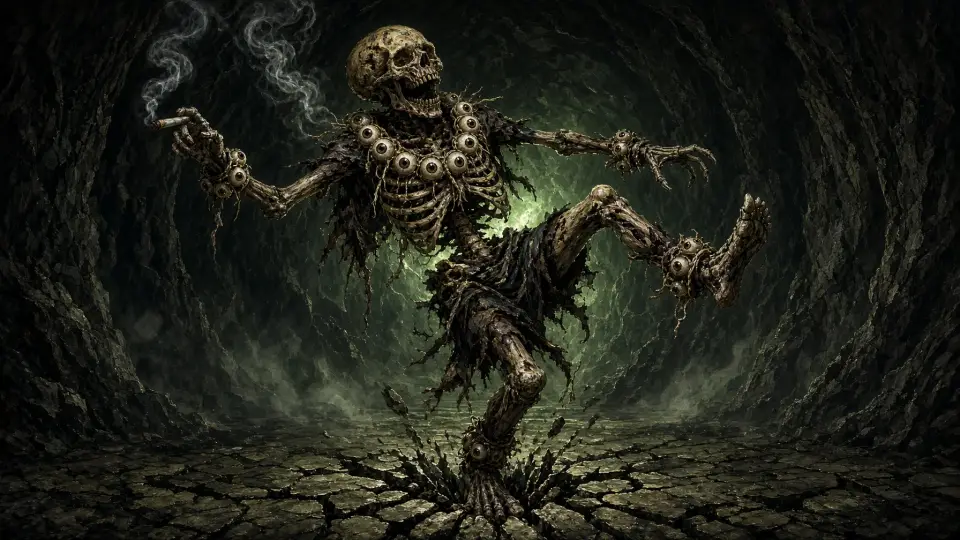
From there the ordeal only worsened. The brothers were sent to spend the night in the Dark House, the first of Xibalba’s trial-houses, and were given cigars and torches that they were told must still be burning, unconsumed, by morning — an impossible condition engineered to guarantee failure. Unlike their sons, the Hero Twins, who would later survive these same houses of trial through cunning substitutions, Hun Hunahpu and Vucub Hunahpu had no such guile prepared. They failed the test, and the lords of Xibalba put them to death, burying Vucub Hunahpu whole but severing Hun Hunahpu’s head and hanging it in the branches of a barren tree beside the road.
The Calabash Tree and Xquic
The tree in which the lords placed Hun Hunahpu’s head immediately burst into fruit, its branches suddenly heavy with gourds indistinguishable from the severed head itself — a transformation the Xibalbans took as such an ill omen that they forbade anyone from approaching or eating from it. The maiden Xquic (“Blood Moon”), daughter of one of the underworld lords, heard of the marvelous tree and went to see it despite the prohibition. When she reached toward the fruit, the skull that was Hun Hunahpu’s head spoke to her and spat into her outstretched palm, and by this act she conceived.
The pregnancy could not be hidden for long, and when the lords of Xibalba discovered it they judged it a disgrace and ordered her sacrificed, her heart to be brought back as proof. Xquic persuaded the owl executioners assigned to kill her to spare her life, substituting the coagulated red sap of the croton tree for a human heart, and fled upward to the surface of the earth, seeking refuge with Hun Hunahpu’s bereaved mother, Xmucane. There, after proving herself through a magical feat — filling a net with a single ear of maize that multiplied to overflowing — she was accepted into the household, and in time gave birth to the twins Hunahpu and Xbalanque, who would grow up to avenge their father and uncle.
Symbolic and Cosmological Significance
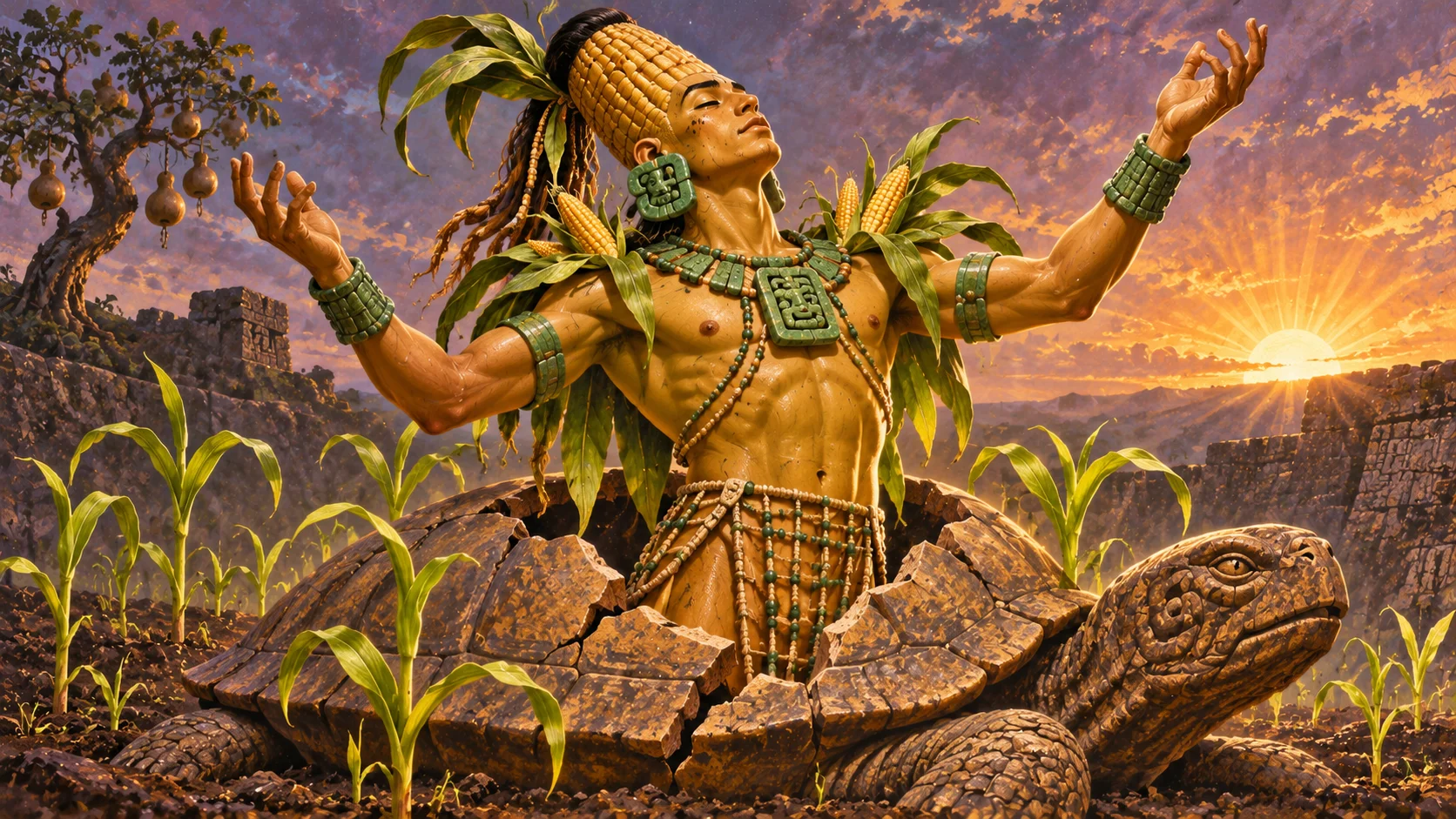
Hun Hunahpu’s death and the miraculous conception that follows it encode one of the Popol Vuh’s central preoccupations: the cyclical relationship between death and agricultural renewal. Many scholars, following iconographic study of Classic-period Maya ceramics, have connected Hun Hunahpu with the so-called Tonsured Maize God, a youthful deity depicted with an elongated, corn-cob-shaped head who is shown dying, being dismembered, and being reborn from a crack in the earth or a turtle’s shell — imagery that resonates strongly with a maize deity cut down, buried, and sprouting anew each planting season. The identification is influential but not uncontested: the hieroglyphic name recorded for the Classic Maize God does not correspond directly to Hun Hunahpu’s name glyph, so the equation, while widely repeated, remains an interpretive bridge between a sixteenth-century K’iche’ text and centuries-earlier Classic-period art rather than a one-to-one textual match.
Whatever the precise identity behind the Classic imagery, the narrative logic of Hun Hunahpu’s story is unmistakably agricultural and generative: a buried, decapitated figure becomes, through his descendants, the means by which the present world of humans and maize is made possible. His severed head does not simply end his story; it transmits his essence forward, first into fruit, then into conception, then into the sun itself, since the Hero Twins he never lived to see are ultimately transformed into the celestial bodies that light the world his death made possible.
Sourcing and Textual Transmission
The fullest account of Hun Hunahpu’s story survives in the K’iche’-language Popol Vuh, composed in alphabetic script by K’iche’ authors in Santa Cruz del Quiché, Guatemala, sometime between 1554 and 1558, drawing on earlier pictorial and oral tradition that predates the Spanish invasion. The original K’iche’ manuscript no longer survives; the text is known today only through the transcription and Spanish translation made around 1701 by the Dominican friar Francisco Ximénez, whose manuscript passed through the hands of the French scholar Charles Étienne Brasseur de Bourbourg in the nineteenth century before eventually reaching the Newberry Library in Chicago, where it remains. The standard modern scholarly translations into English, by Dennis Tedlock (1985, revised 1996) and by Allen J. Christenson (2003, 2007), are the versions most commonly consulted for the narrative detail summarized here.
Hun Hunahpu’s Sons and the Household He Left Behind
Before his death, Hun Hunahpu was already a father: by an earlier wife he had two sons, One Monkey and One Artisan, gifted musicians, singers, and craftsmen who remained behind with their grandmother Xmucane when Hun Hunahpu and Vucub Hunahpu departed for Xibalba. Their later mistreatment of their newly arrived half-brothers, Hunahpu and Xbalanque, and their eventual transformation into monkeys as punishment for that cruelty, forms one of the Popol Vuh’s best-known interludes and indirectly completes Hun Hunahpu’s own story: the household he left behind is thrown into disorder by his death and only set right again once his younger, posthumously conceived sons come of age and assert themselves. The juxtaposition of One Monkey and One Artisan’s eventual demotion to animal form against Hunahpu and Xbalanque’s eventual ascent to the sky underscores a pointed distinction the text draws between artistic accomplishment pursued with cruelty and heroic accomplishment pursued with justice.
Living Legacy
The Popol Vuh is not a closed historical artifact but a living text among K’iche’ Maya communities in the Guatemalan highlands today, where an estimated three-quarters of a million K’iche’ speakers live, concentrated in departments such as Quiché, Totonicapán, and Quetzaltenango. Traditional daykeepers, known as ajq’ij, continue to draw on its account of the world’s origins in ceremony and teaching, and in 2012 UNESCO recognized the Popol Vuh as part of Guatemala’s Intangible Cultural Heritage, affirming the ongoing significance of Hun Hunahpu’s story — and the larger cycle it opens — to the descendants of the people who first set it down. Modern retellings for general audiences, alongside academic study of the Ximénez manuscript, continue to introduce Hun Hunahpu’s story of death, hidden fatherhood, and eventual vindication through his sons to new readers well beyond Guatemala, cementing his place as one of the foundational figures of Indigenous American literature.
Sources & traditions
- EncyclopediaWikipedia — Hun Hunahpu
- TraditionMaya texts, oral tradition and village tellings (Mesoamerica)
Myths change from area to area and from time to time. This chronicle follows the most widely told versions; tellings in other villages, regions and eras may differ.