Xpiacoc (also transliterated Xpiyacoc) is the elderly grandfather creator-god and diviner of the K’iche’ Maya, appearing throughout the Popol Vuh as the constant male counterpart to the grandmother goddess Xmucane. Together the pair represent the oldest generation of K’iche’ divinity, embodying accumulated ritual wisdom and the specialized skills of divination rather than the cosmic, elemental power wielded by the primary creator trio of Tepeu, Gukumatz, and Huracan.
Role as Elder Diviner
The Popol Vuh identifies Xpiacoc and Xmucane as aj q’ij, daykeepers — ritual specialists trained in reading the sacred 260-day calendar, interpreting omens and illness, and divining the proper course of action in matters of consequence. This designation places Xpiacoc in a functionally distinct role from Tepeu, Gukumatz, and Huracan: rather than speaking the physical world into existence through cosmic deliberation over the primordial sea, Xpiacoc's contribution is one of specialized craft, precision, and inherited procedural knowledge, called upon by the primary creators precisely when their broader, more elemental powers need to be applied with careful exactness.
Involvement in the Creation of Humanity
Xpiacoc is drawn into the Popol Vuh's central creation narrative during the gods' second attempt to make humanity, after the first attempt — humans formed from mud — fails because the mud figures simply dissolve, crumble, and cannot hold together, speaking without understanding. Working with Xmucane, Xpiacoc assists in carving the second generation of humans from wood; these wooden people prove far more durable and capable than the mud people, able to move, speak, multiply, and build households, but they are ultimately found wanting because they possess no hearts, no minds, and no memory or gratitude toward the gods who made them — they exist without genuinely understanding their own existence. This failure prompts Huracan to destroy them in a flood, with their own tools, animals, and cooking implements turning against them, and the survivors, according to the text, becoming the ancestors of modern monkeys.
Xpiacoc and Xmucane's assistance proves essential again during the fourth and finally successful attempt at creating humanity, when the gods use white and yellow maize as the substance from which true, satisfactory humans are made. While the Popol Vuh specifically credits Xmucane with grinding the maize into the flesh of the first humans, Xpiacoc is consistently named alongside her throughout this whole sequence of trial, failure, and eventual success, reflecting the pair's inseparable joint authority as the gods' most trusted diviners and craftspeople.
Grandfather of the Hero Twins
Xpiacoc and Xmucane are the parents of One Hunahpu and Seven Hunahpu, whose fatal encounter with the lords of the underworld realm of Xibalba — who summon the two brothers after being disturbed by the noise of their ballgame, subject them to a series of humiliating and impossible trials, and finally defeat and sacrifice them — sets in motion the Popol Vuh's central heroic narrative. This makes Xpiacoc the grandfather of the Hero Twins Hunahpu and Xbalanque, who are conceived after One Hunahpu's severed head (hanging in a calabash tree in Xibalba) magically impregnates the underworld maiden Xquic. When Xquic later travels to the surface world seeking shelter, it is primarily Xmucane who takes her in and subsequently raises the twins, though Xpiacoc remains present as her partner and co-authority throughout this household. Later in the narrative, when Hunahpu suffers a grievous injury — his arm torn off by the monstrous sons of the boastful false-sun being Seven Macaw — it is Xpiacoc together with Xmucane who help restore and heal him, underscoring the grandparental pair's continuing protective role deep into the story, long after their initial creative work is finished.
Relationship to Other Deities in This Group
Xpiacoc functions as an inseparable pair with Xmucane; the Popol Vuh names them together so consistently that most scholarly discussion treats their roles jointly rather than attempting to sharply distinguish one from the other's individual contributions. Structurally, their partnership echoes — without exactly mirroring — the pairing of Tepeu and Gukumatz among the primary creators: in each case, two closely linked deities function almost as a single compound entity within the text. Where Huracan supplies the sudden elemental force of creation (lightning, flood, storm) and Tepeu and Gukumatz supply speech, sovereignty, and cosmic design, Xpiacoc and Xmucane supply aged wisdom, precise ritual and calendrical knowledge, and the more delicate, hands-on labor of successfully completing what the primary creators begin. This division of labor across the pantheon reflects a broader pattern in K’iche’ cosmology in which creation is depicted as a genuinely collaborative, multi-stage project requiring different kinds of divine expertise rather than the instantaneous act of a single omnipotent being.
A Living Inheritance
The Popol Vuh, recognized by UNESCO in 2012 as part of Guatemala's Intangible Cultural Heritage, continues to be read, taught, and drawn upon by K’iche’ Maya communities today, for whom figures like Xpiacoc and Xmucane remain meaningful ancestral archetypes of elder wisdom and ritual authority rather than characters confined to a closed historical past. Traditional K’iche’ daykeepers who continue to practice divination according to the sacred calendar carry forward, in a direct and living sense, the same specialized role the Popol Vuh assigns to Xpiacoc at the dawn of the world.
Xpiacoc and the Structure of Paired Divinity
The consistent pairing of Xpiacoc with Xmucane reflects a broader pattern found across Mesoamerican religious thought, in which fundamental cosmic or generative forces are frequently imagined as complementary male-female dyads rather than solitary figures. This pattern appears elsewhere in Mesoamerica in concepts such as the Aztec dual-gendered creative principle sometimes called Ometeotl, though scholars are careful not to treat these various paired-deity traditions as identical expressions of one underlying idea; each culture's version of paired divine grandparents or creators carries its own specific narrative role, iconography, and theological weight. In the K’iche’ case specifically, the pairing of Xpiacoc and Xmucane is textually grounded in the Popol Vuh's own consistent, repeated naming of the two together across multiple distinct episodes — the creation of the wooden people, the creation of the maize people, the raising of the Hero Twins, and the healing of Hunahpu's arm — making their joint identity a documented feature of this specific text rather than a modern scholarly imposition drawn from comparison with other cultures.
Daykeepers and the Count of Days
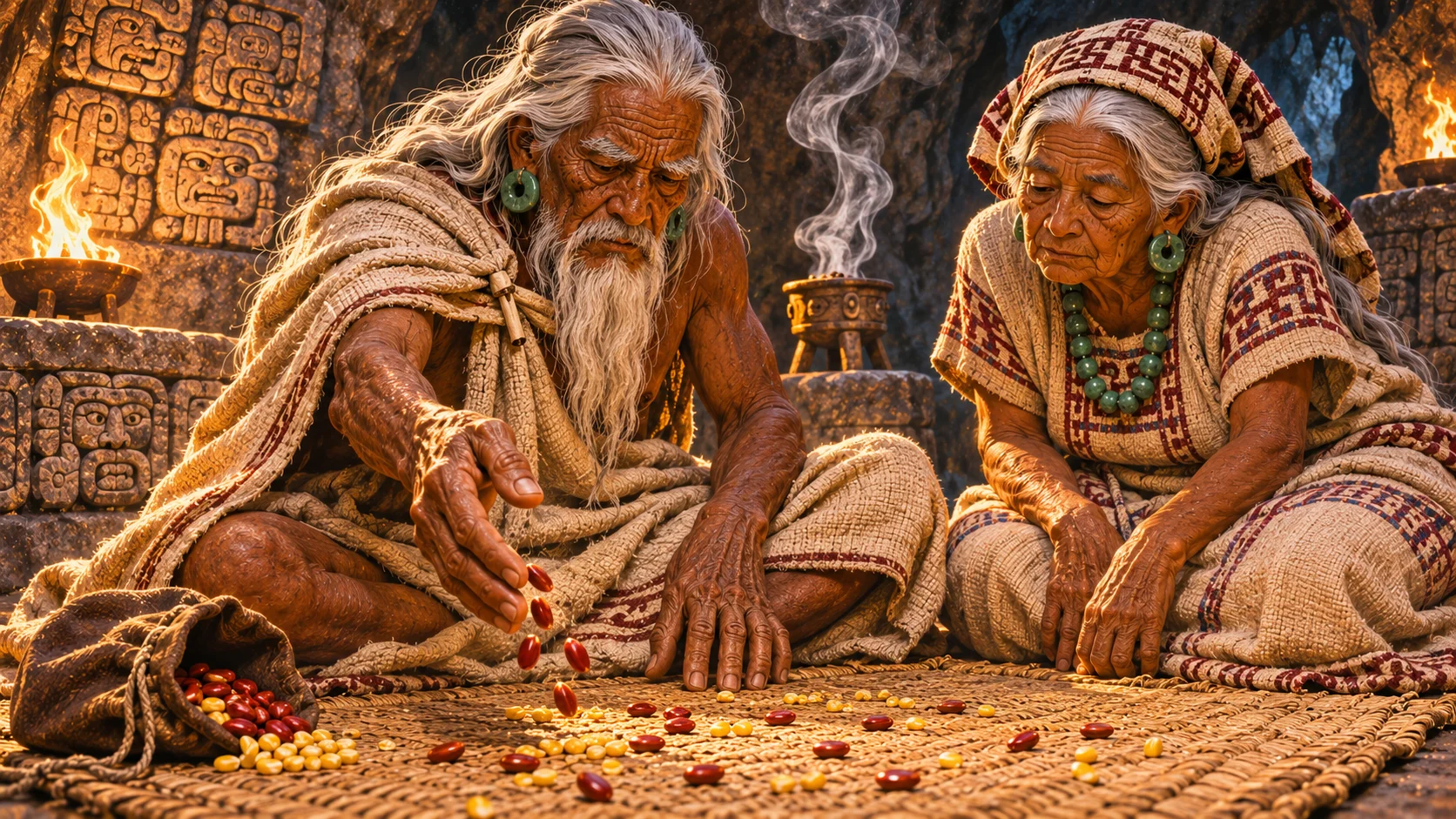
Among the K'iche' and other highland Maya peoples, specialists known as ajq'ij, or daykeepers, continue to use the 260-day sacred calendar for divination and ritual. They may cast the seeds of a coral tree, called tz'ite, and read patterns in them to advise clients.
Xpiacoc, as the diviner of the Popol Vuh, is a mythic ancestor of this practice. Whether or not modern daykeepers think of him directly, their work reflects the same ideas of counting time and reading signs that the text attributes to the grandparent pair.
Grinding the Maize
In the Popol Vuh the grandmother Xmucane grinds yellow and white maize and rinses her hands to make the drink from which the flesh of the first humans is formed. The text describes nine grindings, and the maize dough becomes the stuff of human bodies.
Xpiacoc stands beside her as an elder who shares in the creation. The scene reflects how important maize is to Maya life, and it links the grandparents with the daily labor of preparing food.
Great White Peccary and Great White Coati
In addition to their names, Xpiacoc and Xmucane are described in the Popol Vuh with animal-related epithets, which have been translated as the Great White Peccary and the Great White Coati. These titles appear in the opening passages, where the creators are invoked.
The meaning of the epithets is not fully clear, but they suggest a connection between the old couple and creatures of the forest. They are a reminder that Maya religion often expressed divine identity through animal imagery.
Elders in K'iche' Society
Respect for elders is a strong value in highland Maya communities, and the grandparent gods of the Popol Vuh reflect that value. Age was associated with knowledge, experience and ritual authority.
The portrait of Xpiacoc as a wise old man engaged in divination fits that social picture. It shows how the structure of the divine world mirrored the human one, with respected elders guiding the actions of younger generations.
The Elders Who Remember the Rules
In the Popol Vuh, the grandparent couple are the keepers of knowledge that the younger generation lacks. When the Hero Twins need guidance, when the creators need the correct method for shaping people, and when a decision has to be made about how to count and interpret signs, the elders are consulted.
This role matches the position of grandparents in many Maya households, where older relatives are the carriers of family memory and ritual obligations. The portrayal of Xpiacoc as a patient, knowing figure reflects respect for accumulated experience.
Because the grandparents do not dominate the story with dramatic deeds, they are easily overlooked. Yet without them the creation of humans and the success of the twins would not be possible, a reminder that quiet expertise can be as important as heroic action.
Xpiacoc's Comparatively Quiet Textual Presence
It is worth noting honestly that the Popol Vuh gives Xpiacoc somewhat less individualized narrative attention than it gives Xmucane; several of the text's most vivid episodes involving the grandparental pair — grinding the maize, testing Xquic, raising the household of grandsons — foreground Xmucane's specific actions and decisions more than Xpiacoc's. This does not diminish Xpiacoc's standing as a co-equal creator and diviner named consistently at Xmucane's side throughout the narrative, but it does mean that reconstructing a fully independent profile of Xpiacoc, separate from his partnership with Xmucane, is difficult based on the surviving text alone. Scholars generally treat this imbalance as a feature of how the Popol Vuh's specific narrative choices happened to unfold rather than as evidence of any lesser theological importance on Xpiacoc's part; the text names the pair jointly as authoritative diviners and creators from their very first appearance onward, and nothing in the surviving K’iche’ tradition suggests Xpiacoc's status was considered secondary to Xmucane's within the pantheon itself.
Sources & traditions
- EncyclopediaWikipedia — Xmucane and Xpiacoc
- TraditionMaya texts, oral tradition and village tellings (Mesoamerica)
Myths change from area to area and from time to time. This chronicle follows the most widely told versions; tellings in other villages, regions and eras may differ.