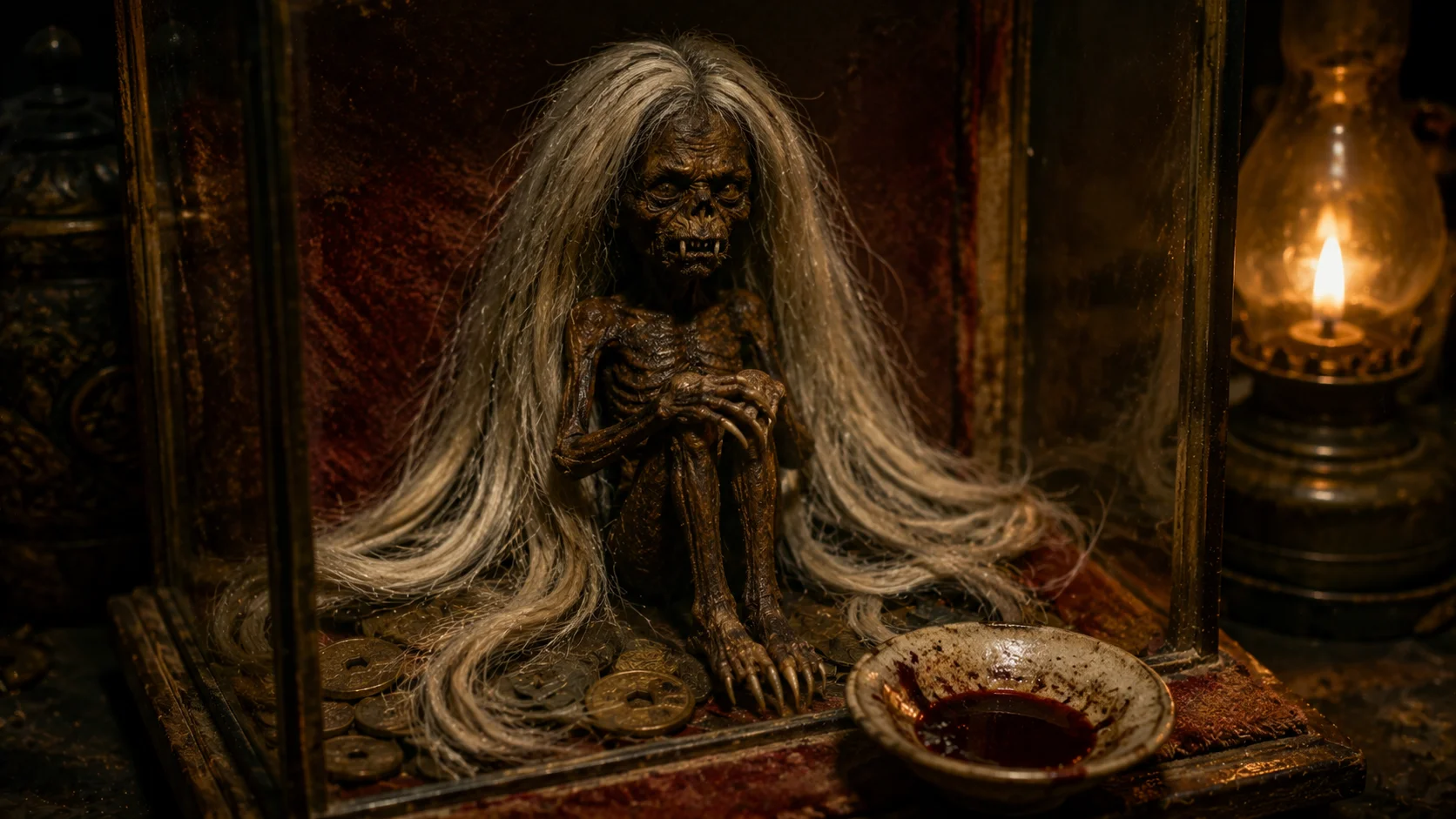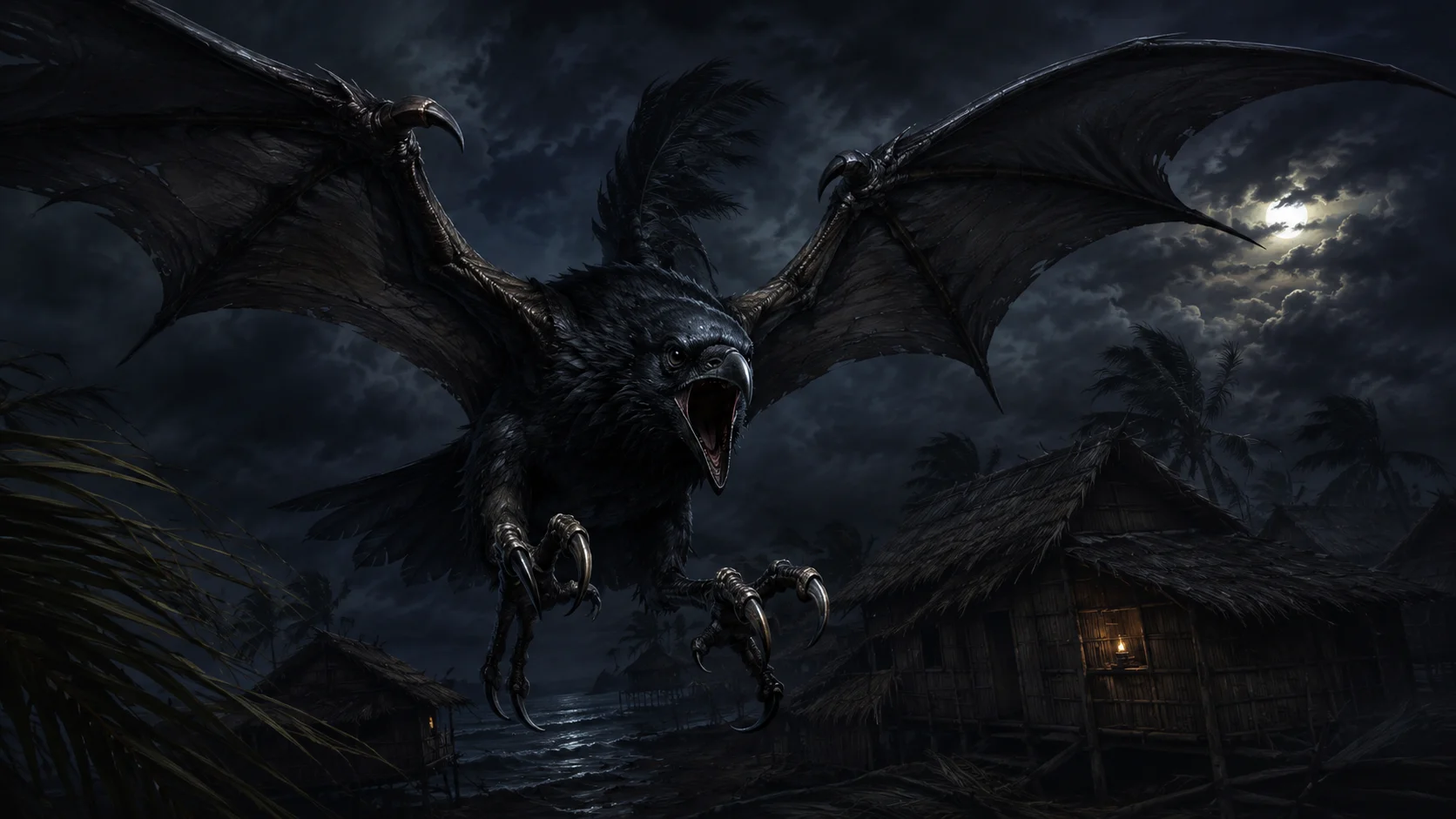
The Wakwak is a vampiric bird-creature of Philippine folklore, especially of the Visayas and Mindanao: a winged monster of the night that snatches and devours its victims, named for the eerie wak-wak sound of its wings, or its cry, that signals its dreadful approach.
The Sound That Names It
The Wakwak, sometimes rendered Wak-wak, takes its name directly from the sound it is said to make while on the wing: a repeated wak-wak or tik-tik cry cutting through the dark over a sleeping barrio. In the oral tradition of the Western Visayas, and above all around Capiz province on Panay Island, that cry was not treated as birdsong or coincidence. It was read as a warning, a signal passed by word of mouth from one generation to the next that something unnatural was hunting the night sky, and that the households below needed to take notice before it was too late.
Last updated .
A Cry That Lies
What set the Wakwak apart in the telling was not merely that it cried out, but how the cry behaved. Visayan folk belief held that the sound worked backwards from ordinary expectation: the call of the Wakwak grew fainter as the creature drew closer to its target, and grew louder the farther away it was. A soft, distant-seeming wak-wak might mean the thing was already circling the roof, while a loud one might mean it was still far off. This inversion is widely cited as distinct from the more commonly known tiktik creature, whose cry was said to remain more consistent in volume as it approached. The effect, whether by design or by the logic folklore assigns to predators, was to make the sound nearly useless as a straightforward warning — a family that judged the danger by ear alone could be lulled into false safety by a cry that seemed to be retreating.
By Day an Old Woman, By Night a Hunter
Like other beings of the aswang complex in Visayan belief, the Wakwak was understood to live a double life. By daylight it passed for an ordinary person, most often described as an old woman, indistinguishable from any neighbor going about her business in the barrio. It was only after dark that the transformation came: wings unfurling, the human shape giving way to something bird-like or bat-like, fitted with sharp talons or claws built for seizing prey from above. This shape-shifting was central to the fear the Wakwak inspired — the danger was not a stranger from outside the community but potentially someone already known, already trusted, already living among the very households it might later hunt.
What the Night Sky Was Hunting For
The Wakwak's prey, in the folklore that describes it, was drawn overwhelmingly from the most vulnerable members of a household: unborn children, newborn infants, and those gravely ill. A home with a pregnant woman or a dying relative was, in this belief system, a marked home, one that required particular vigilance after sundown. This targeting of the vulnerable is a motif the Wakwak shares broadly with the wider aswang-type lore of the Visayas, and it gave the creature's cry a specific, dreaded meaning: it was not simply a monster abroad in the dark, but one that seemed to know exactly where weakness could be found.
Panay's Reputation in the Dark
No place in the Philippines carries the folkloric weight that Capiz province does when it comes to the Wakwak and its kin. Long-standing regional reputation has fixed Capiz, on Panay Island, as a center of aswang and witchcraft belief, a reputation still invoked in Philippine popular culture today whenever the subject of night-flying witches comes up. The association is strong enough that the mere mention of Capiz, in certain contexts, carries with it the implication of Wakwak country — a place where the old stories were told with particular conviction and where the sound of wings at night was not something to shrug off.
One Name Among Many, or a Thing Apart
The Wakwak does not stand alone in Visayan lower mythology; it sits within a wider family of aswang-type beings that includes the manananggal and the tiktik among other named forms. In some tellings, these are understood as different manifestations or regional names for the same broader witch-monster complex, distinguished more by which town or informant is doing the telling than by any fixed, agreed-upon taxonomy. Folklorists have noted that the boundaries between Wakwak, tiktik, and manananggal are not standardized on a national level, so a creature called Wakwak in one community might be described in terms that would be attributed to a tiktik or manananggal elsewhere. This fluidity is not a flaw in the tradition but a feature of oral folklore itself, shaped town by town rather than fixed by any central authority.
Guarding the Threshold
Communities that feared the Wakwak did not simply wait passively for the cry to fade into silence. Visayan oral tradition records a set of protective countermeasures shared broadly across aswang belief: garlic hung or rubbed at doorways, sacred or blessed oil, salt scattered at thresholds, and the dried tail of a stingray, known locally as buntot pagi, kept as a ward against the night's predators. That the Wakwak answered to the same defenses used against aswang more generally underscores its place within that shared belief system, a member of the same feared family rather than a wholly separate threat requiring its own unique countermeasures.
Explaining the Unexplainable
Beyond the fear it inspired on any given night, the Wakwak belief system served a deeper function in the rural communities where it took root. Infant mortality and unexplained illness or death were, for much of Philippine history, everyday tragedies without any clinical explanation available to the families who suffered them. The figure of the Wakwak, and the aswang complex more broadly, offered a framework for understanding what medicine of the time could not: a cause, a shape, a story that made sense of loss. But this same belief system carried a darker social function as well, one documented by Philippine folklorists — it could operate as a mechanism of suspicion and social control, with accusations of being an aswang historically falling on marginalized individuals, typically older women, in real and documented community conflicts.
The Scholar Who Catalogued the Night
Much of what is known today about the Wakwak in any systematic way traces back to the work of Maximo D. Ramos, the foremost documented scholar of Philippine lower mythology. In his mid-20th-century folklore surveys, Ramos catalogued the Wakwak among the aswang-complex creatures of the islands, recording the traits, behaviors, and regional variations that oral tradition had preserved. His surveys remain the standard academic reference point for the being's attested characteristics, the closest thing to a fixed record that a creature defined by shifting local retellings has ever received.
From Barrio Tale to Cinema Screen
The Wakwak and the wider aswang complex did not fade with the arrival of modern media; if anything, Capiz's folkloric reputation as their epicenter has made the subject a recurring one in Philippine popular culture. Philippine horror cinema, komiks, and television anthology series have returned to aswang material again and again, with long-running franchises such as Shake, Rattle & Roll and regional folklore documentaries keeping the tradition visible to new generations. Notably, many of these onscreen depictions tend to blend Wakwak traits with the more visually striking manananggal, whose self-segmenting torso has proven the more cinematic image, so that the two figures are often merged on screen even where oral tradition in specific towns kept them distinct.
A Creature Without a Single Fixed Shape
Because Visayan oral tradition varies so significantly from town to town, several of the Wakwak's most specific details resist being pinned down into a single, universal account. The exact mechanics of its cry, the precise line separating it from the tiktik, and even its preferred type of victim are attested inconsistently across the sources that have recorded them. This is not a gap to be filled in with invention but a genuine feature of the tradition itself: the Wakwak, like much of Philippine lower mythology, exists as a constellation of regionally variable folklore rather than a single fixed canon handed down unchanged from one authoritative source.
What Endures in the Silence After the Cry
What has carried the Wakwak from whispered barrio warning to a name still recognized in Philippine folklore today is precisely that unsettling inversion at its heart — a cry that lies about distance, a neighbor who might be something else after dark, a danger aimed at those least able to defend themselves. Grounded in Capiz's enduring reputation and preserved through Ramos's scholarship even as popular media reshapes it for new audiences, the Wakwak remains one of the more distinctive night terrors of Visayan tradition: not simply a monster to be feared, but a sound to be listened to, and mistrusted, precisely because it does not tell the truth about how close it has already come.