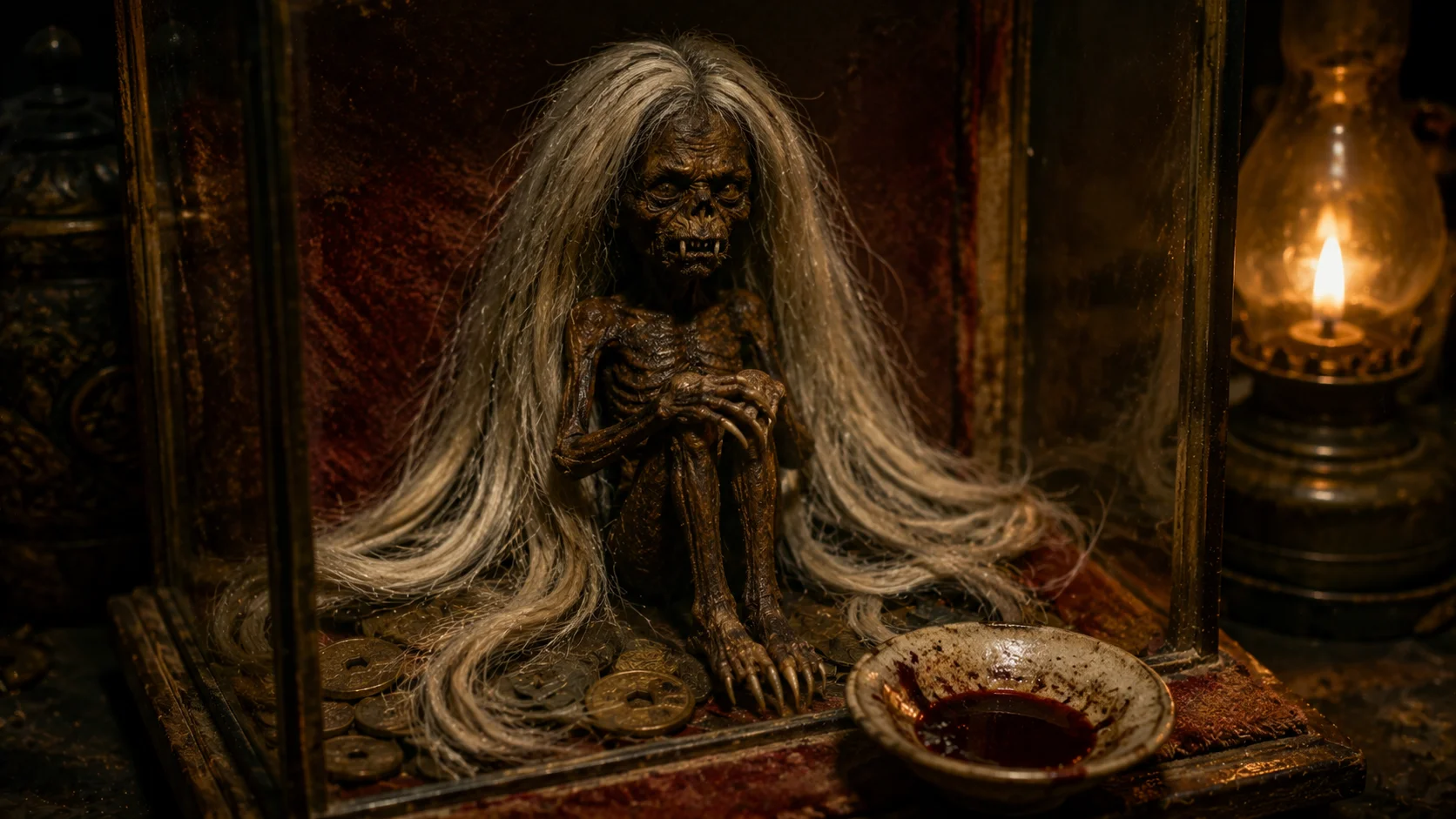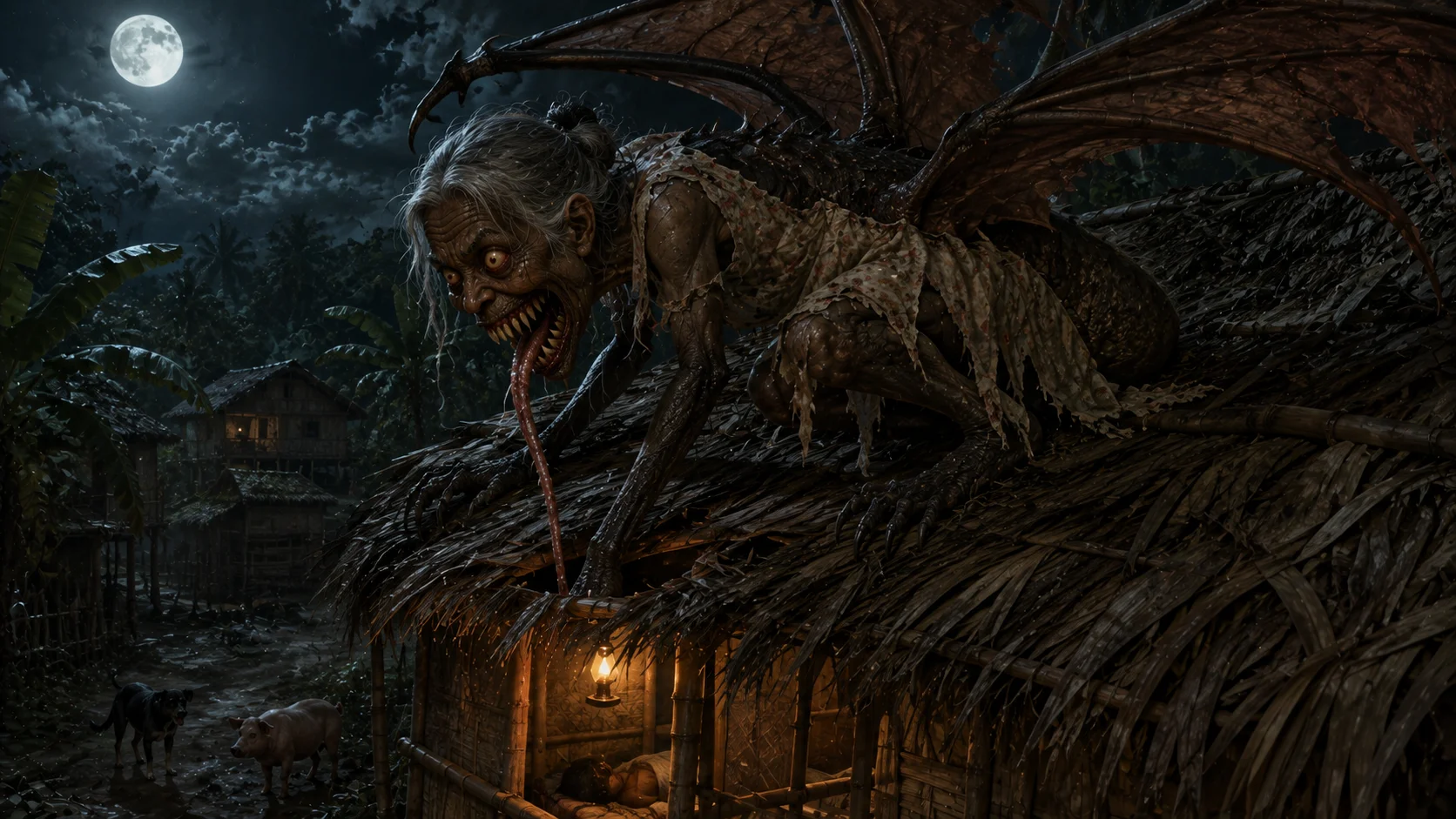
The Aswang is the most feared and famous monster of Philippine folklore: a shapeshifting, flesh-eating, blood-drinking creature, part vampire, part ghoul, part witch, part were-beast, that by day passes as an ordinary human and by night transforms to prey upon the living and the dead.
A Name That Holds Many Monsters
Aswang is not one creature but an umbrella term, a catch-all word stretched across several distinct shapeshifting monster types that regional storytellers have folded into a single dreaded name. Depending on who is telling the tale and where, an aswang might be a viscera-sucker that drains organs from the sick, a blood-drinking ghoul that stalks the newly dead, a weredog or werecat that pads silently through moonlit yards, a plain man-eating ghoul, or the self-segmenting flying horror known as the manananggal. The traits attached to the word shift from province to province, even from barrio to barrio, so that no two tellings of "aswang" quite agree on what the thing actually is. Folklorists have long noted this instability: the aswang is less a fixed monster than a vessel into which a community pours its particular fears, reshaped each time the story is retold.
Last updated .
Capiz, Whispered as the Capital
Belief in the aswang runs across the Visayas, through Luzon, and into Mindanao, but no place carries its reputation more heavily than Western Visayas, and within it, the province of Capiz. Capiz has become, in provincial lore and popular culture alike, widely cited as the aswang's capital, a place where the old stories are said to run thickest and where a stranger arriving after dark might still be met with a wary glance. Whether this reputation reflects a genuine density of belief or simply the accumulated weight of stories told about the stories, it has calcified into something close to legend in its own right, repeated in films, travel writing, and cautionary talk long after the original tales that built it have faded from memory.
The Torso That Flies Alone
Among the aswang's most striking variants is the manananggal, whose name comes from the Tagalog tanggal, to separate or detach. At night, the manananggal severs its upper torso from its lower half, leaving the legs standing rooted in place like some abandoned garment, while the torso sprouts great bat-like wings and lifts into the dark sky. It is strongly associated with hunting pregnant women, gliding low over nipa roofs in search of a household where new life is close to arriving. The image of a bodiless torso beating leathery wings above a sleeping village, its legs left standing sentinel in an empty house, is one of the most viscerally unsettling figures in all of Philippine folklore, and it is this image, more than any other aswang variant, that has come to define the creature in popular imagination.
The Tongue Through the Wall
The predation most widely attested in aswang and manananggal lore is also its cruelest: an elongated, proboscis-like tongue, thin as thread yet strong enough to pierce, reaching through the woven walls or thatched roof of a nipa hut to find a sleeping pregnant woman. Through this tongue the creature drains blood or entrails, or draws out the unborn child itself, leaving the mother to wake to unspeakable loss with no sign of intrusion but the faint mark where the tongue had touched. This motif, retold across generations of storytellers, reflects deep folk anxieties surrounding pregnancy and childbirth in communities where maternal and infant mortality once loomed large and unexplained, and where a monster with a tongue like a blade gave shape and a kind of terrible sense to griefs that otherwise had none.
Salt, Garlic, and the Sting of the Ray
Against so patient and intimate a predator, Filipino communities kept a working arsenal of countermeasures, passed down as practical folk knowledge rather than idle superstition. Salt or ash sprinkled on a manananggal's severed lower half was said to prevent the two halves from rejoining before dawn, condemning the creature to be caught and destroyed by sunrise. Garlic hung at doors and windows, stingray tails known as buntot pagi kept close at hand, and blessed or holy items placed within the home rounded out the defenses. These were not abstract rituals but the practical vigilance of households who took the threat seriously enough to keep salt by the door and a stingray tail within reach, treating the aswang less as myth than as a hazard to be managed like fire or flood.
The Neighbor Who Smiles by Day
What makes the aswang uniquely terrifying among the world's monsters is not merely its appetite but its disguise. By day it walks the barrio as an ordinary neighbor, sometimes an unremarkable old woman, sometimes an attractive young woman drawing admiring glances, indistinguishable from anyone else at market or at mass. Only at night does the true nature emerge. Folklorists including Herminia Menez and Maximo Ramos, the mid-twentieth-century scholar whose extensive cataloguing did much to preserve and systematize aswang lore, have linked this hidden-monster-next-door motif to deeper currents of social anxiety and scapegoating within the close, interdependent life of small barrios, where suspicion could fall on any woman who seemed too solitary, too strange, or simply unlucky in the eyes of her neighbors.
Kin Across the Same Dark Country
The aswang does not haunt the Philippine imagination alone. It belongs to a broader mythical ecosystem shared with the tikbalang, the horse-headed trickster that leads travelers astray on forest paths, and the kapre, the giant, cigar-smoking dweller of ancient trees. Popular media often lumps these figures together as interchangeable Filipino monsters, but in the folklore itself they remain distinct beings with their own habits, hungers, and haunts, no more interchangeable than a wolf and a bear simply for sharing a forest. Keeping them separate matters to the tradition even as modern retellings blur the lines between them.
The Blood-Sucker in Borrowed Beauty
Closely related, and sometimes folded directly into the aswang family, is the mandurugo, whose name means blood-sucker. By day she is a beautiful young woman, courted and admired; by night she becomes winged and blood-drinking, turning on those closest to her. Some folklorists treat the mandurugo as a Tagalog or Visayan variant within the aswang's wide umbrella, while others hold it apart as its own figure. The classification has never been fully standardized, and the mandurugo's story is often told as a kind of cautionary romance, a warning that the loveliest suitor may conceal the hungriest nature.
Friars, Suspicion, and the Babaylan
Spanish colonial-era friars and chroniclers recorded aswang-type beliefs from the very earliest years of contact, folding indigenous fears into their own written record of the islands. Some scholars have argued that colonial authorities used accusations of witchcraft and aswang identity as a tool to suppress the babaylan, the shaman-priestesses who held spiritual authority in pre-colonial communities, casting powerful indigenous women as monsters to be feared rather than healers to be respected. The extent of this dynamic remains debated among historians, a matter of ongoing scholarly argument rather than settled fact, but the possibility itself reframes the aswang's history as entangled with questions of power, gender, and who gets to be believed.
The Corpse-Eater of Sulu
Some folklore compilations, following Ramos's cataloguing, list the berbalang as a further relative, a corpse-eating shapeshifter associated with lore from the Sulu area and sometimes grouped within the wider aswang family. Its documentation is comparatively thin, resting largely on a single line of sourcing rather than the deep, cross-regional attestation that supports the manananggal or the mandurugo, and it is best held at arm's length as a lightly evidenced strand of the tradition rather than a settled feature of it.
Reading the Signs Before Dawn
Communities that believed an aswang might be living among them developed methods, however unevenly applied, for detection. A person's reflection or shadow might be checked for wrongness, an unusual eye-shine noted in lamplight, or reddened, tired eyes taken as the telltale mark of a night spent transformed and hunting. Per Ramos's catalogues, the specific tests varied enormously from town to town and informant to informant, no fixed checklist existing across the islands, which meant that suspicion could be raised or dismissed almost entirely on the word of whoever was doing the watching, a fact that sat uneasily alongside the aswang's darker history of scapegoating.
The Monster That Never Left the Screen
Few Philippine folk monsters have proven as commercially durable as the aswang. It has recurred across generations of Philippine cinema and television, including multiple entries in the long-running Shake, Rattle and Roll anthology films since the 1980s and dedicated Aswang features of its own. It is actively documented and preserved by initiatives such as The Aswang Project, and it appears in international games and comics that carry Filipino folklore to audiences far beyond the archipelago. Alongside the tikbalang, the aswang stands among the two or three most internationally recognized figures of Philippine mythology, a rare case of a folk terror becoming, in the modern era, a genuine cultural export.
A Word Whose Roots Stay Hidden
Even the origin of the word aswang resists easy answers. Proposed etymologies point toward Sanskrit- or Malay-linked roots, tracing the name back through centuries of trade and cultural exchange across Southeast Asia, but no single derivation has been definitively established. The uncertainty feels almost fitting for a creature that has always resisted a single fixed shape, its name as unsettled and shifting across the islands as the monster itself.
The Shape Fear Still Wears
Across every regional variant, every disputed etymology, and every disputed boundary between it and its kin, the aswang endures as the clearest shape Filipino storytelling has given to fear itself: the danger that wears a familiar face, that shares a meal at the table by day and hungers by night, that turns the safety of home and neighbor into the very ground on which dread is built.