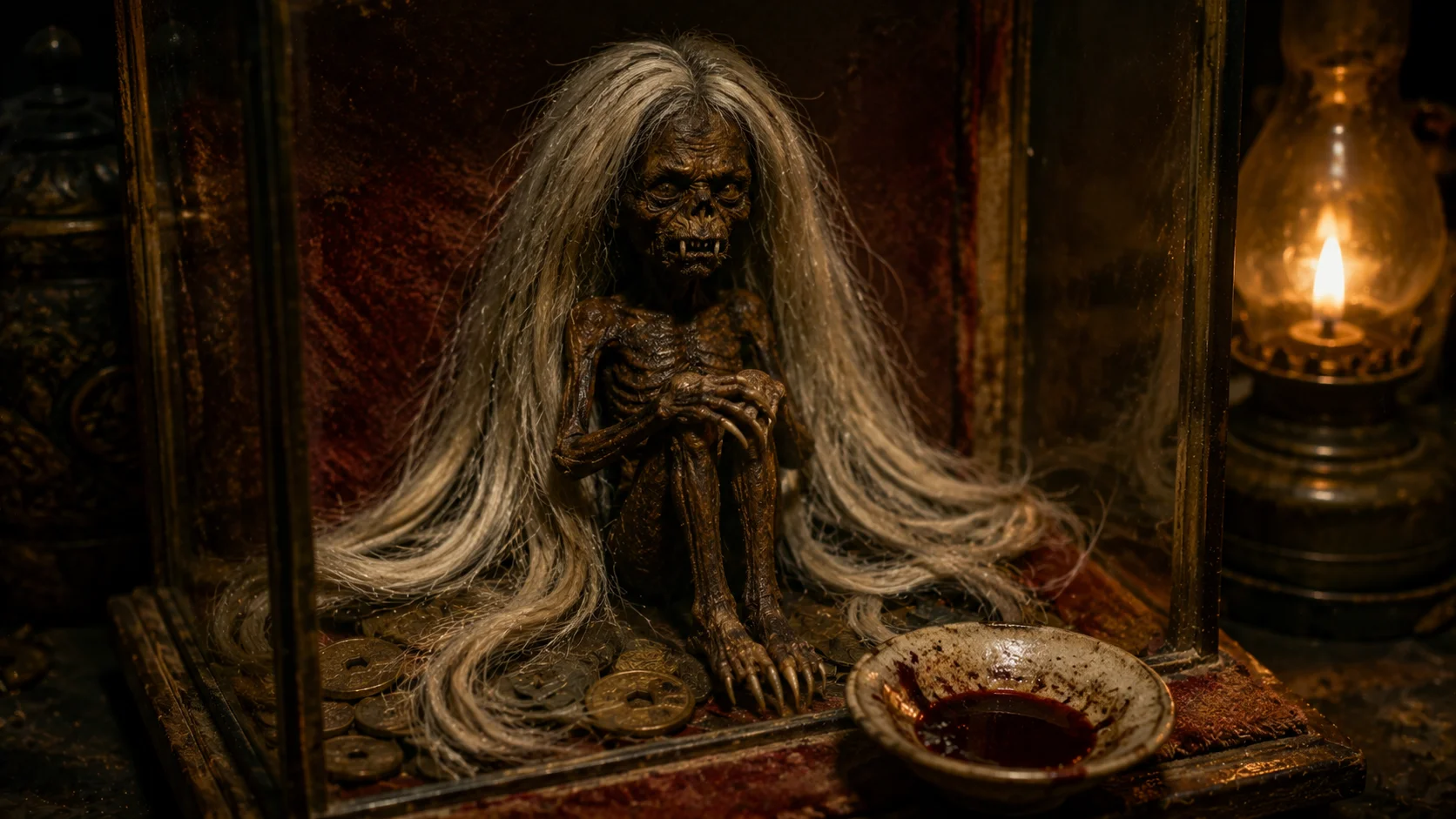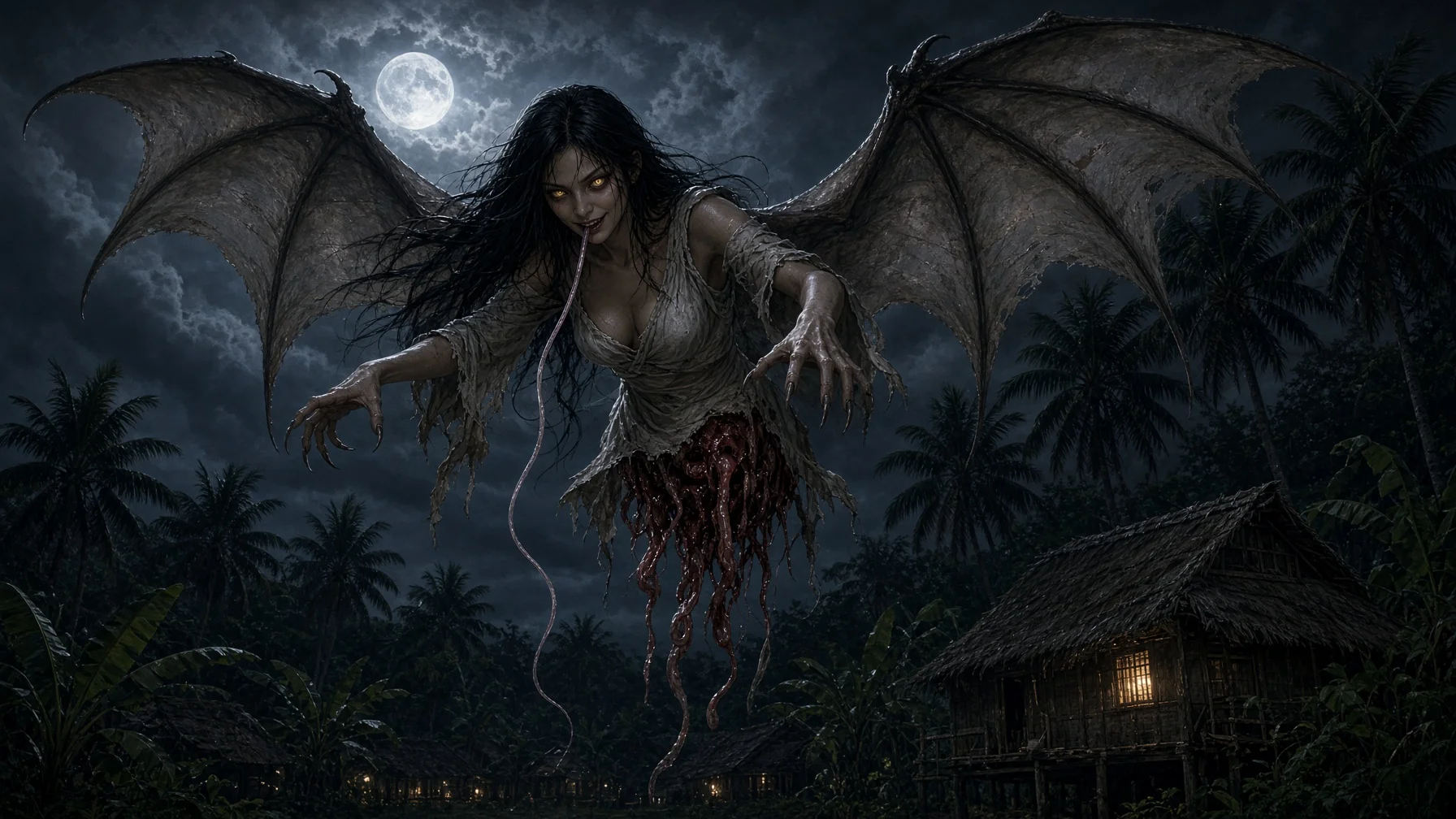
The Manananggal is one of the most horrifying and iconic monsters of Philippine folklore: a vampiric creature, usually appearing as a beautiful woman, who by night severs her own body in half at the waist, sprouts great bat-like wings from her back, and flies off into the darkness, her upper torso hunting for prey while her lower half stands abandoned. Her name means the one who separates herself.
The One Who Severs Herself
The manananggal, from tanggal, to remove or separate, is a self-segmenting vampire-creature, related to the broader aswang family of Visayan folklore. By day she appears as a normal woman, often strikingly beautiful, and by most tellings an older or unmarried woman who lives somewhat apart from the rest of the community rather than at its center. But at night, her body splits in two at the waist: the upper half, head, arms, and torso, with the entrails sometimes dangling beneath, sprouts enormous leathery, bat-like wings and flies off into the night to hunt, leaving the lower half, the legs and lower torso, standing upright and motionless wherever she removed it.
Last updated .
A Belief Rooted in the Western Visayas
The creature is most strongly associated with the provinces of Capiz and Iloilo and the wider Western Visayas region, where oral accounts of the manananggal have circulated for generations. The belief did not stay confined there; it spread nationally through print and, later, through film and broadcast media, until the manananggal became one of the most recognized supernatural figures across the Philippine archipelago rather than a purely local one. Even so, its heartland remains the Visayas, and it is there that the fullest, most consistent versions of the story are told.
Capiz and the Reputation of the Aswang Capital
Capiz in particular carries a popular reputation today as the so-called aswang capital of the Philippines, a label repeated in folklore tourism and in modern media framing of the province. This reputation is best understood as a modern amplification of older regional beliefs rather than an ancient, fixed designation; the manananggal and her aswang kin were spoken of in Capiz long before the province acquired a branded nickname for it, and the nickname itself belongs to the more recent layer of the tradition's life, not to its origin.
The Hunter of the Night
The flying upper-half of the manananggal preys, like the aswang, upon the vulnerable. Above nearly all others, in the variant recorded most consistently across Visayan oral accounts, she hunts pregnant women and their unborn children. She extends an immensely long, thin, hollow, proboscis-like tongue toward a sleeping pregnant woman, and with it reaches the womb to draw out the blood of the mother or to consume the heart and entrails of the fetus in utero. This fetus-targeting detail is one of the most stable and widely repeated motifs in the entire tradition, appearing again and again across separate folklore compilations rather than as an isolated regional embellishment. She is also said to feed on the sick and the sleeping, drawing blood and flesh through the same terrible tongue.
The Weapon Hidden in the Tongue
It is this proboscis-tongue, more than the wings or the severing itself, that folklore treats as the manananggal's signature instrument of harm. Thin as a thread yet strong enough to pierce a sleeping body, it allows her to feed without waking her victim and without needing to enter the house at all, reaching her prey from outside while she herself remains at a distance, waiting in the dark.
The Secret of the Lower Half
The manananggal's great vulnerability is her abandoned lower half. While she flies and hunts, her legs stand defenseless wherever she left them, and if they can be found, the creature can be destroyed. Folk method, documented consistently across multiple published folklore collections, including the work of the folklorist Maximo Ramos, holds that sprinkling salt, garlic, ash, or crushed spices upon the exposed flesh of the standing lower half prevents the two halves from rejoining at dawn. Sunlight and daybreak are recorded consistently as lethal, or at least severely weakening, to a manananggal that has not reunited her body by then, so that when daylight comes and she cannot reattach, the creature dies where her legs were left standing.
A Predator Bound to a Deadline
This dawn deadline is part of what gives the manananggal her particular shape as a monster: she is not an unbound horror that can strike at any hour, but a nocturnal predator racing the sun. Every night's hunt carries the same built-in risk, that she will be delayed, or that her lower half will be discovered and salted, and that the coming daylight will finish what her own hunger began.
Ramos and the Taxonomy of the Aswang
The manananggal is generally classified by folklorists, most systematically by Maximo Ramos in his catalogue of Philippine lower mythology, as one type within the broader aswang complex, a category of shapeshifting, flesh-and-blood-eating creatures in Visayan folklore. The exact relationship between manananggal and aswang is not settled even in scholarship: aswang is sometimes used as a general umbrella term covering many kinds of predatory shapeshifters, and sometimes as a name that overlaps or is nearly synonymous with the manananggal herself. This should be understood as a documented classificatory ambiguity within the folklore record, not as a settled fact with one correct answer.
Wakwak and the Regional Voices of the Same Fear
Related or overlapping self-segmenting witch-creatures appear under different names in different parts of the Philippines. In some Visayan and Mindanao tellings a figure called the wakwak is described, associated with a distinctive bird-like cry said to precede an attack, and comparable figures appear elsewhere in Ilonggo and Cebuano oral traditions. Scholars differ on whether these names describe true regional synonyms for the manananggal or beings that are related but ultimately distinct, so any identification between them should be treated as variant and contested rather than definitive.
Neighbors in the Dark: Tiyanak and Aswang Proper
The manananggal is often mentioned alongside other named Philippine folkloric beings without being the same as any of them. The tiyanak, a shapeshifting infant-like vampiric spirit, is a distinct and separately documented figure, as are the general aswang shapeshifters said to take the form of a dog, a pig, or a bird. These beings sometimes appear together in the same warning narratives about the dangers of the night, since a household on guard against one kind of threat was often on guard against all of them at once, but folklore keeps them as separate figures with their own forms and habits rather than merging them into one creature.
What the Story Was Made to Guard
Folklorists have read the manananggal myth as functioning, in part, as a social-control narrative. Its fear of the solitary or unmarried woman living apart from the community, and its intense focus on the safety of pregnant women, are said by scholars to have reinforced real community vigilance around pregnancy and postpartum practice, giving supernatural weight to caution that already had practical roots. This is offered in the scholarship as an interpretive reading of what the story may have done in the communities that told it, not as attested indigenous doctrine about the creature's own nature, and the chronicle preserves that distinction rather than collapsing it.
From Village Tale to Movie Screen
Modern cultural reception of the manananggal is extensive. She is a staple antagonist in Philippine horror cinema, from mid-twentieth-century Filipino horror films through contemporary movies and television, and she appears in comics such as Trese, created by Budjette Tan and Kajo Baldisimo. She has also become part of tourism branding in Capiz and Aklan, where the older regional belief has been folded into a marketable image of the province. Some contemporary retellings soften or alter original details, such as the type of victim or the precise method of destroying her, for the sake of entertainment, and these newer media versions should be understood as adaptations rather than as equivalent to the older oral-tradition accounts they draw from.
The Woman Who Flies in Two Pieces
In the manananggal, Filipino folklore gave form to one of its most unforgettable horrors: the beautiful woman who severs her own body and flies on bat-wings to feed on the unborn through her terrible tongue, racing the sunrise to rejoin the two halves of herself, the self-dividing vampire whose abandoned lower half is the secret of both her hunting and her doom.