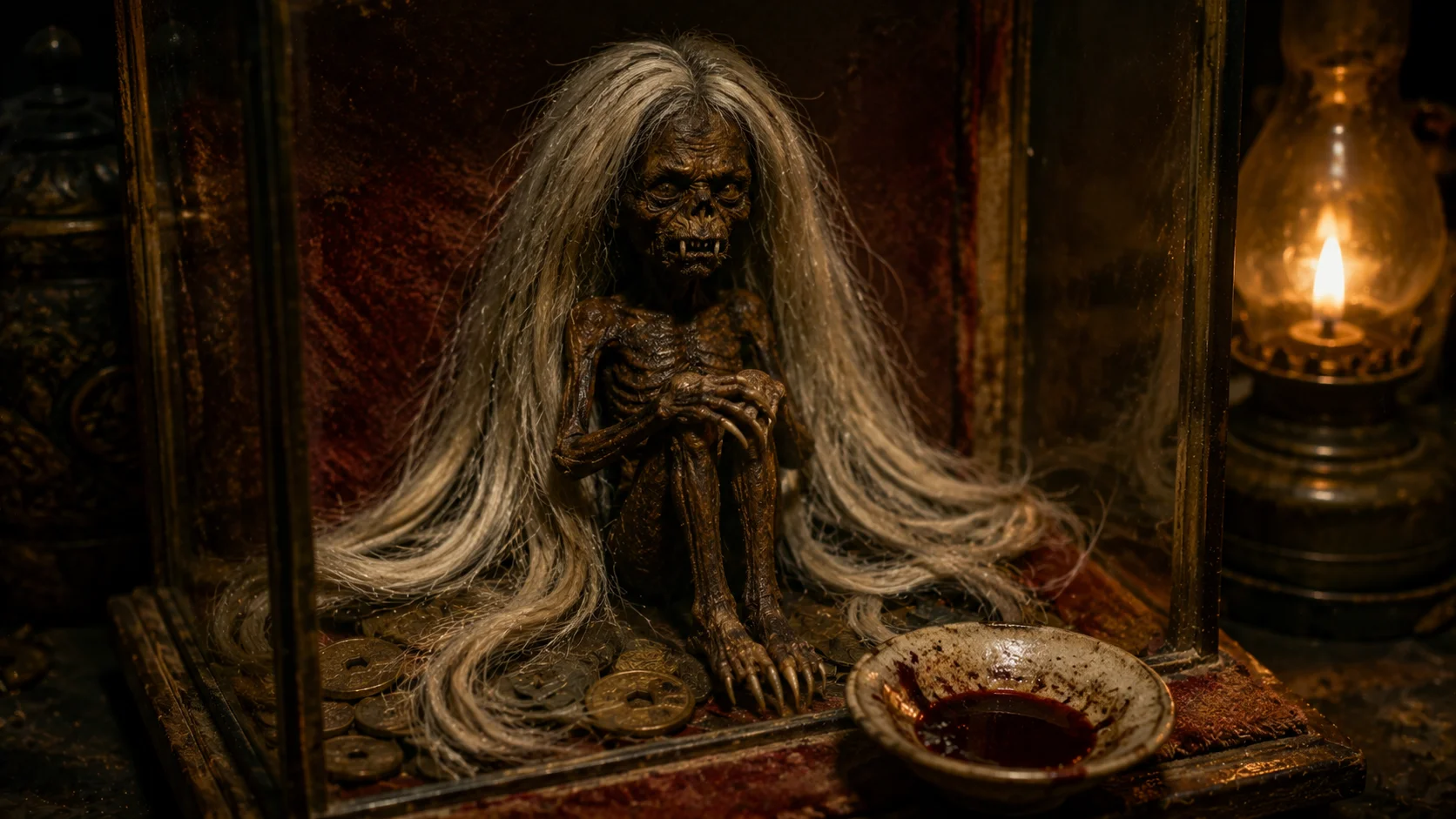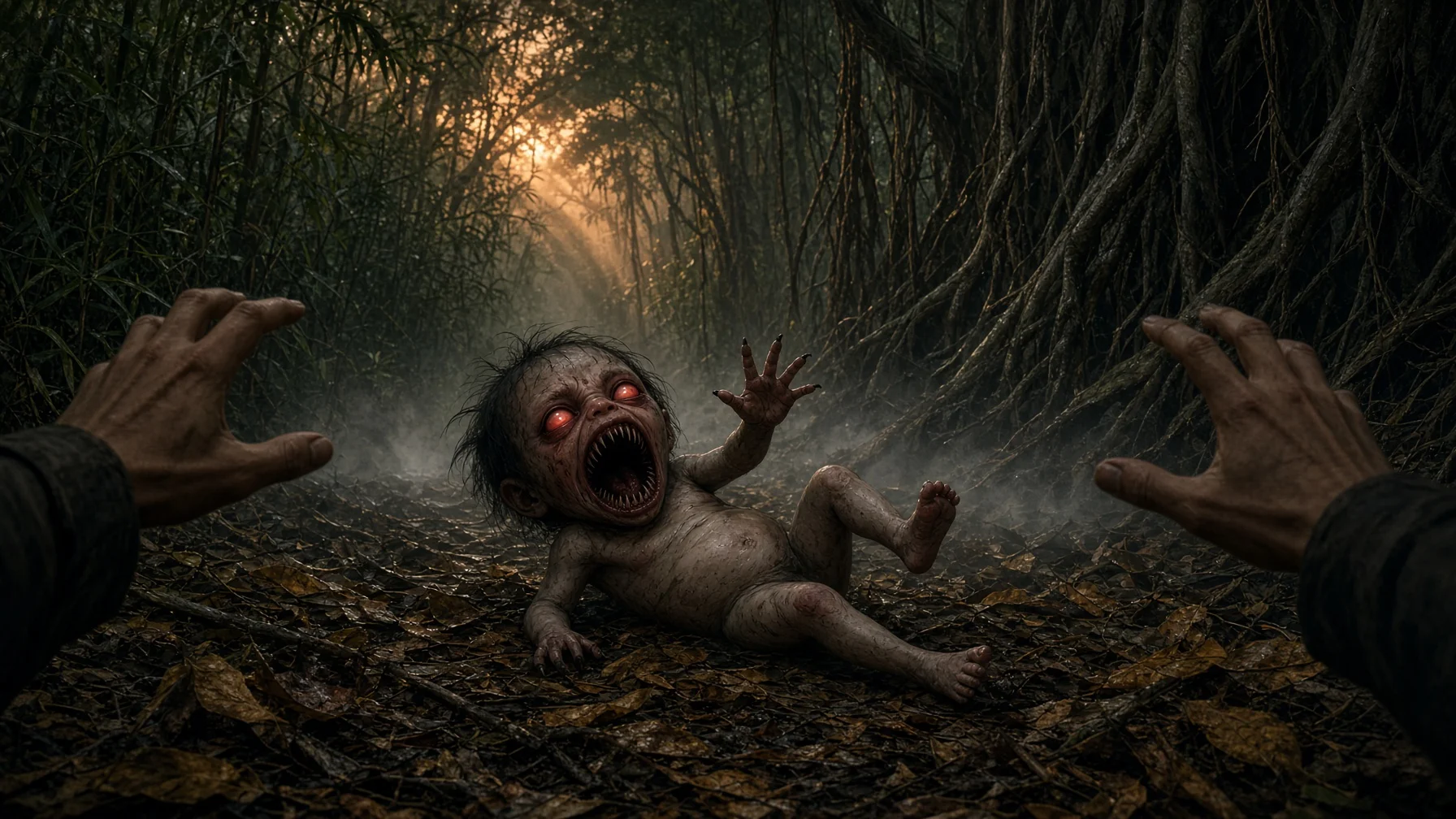
The Tiyanak is a demonic infant of Philippine folklore: a monstrous creature that takes the form of a crying baby to lure compassionate travelers into the wilderness, then reveals its true, fanged, monstrous nature and attacks.
The Crying Baby in the Wild
The tiyanak appears as an abandoned infant, lying in the forest, the fields, or by the roadside, crying piteously as if lost and helpless. When a kind-hearted traveler, moved by pity, picks up the seeming-baby to comfort or rescue it, the tiyanak reveals its true form: its face contorts into a monstrous, wrinkled, fanged visage, its eyes turn red, its mouth fills with sharp teeth, and it attacks the would-be rescuer, biting, clawing, and devouring, or leading them deeper into the wild to be lost.
Last updated .
A Voice Pitched to Pity
What makes the tiyanak feared is not raw strength but the precision of its lure. It does not chase; it waits, and it weeps in exactly the register that a passing adult cannot walk past. Storytellers describe the cry as unmistakably that of a newborn in distress, crying piteously as though lost and helpless. The trap depends entirely on an ordinary human decency: no one is punished for cruelty in these stories, only for kindness extended in the wrong place, at the wrong hour, to the wrong small shape in the grass.
Where the Grass Grows Over Silence
The tiyanak belongs to forests, overgrown thickets, untended fields, and lonely rural roadsides, the same liminal spaces that folk tradition marks as places between the settled and the wild. These are not incidental backdrops; they are the terrain where the creature's role as a hazard-warning figure makes sense, cautioning travelers, and especially pregnant women, against straying into ground that is uncleared, unwatched, and unclaimed after dark.
The Small Body of Grief
Various origins are given for the tiyanak. In the most commonly told account, it is the spirit of a child who died unbaptized, or of an infant who was miscarried, stillborn, or aborted, returning to the world as a malevolent demon-infant rather than passing on. Other tellings connect its origin to the spirit of a woman who died in childbirth, or to her lost child, echoing a wider Southeast Asian pattern of malevolent spirits born from reproductive death. Folklore scholarship treats none of these as a single settled account: the idea is understood to reach back to precolonial beliefs about the spirits of abandoned infants attaching themselves to the places they were left, with the specifically "unbaptized" framing read as a later layer, added as Christianization and Catholic teaching reshaped how the old fear was explained. Each version is best held as a variant, not a verdict.
A Rite Remembered in a Monster's Shape
The unbaptized-child explanation did not appear from nowhere; it sits on top of real historical customs and taboos surrounding the burial of infants who died before they could be baptized. Communities that took those rites seriously, and grieved the children denied them, produced a story that gave the grief a shape that could be feared, warned against, and told to children learning to stay close to the path. In that sense the tiyanak carries a double weight: it frightens travelers away from the wild, and it quietly reinforces, generation to generation, why baptism and proper burial mattered so much to the people who told the story.
Shape-shifting is central to the tiyanak's danger. It moves between an innocent-infant appearance and a grotesque true form, and in some tellings it is not limited even to that pair of shapes, disguising itself as other small animals to draw a victim off the path before striking. This instability, the refusal to hold still as any one thing, is what separates the creature from a simple monster ambush: the horror is in not knowing, until it is too late, which face was ever real.
Claw, Fang, and Feeding
Once the true form emerges, the tiyanak's attack is described as scratching, biting, and feeding on the flesh and blood of its victim. This predatory method loosely aligns it with the aswang-adjacent tradition of Philippine folklore, creatures defined by a hunger for human flesh or blood, though most tellings are careful to keep the tiyanak as its own distinct folk category rather than simply another aswang.
Cousin, Not Kin, to the Night's Other Terrors
Popular retellings sometimes lump the tiyanak in with the wider aswang umbrella, or blur it together with the manananggal, the self-segmenting flying torso that hunts by night, or the kapre, the great tree-dwelling giant. The tiyanak is none of these. It is sometimes loosely grouped under the aswang label and, in some tellings, linked to it by origin, but it remains its own figure: a shape-shifting infant-spirit defined by ambush and grief, not a segmenting horror or a tree-bound giant. Keeping the distinction matters to the tradition itself, which treats each creature as answering a different fear.
Echoes Across the Water
The name tiyanak, also spelled tianak, is broadly pan-Tagalog and pan-Filipino, known under close variants across much of the archipelago. Comparable figures tied to infancy and childbirth death appear elsewhere in Southeast Asian folklore, most notably the Malay pontianak, a vengeful ghost of a woman who died in childbirth. The two are related by motif, the shared root of reproductive grief turned malevolent, but they are not the same being, and the tiyanak's own defining trait, the disguise as a helpless infant rather than a grown woman's ghost, sets it apart.
A Fear Retold in Every Generation
Beneath the ambush and the fangs, the tiyanak functions as a cautionary and moral figure, giving shape to grief and anxiety around infant death, miscarriage, and abandonment, and reinforcing, through fear rather than instruction, the norms around baptism and the care of infants that a community wanted upheld. A story that punishes only kindness misdirected is, underneath, a story about how much a lost child was mourned. It is not a battle, not a hunt, not a curse laid on a wrongdoer; it is a decision made in an instant by someone walking home, someone gathering wood, someone taking a shortcut through a field after dark. Hearing a baby cry and choosing to keep walking is, in any other story, the mark of a hard heart. Here it is the only choice that keeps a traveler alive, and that inversion is what the story is built to unsettle.
The Nursery Terror on Screen
Few Philippine mythological creatures appear as often in modern media as the tiyanak. It is one of the most frequently depicted figures in Filipino film and television horror, with multiple films titled or centered on the creature outright, and it recurs constantly in ghost-story and urban-legend retellings, horror comics, and pop-folklore anthologies, including modern series such as Trese. The precolonial-versus-colonial balance of its origin, and any claim to a single canonical origin story, remain debated among folklorists, and each screen retelling tends to lean on whichever variant serves its story best, keeping the figure adaptable even as its core image, the crying bundle that is not what it seems, stays constant.
Layers Older Than Any One Telling
Folklorists are candid that no single account of the tiyanak's origin can be called definitive. Some threads point toward a much older, precolonial belief in the restless spirits of infants left in the wild, spirits already understood as dangerous long before any church stood nearby; other threads point toward the specifically Catholic frame of the unbaptized soul as evidence of a later reworking, laid over an existing fear once baptism became the marker of a properly settled afterlife. Rather than treat one strand as the truth and the rest as corruption, the tradition is better understood as layered, each generation folding its own anxieties and its own theology into a figure that was already doing the work of warning people away from the dark.
The Innocence That Was Never Innocent
In the Tiyanak, Filipino folklore gave form to the false innocent and the predatory trap, the demon-infant that cries like a lost baby to lure the compassionate into the wild, then reveals its fanged, monstrous nature, the dread that turns pity itself into peril.