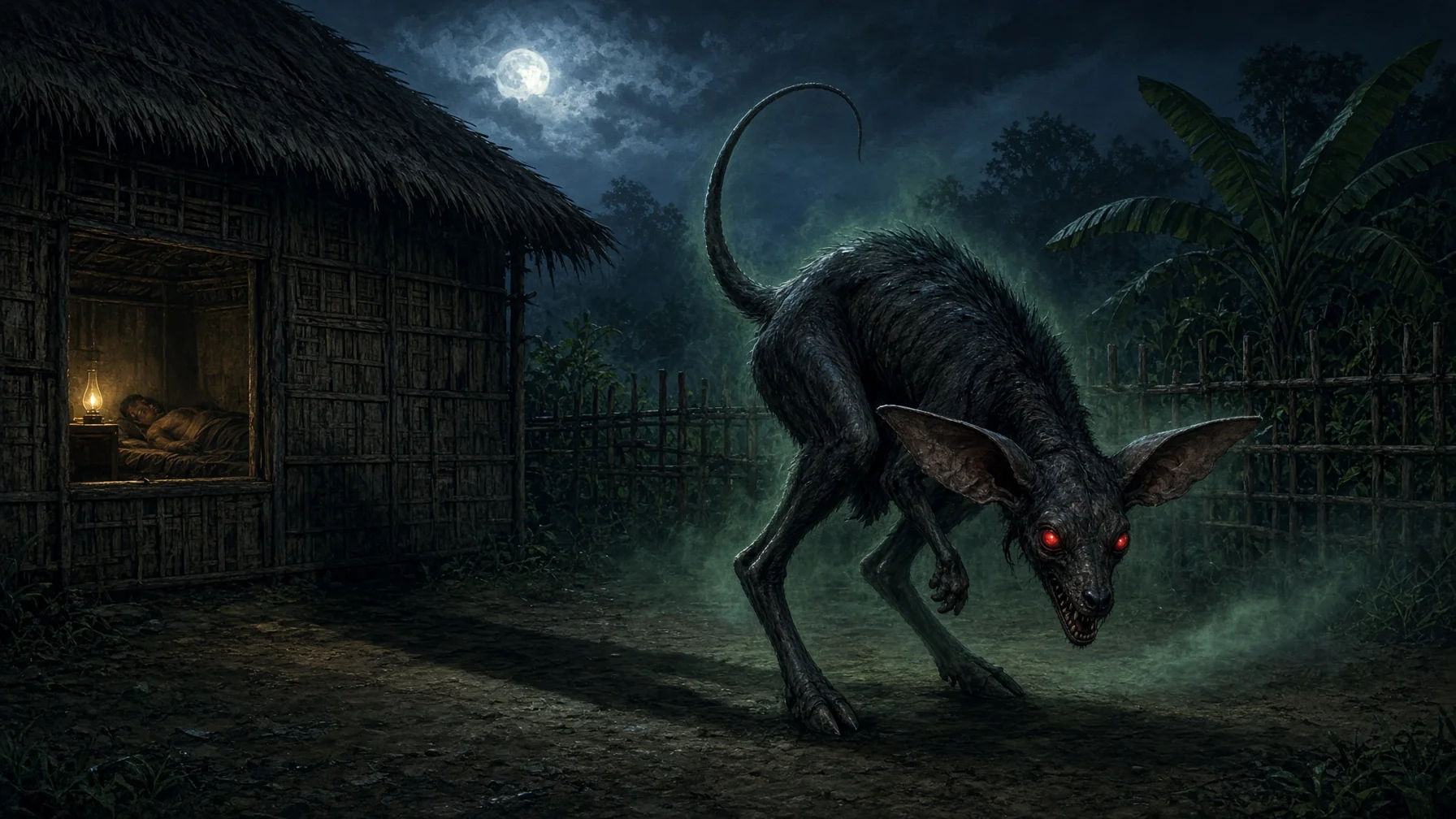
The Sigbin is one of the strangest and most feared creatures of Philippine folklore, an animal born of Visayan storytelling and rooted most firmly in the province of Capiz on Panay Island — a region so associated with sorcery in popular reputation that it is often called, in tourism and media retellings, the country's "sorcery capital." The sigbin is described as a goat-like beast, hornless, with its head held low near the ground, ears large enough to serve as wings for leaping, a long whip-like tail, and legs said to bend backward so that its footprints, and even its walk, appear reversed. It is said to move by night and vanish by day, hidden away in a covered basket by the human family that keeps it, a household said to have bred, inherited, or otherwise kept the creature across generations as a secret familiar.
A Beast Shaped Like No Other
Folk descriptions of the sigbin agree on little except that it is unsettling to imagine. It is likened to a goat without horns, its head hanging low as though sniffing the earth, its body carried on legs that bend the wrong way. Storytellers in Panay and Capiz explain that this backward bend makes the sigbin appear to walk backward, and that its tracks, where anyone claims to have found them, run in the opposite direction from where the animal actually went. This detail functions in oral tradition less as zoology than as a piece of practical folk knowledge: a way that a community could claim to identify sigbin activity after the fact, by reading a trail that seemed to contradict itself.
Last updated .
Ears Built for Leaping
The sigbin's ears are remembered as unusually large, and the folklore gives them a purpose beyond hearing. They are described as functioning like wings, letting the creature spring and leap with a speed and reach no ordinary goat could manage. Paired with the long, whip-like tail trailing behind it, the sigbin as pictured in Visayan storytelling is an animal built entirely for covering ground fast and unseen — an appearance calibrated, in the way folk monsters often are, to explain how something could steal from a house and be gone before anyone woke.
What Moves Only in Darkness
By tradition the sigbin is active strictly at night, and by day it is said to be hidden away entirely — kept, according to the folk motif, inside a covered basket by the family that owns it. This nocturnal, concealed existence is central to why the sigbin is spoken of as something few people claim to have seen directly. It is also described as invisible, or nearly so, to ordinary human sight, which in the logic of the folklore reinforces the same idea from another angle: the sigbin is not meant to be caught looking like what it is.
The Hidden Basket
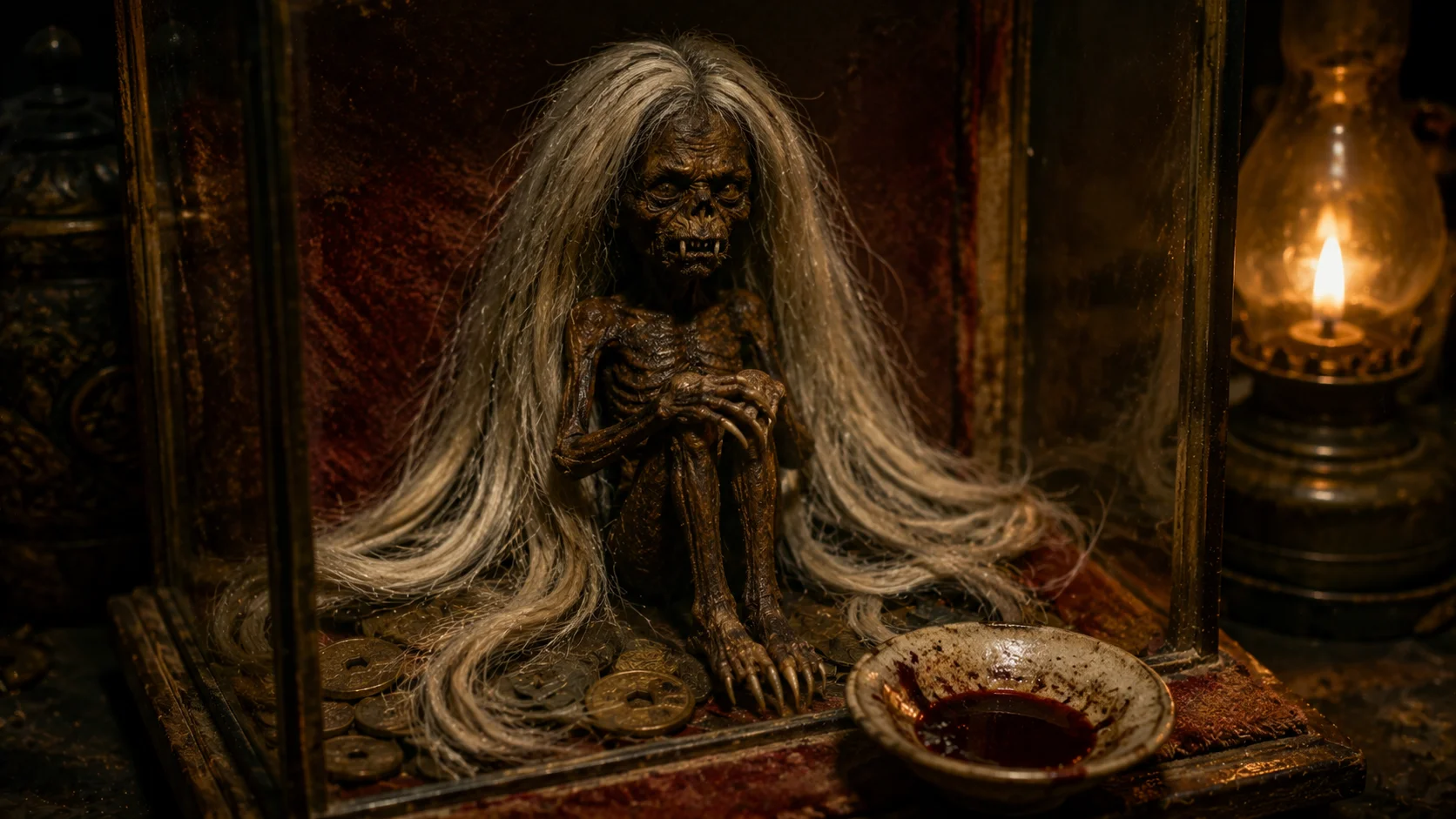
Among the most distinctive pieces of sigbin lore is this detail of daytime concealment — the creature kept, covered, out of sight, inside the home of the family that possesses it. It is not described as living wild or roaming a forest between hunts; it is described as domestic in the most unsettling sense, a possession tucked away like a household object until night releases it for its true purpose. This image, more than any other, is what separates the sigbin in popular imagination from ordinary cryptids said to lurk at a safe distance from human settlements — the sigbin's danger is imagined as coming from inside the community, not from outside it.
Kin to the Aswang, Yet Its Own Kind
Folklorists generally place the sigbin within, or closely alongside, the broader Visayan aswang complex — the wide family of shapeshifting and predatory monsters that also includes the manananggal, a torso-severing flyer, and the wakwak, a bird-like predator associated with a distinctive cry. The sigbin is usually treated as a distinct type within or near this family rather than as a variant of either of those two. Popular retellings do, at times, blur the boundaries between these Visayan monster figures, folding traits from one into descriptions of another — a pattern worth naming plainly as folk variation rather than settled fact, since the traditions themselves are oral, regional, and not standardized into a single canonical account.
A Thief in the Night
Beyond its strange gait and hidden habits, the sigbin carries a functional role in the folklore of the families said to keep it: it is tasked with theft. Oral tradition describes it being sent out to steal objects and treasure on behalf of its owners, returning before daylight with whatever it had been set to take. In some tellings, the theft goes further, extending to body parts — most notably hearts — said to be taken for use in ritual. This is folk tradition passed through households and communities rather than a fixed, single-source story, and its details shift from one telling to the next.
A Drinker of Life
Some accounts describe the sigbin as feeding directly on the vulnerable, particularly children, said to drain blood or what is described as "life essence" from its victims. This predatory dimension is what loosely aligns the sigbin with the wider aswang complex in the popular imagination, since blood- or essence-draining predation on the defenseless is a recurring theme across that family of Visayan monsters. As with the theft lore, this predatory role belongs to oral folk tradition and community storytelling rather than to any single fixed narrative.
Bone, Amulet, and Invisibility
Popular retellings connect parts of the sigbin's body — most often cited as a bone, or sometimes its tail — to anting-anting, the amulet tradition of Filipino folk belief, with claims that such a relic could grant its bearer invisibility. This is a widely repeated strand of popular folklore rather than a claim verified by scholarly ethnography, and it should be understood as belonging to that layer of retelling — the kind that circulates readily in creature compendiums, tourist retellings, and popular media — rather than as an attested detail of older oral tradition. It nonetheless remains one of the most frequently repeated pieces of sigbin lore in circulation today.
The Families Who Kept Them
At the heart of sigbin folklore sits a social accusation as much as a monster: certain families in Panay and Capiz communities were said, in whispered reputation, to secretly breed, inherit, and keep sigbin as familiars, passing the creature and the practice down through generations. Owning a sigbin marked a household as a family of sorcery — feared, avoided, and blamed. This is the mechanism by which the sigbin functioned in daily community life: not merely as a monster in a story told to frighten children, but as a live social explanation, a way for a community to account for the otherwise unexplained.
What the Sigbin Explained
In Panay and Capiz communities, the sigbin served as a ready folk explanation for the kind of loss that had no obvious cause — livestock found dead without a mark of ordinary predation, valuables that vanished from a locked house, misfortune that fell on a family without any accident to blame. Where such events occurred, suspicion could turn toward a neighboring household rumored to keep a sigbin, and the animal's reputation as a thief and a devourer gave shape to that suspicion. In this sense the sigbin is less a creature encountered in the wild than a figure invoked to make sense of harm already done.
A Name Without Rival
"Sigbin" is the standard term for the creature in Hiligaynon and Capiznon, the languages of the region most associated with its lore, and no alternate name for the same figure carries comparable scholarly attestation. Where other names surface in circulation, they should be treated as unverified unless they can be traced to a genuine local source, rather than assumed to be interchangeable regional synonyms. The consistency of the name across Capiz and Panay storytelling is itself part of what marks the sigbin as a distinct, regionally rooted figure rather than a loose composite of aswang traits.
A Cryptid Carried into Modern Telling
The sigbin has traveled well beyond the oral traditions of Panay and Capiz into the wider landscape of Filipino popular culture, appearing in cryptid documentaries, comics, and creature compendiums, including media in the vein of Trese-adjacent storytelling that draws on Philippine folklore for a modern audience. Capiz's popular branding as a province linked to sorcery owes much to sigbin and aswang lore together, and the creature remains one of the more recognizable regional cryptids to emerge from that reputation — carried forward less by formal ethnography than by the same instinct for retelling that kept it alive in Visayan households for generations.
A Monster Kept Close
What distinguishes the sigbin, in the end, is not simply its backward legs or its wing-like ears but the intimacy of its danger. It is not a beast that waits in a forest for the unwary traveler; it is a beast imagined as living inside a neighbor's house, released each night and returned each dawn to its covered basket, its loyalty bound to the family that raised it. In that image, Visayan folklore gave form to a fear less about a wild animal than about what might be hidden, deliberately, in plain sight — a fear that has kept the sigbin walking, backward, through generations of telling.