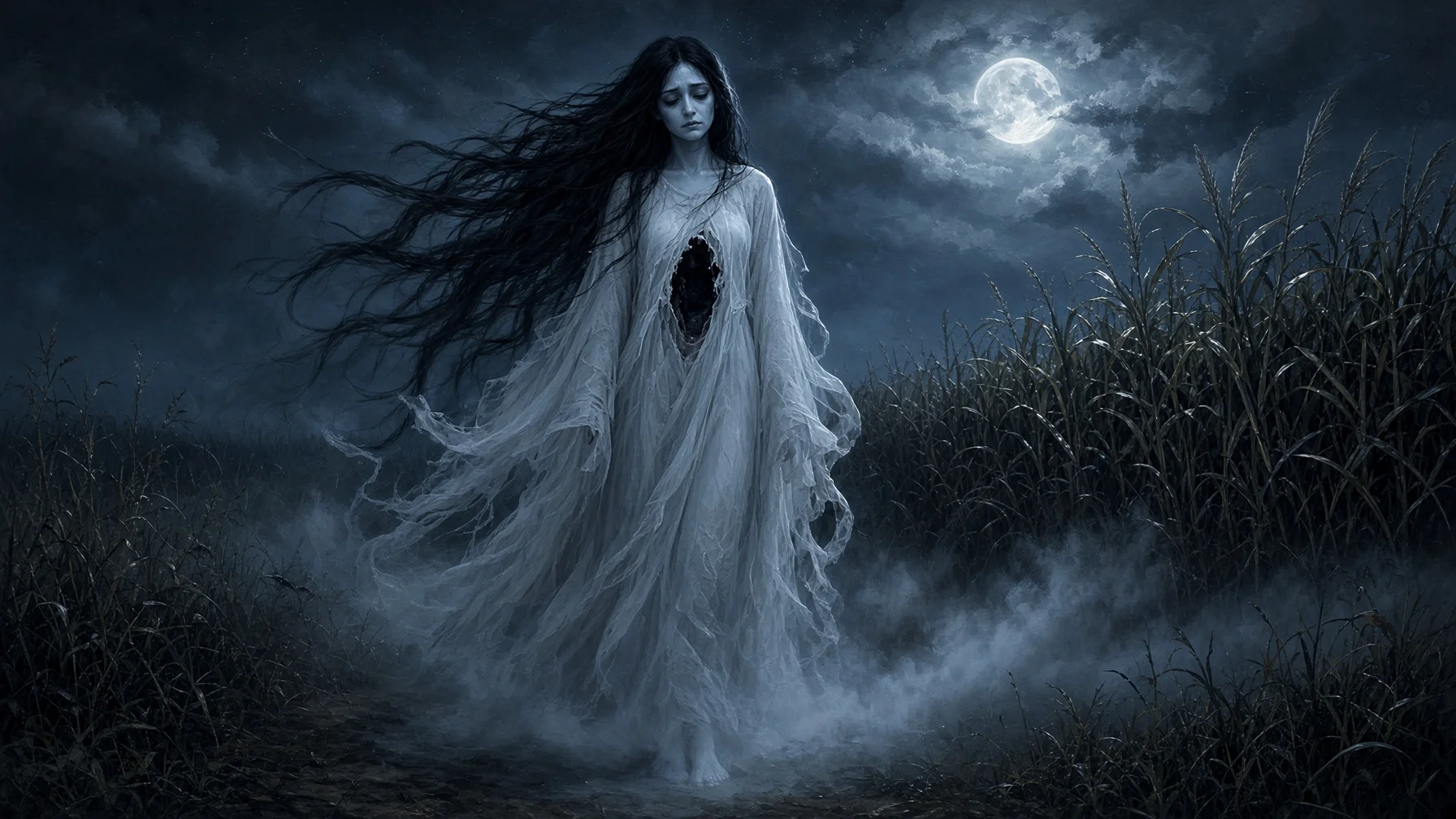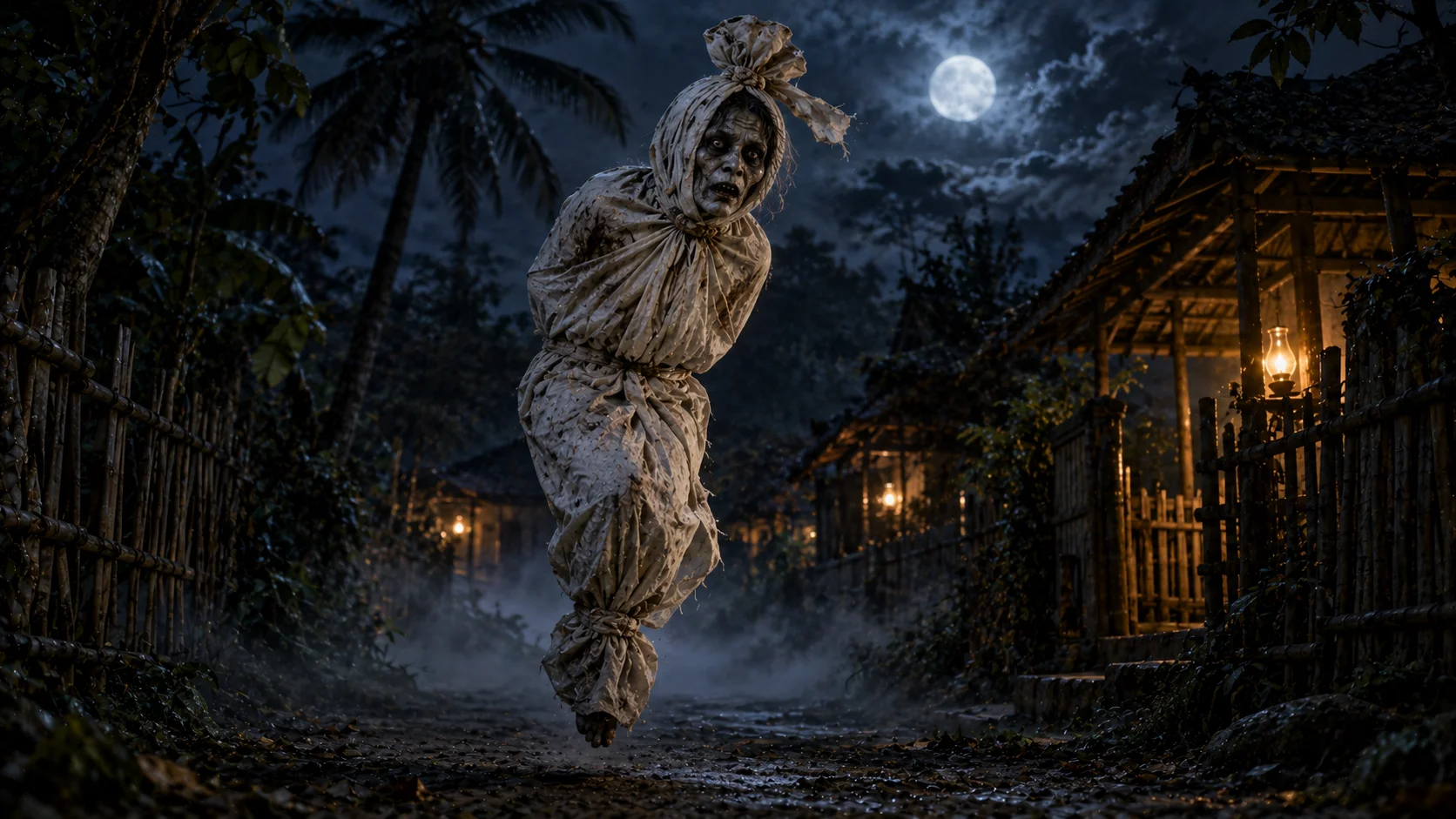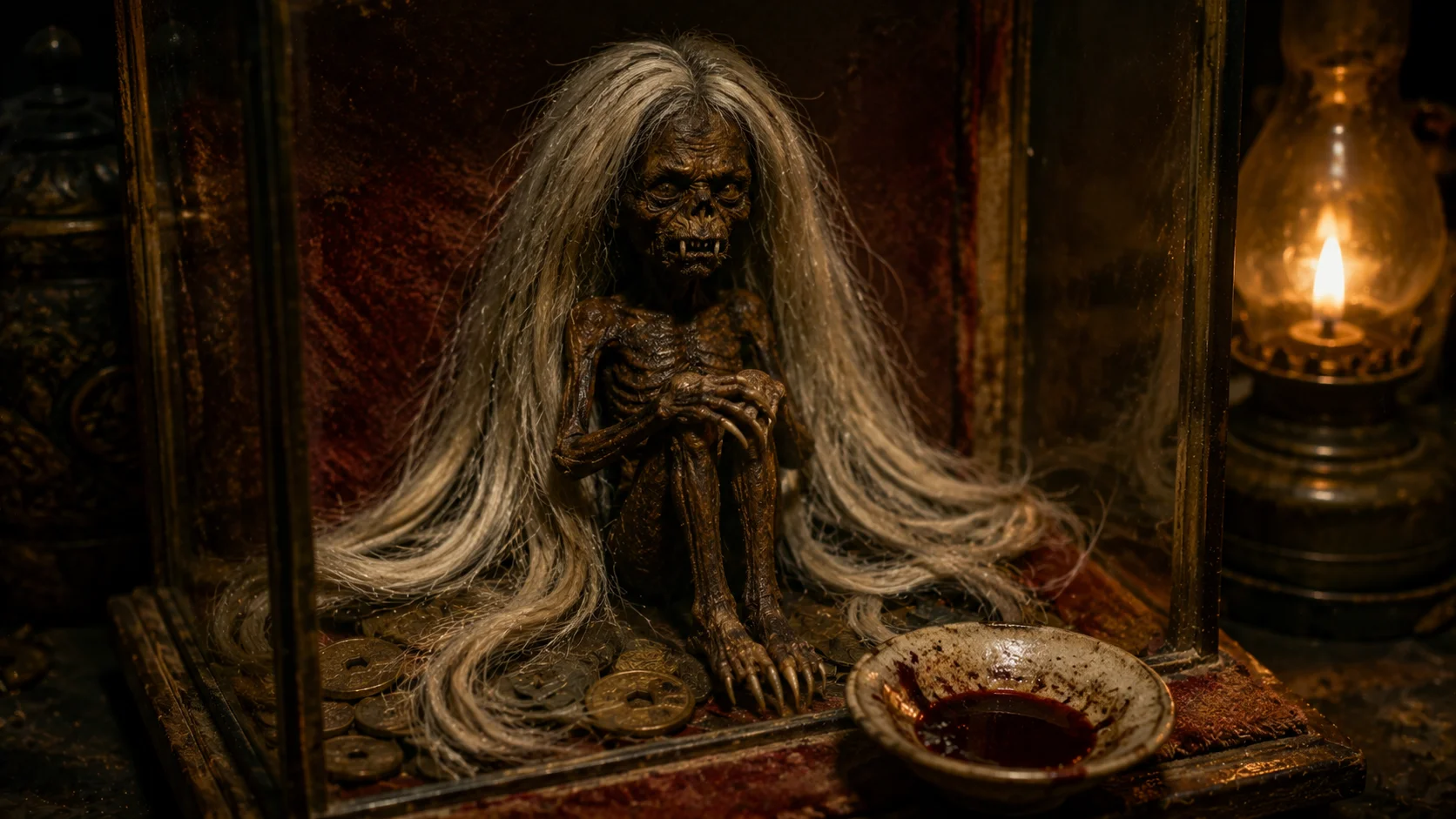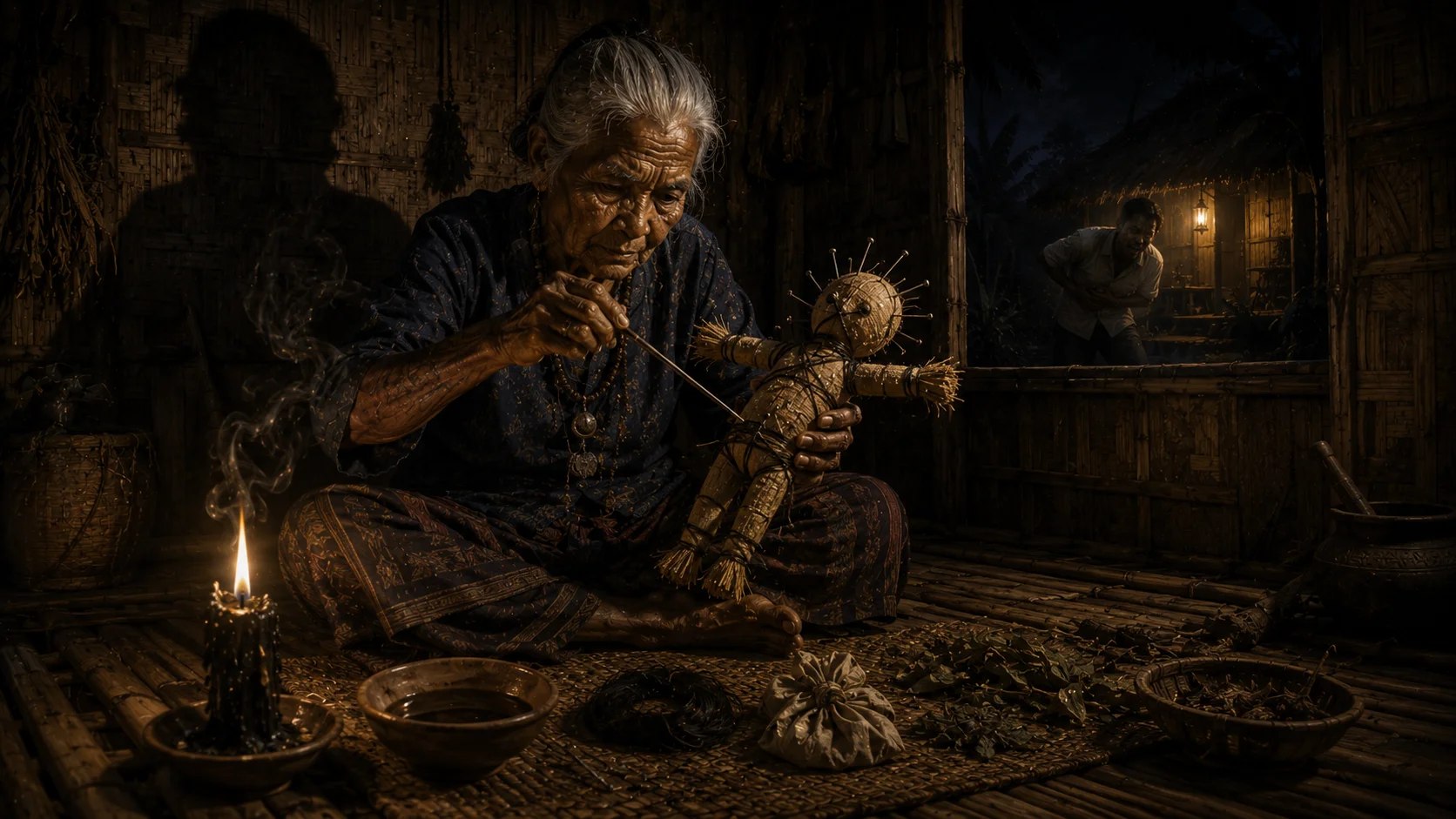
The Mangkukulam is the witch or sorcerer of Philippine lowland folk belief, chiefly attested among Tagalog and Visayan communities: a practitioner of kulam, the dark art of cursing, who inflicts pain, illness, and misfortune upon victims through sympathetic magic, above all through the dreaded cursing-doll, pierced with pins to torment the one it represents. The mangkukulam is not a monster or a spirit but, in nearly every account, an ordinary human being who has acquired occult power through pact, inheritance, or long apprenticeship, and who lives, outwardly, as an unremarkable neighbor.
The Name Behind the Word
Mangkukulam is built from the root word kulam, meaning curse, hex, or witchcraft, joined to the agentive prefix mang-, which in Tagalog turns a noun into "one who does" it. A mangkukulam is, literally and exactly, one who practices kulam. Philippine dictionaries of folk belief record related phrasings such as kulam sa bisa, describing particular potencies or applications of the curse, but there is no single fixed proper name behind the term. Mangkukulam names a role, a type of person defined by what they do, in the same way that "witch" names a role in English rather than any one individual. This distinguishes the mangkukulam from named deities or heroes of myth: there is no single canonical figure to whom every story of kulam is attached, only a widely shared, widely feared category of practitioner.
An Ordinary Face for a Feared Power
Where the aswang of Philippine folklore is imagined as a monstrous, often shapeshifting predator, the mangkukulam is emphatically human. Regional accounts most often picture an older woman, frequently one living alone, though male practitioners are described as well. By day the mangkukulam is a villager like any other, tending a household or a small plot, exchanging greetings on the road. The power is hidden, exercised in secret, and turned against those who have given offense, wronged the practitioner in the past, or against a victim on behalf of a paying client who wishes harm on someone else. This ordinariness is central to the fear the figure inspires: a mangkukulam cannot be identified by any monstrous sign, only suspected, which meant that in practice almost anyone marginal or unpopular in a community could fall under suspicion.
Three Roles the Folklore Keeps Apart
Strict Tagalog usage is careful to separate three figures who are sometimes blurred together in popular retellings. The mangkukulam works kulam, hex magic transmitted through effigies and objects. The mambabarang works barang, a related but distinct practice using insects or vermin sent against a victim rather than a pierced doll. The albularyo, sometimes called herbolario, is not a sorcerer at all but a benevolent folk healer, the one a village turns to for cures, including cures for kulam itself. Popular media, tourist-facing folklore writeups, and some regional retellings conflate the mangkukulam with the mambabarang, or edge the mangkukulam toward aswang-like traits, but this blending is best understood as a looseness in popular sourcing rather than as traditional canon. The three roles, sorcerer of the hex, sorcerer of vermin, and healer, occupy distinct and consistent places within the broader belief system.
The Doll That Carries the Curse
The mangkukulam's most iconic method, and the one most consistently attested across sources, is sympathetic magic worked through a doll or effigy. The practitioner fashions a small figure of wax or cloth to represent the intended victim, and to strengthen the magical link between doll and person, may work into it something drawn from the victim directly: a lock of hair, nail clippings, or a scrap of clothing. Once the link is fixed, whatever is done to the doll is believed to happen to the person it represents. A pin driven into the doll's stomach brings agonizing stomach pain to the victim, a pin in the head a splitting headache, and so on through whatever part of the body the sorcerer chooses to torment. The doll may also be melted or burned, bringing a wasting fever or slow decline upon the one it stands for. This is the practice popularly meant whenever kulam is invoked as a single word, an act of harm carried out at a distance, on an effigy the victim never sees and cannot defend.
Other Roads a Curse Might Travel
The effigy is the signature method, but folklore describes other means by which a mangkukulam was believed to deliver a curse. Cursed food or drink, secretly prepared and given to the intended victim, could carry kulam into the body directly. And, as with the doll, anything intimately connected to a person, hair, nail clippings, an article of clothing, could itself serve as the magical link for a curse without an effigy ever being made, a form of contagious or sympathetic magic common to sorcery beliefs across Southeast Asia and applied here specifically to the mangkukulam's craft. Because of this, personal leavings were treated with real caution in communities where fear of kulam was current: loose hair, clipped nails, and old clothing were not left carelessly where a suspected sorcerer might gather them.
The Body's Warning Signs
Victims of kulam were said to suffer afflictions that resisted ordinary explanation, sudden and severe pain with no visible cause, wasting illness that no remedy touched. Philippine folk medicine and the related lore of anting-anting amulets record a particularly striking symptom taken as unmistakable proof of a curse: the victim mysteriously vomiting or otherwise expelling foreign objects from the body, pins, nails, insects, strands of hair, or shards of glass, things that could have no natural way of entering a person and that pointed directly to sorcery at work. The appearance of such objects, drawn from the body during illness, functioned in folk belief as diagnostic evidence, confirming that the sufferer's condition was not sickness in the ordinary sense but the working of kulam.
The Healer Who Answers the Curse
Against the mangkukulam stands the albularyo, also called herbolario or mananambal in different regions, the traditional folk healer sought out to diagnose an affliction as kulam and to perform the rituals of reversal or protection that might undo it. Where the mangkukulam works in secret to cause harm, the albularyo works openly to identify and lift it, sometimes drawing the embedded pins or foreign objects out of the victim's body by ritual means, sometimes turning the curse back upon the one who cast it. The two figures form an adversarial and complementary pair within the same belief system, sorcerer and counter-sorcerer, harm and its remedy, and a community's sense of who to fear and who to trust rested on keeping the two clearly distinguished.
Amulet and Prayer Against the Hex
Protection against kulam did not rest on the healer alone. Anting-anting, amulets carried or worn for supernatural protection, are widely cited in Philippine folklore as a defense against a sorcerer's hex, and orasyon, prayer-incantations often composed in Latin- or Spanish-derived phrasing, served a similar protective purpose. Both reflect the syncretic character of lowland Philippine sorcery belief, in which centuries of folk Catholicism sit alongside older, pre-colonial ritual elements without either displacing the other. An amulet blessed with orasyon, or an orasyon spoken over oneself or one's household, was understood as a standing ward against the reach of a mangkukulam's curse, a form of everyday spiritual armor available to anyone who feared becoming a target.
Suspicion as a Social Weapon
Beyond any single act of cursing, the mangkukulam played a documented social role in Philippine communities. Accusations of practicing kulam functioned as a way to explain otherwise unexplained illness or misfortune, a death, a failed harvest, a wasting sickness, and gave a community a name to attach to its fear. Philippine folklore and anthropological writing repeatedly observe this as a mechanism of social suspicion and ostracism, falling with particular weight on marginal individuals, especially elderly women living alone, who fit the expected image of the sorcerer and had the least social standing to resist the label once it was attached. This is not a single fixed myth-event but a recurring dynamic, observed again and again across regions and accounts: the mangkukulam as a figure onto whom a community's fear of the unexplained could be projected, with real consequences for the person so accused.
A Belief and Practice, Not a Single Story
Because the mangkukulam is a role within a living belief system rather than a fixed narrative myth with named episodes, it would be a mistake to look for one authoritative origin story the way one might for a deity. What the ethnographic and folkloric record actually preserves is a complex of recurring motifs, attested again and again across sources rather than told once and fixed: the fashioning and piercing of the effigy, the mysterious expulsion of foreign objects from a cursed body, the healer's diagnosis and counter-ritual. These motifs recur with remarkable consistency from account to account, region to region, which is itself the evidence of how deeply and widely the belief took hold, not the record of a single event repeated in memory.
From Whispered Fear to the Screen
In the twentieth and twenty-first centuries the mangkukulam became a stock figure of Philippine horror cinema, komiks, and long-running television anthology drama, almost invariably shown wielding a doll and a pin, the cursing-effigy having become visual shorthand for the whole belief. This popular reception has carried the figure far beyond its folkloric origins while, notably, keeping its single most iconic image, the pierced doll, front and center. At the same time, the belief has never become purely fictional. Contemporary journalism from rural provinces still occasionally reports fear of kulam, or accusations of it, as a present and living concern rather than a folkloric memory, a reminder that for some communities the mangkukulam has never fully left the realm of the everyday.
The Shape the Fear Still Takes
Across cinema screen and village rumor alike, the mangkukulam endures as Philippine folklore's answer to the witch: not a monster to be slain but a neighbor to be watched, not a demon summoned but a power quietly practiced, in a doll pierced with pins and a curse sent out to find its mark from a distance. Countered only by the healer's craft and warded off only by amulet and prayer, the mangkukulam remains one of the most enduring and most human figures in the folklore of the islands, precisely because the fear it represents, of hidden harm worked by someone close at hand, never required a monster to explain it.
Sources & traditions
- TraditionFilipino folk and village traditions (Philippines)
Myths change from area to area and from time to time. This chronicle follows the most widely told versions; tellings in other villages, regions and eras may differ.