Sitan is recorded in the earliest colonial-era ethnographic accounts of pre-Hispanic Tagalog belief as the lord of Kasamaan, a realm of grief and affliction reserved for the dead. He appears principally in Fray Juan de Plasencia's 1589 Relacion de las Costumbres de los Tagalos, the Spanish missionary survey that catalogued Tagalog "idolatry" for the purpose of suppressing it — and Sitan is known to history almost entirely through that single document. No surviving indigenous epic, oral tale, or ritual text gives him an independent story of his own; what can be said about him is bounded tightly by what one friar chose to write down.
A Name Set Down by a Single Hand
Plasencia's listing places Sitan in a catalogue of Tagalog supernatural figures alongside Bathala, the supreme sky deity, and beings associated with him. But the friar's text does not describe any direct kinship between Sitan and Bathala — no sibling rivalry, no family bond, no shared lineage. Later retellings that cast Sitan as Bathala's brother, rival, or relation are modern inventions layered onto a record that simply does not contain them. What Plasencia does establish is a functional opposition: Sitan governs the realm of grief, standing apart from Bathala's sky, but the two are not portrayed as co-equal creator-gods locked in cosmic combat. That dualistic "good sky god versus evil underworld lord" framing is itself widely understood by scholars as a colonial interpretive lens, imported from Christian cosmology and pressed onto the material, rather than a native cosmological structure the Tagalog themselves would have recognized in those terms.
Last updated .
Kasamaan, Realm of Grief
The domain over which Sitan is said to preside, Kasamaan, is glossed in Plasencia's account as a place of grief or affliction for the dead. It is worth holding this description carefully, because it is easy to let it slide into something it was not: later, Christianized retellings describe Kasamaan as a literal fire-and-brimstone hell, complete with the trappings of Catholic damnation. That image is a syncretic accretion that grew up over the centuries as Filipino folk Catholicism layered the imported concept of impiyerno onto older indigenous ideas of the afterlife. The original account gives no such iconography — no flames, no torment-chambers, no described geography of punishment. It gives only a name and a mood: a realm of grief, ruled by a figure associated with sorrow and misfortune, offered to the reader in a handful of lines rather than a landscape.
The Four Who Carry His Harm
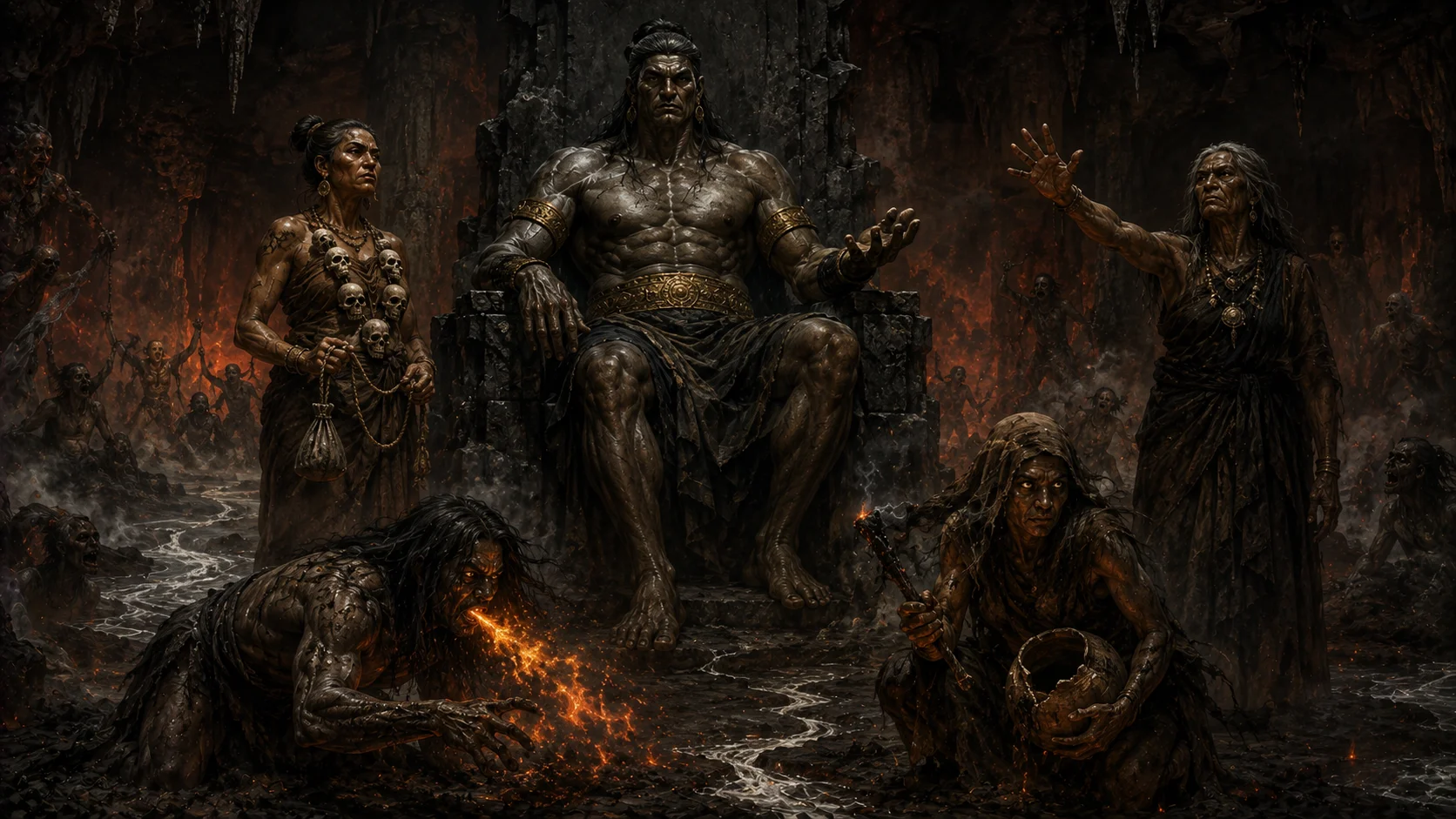
The most specific and most frequently cited detail from Plasencia's record is that Sitan commanded four subordinate spirit-agents, each an intermediary of a particular harm brought against the living. Manggagaway was a sorcerer or poisoner spirit, causing fatal illness through touch or contact. Manisilat worked on households rather than bodies, sowing discord between husband and wife until marriages broke apart. Mangkukulam was tied to hex-casting and witchcraft, and was recorded as manifesting through fire. And Hukluban was described as an aged, shapeshifting spirit, capable of killing outright or, just as strikingly, of restoring a prostrate, dying victim to health — a power that cuts against any simple reading of the four as uniformly murderous.
A Taxonomy Wearing the Shape of Persons
Historians of Philippine folk religion have proposed a useful caution about this fourfold retinue: rather than reading Manggagaway, Manisilat, Mangkukulam, and Hukluban as individualized mythic characters with their own arcs and adventures, it may be more accurate to read them as a taxonomy of harm given personified form — sickness, marital ruin, hex-fire, and the crone's power over life and death, each assigned a name so that a Spanish chronicler's Tagalog informants could speak of them at all. Many "evil spirit" figures recorded by the friars across the archipelago follow this same pattern: less singular personified devils in the European sense, more categories of misfortune that had been given faces and names long before any European asked what to call them. Sitan, as the figure said to command all four, sits atop this taxonomy rather than starring in a mythology built around him.
The Devil Question
Because Plasencia's document exists to catalogue and ultimately suppress what he understood as idolatry, scholars have raised a serious methodological caution about how Sitan is characterized within it. The text presents him as an evil or devil-like figure, opposed to the good of Bathala's sky — but that moral framing may reflect Christian categories imposed on the material rather than an indigenous understanding of Sitan's own nature. A pre-colonial underworld lord governing a realm of grief need not have been understood by the Tagalog themselves in binary good-versus-evil terms at all; he may have been a more morally ambiguous or simply amoral figure, the presiding spirit of an unavoidable fact of existence — death and sorrow — rather than a moral antagonist in the Christian sense. The record as it survives cannot settle this question either way; it can only be read with the friar's purpose kept in view.
An Echo Across a Trade Route, or a Trick of the Ear
The name Sitan bears a striking phonetic resemblance to Shaitan, the adversarial figure of Islamic and Abrahamic tradition — a resemblance noted by scholars including F. Landa Jocano and debated ever since. Three possibilities have been raised, and none of them has been resolved. The name may reflect genuine pre-colonial Tagalog belief that simply happens to sound like its Abrahamic counterpart. It may reflect syncretism absorbed through Islamic trade contact around Manila Bay in the period before Spanish colonization, when Muslim traders and polities were already present in the region. Or it may reflect distortion introduced by the Spanish friar-chroniclers themselves, who arrived already primed to hear a Satan-figure in whatever underworld lord their informants described to them, and who may have shaped the name — or its spelling — accordingly in the act of writing it down. Each of these is a live scholarly position, not a settled fact, and any confident claim to know which one is correct outruns what the evidence actually supports.
What the Record Does Not Say
It is worth being direct about how little survives. There is no well-attested pre-Hispanic epic, ritual text, or passage in the separate Boxer Codex — a related but distinct manuscript from the 1590s with its own, differently inflected deity list — that gives Sitan a spouse, offspring, or personal biography. No festival, temple, or specific act of worship directed at Sitan is documented anywhere in the surviving record. No physical description or iconography of Sitan survives either; nothing tells us what he was imagined to look like, if he was pictured at all. Details of this kind that circulate today — a wife, children, a face, a shrine — are unsourced modern elaboration, however confidently they may be repeated, and they do not trace back to Plasencia or to any other primary source.
A Single Source, Weighed Honestly
This scarcity is itself the single most important thing to understand about Sitan. Nearly every descriptive claim made about him — his rulership of Kasamaan, his opposition to Bathala's sky, his command of the four agent-spirits — traces back to one Spanish missionary's listing, written for one purpose, in one year, by one hand. That does not make the record worthless; it is, after all, the earliest substantial European account of Tagalog religious belief that survives, and its details about the four agents in particular are specific enough that they were plainly drawn from real informants rather than invented outright. But it does mean that "Sitan" as a figure is thinner and more fragile than his dread reputation might suggest — a name and a role sketched in a single colonial catalogue, not a god with a rich, independently attested mythos of his own.
A Figure Remade in Later Centuries
In the modern era, particularly from the late twentieth century onward, Sitan has found new life in Anito revivalism — contemporary Filipino pagan and folk-religious reconstruction movements — as well as in comics, games, and other popular retellings. In these newer contexts he is often recast explicitly as a Filipino Satan-equivalent, a trickster or adversary figure drawn in far bolder, more developed lines than the sparse original record ever provided. This reception history is real and documented in its own right, but it belongs to the twentieth and twenty-first centuries, generations removed from Plasencia's sixteenth-century account, and it should be recognized as a distinct layer of tradition rather than mistaken for the primary attestation itself.
What Remains of Kasamaan's Lord
Strip away the later accretions — the hell-imagery borrowed from Christian doctrine, the family ties invented for Bathala, the biography given to a figure who has none, the devilish costume stitched on by centuries of retelling — and what remains is spare: a lord of grief, ruling a realm named for sorrow, attended by four spirits who carried sickness, discord, hex-fire, and the crone's uncanny power over life into the world of the living. It is a small, precise fragment of a much larger belief system that colonization interrupted before it could be recorded in full, preserved only because one friar, writing to catalogue what he meant to suppress, thought it worth setting down.