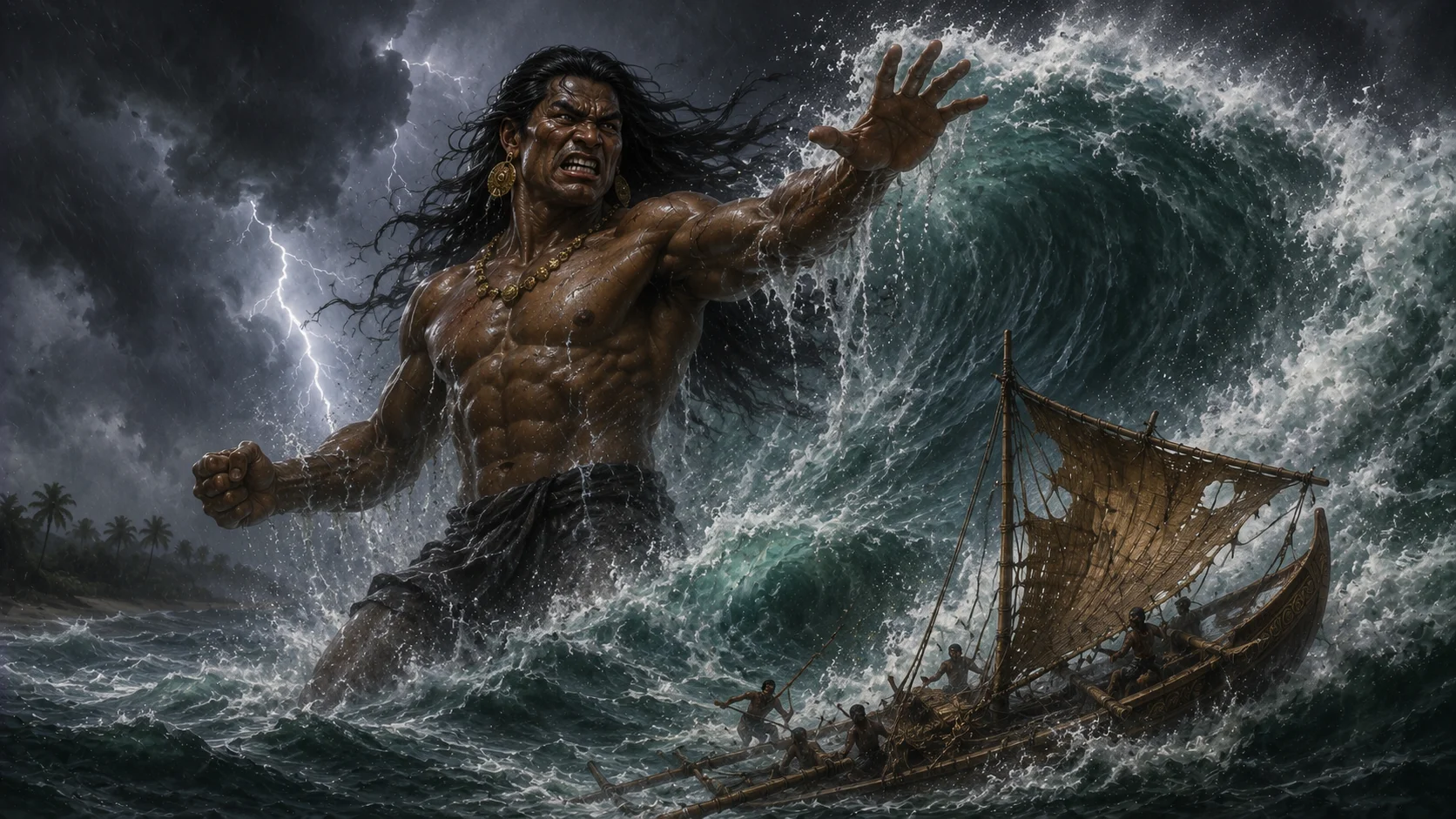
Amanikable is the god of the sea in Philippine mythology: the ill-tempered, vengeful deity of the ocean and the hunt, whose moods stir the waves and whose wrath sends the storms and the perilous seas that wreck the ships and drown the sailors of the islands. He is the dangerous lord of the deep in the Tagalog pantheon.
The God of the Sea
Amanikable is the deity of the sea — the vast ocean that surrounds the thousands of islands of the Philippine archipelago — and, in some traditions, of hunting as well. He is counted among the deities of the Tagalog pantheon, often as one of the children or great spirits under the supreme creator [bathala]. As the god of the sea, he governs the waters, the waves, the tides, and the creatures of the deep, and his favour or wrath means the difference between calm seas and deadly storms for the seafaring peoples of the islands.
Last updated .
The Wrathful Lord of the Waves
Amanikable’s defining trait is his ill temper and vengeful nature. By the myth, he was a god who loved a beautiful mortal woman, but she spurned him and married a mortal man instead; enraged and embittered by this rejection, Amanikable swore vengeance — not only on her, but on all of humankind. From then on, he vented his wrath upon the sea, sending the great storms, the towering waves, and the treacherous waters that wreck ships and drown sailors, taking out his eternal bitterness on the seafarers who venture upon his domain. His moods are the moods of the sea: calm when content, deadly when angered.
The Dangerous Deep
Because of his vengeful temper, Amanikable was a god to be feared and propitiated by those who depended on the sea — the fishermen and sailors who prayed and made offerings to calm his wrath and win safe passage and a good catch. In a nation of islands and seafarers, the dangerous sea-god held a place of real dread. In Amanikable, Filipino myth gave form to the perilous sea and its wrath — the ill-tempered, vengeful god of the ocean, embittered by a mortal’s rejection, who sends the storms and the deadly waves upon humankind, the dangerous lord of the deep whom the seafarers of the islands feared and sought to appease.
Aman: the father of the first catch
Most god-names arrive worn smooth, their meanings rubbed away by centuries of use. Amanikable’s has not worn at all — there is still a working Tagalog word sitting at the front of it. Ama is father. The Aman– that opens the name is the same element that opens Amansinaya, the deity the fishermen called on, and it recurs in the Kapampangan Amang Sinukuan of Mount Arayat. These gods are addressed as fathers.
What that address actually means is easiest to see in Amansinaya, because the 1613 Tagalog dictionary bothers to translate it: padre de sinaya, father of sinaya. And sinaya is not a person. It is the first catch — the first thing taken in a newly used net or fish trap, and, tellingly, the first thing brought back by a hunting dog. The word is still alive in pasinaya, the invitation to share that opening catch.
So the father in these names is not the parent of some child whose story has been lost. He is the father of the yield: the one the first take belongs to, the one acknowledged before anybody keeps anything. What Amanikable is the father of, no surviving source says — the second half of his name has never been convincingly glossed. But the pattern standing next to him suggests the missing word is a thing rather than a person, and that the whole name was once a plain description of what he was owed.
That is a different kind of god from the one the word “deity” usually summons. Not a remote sovereign on a throne, but senior kin — someone you are related to, and therefore someone you owe.
How thin the record is, and why
Almost everything anyone claims to know about the pre-colonial Tagalog gods comes from a narrow band of Spanish missionary writing produced between roughly 1570 and 1620 — Juan de Plasencia’s account of Tagalog customs from 1589, Pedro Chirino’s Relación de las Islas Filipinas of 1604, the illustrated manuscript known as the Boxer Codex, and Pedro de San Buenaventura’s Tagalog dictionary printed at Pila in 1613. These are extraordinary documents. They are also hostile witnesses. The friars catalogued this religion in order to dismantle it; a dictionary entry naming a deity was, functionally, a target list. Nothing here was written down because it was beautiful. It was written down because it had to be found and stopped.
So the surviving material is a set of names with brief glosses beside them — and glosses shift. The tidy family tree of Tagalog deities that circulates today, with Bathala at the head and a dozen children arranged neatly by portfolio, is a twentieth-century reconstruction assembled from those scattered notes, popularised through school textbooks, and then hardened by endless repetition online. The parts of it that are old are genuinely old. The arrangement is modern.
Amanikable sits right in the middle of that problem, and his case is unusually clear. The oldest surviving notice of him is San Buenaventura’s 1613 entry, and it does not put him in the sea at all. It calls him abogado de los caçadores — advocate of the hunters — and adds that they called on him when they went out to hunt. The identification held: the same reading appears in Zoilo Galang’s Encyclopedia of the Philippines in 1936, and in William Henry Scott’s Barangay, the standard modern study of sixteenth-century Philippine society.
The sea-god everybody now knows is a later arrival. That version traces to the folklorist F. Landa Jocano, working in the twentieth century from folk tales collected in the field, and it is his telling — the god whose love was refused by a mortal woman, who turned his bitterness on all of humankind and has been drowning sailors ever since — that filled the textbooks and the internet. In that telling the woman is called Maganda, which is simply the Tagalog word for beautiful.
None of that makes the god fake, and none of it makes the sea story worthless. A myth collected from living people in the twentieth century is still a myth people held. It just is not the same evidence as a 1613 dictionary entry, and the two should not be quoted in the same breath as though they were. What we hold is driftwood from a wreck. It is worth saying so plainly rather than pretending the plank is the whole boat.
A god without a temple
Here is the detail that reorganises everything: the Tagalogs, by the friars’ own explicit testimony, had no temples. Plasencia is blunt about it — there were no buildings consecrated for sacrifice or the adoration of idols anywhere in the islands he knew. No sanctuary of Amanikable ever stood on any headland. There was no priesthood in residence, no altar to visit, no building to burn.
Worship came to the house instead. When a festival was held — a pandot — it took place in the large house of a chief, and for the duration of the rite that house was called a simbahan. Plasencia records the word precisely because it puzzled him: the Tagalogs had a term meaning temple and no temples to attach it to. And yes, simbahan is the word Filipinos use for a church today, and simba, to attend worship, is the same verb. The Spanish took the vocabulary of a religion they were suppressing and handed it to the religion replacing it. Every Sunday, in a language the friars themselves helped standardise, the older faith is still speaking.
The rite was led by the catalonan, the Tagalog ritual specialist — most often a woman, and sometimes a man who lived and dressed as one, a role the Spanish noted with open disgust. To mag-anito was to call the spirits: food set out, wine poured, an animal killed, chanting, and the god answering through the body of the medium. This is not congregational religion. It is negotiation, conducted in somebody’s house, between a family and a powerful relative who might be persuaded.
Which is exactly the register these gods belong in. You did not worship the father of the first catch in the abstract. You acknowledged him because you were going out tomorrow.
The sea that made the country
To understand why the archipelago needed a dangerous water-god, look at what the water actually is there. The Philippines is more than seven thousand islands. For most of its history the sea was not a barrier between communities but the road connecting them — the only road.
The vessel that carried people along it has been coming out of the mud at Butuan in Agusan del Norte since 1976: the balangay, a plank-built boat with its strakes joined edge to edge by wooden dowels and lashed to internal lugs, no metal anywhere in it. The oldest of the Butuan hulls radiocarbon-dates to around AD 320. It is the earliest excavated wooden watercraft in Southeast Asia, and it predates the first European arrival in the islands by roughly twelve hundred years.
And the word did not stay with the boat. A balangay carried a kin-group and its leader; the group came to be named after the hull that brought it; and that word, worn down to barangay, is still the name of the smallest unit of government in the Philippines. Filipinos live, vote and register births inside an administrative unit named after a boat. The community and the vessel were once the same thing — which is precisely why a god who capsizes boats is not a god of inconvenience. He is a god who can delete a village.
Then there is the weather. Around twenty tropical cyclones enter Philippine waters every year, more than reach any other country on earth. The winds have names still in daily use: the habagat, the southwest monsoon that brings the rain and the bad water, and the amihan, the cool northeast wind of the dry months. A culture that keeps separate proper names for the winds is a culture that has been reading the sky for its life for a very long time.
The other faces of the water
Amanikable is one answer among many. The archipelago is not a single mythology but hundreds of related ones, and its seas are crowded.
- Amansinaya — the fisherman’s deity of the Tagalogs, addressed at the moment the net or the line first goes into the water.
- Magwayen — in Visayan tradition, associated both with the sea and with the passage of the dead, the ferrying of souls across water. The ocean as border and as hearse.
- Bakunawa — the great serpent of the deep who rises to swallow the moon, and whom people drive off by beating pots, drums and gongs until it lets go. An eclipse, in that reading, is something you can personally help fix.
- Magindara — the dangerous sea-women of the Bicolano epic tradition, who drown men rather than rescue them.
- Kataw and sirena — merfolk of Visayan waters, the second name carrying its Spanish origin openly, showing how quickly imported figures were absorbed into an existing sea-population.
And the sea is still inhabited by more than fish for the people who live on it. The Sama Dilaut of the Sulu archipelago and the wider Sulu–Celebes seas maintain their own relationships with the spirits of the water — a living tradition, held by living communities, not a relic. Filipino courtesy toward the unseen residents of a place survives far beyond any one faith: the murmured tabi-tabi po, asking permission before disturbing ground that may not be empty, is said by Catholics every day.
The hunter and the drowner
The double attribution — hunt in the old dictionary, sea in the modern one — looks like a filing error until you notice that the vocabulary had already fused the two. Sinaya, the first catch, covered the net and the hunting dog in a single word. Whatever came back first, from water or from forest, belonged to the same category and was owed to the same kind of father.
The logic is not hard to reconstruct. Farming is negotiation with land you own and improve. Hunting and fishing are raids on territory belonging to someone else, taken by luck and returned to by necessity. Both are the frontier where a household’s food comes from a place it does not control.
A god presiding over the forest and the water is therefore not a confusion of portfolios. It is one idea: the lord of everything wild that must be taken without permission, and who may take back. A hunters’ god drifting seaward over four centuries is not much of a drift at all.
Why the grudge is the whole point
Take Jocano’s version on its own terms — as a story people were telling in the twentieth century, whatever its age — and strip it to its mechanism. It is about arbitrariness. A god loved a woman; she chose someone else; and ever since, boats sink. Notice what is missing from that chain: the sailors. They did nothing. They were not impious, they broke no taboo, they simply went out in the morning and did not come back.
That is not a flaw in the story. It is close to the reason such stories exist. Every seafaring culture has to account for the same unbearable fact: the sea kills good people at random, and the drowned are not worse than the saved. A god with a private grievance, bitter about something that happened before you were born and has nothing to do with you, is a precise and honest way of holding that. The disaster is real, the malice is real, and your innocence is irrelevant — which is exactly what the survivors on the beach already knew.
And it leaves one thing you can still do. A god who resents you for reasons of his own is at least a god who can be approached, flattered, fed. Propitiation is not superstition here; it is the last available form of agency when the alternative is admitting the water does not care at all. Given the choice between an indifferent ocean and an angry one, people tend to choose the angry one. You cannot bargain with indifference.
The god comes back
For most of the twentieth century Amanikable existed mainly as a line in a school textbook, one entry in a list Filipino children memorised and forgot. That has changed sharply. Philippine mythology is in the middle of a genuine revival — in comics such as Trese, in fantasy novels, in games, illustration and film — driven by a generation deliberately reaching past four centuries of imported saints for figures that were here first.
The revival carries its own hazard, and it is the same one that produced the tidy pantheon in the first place: every retelling adds, and additions become canon within a decade. The vengeful lover is already, for most readers, the real Amanikable — and the hunters’ advocate of 1613, the only version with a sixteenth-century document behind him, has been quietly written out. That is how living myth has always worked, and there is nothing dishonest in it, provided somebody keeps track of which parts are driftwood from the wreck and which were carved last year.
What is certain is the shape underneath. An island people, twenty storms a year, a road made of water, and a powerful relative out there who is owed the first of everything you take. That much is old, and every fisherman who has watched the horizon darken understands it without needing a source.