Apolaki is the sun-god and god of war in Philippine mythology: a mighty deity of the blazing sun and of warriors, the patron of the brave and the lord of the daylight, who in some traditions contended with his sister the moon-goddess [mayari] for dominion over the world. He is the fierce solar warrior of the Filipino pantheon.
The Sun and War God
Apolaki is the god of the sun — the blazing light of day — and of war and warriors, a powerful and martial deity. In the Tagalog tradition he is often counted as a son of the supreme creator [bathala] (or, in some accounts, of other primal deities), and he is the patron of soldiers and the brave, invoked for courage and victory in battle. As the lord of the sun, he governs the daylight, the warmth and power of the sun that rules the day.
Last updated .
The Battle for the Sky
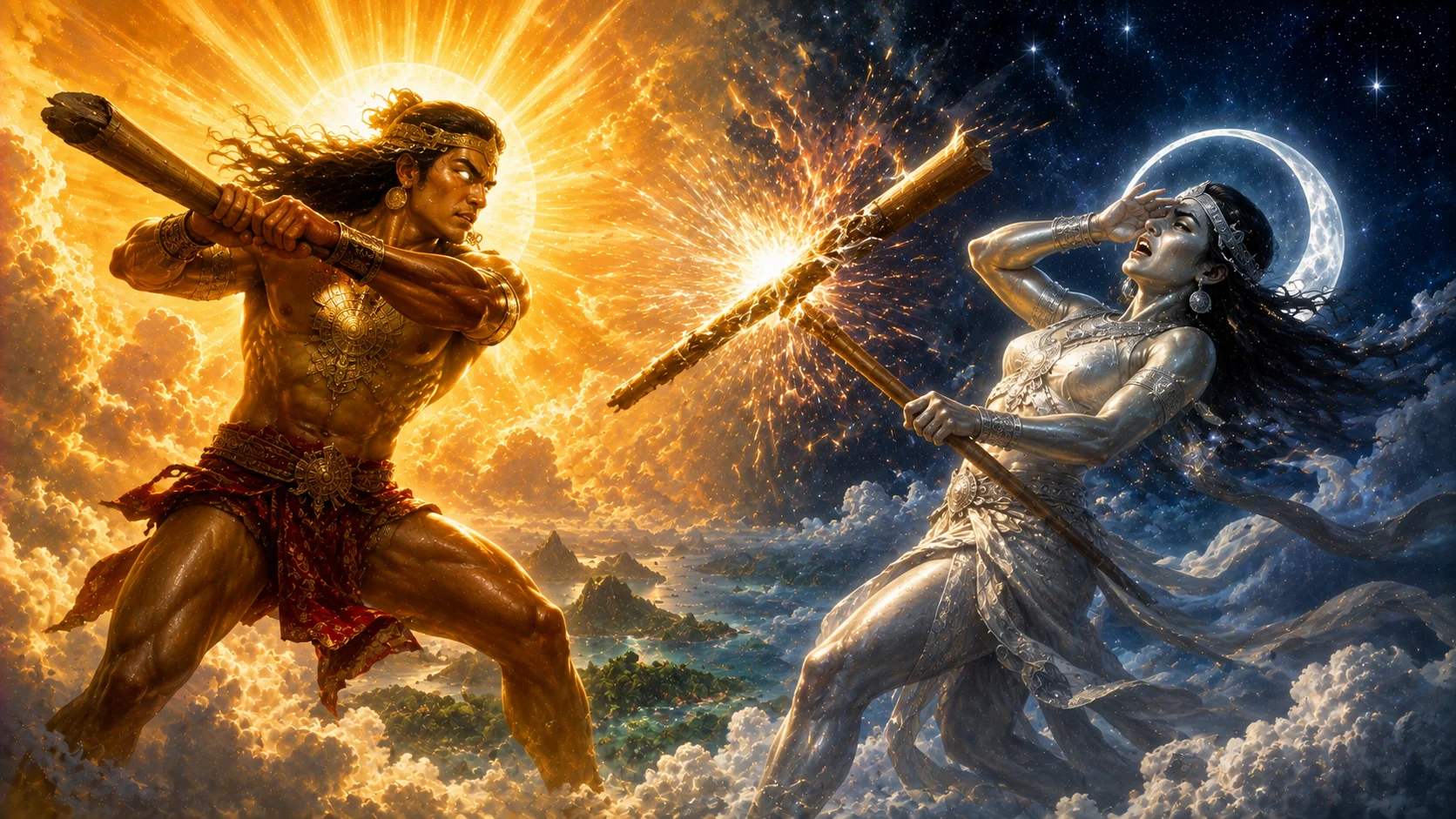
Apolaki’s most famous myth is his contest with his sister Mayari, the goddess of the moon, for rulership of the world after the death of their father. When the great god died, both Apolaki and Mayari claimed the right to rule, and neither would yield; their dispute turned to a fierce battle. In the struggle, Apolaki struck Mayari with a blow (a bamboo cane) that cost her one of her eyes — and at this, seeing his sister’s blood and her diminished light, Apolaki relented, struck with remorse. The two agreed to share the rule: Apolaki to govern the day with his full sun-light, and Mayari, now one-eyed, to govern the night with her softer, dimmer moon-light. So the myth explains why the sun shines bright and full by day while the moon gives only a paler light by night.
The Lord of the Day
Apolaki, with his sister Mayari and (in fuller pantheons) their sister the star-goddess [tala], forms the celestial family of the sun, moon, and stars, the children of the great gods who divide the heavens between them. As the sun-god and war-god, Apolaki embodies the fierce, bright, martial power of the day — the patron of warriors and the lord of the blazing sun. In Apolaki, Filipino myth gave form to the sun and the valour of war — the mighty solar warrior who battled his sister for the world, won the rule of the day, and reigns as the god of the sun and the patron of the brave.
What the Name Actually Means
Say the word aloud and a Filipino ear catches something in it before any linguist has to explain it: apo. That syllable opens the names of revered elders and revered powers across the archipelago’s Austronesian languages, from the Cordillera highlands to the Luzon lowlands — and it is not a word for “god” at all, but an honorific, reserved for whoever is owed deep respect: a grandparent, a chieftain, a force that must be addressed with care. The same honorific stands at the head of Apo Namalyari, the supreme deity of the Sambal and Aeta peoples of the Zambales range. Fuse it to laki — the root behind Tagalog malaki, “big” or “great” — and the name reads less like a label pinned on a sky object than a title spoken aloud before something dangerous: the great lord. It is a name built to be invoked, not merely a word for the thing that lights the sky.
Not Apollo
The resemblance to the Greek Apollo is one of the most persistent false leads in comparative mythology — two solar names a syllable apart, and no relationship between them whatsoever. Tagalog belongs to the Malayo-Polynesian branch of the Austronesian family, carried into the islands by seafarers millennia before any Mediterranean story could plausibly have reached them, and there is no proposed route by which the word could have travelled from the Aegean to Luzon. What the coincidence points to instead is more interesting than borrowing: cultures with no contact at all kept arriving, independently, at the same intuition — that the sun’s heat and glare make a natural metaphor for martial glory. The Aztec Huitzilopochtli fused sun and war just as completely, and was held to need blood to keep the sun climbing each morning; Egyptian Ra carried solar kingship together with a nightly battle against the serpent Apep to keep chaos out of the world. Apolaki belongs to that recurring pattern on his own terms, not as an echo of anyone else’s sun-god.
One Archipelago, Many Suns
It is a mistake to treat “Philippine mythology” as one system with Apolaki enthroned at the top of it. Before Spanish contact the islands held well over a hundred distinct language communities, each keeping its own cosmology, and Apolaki belongs to Luzon — the contest with Mayari comes down to us through Tagalog and Kapampangan telling, while other communities knew other names entirely. Sail south to the Visayan islands and even the vocabulary changes: adlaw, the ordinary Cebuano and Hiligaynon word, does duty for both “sun” and “day,” owing nothing to the Tagalog figure or his story. Other lowland and highland peoples raised their own sun-figures under their own names, most of which colonial disruption thinned out of the record before anyone thought to write them down. What circulates today as “the” Apolaki myth — the quarrel with Mayari, the sharing out of day and night — is one regional telling that happened to be preserved, not a national scripture everyone once recited alike.
A God Without a Statue
Walk into a museum built around Zeus or Ra and the god meets you in stone before you ever hear a story about him — centuries of temples, cult statues and painted tombs did the introduction in advance. Apolaki offers no such meeting. Precolonial Tagalog religious life produced nothing resembling the monumental stone temples of Angkor or of the Hindu-Buddhist courts elsewhere in maritime Southeast Asia; devotion ran through household figures, offerings and spoken invocation rather than durable public monuments, and no image identified as Apolaki himself has come down to the present. Spanish evangelisation, once it arrived, actively worked to burn and confiscate what devotional objects the old religion did keep. What survives of Apolaki survives almost entirely as narrative — a story carried by voice, written down only generations after conversion had already pushed the old worship out of daylight and into memory. There is no ancient face to check a modern illustration against; every sun-crowned, spear-armed Apolaki drawn today is an act of imagination filling a gap the historical record simply does not close.
Why the Sun Also Carried the War
The pairing of sun and war was never an arbitrary combination bolted together for a good story — it reflects how the sun actually mattered to the rice-farming communities that told this myth. A harvest lived or died on the sun’s reliability, so solar favour was not an abstract theological question but the difference between a full granary and a hungry year. War, meanwhile, was an ordinary fact of life between rival datus and against seaborne raiders, and like almost all pre-modern fighting it was work for the daylight: you could see your enemy, or you could not. A god who governed the light that fed the paddies and the light that armies fought by is not two ideas awkwardly forced into one figure. He is a single anxiety about survival, answered once, in one god.
A Myth That Refused to Stay Buried
Centuries of Catholic conversion pushed Bathala’s pantheon out of open worship, but never fully erased it, because the stories survived in the one place colonial authority could not police: told at home, parent to child, long after the last public shrine had gone. Everything we can read of Apolaki now reaches us second-hand and late — through colonial-era observers who documented the old religion in order to replace it, and through folklore gathered and published only in the twentieth century, generations after conversion. That is why the myth arrives as a story rather than a scripture: nobody was transcribing it while it was still believed in daylight, and the fixed shape it holds today is the shape it happened to have when someone finally wrote it down. In the decades since, as Filipino writers, illustrators and game designers have gone looking for a pre-colonial imaginative canon that owes nothing to European chivalry or borrowed pantheons, Apolaki has proven one of the readiest figures to reach for — a warrior-god with no temple and no fixed portrait, and therefore no wrong way to draw him. Each new retelling is not really a footnote to the old religion; it is the same mechanism that always carried Apolaki forward, one storyteller handing him to the next.