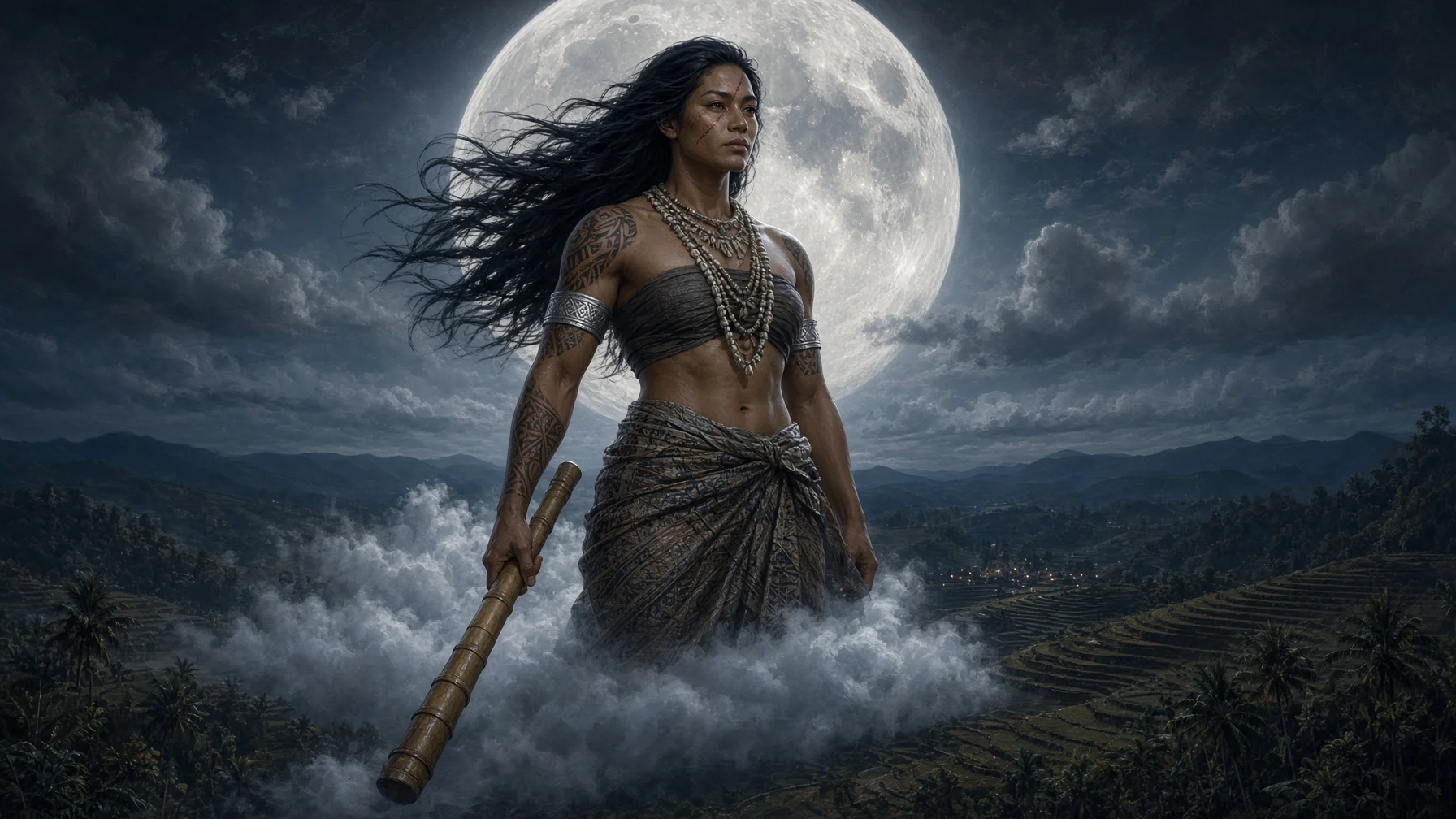
Mayari is the moon-goddess of Tagalog mythology, one of the celestial children of the supreme sky god Bathala: a luminous, beautiful, and formidable deity of the night whose most enduring story is a contest with her brother, the sun-god Apolaki, over who would govern the world — a struggle that cost her one eye and left her, ever after, ruler of the moon and the dark hours, her beauty undimmed even by the wound that dimmed her light.
A Daughter Born of Sky and Earth
In the folklore compilations that preserve her fullest story, Mayari is counted among the children of Bathala Maykapal, the creator-god who presided over the Tagalog heavens and its lesser spirits. Several retellings, gathered and set down by twentieth-century Filipino folklorists such as Damiana Eugenio, describe her mother as a mortal woman rather than a wholly divine consort — one of several mortal wives or lovers attributed to Bathala across different tellings. Where that detail appears, it casts Mayari as something closer to a demigod than a fully divine being, born of the meeting between sky and earth, and lovely, the tellings say, in the way of both her parents' worlds. This is presented in the sources as a variant, not a single fixed origin; other tellings are less specific about her mother's nature, and a careful account of Mayari should hold that uncertainty rather than smooth it away.
Last updated .
Sisters of the Night Sky
Mayari does not stand alone among Bathala's celestial daughters. Folklore compilations name a sister, sometimes called Hanan and sometimes Tala depending on which version is consulted, associated with the morning or dawn star. The exact roster of these sibling goddesses, how many there are, and what each one governs, is not standardized across the surviving accounts; different collectors recorded different constellations of sisters. What holds constant is Mayari's own distinct portfolio: she governs the night sky and moonlight specifically, a domain kept separate from the stars generally, which in a number of versions belong to a separate star-goddess rather than to Mayari herself. Her beauty, in these tellings, is bound up with that domain, she is the moon's fair face, not merely its keeper.
A Father's Passing and a Throne Left Empty
The central drama of Mayari's mythology begins with the death or departure of Bathala. With the great father gone, the rule of the world was left unclaimed, and two of his children, Mayari, goddess of the moon, and Apolaki, god of the sun, each believed the right to govern belonged to them. The folkloric record is candid that accounts differ on exactly how this succession dispute began; the disagreement itself, and the variation in how it is told, is a documented feature of the oral tradition rather than evidence of a single lost correct version. What every telling agrees on is the outcome: neither sibling was willing to yield, and the standoff between them could not be settled by words.
The Quarrel Turns to Battle
Unable to resolve their claim peacefully, Mayari and Apolaki turned to combat. In the most widely retold version, the siblings fought, each determined to prove the stronger claimant to their father's place. It was a battle between equals in ambition, if not in outcome, a contest fought in earnest, between a brother who commanded the blazing day and a sister who commanded the quieter night, with the fate of the world's governance hanging on it.
The Blow That Cost an Eye
In the fighting, Apolaki struck his sister and put out one of her eyes. This eye-loss is the single most frequently cited element of Mayari's mythology, and it is the hinge on which the rest of her story turns: her light was dimmed from that moment on, and the softer, paler glow of the moon is explained, in this telling, as the visible mark of her wound. It is not a story of simple defeat, nor of beauty erased, Mayari did not withdraw from the contest, and the injury did not settle the question of rule in Apolaki's favor.
A Truce Struck Between Equals
Seeing what the fight had cost his sister, Apolaki relented, and the two arrived at a shared arrangement rather than a victor's claim: they would divide the rule of the world between them. Apolaki would govern the day, blazing and undiminished, as the sun. Mayari would govern the night, her one-eyed light dimmer than her brother's but hers alone to command, as the moon, the wounded sovereign of the dark hours. The division is remembered less as a consolation prize than as a genuine settlement, two siblings, each too strong to be denied, splitting the heavens into shifts rather than letting one of them rule alone.
The Gap Between First Mention and Fullest Story
It is worth being precise about where this story comes from. Pre-Hispanic Tagalog religious life was preserved almost entirely through Spanish colonial ethnography, chiefly the account of the friar Juan de Plasencia, and later through oral tradition gathered by folklorists long after. Plasencia's sixteenth-century writing names Bathala and the spirits and lesser deities beneath him, situating Mayari's later placement as one of his children within that broader structure. But Plasencia's own text does not enumerate Mayari by name, nor does it narrate any conflict with Apolaki. The fullest telling of Mayari's story, the battle, the lost eye, the shared rule, comes from twentieth-century folklore anthologies rather than from that earliest colonial record. The distance in time between earliest documentary mention of Bathala's court and fullest narrative of Mayari is real, and it belongs in any honest account of her rather than being blurred into a single unbroken tradition.
A Name Not to Be Confused With Others
Care is owed to Mayari's name specifically because the Philippines holds more than one moon tradition. The name Bulan is used for a moon deity in other Philippine ethnolinguistic traditions, including certain Visayan mythologies distinct from the Tagalog world Mayari belongs to. Conflating Bulan traditions from other groups with Mayari is a documented error in popular retellings, and it is one worth resisting deliberately: Mayari's story belongs to the Tagalog tradition specifically, and keeping her separate from moon deities of other Philippine peoples honors the distinctness of each.
An Absence in Stone and Wood
Unlike some lunar deities elsewhere in Southeast Asia, whose images survive in a continuous line of temple carving and statuary, no surviving pre-colonial visual or iconographic tradition has been definitively identified as depicting Mayari. There is no ancient statue, no carving, that can be pointed to as her attested image, and so no image survives to confirm or contradict how the tellings describe her. The moon-goddess who appears in illustrated books, games, and art today is therefore a modern artistic invention built from the textual folklore, a reasonable and often reverent act of imagination, but not a continuation of an unbroken indigenous visual tradition, and that distinction is worth keeping clear.
A Goddess Reclaimed
From the 2000s onward, Mayari has become one of the more prominent figures in a broader revival of Philippine indigenous mythology, appearing in retellings, illustrated children's books, tabletop and video games, and explicitly feminist reclamation projects. In this contemporary reception, her partial blindness is reframed positively, as a mark of endurance rather than defeat: a goddess who fought as an equal, was wounded, and still claimed her half of the heavens. Some modern retellings go further, casting her as a goddess of war, strength, revolution, equality, and justice alongside her lunar role. This expanded portfolio is best understood as part of a distinctly modern elaboration, grounded in contemporary reinterpretation rather than in the early ethnographic sources, and it should be understood as a living, ongoing act of retelling rather than as pre-colonial belief recovered intact.
Mistress of the Dimmer Light
Across every version of her story, certain things about Mayari never change: she is a daughter of Bathala, she is bound to her brother Apolaki by rivalry and eventual accord, and she rules the night sky by right of a battle she did not back down from. Her light is dimmer than the sun's not because she was lesser, but because the story insists she was hurt in a fight she refused to lose. That refusal, to yield the throne without a contest, to accept a diminished light rather than no light at all, is what the tradition keeps returning to when it tells her story again.
What the Night Still Carries
Mayari's myth endures because it does something particular: it gives the moon's paler glow a reason, and gives that reason a face, a goddess who stood against her brother, lost an eye, and kept her half of the sky anyway. The variation between tellings, the uncertainty about her mother, the shifting company of sisters around her, are not gaps to be smoothed over but part of what an oral tradition looks like when it is genuinely alive: told and retold, changing shape a little each time, while the central image, the one-eyed goddess of the moon, ruling her shift of the heavens beside a brother she once fought as an equal, stays fixed at the center of it.