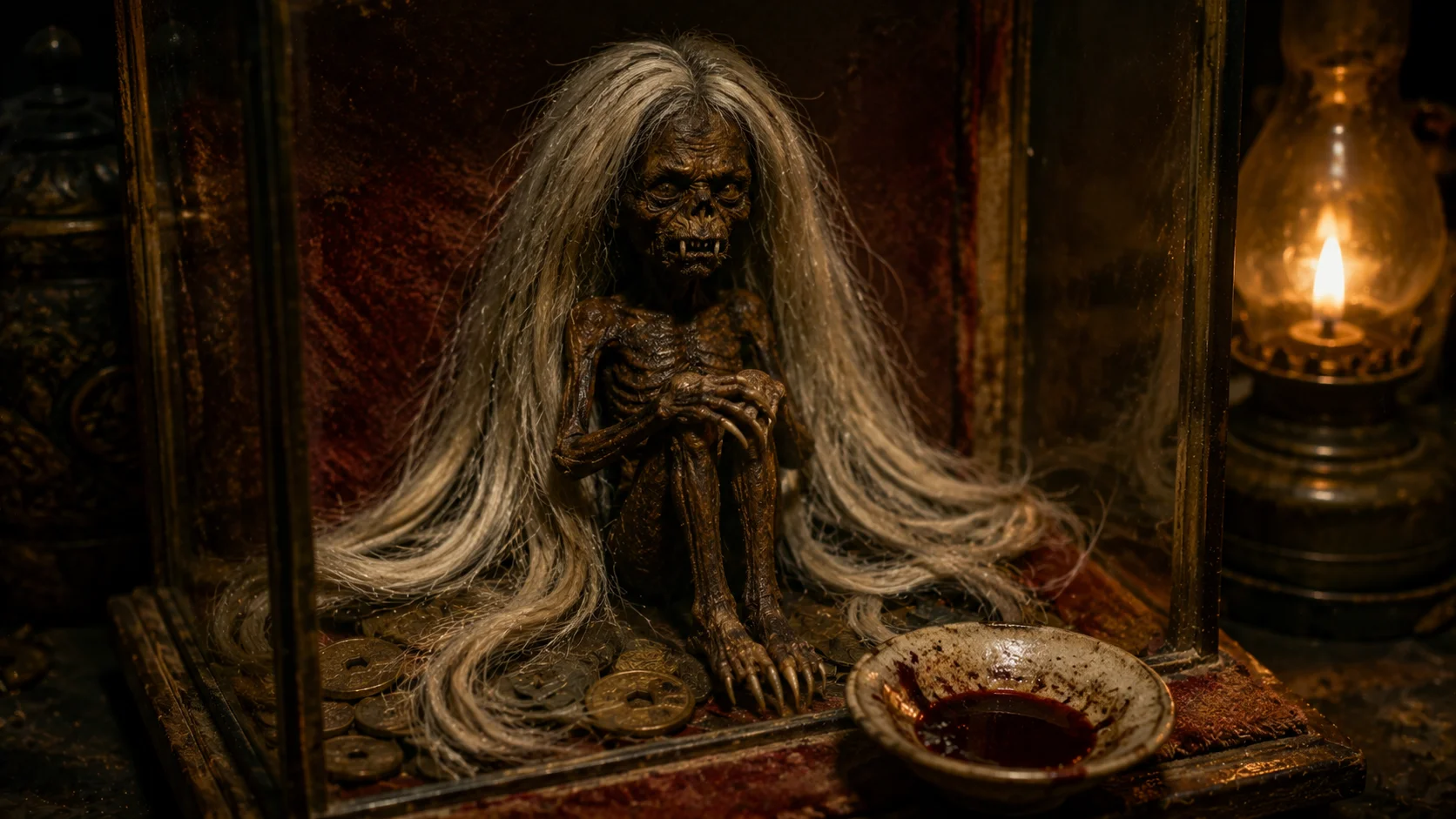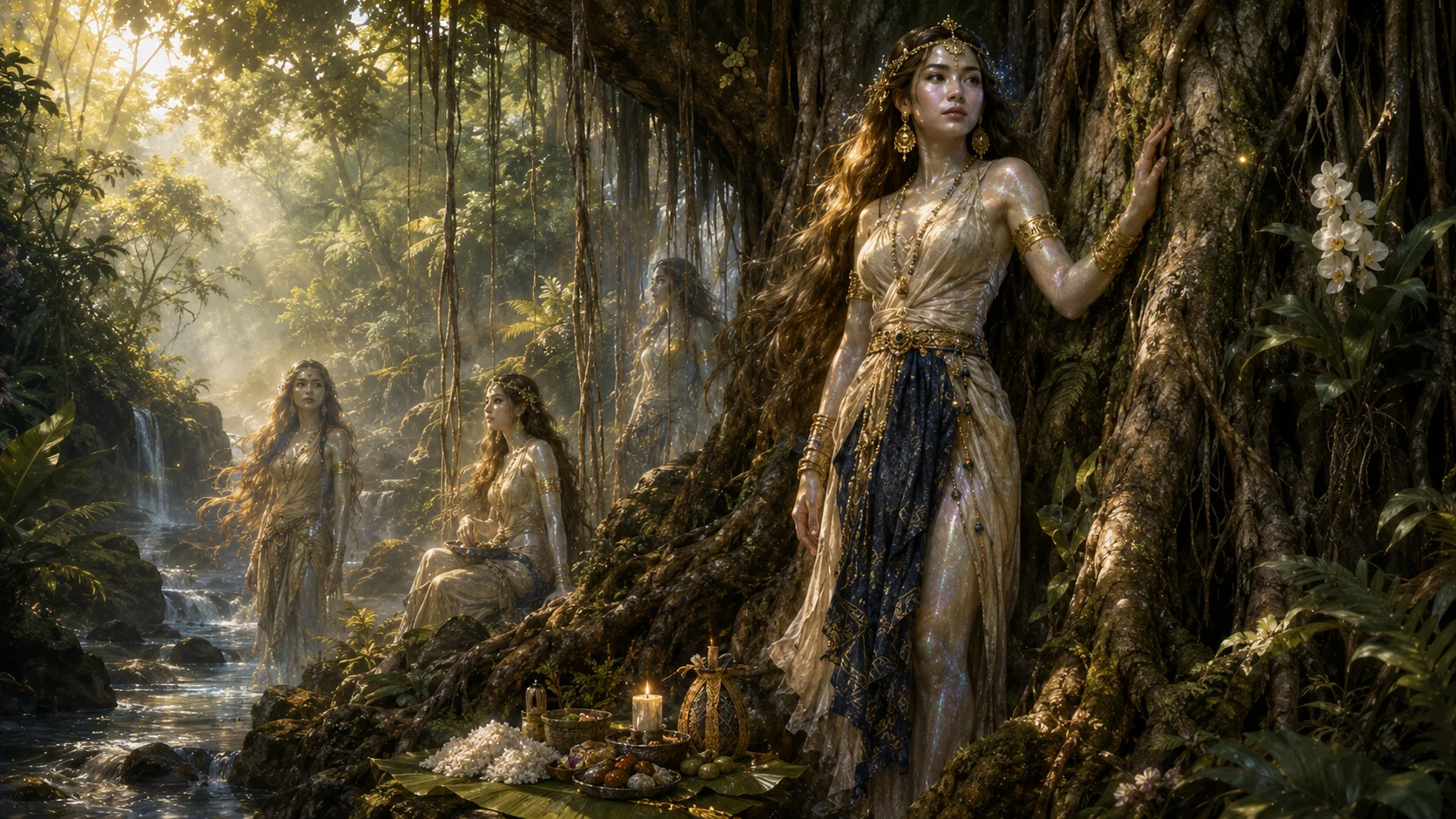
The Diwata are the nature-deities and guardian-spirits of Philippine mythology: benevolent, or sometimes capricious, spirits who dwell in the trees, mountains, forests, and seas, presiding over the natural world and granting blessings or misfortune to humankind according to how they are treated.
A Name Carried on the Trade Winds
The word diwata did not arise in isolation on the islands; it travelled. Philippine folklore scholars, F. Landa Jocano prominent among them, trace it to the Sanskrit devata, meaning deity, a loanword that reached the archipelago through centuries of pre-colonial contact with the Hindu-Malay trading worlds of Srivijaya and Majapahit. Long before Spanish sails appeared on the horizon, Visayan and Tagalog communities were already woven into a wider Southeast Asian exchange of goods, language, and cosmology, and the diwata's very name is a fossil of that contact: a Sanskrit root, carried by merchants and settlers, taking root in island soil and flowering into something distinctly Filipino.
Last updated .
Guardians of the Green and the Deep
In the folk belief of the Visayan and Tagalog lowlands, diwata are understood as the spirits and minor deities who inhabit and watch over the natural landmarks around them: forests, mountains, rivers, and particular sacred trees. They are not abstract forces but attached presences, bound to specific places, so that a given mountain, a given ancient tree, a given bend in a river may be spoken of as having its own diwata, its own resident guardian who has kept that place for longer than any living memory.
Dwellers in the Balete's Shadow
Tradition holds that diwata favour certain kinds of dwelling above others: the great old balete trees, whose spreading, root-curtained trunks are widely regarded as thresholds into the spirit world, along with termite mounds known as punso, hidden caves, and the high slopes of mountains. These are not treated as ordinary features of the landscape. To cut such a tree, to kick apart such a mound, or to disturb such a cave without first asking leave of what may dwell there is, in many communities, believed to invite illness or misfortune upon the offender. The proper practice, still observed today, is to murmur tabi-tabi po, an apology and a request for passage, before stepping into or disturbing such places.
Faces Beautiful and Uncertain
Across the regional folklore collections of Panay, Bicol, and the Tagalog provinces alike, diwata are described in strikingly consistent terms: beautiful, humanlike in form, and capable of walking among people almost unnoticed. Yet this beauty carries no fixed temperament. A diwata may be generous to those who honour the land, or cold and vengeful toward those who do not, and the same spirit that blesses one traveller's harvest may curse the next who tramples carelessly through its grove. This duality, gracious host and unpredictable power in a single figure, runs through nearly every regional account of them.
Kin to the Anito, or Something Higher
The diwata do not stand entirely alone in the wider landscape of Philippine spirit-belief. In parts of the Tagalog region and in northern Luzon, the term anito is used for ancestor-spirits and nature-spirits in a way that overlaps, sometimes confusingly, with diwata. Ethnographers have long debated the exact relationship: some treat the two words as roughly synonymous, regional variants for the same category of being, while others argue for a hierarchy, with diwata standing as higher deities and anito as the spirits of one's own ancestors. No single resolution commands universal agreement among scholars, and the honest account is that the boundary between them remains, to this day, a matter of ongoing debate rather than settled fact.
Under Kaptan's Sky and Maguayan's Sea
Nowhere are the diwata given fuller shape than in the epic traditions of Panay, particularly the Hinilawod cycle recorded among the Sulodnon by F. Landa Jocano. There, diwata appear as a class of powerful supernatural beings comparable in stature to gods proper, distinct from the more localized dungan or the engkanto of everyday belief. Within this Sulodnon cosmology, the diwata take their place beneath a greater pairing: Kaptan, the god of the sky, and Maguayan, the goddess of the sea, with the diwata functioning as intermediary or lesser divine beings under this pantheon. It is worth stating plainly that this particular architecture of sky-god, sea-goddess, and attendant diwata belongs specifically to the Sulodnon of Panay, and should not be read as a universal Philippine pantheon; other ethnolinguistic groups tell the diwata's story without reference to Kaptan or Maguayan at all.
Neither Wholly Male Nor Wholly Female
Popular imagination often pictures the diwata as exclusively female, gentle guardian-women of forest and mountain, but the sources themselves resist so simple a picture. While many accounts do describe them as female nature-guardians, the epic literature, the Hinilawod chief among it, includes male diwata as well, warriors and deities in their own right. No single tradition fixes the diwata to one gender, and the honest picture is of a category broad enough to hold both.
Gifts Left Beneath the Old Trees
Devotion to the diwata has never been merely a matter of avoidance and caution. It is also, and perhaps more fundamentally, a matter of gift-giving. Visayan folk Catholicism preserves, as a syncretic survival of older animist practice, the custom of leaving offerings at sites believed to be diwata dwellings: food set quietly at the foot of a balete, rice wine such as tuba or pangasi poured onto the earth, or betel nut left where the spirit might find it. These are not grand rituals but small, repeated courtesies, the ordinary maintenance of a relationship between the human world and the powers that share it.
Recorded by the Hand That Sought to Silence Them
Much of what is known today about diwata veneration comes down through an uncomfortable channel: the writings of the Spanish missionaries, Jesuit and Augustinian friars among them, who from the sixteenth century onward made it their explicit purpose to suppress belief in the diwata and the wider animist cosmology it belonged to. Their chronicles recorded diwata practices in order to condemn and uproot them, casting the spirits as demons and their worshippers as souls to be won for the Church. That these colonial accounts are also among the primary surviving records of pre-colonial belief is a painful irony of the historical record, and any reading of them has to reckon with the hostility of the lens through which they were written.
Tamawo, Engkanto, and the Limits of One Word
Diwata is often used today as though it were interchangeable with engkanto or engkantada, the broader Filipino category of enchanted beings and fairy-folk, and in casual speech the terms do slide into one another. Folklorists such as Herminia Meñez Coben, however, caution that these words carry different regional histories and connotations and are not strictly identical categories. The picture grows more intricate still in Mindanao and parts of the Visayas, where communities draw a line between diwata and other specific local spirit-beings such as the tamawo. Diwata, in other words, functions less as a single, uniform species of spirit than as an umbrella term whose precise membership shifts from one ethnolinguistic group to the next, a documented regional divergence rather than a single unified belief system.
Echoes on Screen and in a Given Name
The diwata's cultural life has not ended with the old chronicles. In contemporary Philippine popular culture the name has taken on new lives entirely: as a given name for children, as a title invoked in beauty pageants, and as a recurring figure in Filipino fantaserye television and film productions from networks such as GMA and ABS-CBN. These modern uses are a testament to how deeply the word has lodged itself in Filipino cultural imagination, but they belong to the realm of reception and adaptation, reworkings and reimaginings of a folkloric original, rather than to the attested pre-colonial lore itself, and the two should not be mistaken for one another.
Spirits Still Spoken To
What endures across all of this, the Sanskrit root and the Spanish chronicles, the epic pantheons of Panay and the umbrella term stretched thin across a hundred local traditions, the pageant titles and the fantaserye plots, is a living habit of address. Filipinos who murmur tabi-tabi po before stepping past a great old tree, who leave betel nut at the foot of a balete, are speaking to something their grandparents' grandparents also spoke to: the diwata, guardians of a natural world that was never believed to be empty, spirits who ask, still, to be asked.