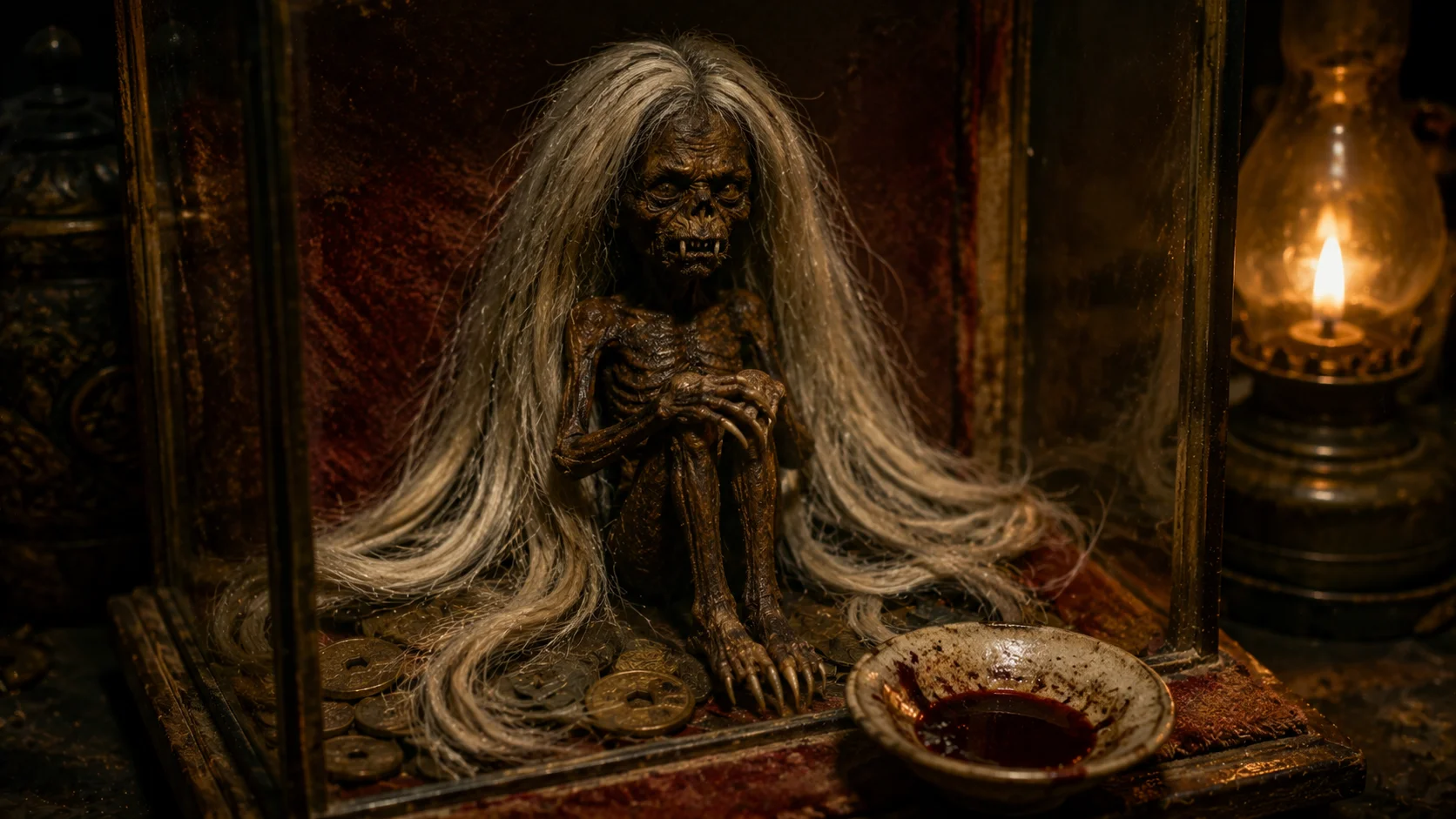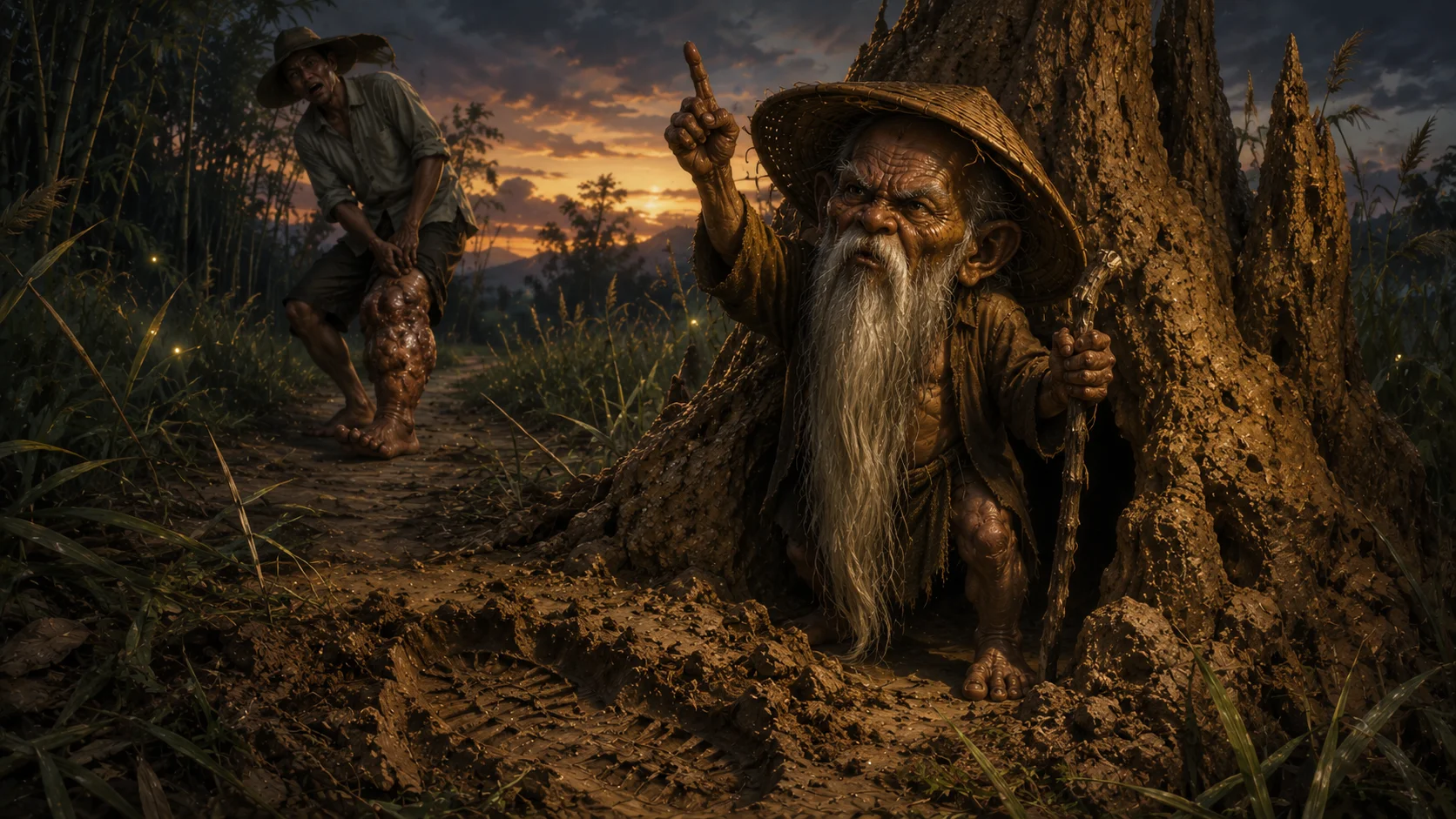
The Nuno sa Punso — “the old man of the mound” — is a goblin-like dwarf-spirit of Philippine folklore who dwells within the anthills, termite mounds, and earthen mounds of the countryside: a small, ancient, easily-offended being who curses those who disturb his home or fail to show him proper respect. He is the irritable little guardian of the mound.
The Old Man of the Mound
The nuno sa punso (“ancestor/old-man of the anthill-mound”) is a tiny, old, bearded dwarf-spirit — a goblin-like creature of small stature with the appearance of a wizened old man — who lives inside the punso, the mounds of earth raised by ants or termites, or in other small mounds, tree-stumps, and earthen heaps in the fields and the wild. He is an ancient and territorial being, dwelling unseen in his mound, and he demands respect from those who pass by or disturb his dwelling.
Last updated .
The Curser of the Disrespectful
The nuno is easily offended and quick to curse. To kick, urinate upon, disturb, or damage his mound, or to pass by without the proper courtesy, is to risk his wrath — and the nuno’s curses are specific and dreaded: he afflicts the offending part of the body. A person who kicked his mound might find their foot swollen and painful; one who urinated on it, an affliction of the genitals; one who pointed at it, a swollen finger; and so on — mysterious swellings, illnesses, and ailments that no ordinary medicine could cure, recognizable as the nuno’s curse. The afflicted would have to return to the mound to make offerings and beg the nuno’s pardon, often with the help of a folk-healer (albularyo), to lift the curse.
The Courtesy of Tabi-Tabi Po
The remedy and the prevention is courtesy. Before passing through the wild, disturbing the ground, or going near a mound, Filipinos say “tabi-tabi po” (“excuse me, please” / “may I pass”) to ask the unseen nuno (and other spirits) for permission and to avoid giving offense. This deeply ingrained custom reflects the belief in the nuno and his kin as real, present, and easily angered. A small but dreaded figure of the everyday supernatural, the nuno sa punso is one of the most familiar of Filipino spirits. In the Nuno sa Punso, Filipino folklore gave form to the irritable guardian of the earth — the ancient little old-man of the mound who curses those who disrespect his home, the goblin-dwarf whose pardon must be begged with offerings and the courteous “tabi-tabi po.”
Nuno, the Word Before the Goblin
Long before a Filipino child learns to fear him, she learns that his name is a term of respect. Nuno is not folklore vocabulary invented for a monster — it is the everyday Tagalog word for an ancestor, an elder, a grandparent, close kin to the lolo a child greets at the dinner table. He was never conceived as a creature to be slain, then, but as a resident to be deferred to, the way one defers to the oldest person in the room. The habit runs deeper than etiquette. In pre-colonial belief the spirits of the dead and the spirits of the land were not two separate populations but one — the anito — and a mound left undisturbed at the edge of a field for generations was exactly the kind of place where that population was assumed to settle. The nuno is what survives of that worldview after the vocabulary around it changed: an ancestor who was never given a name.
Where He Sits Among the Engkanto
Spanish contact did not erase the old spirit-world; it relabelled it. Nature spirits that pre-colonial Filipinos had known by regional and clan-specific names were gathered, over the centuries of colonial rule, under one Spanish-derived umbrella: engkanto, from encantado, “enchanted.” The nuno keeps company there with the horse-headed tikbalang and the tree-dwelling, cigar-smoking kapre — beings owed courtesy and caution rather than worship, a demoted pantheon still very much alive in the countryside. Within that company he is routinely confused with a cousin he is not: the duwende. That name descends from the Spanish duen de casa, a worn-down form of dueño de casa, “owner of the house” — and the duwende is exactly that, a domestic spirit of the garden, the yard, the cool dark beneath the stairs, sorted by tradition into white duwende who bring luck and black duwende who bring mischief. Temperament separates the two as sharply as address does: the duwende is a prankster who lets himself be seen, most often by children, while the nuno is not playful at all and does not care to be looked at. Nor does he live where people live. He keeps to the seam where cultivated land gives out into wild land — the anthill at the edge of the paddy, not the space beneath the kitchen floor. Illustrators collapse the pair into the same bearded little man; the folklore does not.
The Anthill as a Boundary Marker
A punso does not appear by design. It rises where ants or termites have been left alone long enough to build, which in practice means the overgrown margin of a field, the untended corner of a yard, the rim of a forest path — the places where human control of the land thins out and stops. To site a spirit there is to make that thinning legible: cross this line carelessly and you are no longer merely in nature, you are in someone else’s territory. Agrarian cultures elsewhere reached for the same device. Irish farmers still plough around the rath — the earthen ringfort held to belong to the Aos Sí, the fairy host — leaving a green island of thorn and grass standing in the middle of a worked field rather than gamble the luck of the farm, and that reluctance has quietly preserved a great deal of archaeology that tillage would otherwise have erased. The mythology is unrelated and the soil is half a world away, but the logic is identical: an unremarkable mound of earth, precisely because it sits at the edge of what people control, is where a culture chooses to put its guardian.
Diagnosing a Curse
An affliction with no visible cause — a limb that swells after a walk through the fields, a fever that will not break — sent a family to the albularyo, whose work was diagnostic before it was medicinal: to establish which unseen offence had been given, and to whom. Filipino folk medicine recognises a whole family of conditions that sit outside germ theory entirely — usog, pasma, and affliction by the nuno among them — caused not by contagion but by a person falling out of balance with the world around them. The traditional method of naming the culprit is pagtatawas: tawas, a lump of alum, is melted over a flame and dropped into a basin of water, and the shape it takes as it sets is read; candle wax, or an egg passed over the patient, serves the same purpose. The vocabulary of those readings is the revealing part. The verdict comes back not as the name of a disease but as the name of a relationship gone wrong — na-nuno, taken by the nuno — which places the cure in the register of apology rather than of medicine.
Why the Curse Fits the Crime
The nuno’s punishments are famously matched to the body part that gave offence: the foot that kicked, the finger that pointed, the insult answered precisely where it was committed. Read as the temper of a monster, that is merely cruel. Read as instruction, it is exact — and it happens to describe how an anthill actually retaliates. Ants and termites do not curse in the abstract; they bite whatever touched or threatened the nest, and the swelling, the heat and the pain fall on the very limb or digit that made contact. The curse preserves a thoroughly practical warning — keep your foot, your bare skin and your hand away from the mound — and dresses it as courtesy owed an elder rather than as first aid. A society without antihistamines, and without a germ theory to explain why a bite might turn septic, had every reason to keep that warning in a form frightening enough to be obeyed by a five-year-old alone in the fields with nobody watching. The myth is not decoration laid over the danger. It is the danger, translated into a language a child will actually remember.
Still Standing in the Field
The nuno has not retired into storybooks. Earthen mounds are still left standing in the provinces when the ground around them is cleared, and digging still begins, often enough, with a word of permission spoken aloud to nobody visible — half joking, wholly observed. Belief of this kind rarely announces itself as belief; it survives as a caution nobody wants to be the one to ignore. He remains, too, among the first supernatural figures a Filipino child meets, learned in the same breath as the tikbalang and the kapre. What the lesson actually transmits, underneath the goblin costume, is manners: assume the ground you are crossing may not be entirely yours, and extend to an anthill the same po — the honorific particle a child is taught to give any elder — that the word nuno asked for from the very beginning.