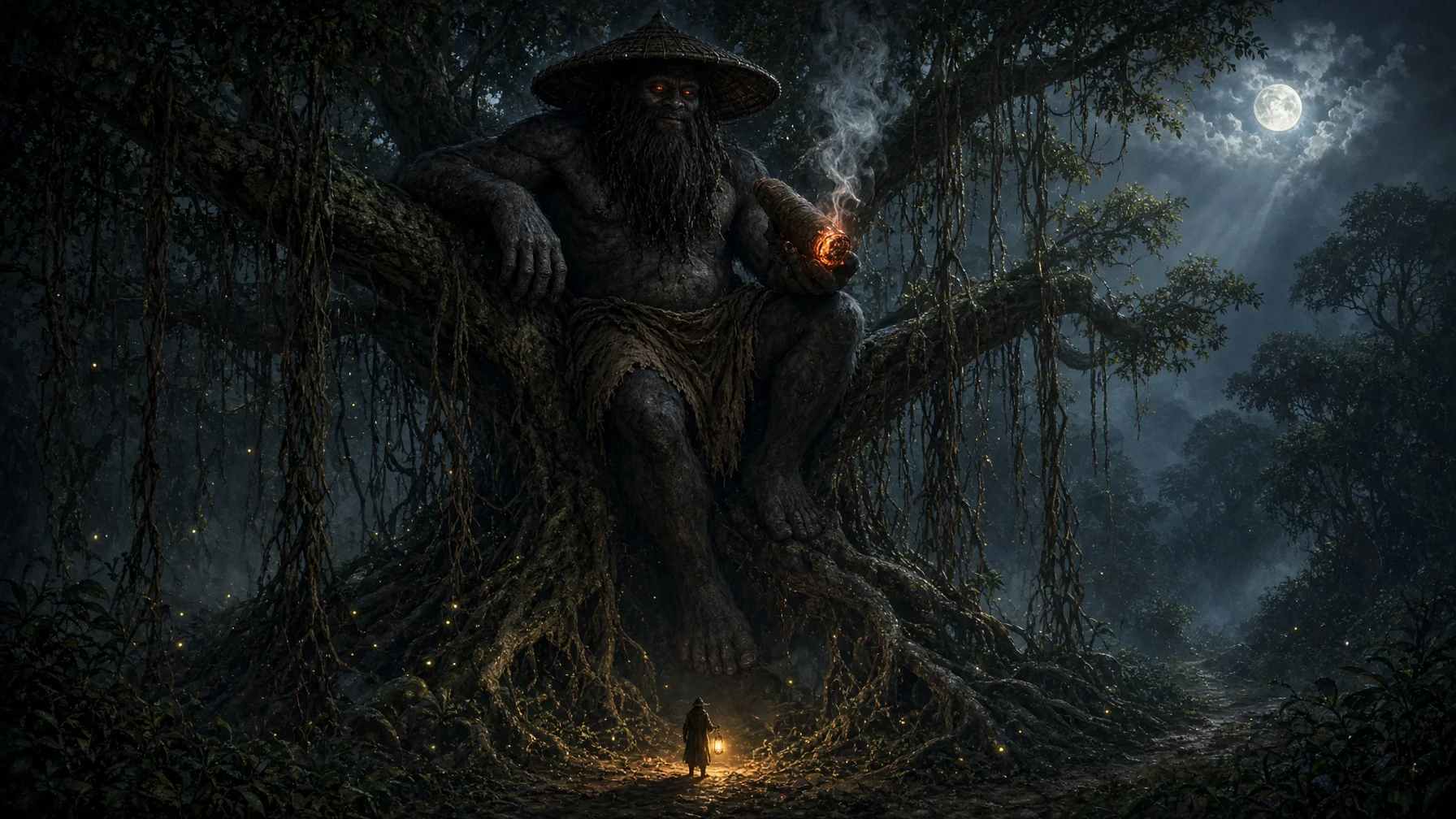
The Kapre is the giant tree-dwelling being of Philippine folklore: a tall, dark, hairy, cigar-smoking creature who lives in the great old trees, the balete, the acacia, the mango, watching the world from its branches, sometimes frightening, sometimes mischievous, sometimes oddly benevolent.
The Ember in the Canopy
Before the shape of the Kapre is ever seen clearly, its presence is smelled and glimpsed in fragments: the heavy, unmistakable scent of tobacco smoke drifting down through leaves that should hold no smoke at all, and, higher up, a single point of orange light glowing and fading in the dark canopy like a slow-breathing eye. This is the classic folk indicator of the Kapre across regions and retellings, repeated so consistently that the ember itself has become shorthand for the being — long before anyone describes the giant who holds the cigar, the story has already told you he is there.
Last updated .
A Giant Shaped by a Foreign Word
The name Kapre carries a history that is itself a small piece of colonial-era folklore. Folklorists widely believe the word derives from the Arabic-rooted term "kafir," meaning non-believer or infidel, a term that appears to have entered Philippine usage through Spanish colonial channels, where it was applied to Moorish or dark-skinned foreigners. It is worth being honest about the limits of this etymology: it is a scholarly hypothesis rather than a settled certainty, one plausible thread among the tangled contact histories that shaped so much of Philippine lower mythology. What the name suggests, whether or not its origin is fully proven, is a figure imagined at the boundary of the familiar — dark-skinned, foreign-seeming, larger than an ordinary man, and unsettling to those who first gave it a name.
Where the Balete Roots Close Over a Name
The kapre is described as an enormous, dark-skinned, hairy humanoid, a giant, often seven to nine feet tall or more, with a muscular build and a fondness for sitting in the branches of great old trees, smoking an enormous cigar or pipe, or rolled tobacco, whose glowing ember can be seen in the dark canopy at night. It dwells especially in the ancient balete trees, the strangler fig, deeply associated with spirits in Filipino belief, the acacia, and other great trees, and it is bound to its particular tree, which it guards and inhabits. Old bamboo groves and long-established mango trees are named too, but it is the balete above all — with its cascading aerial roots and its slow, centuries-long strangling of the host tree it grew around — that is most tied to the Kapre in the popular imagination, a tree already unsettling in shape before any spirit is said to live inside it.
The Scent That Announces a Guardian
Unlike beings that must be seen to be feared, the Kapre announces itself first through the senses that cannot be argued with: smell and half-glimpsed light. A traveler on a quiet road at night who catches the smell of strong tobacco with no smoker in sight, or who notices a small red glow high in a tree where no lamp or fire should be, is understood in the tradition to have found — or been found by — a Kapre. This motif recurs across regional tellings with unusual consistency, functioning almost as a warning system built into the folklore itself: notice the smoke, and choose your next steps carefully.
Naligaw: Losing the Path Beneath the Branches
The Kapre's signature behavior toward people who wander near its tree is disorientation rather than direct attack. A traveler becomes lost or confused, walking in circles on a path they know well, a state described in Filipino folk vocabulary as being "naligaw" — led astray — or caught in a kind of enchantment sometimes called "nawiwilihan." The world does not change shape around the traveler so much as their sense of it does; a familiar road no longer resolves into the way home, and hours can pass in what feels like minutes of confused backtracking near the guardian's tree.
Mischief Without Malice
For all its unsettling size and smoke, the Kapre is generally regarded in the tradition as mischievous rather than outright malevolent, provided it is not provoked. Some accounts describe it playing tricks — leading someone astray, hiding a path, watching unseen — rather than causing lasting physical harm. It is a creature more interested in unsettling and testing than in destroying, closer in temperament to a territorial prankster than a predator, and many tellings hold that the danger it poses grows sharply only when its tree is threatened or disrespected.
The Sash a Human Might Win
One of the most popular motifs attached to the Kapre, especially in modern retellings and children's books, is the belief that it possesses a magical belt or sash, and that a human clever or brave enough to steal it gains power over the Kapre, or protection from being led astray by one. This belt lore should be understood for what it is: a widely attested and beloved piece of Kapre storytelling, but not a universal feature present in every regional account of the being. It sits alongside the core, more consistently told elements — the tree, the smoke, the disorientation — as a popular elaboration rather than a fixed and ancient certainty.
Tabi Tabi Po: Asking Leave of the Tree
The Kapre embodies the Filipino reverence for and wariness of the great old trees, especially the balete, which were held to be the dwelling-places of spirits, to be passed with respect and the murmured "tabi tabi po" — literally, "excuse me, may I pass." This is a broader Filipino folk custom applied to large or old trees generally, meant to avoid offending whatever tree-dwelling spirit might be present, the Kapre very much included among them. To cut down a kapre's tree, or to disrespect it, was to invite the creature's anger; to honour it was to be left in peace, or even aided. In this sense the Kapre functions as a living argument for caution before an axe ever touches an old trunk — a folk mechanism reinforcing the custom of asking permission before cutting a tree, or even before pausing to relieve oneself near one.
The Woman Who Passes Below
A recurring, though not universal, thread in Kapre storytelling describes the giant becoming fixated on, or falling in love with, a human woman who passes beneath its tree. This motif appears alongside — and sometimes instead of — the more general depiction of the Kapre as simply mischievous toward anyone, of any description, who disturbs its territory. Both versions coexist in the wider tradition, and neither cancels the other: the Kapre is remembered variously as a solitary guardian indifferent to who trespasses, and, in other tellings, as a giant capable of a strange, brooding fixation on a particular passerby.
Kin Among the Engkanto
The Kapre does not stand alone in Philippine lower mythology. It is understood as one figure within a broader taxonomy of engkanto, or nature-spirit beings, that also includes the diwata, the tikbalang, and the duwende — a family of tree, field, and earth spirits documented across Filipino folklore scholarship, most notably in the work of folklorist Maximo Ramos. Like the diwata, the Kapre is understood as a guardian or "owner" of a particular natural feature, in its case a specific tree, rather than a wandering or placeless spirit. Popular retellings, particularly in modern media, sometimes pair the Kapre with the horse-headed tikbalang as a friend or rival, but this pairing is best understood as a modern or pop-culture elaboration rather than something uniformly present in classical oral lore — a distinction worth keeping clear even as the two figures are often pictured together today.
A Cousin Figure in the Visayan Forest Canopy
In parts of the Visayas, comparable giant tree-spirit figures appear under different local names, part of a wider Southeast Asian family of "forest giant" folk figures that recur across the archipelago's regional traditions in loosely related forms. Scholars, however, generally treat "Kapre" itself as the standard and most widely used Filipino name for this particular figure, rather than describing many co-equal alternate names in circulation nationally for one single being. The regional cousins are best understood as siblings in a shared folk imagination — the same instinct to place a watchful giant in the oldest trees — rather than simply other words for the same story.
What the Old Scholars Wrote Down
The Kapre was catalogued in early-to-mid twentieth-century Philippine folklore scholarship, notably in Maximo Ramos's studies of the country's lower mythology, which placed it carefully among the engkanto alongside the diwata, tikbalang, and duwende. Spanish colonial-era ethnographic accounts, separately, reference dark-skinned "giant" figures in local belief, a strand of documentation that ties plausibly, if not certainly, to the figure's contested etymology and to the era's contact narratives between colonizers and colonized. Together these threads of documentation give the Kapre an unusually well-recorded place among Philippine nature spirits, even where the earliest origins of its name remain a matter of scholarly inference rather than settled fact.
The Kapre on Screen and Page
Few Philippine mythological figures have been adapted as frequently in modern media as the Kapre. It appears across Filipino horror films, in komiks — the country's long tradition of folklore-themed comic books, including regional folklore comic traditions — in television fantasy and horror anthologies, and in children's mythology books published from the late twentieth century onward. Specific titles and release years vary considerably by source, and are best treated as a living, still-growing body of adaptation rather than a fixed list, but the pattern itself is telling: a being first described in hushed warnings about a particular tree has become, generation after generation, one of the most recognizable figures in Philippine popular storytelling.
The Guardian That Remains
In the Kapre, Filipino myth gave form to the brooding guardian-giant of the great trees, the dark, hairy, cigar-smoking being who watches from the canopy of the old balete and acacia, the territorial spirit of the tree, mischievous and frightening yet not without a strange benevolence. It is a being defined less by any single terrifying act than by a scent on the night air, a glowing ember overhead, and a whispered "tabi tabi po" offered to trees that might, after all, be someone's home.