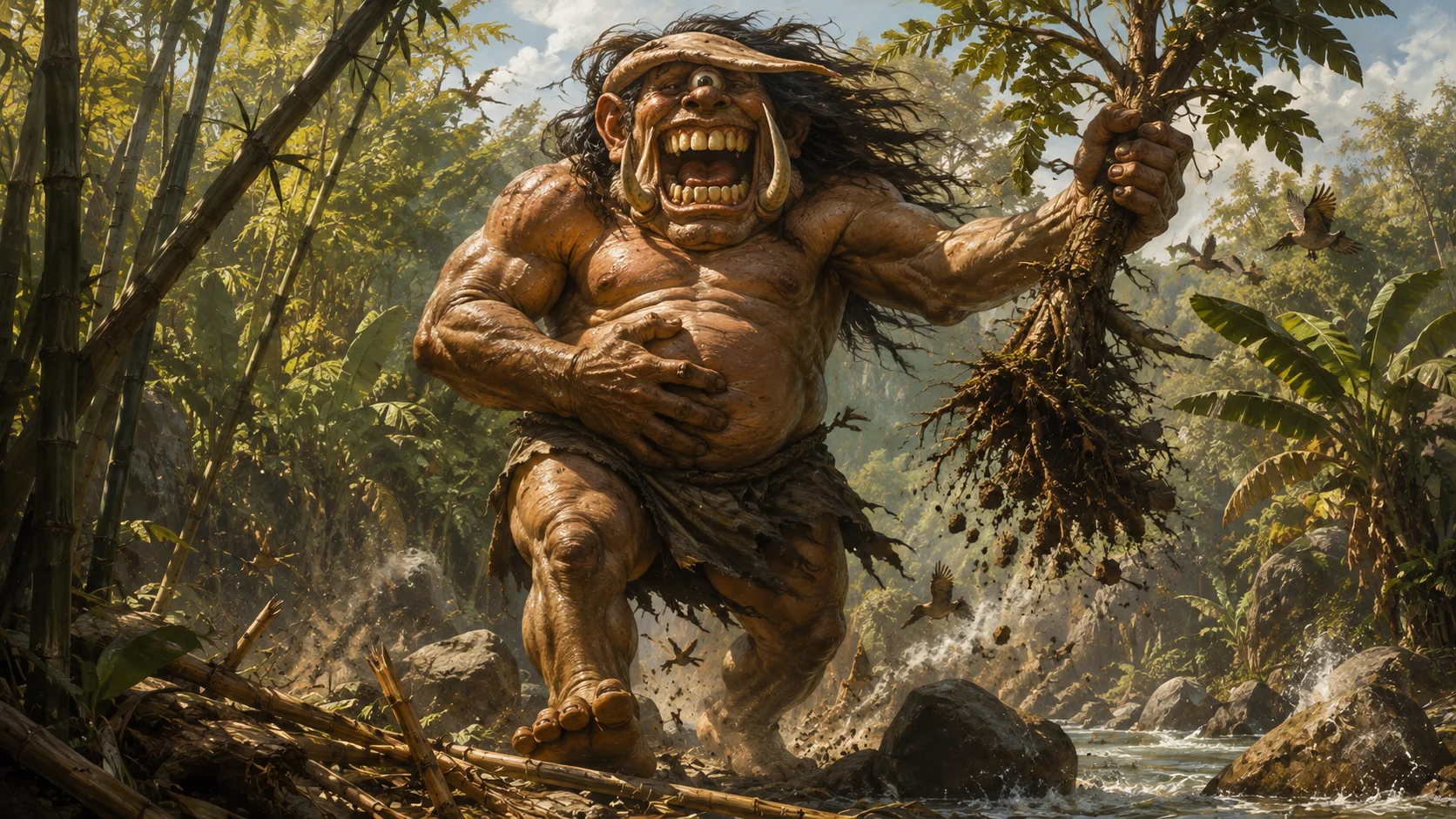
The Bungisngis is the one-eyed laughing giant of Philippine folklore: a huge, cyclopean ogre named for its constant grinning and laughter, ngisi, to grin, a creature of immense strength but limited wits that haunts the forests and rivers, the Filipino cyclops, both menacing and faintly comic.
A Name Built From a Grin
The bungisngis takes its name directly from the Tagalog word ngisi, or its reduplicated form ngisngis, meaning to grin or to giggle. Rendered into the creature's name, it means something close to "the ever-grinning one" or "the constant giggler." This is not a name given in passing description, the way a chronicler might note a distinctive habit; it is the entirety of the creature's identity compressed into a single word. Where other giants of the world are named for size, for hunger, or for the mountains they are said to live beneath, the bungisngis is named for an expression on its face. Every telling of the tale, however much the details shift from town to town, keeps this one constant: the giant laughs, and its laughter is the first and last thing anyone remembers about it.
Last updated .
A Single Eye, a Curling Lip
Philippine folklore classifies the bungisngis among the higante, the giants of the archipelago's oral tradition, and gives it a face built for its name. It is typically described as cyclopean, one great eye set in the middle of its forehead, and its most distinctive feature is an oversized upper lip that curls back on itself, exposing large teeth in a grin that never quite closes. The grin is not incidental to the description; across tellings it is the creature's signature visual trait, the detail a storyteller reaches for first. Some versions have the giant able to fold that great lip back over its own face, using it almost as a hood. As with much of the bungisngis's physical description, however, the exact particulars, the number of eyes, the precise size, are not fixed. Philippine folklore was never centralized into a single canonical text, and the bungisngis's face changes shape somewhat depending on which storyteller, and which town, is doing the telling.
Jolly Rather Than Predatory
What separates the bungisngis from many of its fellow higante is temperament. Philippine folklore holds a number of giant figures who hunt and eat people, predators dressed in the shape of mountains, but the bungisngis is not generally counted among them. It is depicted as jolly, good-natured, and simple-minded, a creature whose menace, such as it is, comes from its size and strength rather than from any appetite for harm. This sets it apart from figures like the man-eating Sarangay, or the giants associated with Kaptan in Visayan tradition, whose stories are built around danger and predation. The bungisngis's stories are built around something gentler and, in their way, more human: a large, strong, foolish creature who means no one any particular harm, and who nonetheless has to be dealt with.
Strength Undone by a Simple Mind
Despite its friendly disposition, folklore is consistent in framing the bungisngis as dim-witted. This is not treated as a flaw the giant might overcome; it is the defining combination the stories are built to exploit. Great strength paired with low cunning is the standard narrative device used against the bungisngis in every tale where it appears, and it is precisely this pairing, rather than any cruelty in the giant's nature, that supplies the conflict. A creature that could simply be avoided would make for a thin story. A creature whose strength is real, whose danger is real, and whose mind can nonetheless be turned against it by anyone patient enough to try, makes for a story with teeth.
The Trickster Who Wins by Wit
The central folk-tale motif built around the bungisngis is a contest between a small, clever human and the far stronger giant, one the human wins not through force but through wordplay, riddles, or a rigged contest. In many oral variants the human is a boy, and the tale sits comfortably alongside other Filipino trickster narratives, the malakas-versus-matalino pattern, strength against cleverness, in the vein of Juan Tamad-style tales, where wit rather than brawn decides the outcome. What makes the bungisngis such a serviceable opponent for these stories is its own laughter and gullibility. The giant that grins at everything is a giant that can be led, distracted, and flattered into a contest it does not realize it has already lost. Its good humor, the very trait that makes it likable, is also the lever the trickster pulls.
A Dweller of Forest and Mountain
The bungisngis belongs to the broader Philippine category of higante, or engkanto-adjacent nature giants, believed within animist and pre-colonial belief systems, later layered over with Spanish-era folklore, to make their homes in forests, mountains, and remote wilderness, away from human settlements. This placement matters to how the stories function. The bungisngis is not a creature that comes looking for people; it is one that people, in the stories, go looking for, or stumble across, deep in territory that does not belong to the village. Its wildness is geographic as much as it is a matter of temperament, a giant that keeps to the tree line and the high ground, laughing to itself where no one else can hear.
A Tale Without a Single Fixed Telling
Although the bungisngis appears predominantly in Tagalog-region folk literature, no single standardized "official" version of its story exists. Some folklore compilations, among them the early twentieth-century anthologies collected by Dean Fansler, group the bungisngis alongside other regional giant figures, but the tellings vary meaningfully by locality and by storyteller. The eye count, the size, the exact habitat, all of these shift from one version to the next. This is worth stating plainly rather than smoothing over: the bungisngis is not a figure with a fixed canon in the way a deity with a cosmological genealogy might be. It survives instead as a living oral character, reshaped a little in every mouth that tells it.
Brute Strength, an Old Idea Dressed Fresh
Symbolically, the bungisngis functions in Filipino oral tradition as a stock "strong but foolish" antagonist, part of a broader Southeast Asian and Filipino folk-narrative pattern in which physical power is defeated by cunning. This pattern is not unique to the bungisngis, and its narrative role, if not its origin, has been compared to giant figures found in other Philippine ethnic traditions. The comparison is one of function, not of lineage: the bungisngis was not derived from those other giants, but it fills the same structural slot in its stories that they fill in theirs, the obstacle that raw strength alone was never going to be enough to solve.
From Forest Tale to Festival Float
In more recent times, some folklore references have drawn a connection between the bungisngis and the higante parade tradition of certain town fiestas, among them Angono, Rizal's well-known higantes festival, and its association with the sarimanok imagery of Filipino festival art. This connection is worth flagging clearly as a modern cultural and artistic extension rather than attested precolonial belief. The paper-mache giants that tower over a fiesta procession are a twentieth-century civic invention, and their link to older forest-dwelling figures like the bungisngis is a matter of shared category, giants, rather than a documented line of descent. It is a real and living part of how Filipino communities engage with their giant-folklore, but it sits apart from the older oral tale.
A Minor Figure, Widely Retold
Among the giants of Philippine folklore, the bungisngis has become one of the more commonly anthologized figures in children's storybooks and folklore compilations produced from the twentieth century onward. Its combination of comic menace and eventual defeat by a clever underdog makes it a natural fit for young audiences, and it has settled into something like a recurring supporting role, the comic-relief giant, in the broader landscape of retold Filipino folk tales. It has never carried the weight of the archipelago's major cosmological figures, and does not need to; its purpose in the tradition was always more modest, and it has filled that purpose well.
No Origin, Only the Telling
Unlike figures such as Bathala, or the paired origin-couple Malakas at Maganda, the bungisngis has no standard, attested origin myth, no creation account explaining where it came from or why it exists. It appears primarily as a character within the prose and oral folk-tale tradition, rather than as a figure with any cosmological genealogy behind it. Any claim of a deeper "origin story" for the bungisngis beyond its role in these trickster tales should be treated as unverified and drawn, at best, from a single source rather than from the broader tradition. The giant simply is, fully formed, at the start of whichever tale is being told, waiting in its forest for someone clever enough to outlast its laughter.
The Grinning Giant, Remembered
In the bungisngis, Filipino folklore gave form to the one-eyed laughing giant, the immensely strong but dim-witted cyclops of the forests and rivers, the grinning ogre whose booming laughter echoes through the wild, menacing yet comic, the Filipino cyclops who can be felled by cunning where strength would fail. It is not a figure of dread, and it was never meant to be. It endures instead as proof of a much older lesson the tradition never tires of telling: that the strongest arm in the forest is no match for the sharpest mind, so long as that mind is patient enough to wait for the giant to laugh.