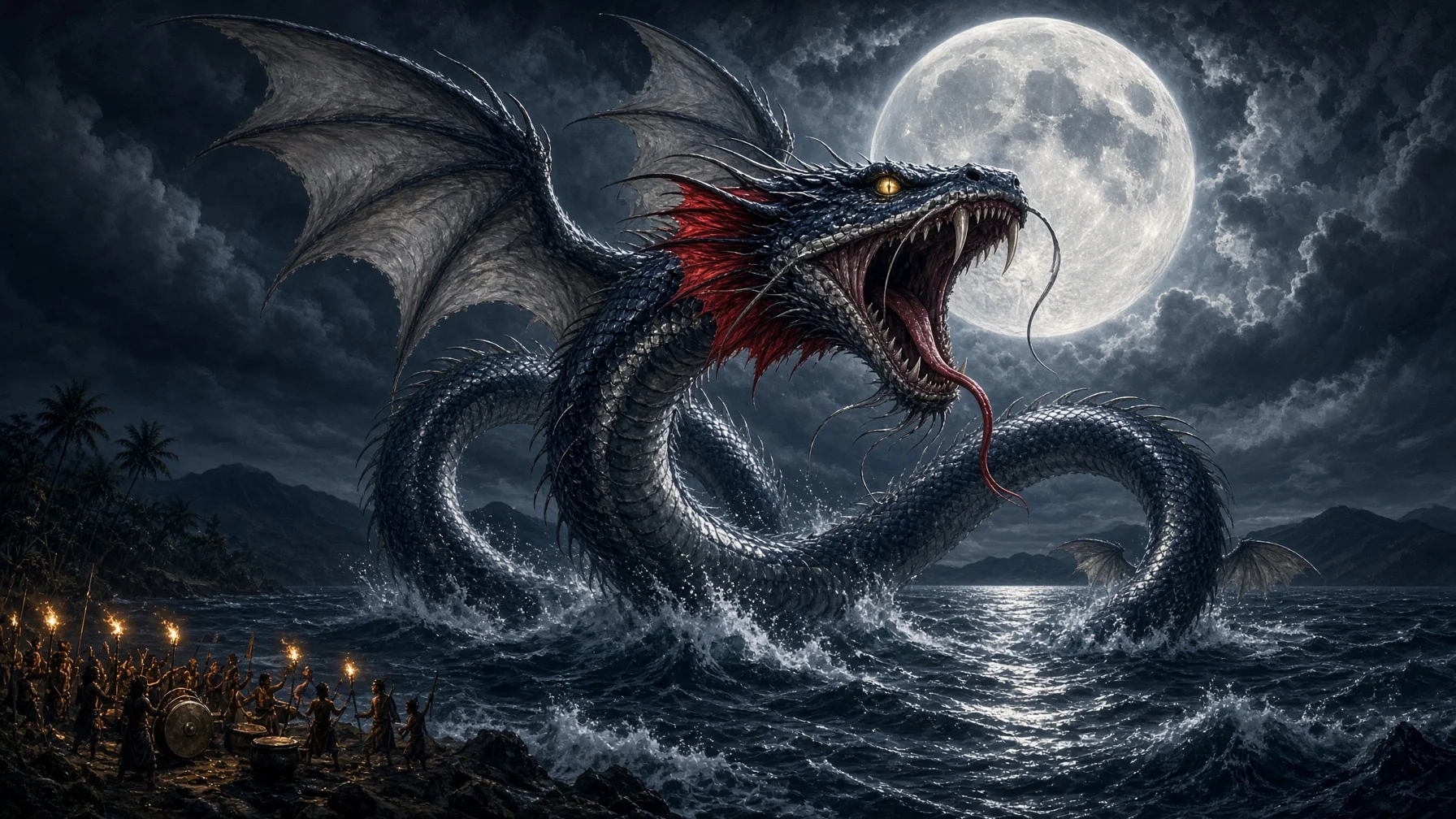
The Bakunawa is the great moon-devouring serpent-dragon of pre-colonial Visayan cosmology: a colossal sea-serpent said to rise from the deep and swallow the moon whole, an act the old skywatchers of the islands held responsible for the eclipse, and which, in the founding myth, had already happened six times before.
A Coil Beneath the Waves
Long before Spanish chroniclers set any of this down in writing, communities across the Visayas told of an immense serpent living in the deep sea, vast enough in scale that its body could reach up out of the ocean and close around the moon itself. Descriptions of the Bakunawa are not uniform from one telling to the next; there is no single fixed portrait that all sources agree on. Most consistently, it is described as a giant, eel-like or serpentine dragon with an enormous mouth, capable of taking the entire moon into it. Later illustrated and popular retellings have added horns, wings, and other more overtly dragon-like features, but folklorists are clear that this imagery reflects the influence of East Asian dragon iconography on modern depictions rather than anything attested in the precolonial oral material. The oldest layer of the tradition is simpler and starker: a serpent, the sea, and the sky.
Last updated .
Seven Moons in the First Sky
The myth that made the Bakunawa famous begins with an early state of the heavens different from the one visible now. In the telling recorded by later folklorists, including material gathered in Damiana Eugenio's collections of Philippine folk literature, the sky once held seven moons rather than one, lighting the night far more brightly than it does today. The Bakunawa, rising from its place in the sea, devoured six of these seven moons in succession, leaving behind the single moon that still crosses the sky each night. This is the story's core claim, and it is the one detail that recurs across the widest range of sources: not a single eclipse, but a sequence of celestial disappearances that explain why the night sky looks the way it does now rather than the way it once did.
The Eclipse as Unfinished Business
The Bakunawa myth is, at its root, an etiological story — one told to account for an observed natural phenomenon rather than simply to entertain. Having swallowed six moons already, the serpent was understood to still want the seventh and last. A lunar eclipse, in this framework, was not a separate or unrelated event; it was read as the Bakunawa returning to make its final attempt, rising once more to try to take the one moon still left in the sky. Every darkening of the moon was, in effect, a live rerun of the founding myth, which is part of what gave the story its lasting grip on communities who watched the sky without modern astronomy to explain what they were seeing.
Noise Against the Dark
Faced with the moon vanishing before their eyes, Visayan communities responded with what remains the most widely documented element of the whole tradition: noise. Villagers would strike pots and pans, beat gongs and drums, shout, and make as much commotion as they could manage, all aimed at frightening the Bakunawa into releasing its grip and disgorging the moon. This practice is attested across multiple regional folklore collections rather than confined to a single island or town, which suggests it functioned as a shared, practical response to eclipses throughout much of the Visayas rather than a story detail unique to one community. It turned an anxious, uncontrollable celestial event into something people could actively answer — noise as a form of communal defiance against the dark.
Bathala's Hand in the Story
In a number of tellings, the myth does not leave the moon's survival to noise alone. The supreme deity Bathala, or in some regional variants a local moon-goddess figure, is described as intervening to protect the last remaining moon from the Bakunawa, which ties the story into the wider Bathala creation-myth cycle rather than leaving it as an isolated tale of a monster and its prey. Which deity is involved, and how directly they act, varies by source, and this variation should be understood as a genuine feature of the oral tradition rather than a discrepancy to be resolved — different communities carried different versions of who, if anyone, stood between the Bakunawa and the sky.
Echoes in the Hinilawod
Bakunawa's presence is sometimes felt beyond its own central myth. Some scholarly and popular retellings place it alongside the Hinilawod epic tradition of Panay, home to heroes such as Labaw Donggon, where serpent and sea-monster antagonists appear as part of the epic's cast. It is worth being precise about what is and is not established here: a direct, one-to-one identification of a specific Hinilawod serpent as the Bakunawa by name differs from one retelling to another, and this connection is best treated as a variant link between two bodies of story rather than a single settled fact shared by all versions of either tradition.
Names the Serpent Wears Elsewhere
The name Bakunawa itself belongs to the Visayan-speaking regions of the Philippines, and it is worth being careful about how far that name travels. In Mindanao and other regions, folk traditions describe broadly similar moon- or sun-eating serpent and dragon beings under entirely different local names. Scholarship on this point urges caution: these should be understood as parallel motifs — the same kind of story appearing independently or through diffusion in different communities — rather than as confirmed identical beings simply wearing different labels. The impulse to explain eclipses through a sky-swallowing serpent was evidently widespread; the Bakunawa is the specifically Visayan expression of it.
A Comparison, Not a Common Origin
Folklorists making comparative studies of Philippine mythology have at times grouped the Bakunawa together with other serpent-adjacent beings, including Naga-influenced imagery found in some Mindanao and Muslim Filipino artistic traditions. This grouping serves an academic, comparative purpose — setting related serpent figures side by side to study their shared and differing features — and it is not a claim that these figures share a single origin or belong to one unified "Filipino serpent mythos." The traditions in question are culturally distinct, and treating them as interchangeable would flatten real differences between separate communities' beliefs.
Helpers at the Edge of the Story
A smaller number of folklore compilations preserve a further variant: in a few Visayan tellings, a woman or a particular bird species is said to help warn of, or ward off, the Bakunawa as it approaches the moon. These helper figures are inconsistently attested — they surface in some regional collections and not in others — and so they are best understood as minor, localized variants layered onto the core myth rather than as part of its settled canon. They are a reminder that oral traditions of this kind were never perfectly uniform even within the Visayas itself; the noise-making response and the seven-moons framework are far more consistently recorded than any particular rescuer figure.
What the Serpent Is Read to Mean
Beyond the narrative itself, folklorists have offered interpretive readings of what the Bakunawa represents. It is generally understood as an embodiment of cosmic disorder or chaos, a force that threatens the settled order of the heavens by removing the lights that structure the night. Some later interpretive writing has also read the Bakunawa as a figure tied to fertility or to the sea's destructive power, given its oceanic origin. These readings belong to scholarship and modern interpretation rather than to the original oral canon itself, and they sit alongside, rather than replace, the more literal function the myth served for the communities who told it: an explanation for why eclipses happen and a script for responding to them.
Bago City and the Living Claim
The Bakunawa has not stayed confined to the past. In parts of the Visayas, and notably in Bago City and other localities in Negros Occidental, local legend and tourism branding claim a specific association with the Bakunawa, using it in civic symbolism and festival themes. This is a living, present-day dimension of the tradition rather than a historical footnote — communities in these areas have taken up the serpent as part of how they represent themselves publicly, a continuation of the myth's presence in everyday cultural life rather than a purely academic survival.
A Modern Recurrence
The Bakunawa also has an active life in contemporary Philippine popular culture, appearing as a recurring name and motif across fantasy novels, comics, and video games. Among the more widely noted examples is Trese, the comics series by Budjette Tan and Kajo Baldisimo, which draws on Bakunawa-related lore as part of its broader engagement with Philippine mythology. This ongoing presence in fiction and games sits apart from the oral tradition proper, but it is one of the clearest signs of how firmly the moon-devouring serpent has held on in the popular imagination long after the eclipse itself stopped needing a mythic explanation.
The Serpent That Remains
Across all its variants — the seven moons, the noise of pots and gongs, Bathala's protective hand, the echoes in the Hinilawod, the parallel serpents of other regions, and its second life in modern fiction and local festival branding — the Bakunawa endures as one of the clearest examples of how a community turned an unpredictable celestial event into a story with a shape, a cause, and a response. It devoured six moons and reaches, in the old telling, for the seventh still; the noise that once answered it has quieted, but the serpent itself has not left the sky it was said to darken.