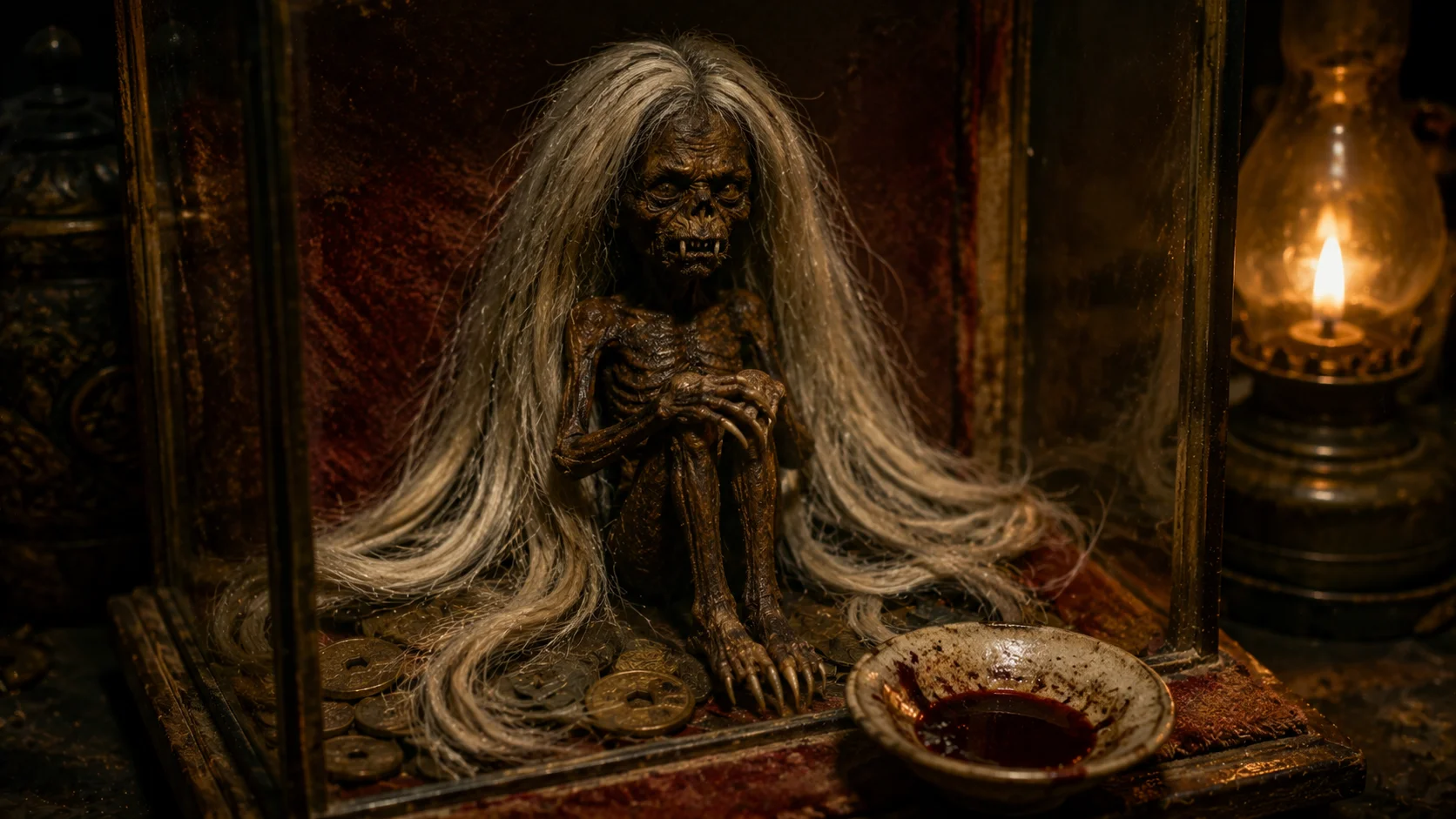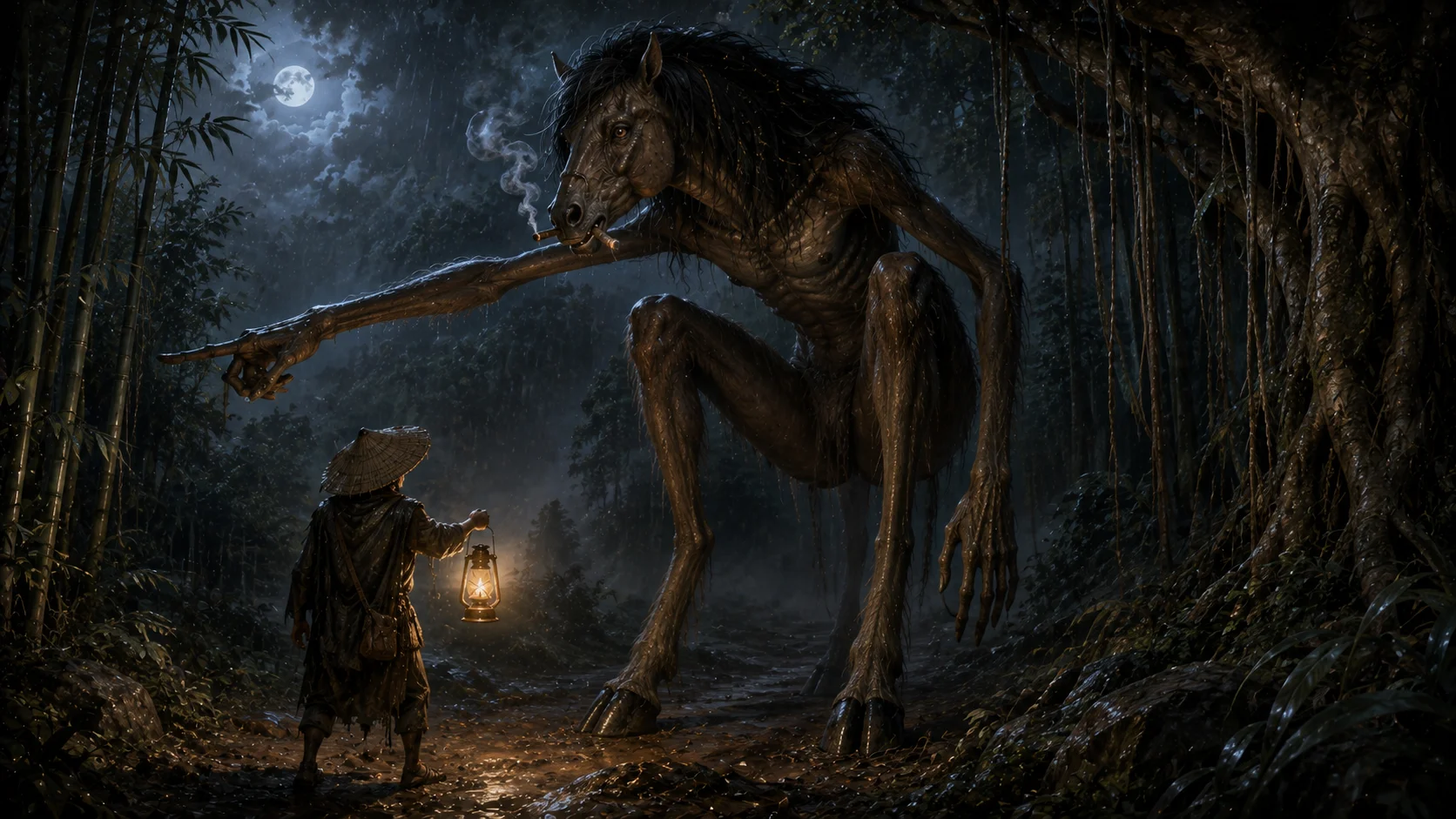
The Tikbalang is the horse-headed trickster-creature of Philippine lowland folklore: a tall, gangly, demon-like being with the head and hooves of a horse and the body of a lean man, who haunts the forests, mountains, and lonely roads, leading travelers astray and playing pranks. Few figures in the islands' oral tradition are as widely attested, and few have travelled as far into modern film, komiks, and fantasy fiction while still keeping one foot in the deep forest where the old stories placed it.
A Silhouette Too Tall for the Trail
The tikbalang is described as a tall, bony, humanoid creature with the head and hooves of a horse and remarkably long limbs, so disproportionately long that when it squats on its haunches, its knees rise above the level of its own head. Travelers who glimpse it at a distance, half-hidden among trunks and shadow, are said to know it first by that wrong proportion, a shape too tall and too thin to be a man, with a horse's profile where a face should be.
Last updated .
Groves, Mountains, and the Roots of the Balete
It dwells in the wild and lonely places: the deep forests, the mountains, the bamboo groves, and especially beneath great trees and along the lonely roads and trails. Old or unusually large trees, and above all the balete, are widely regarded in Filipino folk belief as dwelling places for engkanto and spirits in general, and the tikbalang's association with such trees places it squarely within that broader landscape of the unseen. A traveler passing beneath a balete at dusk is passing, by long custom, through territory that is not entirely his own.
A Name Debated Between Two Tongues
Even the creature's name is contested ground among folklorists. One proposed derivation reads it as a compound of "tao," person, and "kabayo" or "kabalyo," horse, the latter borrowed from the Spanish "caballo." Other scholars argue instead for a pre-Hispanic Malayo-Polynesian root that predates Spanish contact entirely, making the horse-man reading a folk etymology laid over an older word. The debate is not settled, and any account that presents one derivation as certain is simplifying a real and ongoing disagreement among those who study the language.
The Path That Turns Upon Itself
The tikbalang's best-known trick is to lead travelers astray. A person walking a familiar path at night may suddenly find themselves hopelessly lost, walking in circles, unable to find their way home no matter how well they know the road. In Tagalog folklore this disorientation is called being "naligaw sa tikbalang," lost through the creature's doing, or "nawilihan," a supernaturally caused loss of direction. It is not simple confusion but a targeted unmaking of a traveler's sense of place, attributed directly to the creature's mischief.
Turning the Shirt to Turn the Spell
Against this the folk tradition offers a remedy that is documented widely across Tagalog sources: the lost traveler turns his shirt, or other article of clothing, inside-out. The reversal is said to break the tikbalang's enchantment and free the wanderer to find the path again. It is a small, practical piece of counter-magic, requiring no priest or charm, only the presence of mind to remember it while already disoriented and afraid.
Asking Leave of the Unseen Landlord
A second and gentler defense is courtesy itself. Filipino custom holds that one asks permission aloud before passing through territory that may belong to an engkanto, most commonly with the phrase "tabi-tabi po," excuse me, please allow me to pass. This courtesy is used generally toward spirits of the wild, and by extension it is applied to the tikbalang as one of the beings whose ground a careless traveler might otherwise trespass upon. The phrase asks nothing more than acknowledgment, that the wilderness is inhabited and deserves to be addressed as such.
Three Hairs and a Reversal of Power
A bolder strand of legend holds that the tikbalang itself can be mastered. The recurring motif, attested across many tellers with variation in its particulars, involves plucking one of three golden or magical hairs from the creature's mane. The teller who accomplishes this is said to gain power over the tikbalang, sometimes turning it into a servant bound to obey. The exact number of hairs and the precise nature of the power granted shift from one telling to the next, but the shape of the tale, a wild and dangerous being brought low by a single act of daring, recurs constantly enough to count as one of the creature's defining stories.
A Handsome Face Worn Over a Horse's Skull
In some regional and later elaborations, the tikbalang is described as a shapeshifter capable of taking the form of a handsome man in order to seduce or mislead women. This layer of the legend is genuinely attested but is a variant rather than a universal feature, present in some tellings and absent from others, and it sits alongside the creature's more constant reputation as a misleader of travelers rather than replacing it.
Kin Among the Engkanto
Filipino folklorists such as Maximo Ramos have classed the tikbalang among the broader category of engkanto, or lower mythological beings, a taxonomy that took shape after contact with Catholic Spain and that groups it alongside figures such as the duwende and the kapre. The tikbalang and the kapre, a tree-dwelling giant, are often mentioned together as fellow guardian spirits of the forest, and modern retellings sometimes depict them as friends or rivals. That specific relationship between the two is best understood as a popular-culture elaboration rather than a strictly attested precolonial belief, a newer layer built on top of an older shared habitat.
A Nature Spirit Recast as Demon
Some scholarly and folk accounts trace the tikbalang's monstrous reputation to a process of diabolization, in which pre-Hispanic nature spirits were reframed as devils or monsters under Spanish colonial and Catholic influence. Ramos and later folklorists have documented this pattern as a broader feature of how animist belief was recast during and after colonization. This is offered as scholarly interpretation rather than as a native origin myth in its own right, a lens for understanding how the creature's image may have darkened over time rather than a story the tradition tells about itself.
Competing Whispers on Where It Comes From
The tradition offers no single agreed account of the tikbalang's origin. One folk explanation, documented in Ramos's scholarship, ties its origins to aborted fetuses or to the souls of those who died unbaptized, guardian spirits or transformed offspring bound to ancestral or unconsecrated realms. This sits among several competing folk explanations rather than standing as the tradition's settled answer, and different tellers and regions have offered different accounts of how the creature came to be.
A Watchman at the Edge of the Known Path
Beyond any single tale, the tikbalang functions as a guardian-spirit-of-the-wilderness figure, a warning against trespass and carelessness in unfamiliar natural terrain. Its power to disorient a traveler on a path he thought he knew reinforces a broader Filipino folk ethic of respect toward nature and toward the unseen beings believed to inhabit it, the same ethic that underlies the custom of asking leave before entering the forest's deeper reaches.
Cousins Across the Islands
Regional and ethnolinguistic variation runs through Philippine folklore, and figures loosely comparable to the tikbalang are attested elsewhere, including the amomongo and other hybrid beast-men of Visayan tradition. Whether these regional beings are truly equivalent to the Tagalog tikbalang, or simply share a family resemblance as hybrid forest-dwellers, is not fully standardized among folklorists, and the comparison is best understood as loose kinship rather than strict identity between figures from different traditions.
From Forest Path to Film Screen
Of the beings in Philippine folklore, the tikbalang is by far the most mainstream in modern popular culture. It appears extensively across Filipino film and television, particularly in fantasy and horror productions, in the long-running komiks tradition, and in contemporary fantasy fiction, including works such as Trese. It has become something of a mascot for Philippine mythology in general, appearing on merchandise and in mythology-themed media well beyond its older, more oral and forest-bound origins, a striking distance travelled for a creature first described crouched beneath a balete tree with its knees above its head.