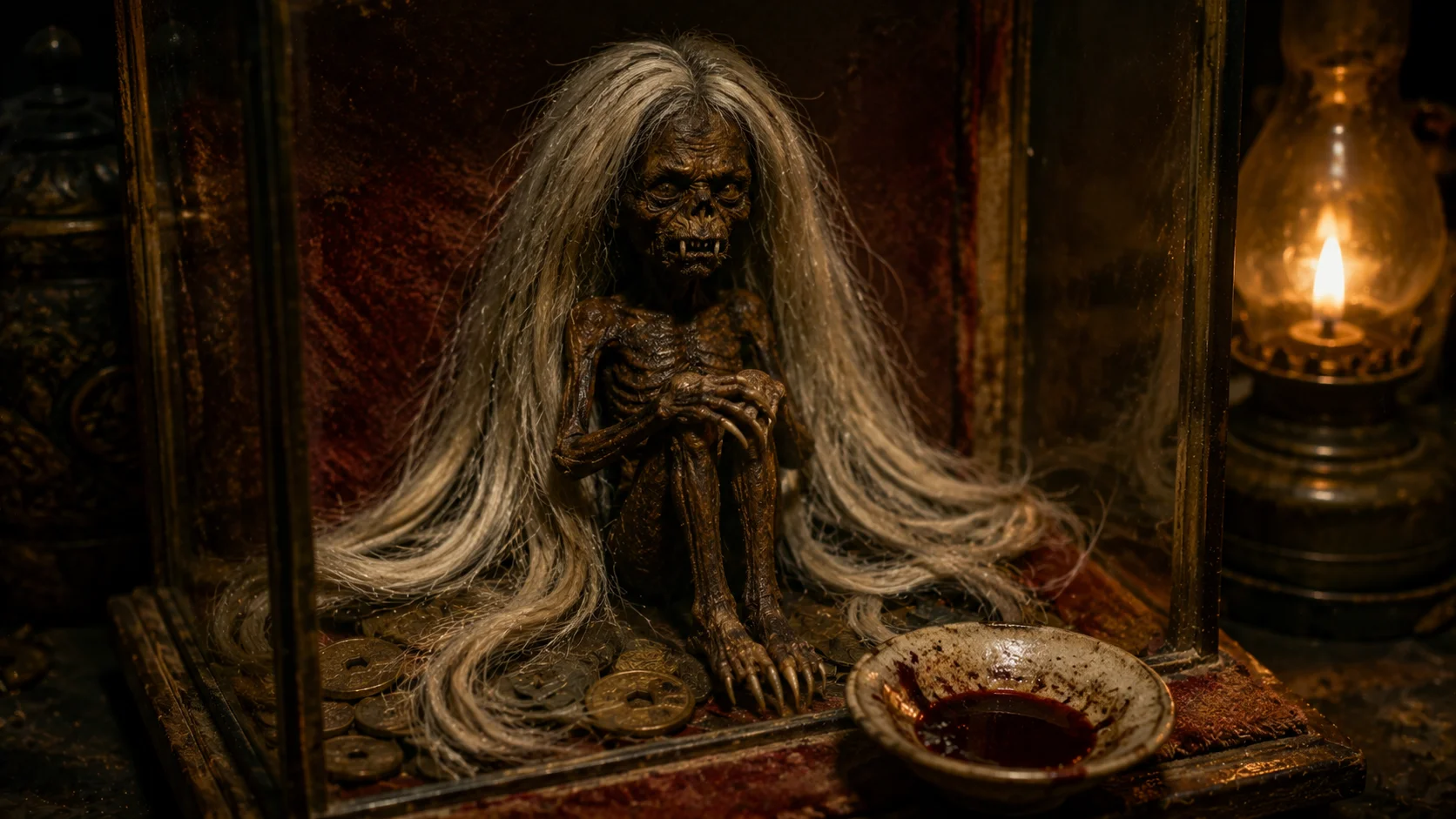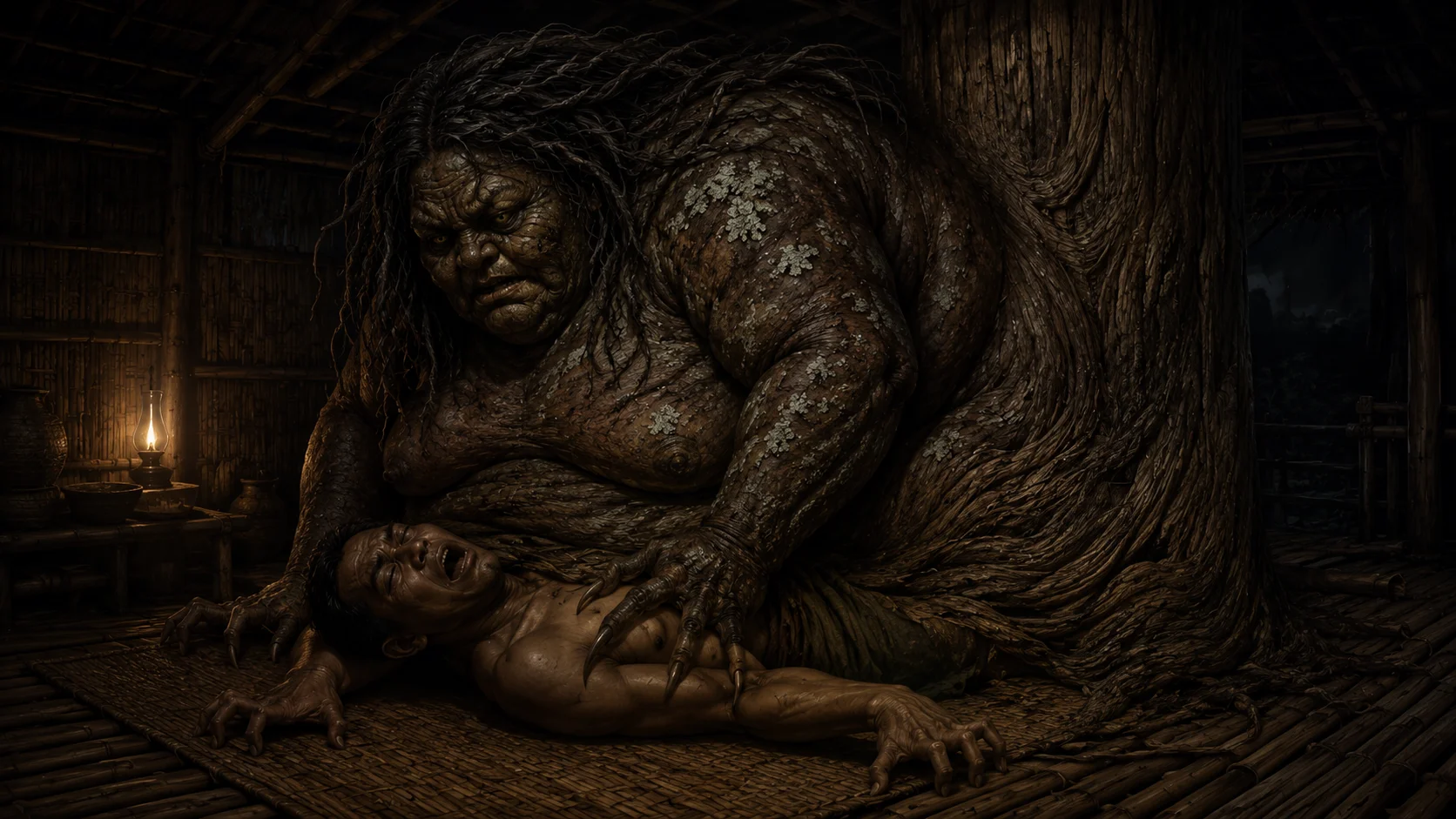
The Batibat is the great, corpulent tree-spirit of Ilocano folklore, dwelling in the north of Luzon, in the region called Ilocos. She is a huge and matronly female demon bound to old trees — the balete, with its curtaining roots, and the dapdap, the coral tree — and she asks nothing of the living so long as her tree is left standing. It is only when the axe falls, when her home is felled for lumber and shaped into the post of a house, that the Batibat becomes what the Ilocano night fears most: the crushing weight that settles on a sleeper's chest and will not let them breathe.
A Spirit Bound to Bark and Hollow
In Ilocano belief, the Batibat is not a wandering demon but a resident one, fixed to a single tree the way a guardian is fixed to a threshold. She favors trees already old when the living generation was born — balete trees with their tangle of hanging roots and shadowed hollows, and dapdap, the coral tree. Within the trunk, in some hollow or crevice, the Batibat is said to keep a kind of dwelling, and so long as the tree stands, she is content to remain there, unseen and mostly unbothered by the people who pass beneath its branches.
Last updated .
She is described, in the tellings that have survived into folklore compilations, as enormous and unlovely by conventional standards — fat, matronly, sometimes outright monstrous in size, though not monstrous in the sense of youthful horror-imagery. Some accounts give her the power to shapeshift, but the core of her description across sources is consistent: she is corpulent, she is female, and she is old in the way the tree she inhabits is old.
The Felling That Follows a Family Home
The engine of every Batibat story is displacement. Ilocos is a land of woodcutters and house-builders, and sooner or later, someone's balete or dapdap is chosen for timber — perhaps for a haligi, the post that will bear the weight of a family's roof for generations. What the woodcutter does not know, or chooses not to heed, is that felling the tree does not evict its resident. The Batibat, driven from her hollow, does not vanish with the sawdust. She follows the wood.
She takes up residence again inside the very beam or post that was cut from her tree, carried now into the frame of a house she never chose and among people who never asked her permission to be neighbors. It is a story with an unmistakable shape: a wrong done unknowingly, and a consequence that arrives not as accident but as retribution, delivered by the one being who remembers exactly what was taken.
Where the Danger Sleeps
Not every corner of the house is equally dangerous. The peril concentrates around the specific post that carries the Batibat within it — the particular haligi cut from her particular tree. Sleeping directly beneath it, or too near it, is what draws her attention, and some versions of the lore are explicit on this point: it is a caution embedded in the practical business of house-building itself, a reminder that where you lay your sleeping mat matters as much as how sound your roof is.
In this way the Batibat's story functions as more than a scare. It threads a genuinely useful piece of domestic wisdom — mind your floor plan, mind which post you sleep beside — into a narrative dark enough that no one forgets it.
The Night She Comes to Sit
When the Batibat chooses to act, she is said to leave the post after dark and approach whoever sleeps nearby. She grows, in these accounts, to a huge and heavy form, and she settles herself upon the sleeper — upon the chest, upon the face — pressing down with the full crushing weight she carries. The sleeper wakes, if they wake at all, into paralysis: unable to move, unable to cry out, unable to draw breath, pinned beneath a weight that feels total and inescapable.
It is the oldest shape of nightmare there is, rendered concrete: the sense, common across many cultures, of a presence sitting on the sleeper's chest in the depths of the night, of waking half-conscious and wholly helpless. In Ilocano tradition this sensation has a name and a cause, a demon with a grievance rather than an unexplained terror, and that naming is itself a kind of comfort — a thing that can be reasoned about, warned against, and in the worst case, resisted.
Bangungot, the Death That Follows
The Batibat's attack is not always survived. Ilocano folklore holds her responsible for bangungot, the phenomenon of a person, apparently healthy, dying suddenly in their sleep — and it is worth being precise about what that word properly names. Bangungot refers most exactly to the death itself, the sudden nocturnal death, while the Batibat is the traditional explanation offered for why it happens: not illness, not misfortune, but a tree-spirit's revenge finally completed.
Bangungot is also a real and documented occurrence, a sudden nocturnal death syndrome that medicine has studied in its own right, in some cases connecting it to a cardiac condition known as Brugada syndrome. This is one of the clearer instances of a folk explanation and a medical phenomenon sharing a name and a set of symptoms while remaining, properly understood, two separate accounts of the same tragic event — the medical cause is not the demon, and the demon's story is not medicine, and Ilocano communities that told these stories were reaching, generation after generation, for a way to give shape and meaning to a death that otherwise arrived without warning or explanation.
Wiggling Free of the Weight
Ilocano tradition is not without its remedies. A sleeper who feels the crushing weight descend and finds themselves unable to move or cry out is counseled to fight back in small ways — to bite down on their own thumb, or to wiggle their toes, forcing some small motion through a body that otherwise refuses to obey. The theory embedded in this advice is that even the smallest deliberate movement can break the demon's hold and wake the sleeper fully.
Help can also come from outside. A person sleeping nearby who notices the trapped sleeper's distress is told to call their name or shake their foot, rousing them from outside the paralysis rather than leaving them to fight it alone. These are remedies that echo far beyond Ilocos — the crushing night-demon and the toe-wiggling, name-calling countermeasure both belong to a wider family of sleep-paralysis folklore found across Southeast and East Asia, each tradition arriving independently at strikingly similar advice for a strikingly similar experience.
Asking Pardon Before the Axe Falls
Beyond the remedies for an attack already underway, the deeper counsel in Batibat lore is preventive. One does not fell an old, unfamiliar tree without a kind of caution — without acknowledging that something may already call it home. Asking the spirit's pardon before cutting, and taking care afterward about where the resulting timber is placed within a new house, are both part of the same underlying ethic: old trees are not simply resources waiting to be harvested, they may be residences, and treating them as empty ground is how a family invites a demon into their own roof beam.
A Cautionary Figure Rooted in Respect for the Forest
Read as a whole, the Batibat functions in Ilocano oral tradition as a figure of consequence rather than of arbitrary cruelty. She does not hunt; she responds. Her violence is always downstream of a violation already committed against her — a home destroyed, a body displaced, a life uprooted without ceremony or acknowledgment. In that shape, her story becomes a vehicle for a value the culture wants preserved: carefulness toward nature, and specifically toward the old, undisturbed corners of the forest that a family might otherwise clear without a second thought.
It is a warning wearing the shape of a demon, doing double duty as both a frightening tale worth repeating around a household and a practical instruction about which trees deserve hesitation before the axe is raised.
Female Among the Guardians of the Trees
Philippine folklorists group the Batibat among a broader category of tree-dwelling nature spirits and guardians — beings tied by function to particular trees across the archipelago's many regional traditions, such as the diwata and the kapre, each said to inhabit and defend specific trees in their own separate lore. The kinship here is one of role, not of shared identity or shared story; these are distinct beings from distinct traditions, and standard Ilocano lore does not record any meeting or rivalry between the Batibat and figures like the kapre — such an encounter belongs to invention, not to what has actually been passed down.
What does distinguish the Batibat within this broader category is her gender. Where many of the Philippines' male tree spirits are given their own separate reputations and behaviors, the Batibat is consistently female across the tellings that survive — a stable, recurring trait that sets her apart even among beings who otherwise share her basic function as a tree's resident guardian.
A Name That Belongs to the Ilocos
It is worth being precise about how far the Batibat's name actually travels. She is specifically an Ilocano figure, native to the beliefs of the Ilocos region, and not a being known uniformly across every Filipino ethnolinguistic group. Other regions of the Philippines — among certain Visayan communities and elsewhere — tell their own stories of a chest-sitting nocturnal demon under entirely different names, and while scholars of Philippine folklore have noted the family resemblance among these nightmare-demon figures, that resemblance is a pattern noticed across separate traditions, not evidence that they are secretly the same being wearing different names. The Batibat, properly understood, belongs to the Ilocano telling and to the Ilocos region specifically.
From the Old Post to the New Page
The Batibat has not stayed confined to oral memory. Across the decades from the 1990s into more recent years, she has found her way into modern Filipino horror media — into comics, into horror-anthology films and television segments, into the compilations of Philippine mythology that introduce younger readers to the country's traditional creatures. The exact list of titles that have carried her forward is not uniformly documented across sources, so she is best described in general terms as one of several traditional beings revived for contemporary audiences, rather than credited to any single named work.
This afterlife matters because it is the mechanism by which a regional, Ilocano-specific figure becomes known to Filipinos well outside the Ilocos — and it is worth remembering, reading any modern retelling, that the original lore is narrower and more specific than the pop-culture version might suggest.
What Endures in the Telling
Documented in the folklore compilations and mythology dictionaries that have preserved Ilocano belief, the Batibat remains a regional figure with a clear and consistent shape: a fat, female tree-spirit, displaced by the axe, taking her revenge from within the very post built to shelter the household that wronged her, sitting her crushing weight upon the sleepers below until someone bites a thumb, wiggles a toe, or calls a name loud enough to pull them back from the dark. She is, in the end, the old fear of the felled tree given a face and a grievance — proof that in Ilocano memory, cutting something down is never quite the end of the story.