Maria Makiling, also called Mariang Makiling, is the diwata — the guardian nature-spirit — of Mount Makiling, a dormant volcano rising over Laguna province on the island of Luzon. She is the best-known named diwata in Philippine legend, a figure so closely bound to her mountain that many tellings give her no family, no lineage, no surname beyond the name of the peak itself. She is not a deity descended from a pantheon of ancestors; she is the mountain's own spirit, given a woman's shape.
The Woman the Mountain Wears
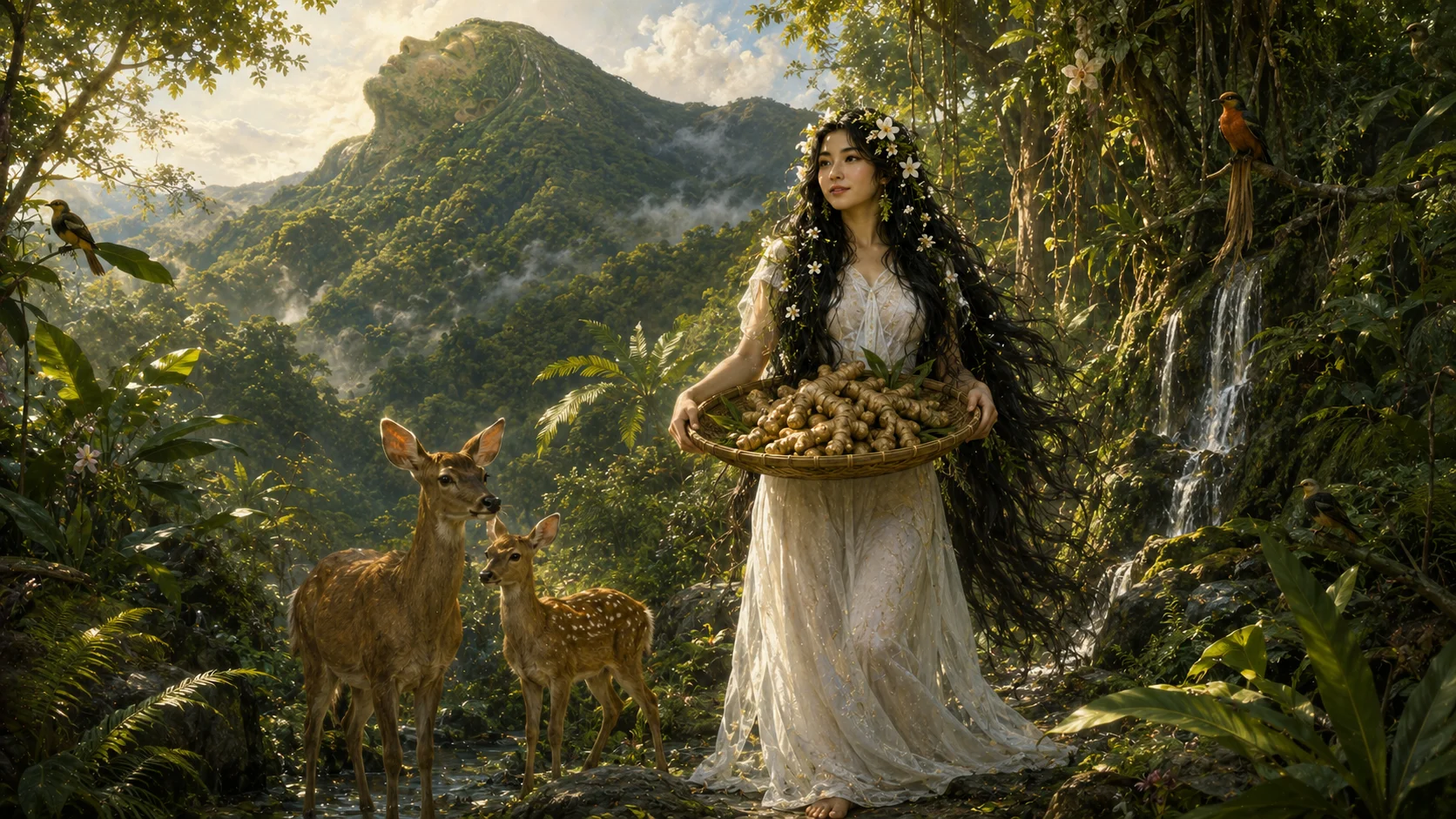
She is described, across generations of retelling, in strikingly consistent terms: a young woman of serene, ethereal beauty, fair-skinned, with long black hair and a quiet, watchful presence that unsettles no one who comes to her mountain with clean intentions. She is the enchanted guardian of Mount Makiling's forest and everything that forest holds — its game, its fruiting trees, its root crops, its water. To walk the mountain is, in the old telling, to walk through her house.
Last updated .
Local lore adds a second, stranger layer to her presence: that her likeness can still be traced in the mountain's own silhouette. Seen from certain angles across the Laguna lowlands, the ridge line is popularly said to resemble a woman reclining — her profile, her hair, the slope of her body laid across the horizon. This is a claim carried by tradition and by the eye of whoever is looking, not a documented fact, and it is repeated as legend precisely because no one claims otherwise.
Guide to the Lost, Healer of the Sick
The oldest and most widely told function of Maria Makiling is not romantic at all — it is practical, almost domestic in its kindness. Hunters who lost their bearings among her trees, farmers caught by weather on her slopes, travelers who fell ill far from any village: these are the people her legend says she found. She is credited with guiding them back to safety and with restoring health to those who fell sick while under her mountain's care.
She was also, in this same body of story, a source of plain material generosity. Those who asked respectfully were given bountiful game, fruit, and root crops from the forest she watched over. But her generosity came bound to conditions, and the conditions mattered as much as the gift: take only what is needed, and never look back while leaving her domain. The instruction reads almost like a warning passed down through households near the mountain rather than a moral invented for a story — practical wisdom dressed as etiquette toward a spirit who was, in every sense that counted to the people who lived below her slopes, a neighbor.
The Borrowed Rice, the Broken Promise
One of the most widely recorded episodes concerning Maria Makiling has nothing to do with romance and everything to do with trust between the mountain and the village. Preparing for a fiesta, or for a wedding, villagers would come to her for rice, for salt, for ginger — provisions borrowed rather than given outright. Her condition was exact: what was borrowed had to be returned in the same amount, unwashed, undiminished, exactly as it had been lent.
In some tellings, it is precisely here that the old abundance is said to have ended. A village failed to honor the condition — returned less than was borrowed, or returned it changed — and Maria Makiling withdrew her generosity from humankind. The story functions, in this shape, as an explanation offered by the people who told it: why the mountain no longer answers as freely as it once did, why her gifts became memory rather than expectation. It is worth holding this strand apart from the romantic legends that follow, since more than one explanation for her withdrawal survives in the tradition, and none of them cancels the others.
Rizal's Mountain, Remembered from Childhood
The most famous literary telling of her legend comes from an unlikely source: the national hero Jose Rizal, who wrote an essay simply titled Maria Makiling, published in 1890 in the reformist paper La Solidaridad. Rizal drew the piece from stories he had heard as a child growing up in Laguna, in the shadow of the mountain itself.
Rizal's account is a major source for how the figure is known today, and it has shaped generations of readers through Philippine schooling. But it is worth naming plainly what it is: a literary retelling, filtered through one writer's craft and one childhood's memory, not a transcription of a single uniform oral tradition. Details that trace specifically to Rizal's essay belong to Rizal's essay — a beautiful and formative version of the legend, but one version among the many that circulated, and continue to circulate, around the mountain itself.
The Suitor Who Chose a Mortal Wife
Woven through the legend cycles is Maria Makiling's courtship by mortal men — most often described as a hunter, or a soldier, drawn up the mountain and into her company. In several versions, she comes to love a human suitor, only for him to marry a mortal woman instead, sometimes named in later retellings as Amasol or Amable, or to fail a promise he had made her.
Her heartbreak, or her disappointment, is the folkloric hinge on which much of her later remoteness turns: the story explains why she grew reclusive, why she became harder for mortals to see, as a consequence of this failed love rather than of anger or caprice. It is a gentler explanation than the broken-promise tale of the borrowed rice, and the tradition does not insist on choosing between them — both exist, told by different voices in different corners of Laguna, each accounting in its own way for the same quiet withdrawal.
Two Men, One Mountain, and a Story of Its Times
A further, more politicized strand of the legend involves not one suitor but two: a doomed love triangle in which a Spanish civil guard and a local Tagalog man both seek her affection. This version reads as allegory as much as folklore — the tension between colonizer and colonized carried inside a love story, the mountain spirit standing at the center of a conflict that was never really about her alone.
This telling belongs more to later literary elaboration than to a uniformly attested pre-colonial motif, and it should be understood as one strand among several rather than the single canonical shape of her story. It says something honest, even so, about how a legend keeps growing new meanings in new eras — the same diwata, asked to carry the weight of whatever her tellers most needed to say.
Diwata, Not Engkanto
Within Tagalog tradition, Maria Makiling is grouped among the diwata — the nature-guardian spirits bound to particular places, mountains, rivers, ancient trees — a category folklorists treat as distinct from the engkanto, though the two are sometimes loosely conflated in casual speech. Diwata is the older, indigenous term for these benevolent nature spirits; engkanto lore carries a more Hispanized character, shaped by centuries of contact with Spanish colonial belief. Maria Makiling belongs properly to the first tradition, and keeping that distinction clear matters to understanding her as she was originally conceived — not an import, but a figure rooted in a naming system that predates the ships that eventually reached Laguna's shores.
A Forest Worth Protecting
Beyond her stories, Maria Makiling has settled into a second life as a symbol of ecological stewardship. Mount Makiling today sits within a protected forest reserve managed together with the University of the Philippines Los Baños, and her legend is regularly invoked in Philippine environmental and conservation messaging — a guardian spirit whose old rule, take only what is needed, reads today as an argument for restraint that predates the vocabulary of conservation by centuries. She personifies the mountain's abundance and stands, in the same breath, as a moral exemplar for how that abundance ought to be treated.
A Face Carved Into Laguna Itself
Her image has spread far past the mountain that gave her a name. Statues and murals of Maria Makiling stand at the University of the Philippines Los Baños and elsewhere around Laguna. She appears throughout Philippine literature and school curricula, carried in no small part by Rizal's essay into generations of classrooms. She has been retold in komiks, in film, and in television adaptations of Philippine mythology, and her name has been lent to local landmarks, awards, and organizations tied to Laguna and to UPLB — a diwata who has become, over more than a century, one of the most recognizable cultural icons the Philippines has produced.
A Presence Still Glimpsed
Local, place-based lore holds that she has never fully left. She is said to still be glimpsed on the mountain even now — a graceful woman in white, moving among the trees, or simply present in the way her silhouette is said to rest across the ridge for anyone who looks up from the right angle in the lowlands below. This is legend rather than record, offered by those who live closest to the mountain rather than settled by any authority beyond their own seeing — and it is offered, still, in the present tense.
What Endures on the Slope
Across every version — the healer of lost hunters, the lender of rice who asked only honesty in return, the beloved who was not loved back, the spirit caught in a colonial-era story not of her own making — Maria Makiling remains, first and last, the shape the mountain takes when it is imagined as capable of caring whether it is treated well. Her many strands do not resolve into a single tidy account, and the tradition never asked them to. What survives instead is a mountain in Laguna that people still describe, when the light falls a certain way, as wearing the face of a woman who is watching.