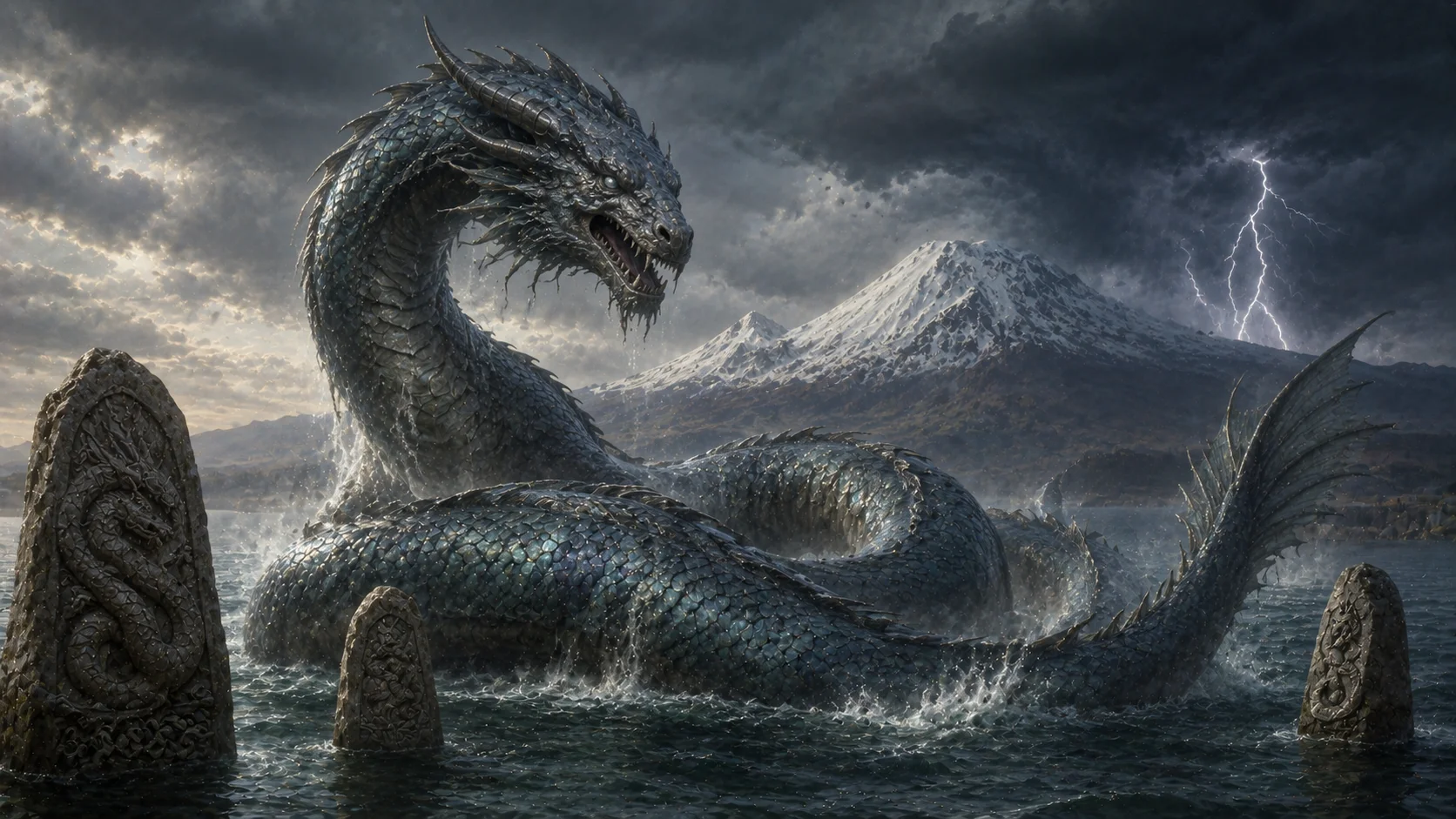
The Vishap, Vishapk, the dragons, are the great dragons and water-serpents of Armenian mythology: monstrous serpent-dragons associated with water, springs, storms, and the high mountains, dwelling in lakes and on the peaks, especially the volcanic heights around Mount Aragats and the Geghama range, hoarders and withholders of the waters, the great adversaries slain by the dragon-reaper Vahagn, and commemorated in the ancient megalithic vishap stones of the Armenian highlands. They are the dragons, the water-serpents of Armenia, and their name and their memory reach back further into the highland's deep past than almost any other figure of Armenian belief.
Serpents of the High Water
The Vishap, Armenian vishap, plural vishapk, are the dragons of Armenian mythology, great serpent-dragons and water-monsters, among the most ancient and important supernatural beings of the Armenian highlands. They are associated above all with water and with the high mountains: they dwell in the deep lakes, the springs, and the rivers, and on the high peaks, in the clouds, and in the storms that break over the highland ridgelines. They are imagined as huge serpents or dragons, beings of great age and power, bound inseparably to the waters and the weather of a mountainous land where every spring and every storm cloud could plausibly hold a coiled and watching presence.
A Name Carried on Old Winds
Scholars examining the word vishap through comparative linguistics have linked it to the Iranian Avestan terms azi and vishapa, the dragon-language of Zoroastrian tradition. This connection reflects a broader pattern in which dragon-lore, absorbed from Iranian religious culture, became woven into the pre-Christian religion of Armenia. The vishap is therefore not an isolated invention of the highland but a figure that arrived, or was shaped, at a crossroads where Armenian belief met the older serpent-mythologies of the Iranian world, and where a shared vocabulary of dragons and chaos-serpents circulated between neighboring traditions.
The Withholders of the Springs
The Vishap are often cast as the withholders and hoarders of the waters, dragons who block the springs, swallow the rains, or dwell in storm-clouds and high lakes, controlling or threatening the waters on which the people depend, and by their hoarding causing drought upon the land. As such they are the adversaries that must be overcome for the waters to flow and the land to be fruitful, the chaos-serpents whose defeat releases the rain and restores the fields. This motif places the vishap within a much wider pattern recognized across the Indo-European world: the storm god who does battle with a water-blocking serpent so that life-giving water may again reach the earth.
Vahagn, the Dragon-Reaper
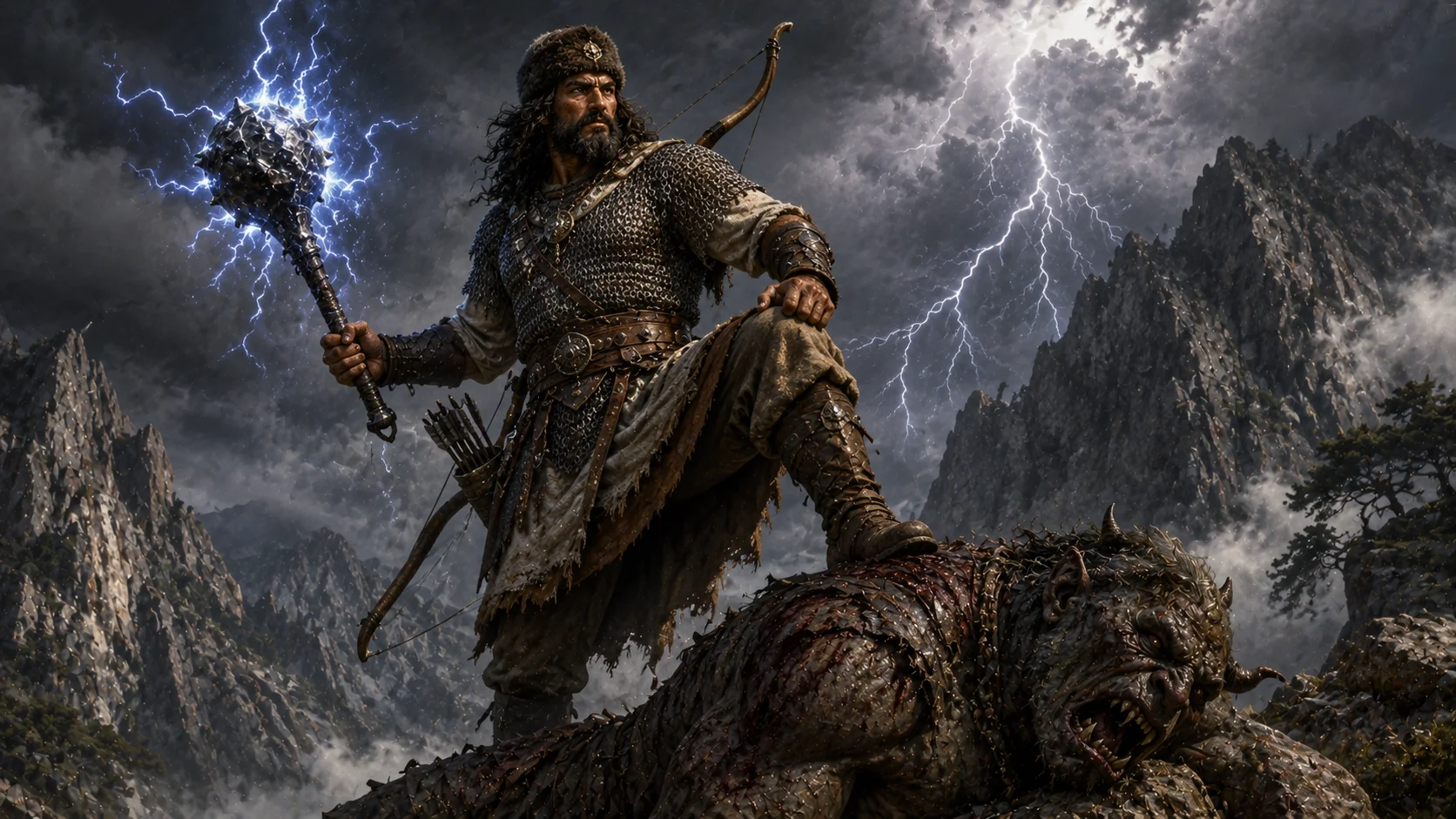
The storm and thunder god Vahagn bears the epithet vishapakagh, the Vishap-Reaper or Dragon-Reaper, an epithet attested in the fifth-century History of Armenia by Movses Khorenatsi. This title casts Vahagn as the principal slayer of dragons, the god who hunts and destroys the vishapk and, in so doing, frees the waters and overcomes the forces of chaos threatening the land. Scholars studying comparative Indo-European myth have drawn a direct line between Vahagn's dragon-slaying and the storm god Verethragna of Iranian tradition, as well as to the Vedic god Indra's slaying of the serpent Vritra — three separate traditions converging on the same essential drama of thunder god against water-serpent.
When the Sky Itself Coils
Later Armenian ethnographic folklore records a further dimension to the vishap: some are described as capable of rising into the sky as storm clouds or as waterspouts and whirlwinds, so that the dragon is not confined to the lake bed or the mountain spring but can become, briefly, the storm itself. This belief binds the vishap to meteorological phenomena as much as to still water, suggesting that in the minds of those who told these stories, a black cloud gathering over a ridge and a serpent coiled beneath a lake's surface were understood as different appearances of the same underlying danger.
Stones Cut in the Shape of Water and Beast
The Vishap are commemorated in one of the most remarkable and best-studied monuments of the ancient Armenian highlands: the vishapakar, the dragon stones, great basalt stelae carved with fish-like bodies and with the imagery of bull hide or bull heads. These stones are found at high-altitude sites near Mount Aragats and across the Geghama mountains, and archaeologists generally date them to the Bronze Age, the second millennium BCE. They are connected by most researchers to water and irrigation cult sites of the period, though the precise original ritual function of the vishapakar remains a matter of ongoing scholarly debate rather than settled fact.
Cranes Among the Carved Fish
Some of the vishapakar stelae bear carved cranes or other waterfowl alongside their fish and bull imagery, a detail that has led some scholars to argue the stones may be linked more specifically to seasonal water and irrigation ritual than to a narrative of dragon-worship as such. This interpretation is not universally accepted among specialists, and the stones continue to resist a single settled reading — but the presence of these birds is itself a reminder that the vishap's stone monuments were raised at the meeting point of water, seasonal cycle, and the sacred, however exactly that meeting was understood by the people who cut them.
Older Than Armenia Itself
Because vishap iconography intersects with the wider ancient Near Eastern and Iranian sphere, some scholars have proposed Urartian-era precedents for the dragon-stone tradition, precedents belonging to the first millennium BCE and to a kingdom that predates the Armenian nation as such. The question of ethnic and cultic continuity between Urartian practice and later Armenian vishap veneration remains disputed, and this chronicle records the proposal as a scholarly hypothesis rather than settled fact — the vishapakar stand at a depth of time where certainty gives way to careful argument.
Dragons of the Deep Lakes
The vishap as a lake-dwelling monster surfaces in local Armenian toponymic legend, tradition tied to specific places on the land rather than to formal chronicle. Folklore associated with Lake Sevan and with other lakes of the Armenian highlands holds that a vishap inhabits the depths of the water. These are localized oral traditions, distinct from the classical textual attestations of Vahagn's dragon-slaying, and they show how the great mythic pattern of dragon-in-the-water persisted at the level of a single named lake, told and retold by those who lived beside it.
New Champions for an Old Battle
In the Christian era, Armenian folklore reassigned the work of dragon-fighting to new figures: to Saint Sarkis, and to legendary heroes given the title vishapakagh in their own right, and in some regional cycles of legend to Artavazd. This is properly understood as a later, distinct stratum of tradition, a folkloric continuation layered on top of the earlier pre-Christian Vahagn tradition rather than a simple replacement of it. The dragon endured through the change of religion; only the name of its adversary shifted to fit the age that was telling the story.
Dragons in the Daredevils' Song
The vishap motif persisted long past its ancient roots, appearing as antagonist in the Armenian oral epic cycle known as the Daredevils of Sassoun, or Sasna Tsrer. In this cycle, heroes such as Mher the Younger and other Sassountsi figures do battle with dragon-like creatures descended, in spirit if not in direct textual line, from the vishap of earlier belief. Their presence in a medieval and early modern epic tradition demonstrates how durable the image of the dragon-in-the-mountains proved to be, carrying the ancient motif forward into a living, sung literature many centuries after the vishapakar were first cut from stone.
A Word Grown to Fit Any Dragon
In Armenian, the word vishap broadened over time beyond its specific mythic origin to become the general lexical term for dragon or giant serpent, and it was carried into later Christian translation literature, appearing, for instance, in Armenian Bible translations to render Leviathan-type sea monsters. This semantic widening shows a being once tied to particular lakes, particular springs, and a particular divine adversary becoming, over centuries, the very word a language reaches for whenever it must name something vast, serpentine, and formidable.
Kin Across the Old World's Storms
Scholars following the structural approach associated with Georges Dumezil have compared the vishap motif to the broader Indo-European mytheme of the serpent-slaying storm god, placing it alongside Greek Typhon and Python, Hittite Illuyanka, and Norse Jormungandr. Whether these figures share a genetic descent from a common ancestral myth or arose in parallel through comparable religious logic remains disputed among specialists, and this chronicle offers the comparison as the scholarly context it is, not as a claim that the vishap and its distant cousins were ever one and the same being.
The Dragon That Remains
As the great dragons and water-serpents of the lakes and peaks, the hoarders of the waters slain by Vahagn the Dragon-Reaper, and the beings whose memory is carved into the ancient dragon stones of the highland, the Vishap are the dragons of Armenia in the fullest sense of that description. In the vishap, the pre-Christian religion of the Armenian highlands gave lasting form to a figure that touched water, mountain, storm, and sky alike — a serpent-dragon old enough to be cut in Bronze Age basalt, resilient enough to survive into Christian-era folklore and the sung epic of later centuries, and present enough in the language itself that its name became simply the word for dragon.
Sources & traditions
- EncyclopediaWikipedia — Vishap
- TraditionArmenian folk and village traditions
Myths change from area to area and from time to time. This chronicle follows the most widely told versions; tellings in other villages, regions and eras may differ.