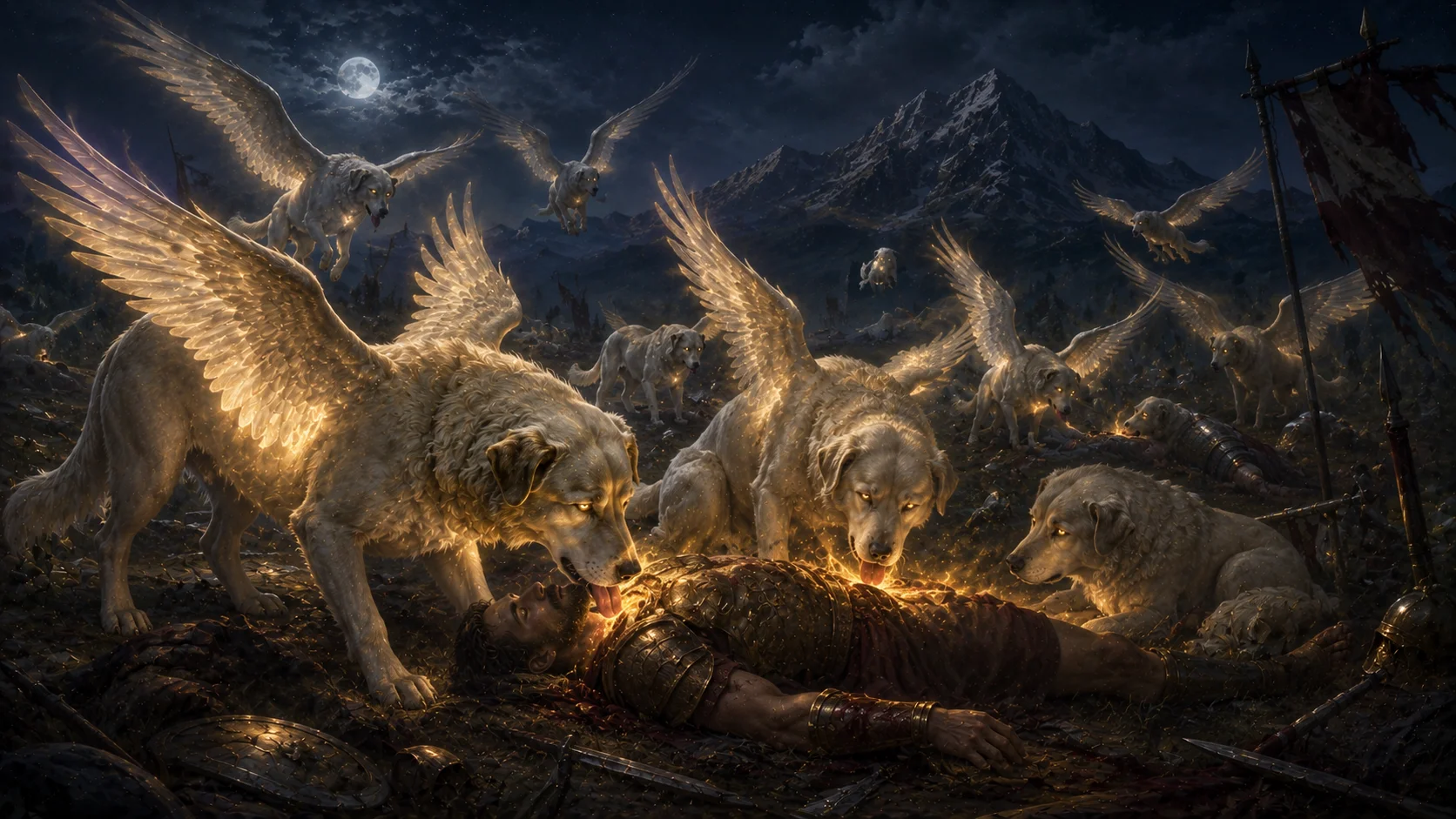
The Aralez (Armenian: Առլեզներ, Aralezner in the plural) are dog-spirits of pre-Christian Armenian belief, said to descend upon the fallen of the battlefield and lick their wounds, hoping in this way to call the dead back into life. They are remembered above all through the medieval historian Movses Khorenatsi, who set their story into the oldest surviving account of Armenian myth, and through the later epic cycle of the Sasna Tsrer, where the old belief still stirs beneath the verse.
Dogs Sent Down From the Heights
In the memory Movses Khorenatsi preserved, the Aralez are not ordinary dogs. They are spirits in the shape of dogs, described in later Armenian folk tradition as winged, set apart from any animal that walks among the living. Their place is not the hearth or the field but somewhere above it, a height from which they are called down, or from which they choose to come, toward the bodies of the slain. What distinguishes them is not ferocity but tenderness turned toward the dead: the single, defining act of licking wounds, performed in the hope — not the guarantee — that life will follow.
Ara the Beautiful and the Queen Who Would Not Let Him Die
The story that carries the Aralez furthest into Armenian memory is that of Ara Geghecik, Ara the Beautiful, and Shamiram — the Armenian rendering of the Assyrian queen Semiramis. Khorenatsi records that Shamiram desired Ara and invaded Armenia meaning to take him alive, and that in the battle which followed Ara was slain. It is at this point, in the version Khorenatsi sets down, that Shamiram orders his body carried to a high place — deliberately, purposefully — so that the Aralez might come to him. The instruction itself is evidence of how real the belief was taken to be: a queen at the height of a war-effort staking part of her hope on the dogs of the sky.
A Wound Licked, A Story Left Open
What happened next is not settled, even in the oldest surviving telling. Khorenatsi himself records more than one version of the Ara legend, and the sources do not agree that the Aralez succeeded. In one telling the licking of the wounds is followed by Ara's return to life; in another, revival does not come, and Shamiram — unwilling to let the army's grief curdle into revolt — disguises one of her own men as the restored Ara to placate the soldiers rather than presenting an actual resurrection. The Aralez's attempt, in other words, stands recorded as attempted and hoped-for, not as uniformly successful. That uncertainty is not a gap in the record to be smoothed over; it is part of what the story is.
The Lick That Was Meant to Undo Death
Underneath the particular story of Ara lies a broader, older belief: that the Aralez did not confine their descent to kings. Armenian folk tradition held that they came for warriors generally, drawn to anyone who fell in battle, licking wounds in the hope of drawing the fallen back across the line death had drawn. The specific act — the tongue against the wound — was not incidental ornament. It was the whole of their power as it was understood: a healing that worked through touch, through the old and widely felt intuition that a dog's licking tends and cleans a wound, lifted here into something that might, if the spirit willed it, reverse death itself.
This wider belief is worth holding beside the story of Ara rather than treating it as a mere footnote to it. Where the tale of Ara and Shamiram fixes the Aralez to one battlefield, one slain prince, and one grieving queen who staked a command on their power, the broader folk tradition scatters that same hope across every battlefield Armenia's warriors ever fell on. Any fallen fighter, not only a king remembered by name, might be laid out in the hope that the dog-spirits would come. The myth of Ara is the sharpest surviving instance of a hope that, in ordinary practice, was believed to extend far wider than any single legend could record.
A Name Built From the Act Itself
Armenian philologists have long connected the word aralez to the root lizel, to lick, though the fuller shape of the etymology remains debated and no single derivation commands full agreement. What can be said is that the name, however its pieces are finally parsed, keeps faith with the defining action: a dog-spirit is called what it is because of what its tongue does to the wounds of the dead. Few mythic beings anywhere carry their function so plainly folded into their own name.
Gods Older Than Memory Itself
The Aralez belong to a layer of Armenian religious life that predates the written record which preserves them. Khorenatsi, writing after Armenia's conversion to Christianity as state religion in the early fourth century, records the Aralez as inherited pagan lore — a historian's account of what earlier generations had believed, not a doctrine of his own church. That distance matters: it means the Aralez survive to us at all only because a Christian chronicler thought the old belief worth setting down rather than erasing, treating it as part of Armenia's history even as the faith around him had moved elsewhere.
The Dog as a Being Between Worlds
The reverence given to the Aralez sits inside a wider pre-Christian Armenian regard for the dog as a creature standing at thresholds — between the living and the dead, between the ordinary animal and something touched by the sacred. This is a distinctly Armenian tradition in its particulars, even as it echoes a broader pattern found elsewhere across the Indo-European and ancient Near Eastern world, where dogs recur as beings that move along the boundary of death rather than staying safely on one side of it. The Aralez are Armenia's own answer to that intuition, given a name, a story, and a single sacred task.
What the Sight of Them Was Believed to Mean
To see, or to imagine, the Aralez descending was itself an omen — a sign bound up with death and with the fragile possibility that death might yet be answered. Their coming did not announce triumph or doom on its own; it marked the moment where a life hung between the two, and where the community watching could do nothing further but hope the dogs would do what only they were said to be able to do. That is the emotional core the myth protects: not certainty of resurrection, but the permission to hope for it even at the graveside.
Carried Forward Into the Songs of Sassoun
The Aralez did not remain locked inside Khorenatsi's account of ancient kings. They travelled onward into the Sasna Tsrer, the Daredevils of Sassoun, Armenia's great medieval epic cycle, where the deaths of heroes still summon the old dog-spirits into the telling. That the belief could migrate from a fifth-century historian's record of pagan antiquity into a living oral epic tradition centuries later says something about how deeply the image had settled into Armenian storytelling: not a curiosity confined to one queen and one slain prince, but a motif the culture kept reaching for whenever a hero fell.
A Hope Worn Down Into a Saying
Over time the image of the Aralez licking a wound passed out of epic and into everyday Armenian speech, becoming a proverbial way of gesturing at a hoped-for recovery that does not, in the end, arrive — the wish for revival invoked precisely because the outcome is not assured. That a myth should end up folded into idiom is its own kind of survival: the Aralez outlived the battlefield, the epic verse, and even literal belief in winged dogs, by becoming a shorthand the language itself still remembers.
Reading the Old Belief on Its Own Terms
To take the Aralez seriously is to resist smoothing their story into a single tidy shape. They are not simply "resurrection gods" with a guaranteed happy ending, nor are they a minor decorative detail in the tale of Ara and Shamiram. They are dog-spirits whose power was believed real enough that a queen would act on it, whose success or failure the sources themselves leave open, and whose deeper meaning lies less in whether Ara rose than in what it meant for a whole tradition to keep hoping that he might. Armenia's oldest surviving mythic record chose to preserve exactly that: not a miracle confirmed, but a wound, a height, and dogs sent down to try.
Why the Historian Kept the Story At All
It would have been easy for Movses Khorenatsi, writing squarely within a Christian Armenia, to leave the Aralez out of his history altogether, or to fold them into a single dismissive line. He did neither. He set the belief down with enough care that later readers can see not only that the Aralez were believed in, but how — what act they performed, where they were thought to dwell, and what a ruler was willing to do on the strength of that belief. A historiographer's caution, recording inherited lore rather than endorsing it as his own faith, turns out to be the reason the Aralez survive for us to read about at all. Without that willingness to preserve what had already passed out of active worship, the dog-spirits of the wound-lick would likely have vanished as completely as countless other pieces of Armenia's pre-Christian religious world.
Two Deaths, One Unanswered Question
It is worth sitting with what the variant tellings actually offer, rather than choosing the more comforting one and calling it the myth. In the version where the Aralez succeed, Ara returns and the story closes on restoration. In the version where they do not, Shamiram's response is not despair but strategy: a substitute dressed to resemble the fallen prince, presented to the army so that grief does not tip into mutiny. Read together, the two versions are not really in competition. They preserve, side by side, both the sincerity of the hope invested in the Aralez and the honest Armenian acknowledgment that hope of this kind is not the same thing as certainty. A tradition capable of holding both versions at once, without forcing a single verdict, is a tradition thinking seriously about what it means to ask the dead to return.
A Belief That Refused to Stay Buried With the Old Religion
Most of pre-Christian Armenia's specific gods and spirits faded from active memory once the old religion gave way, surviving today mainly as names in a historian's account. The Aralez took a different path. Their image kept resurfacing — first preserved deliberately by Khorenatsi as history rather than devotion, then picked up again centuries later by the oral poets who shaped the Sasna Tsrer, and finally worn smooth into everyday idiom, invoked whenever someone speaks of a recovery hoped for but not assured. Few figures from Armenia's pagan substratum can claim that long a second life, moving from altar, to chronicle, to epic, to language itself, without ever quite becoming pure metaphor along the way.
Sources & traditions
- EncyclopediaWikipedia — Aralez (mythology)
- TraditionArmenian folk and village traditions
Myths change from area to area and from time to time. This chronicle follows the most widely told versions; tellings in other villages, regions and eras may differ.