Ochokochi is the wild forest-man of western Georgian, particularly Mingrelian, mountain folklore — a huge, hair-covered, ape-like being of the deep woods, remembered above all for the sharp, axe-like ridge of bone said to run down its chest, the weapon with which it crushed those unlucky enough to be caught in its embrace. Recorded by Georgian folklorists from the oral tradition of highland and forest communities in the nineteenth and twentieth centuries, Ochokochi belongs to the wider Caucasian family of "wild man of the woods" legends, a regional cousin in theme, though not in name or identity, to the almasty told of further north and east in the Caucasus. It is one of the best-known forest-spirits of Georgian folklore, a figure still cited in Georgian folklore scholarship and popular tradition as an emblem of the untamed wild that begins where the village ends.
A Name Carried Down From the Forest
The name Ochokochi, rendered in Georgian script as ოჩოკოჩი, is understood by those who have studied western Georgian regional folklore as combining elements that point toward "forest man" or "wild, hairy man" — a name that describes the being rather than merely labelling it, in the way that much of Caucasian oral tradition names its spirits for what they are and where they dwell. As with any name passed down through generations of village storytellers rather than fixed in a single written text, its exact derivation is not settled with certainty in the surviving scholarship, and it should be understood as a traditional, regionally rooted name rather than a precisely documented etymology. Variant forms of the name are recorded across different Georgian highland communities, a natural feature of a figure who lived in spoken memory long before he lived on any page, carried from valley to valley by tellers who each kept the shape of the story while letting its details, and sometimes its very name, shift a little in the telling.
The Shape of the Creature
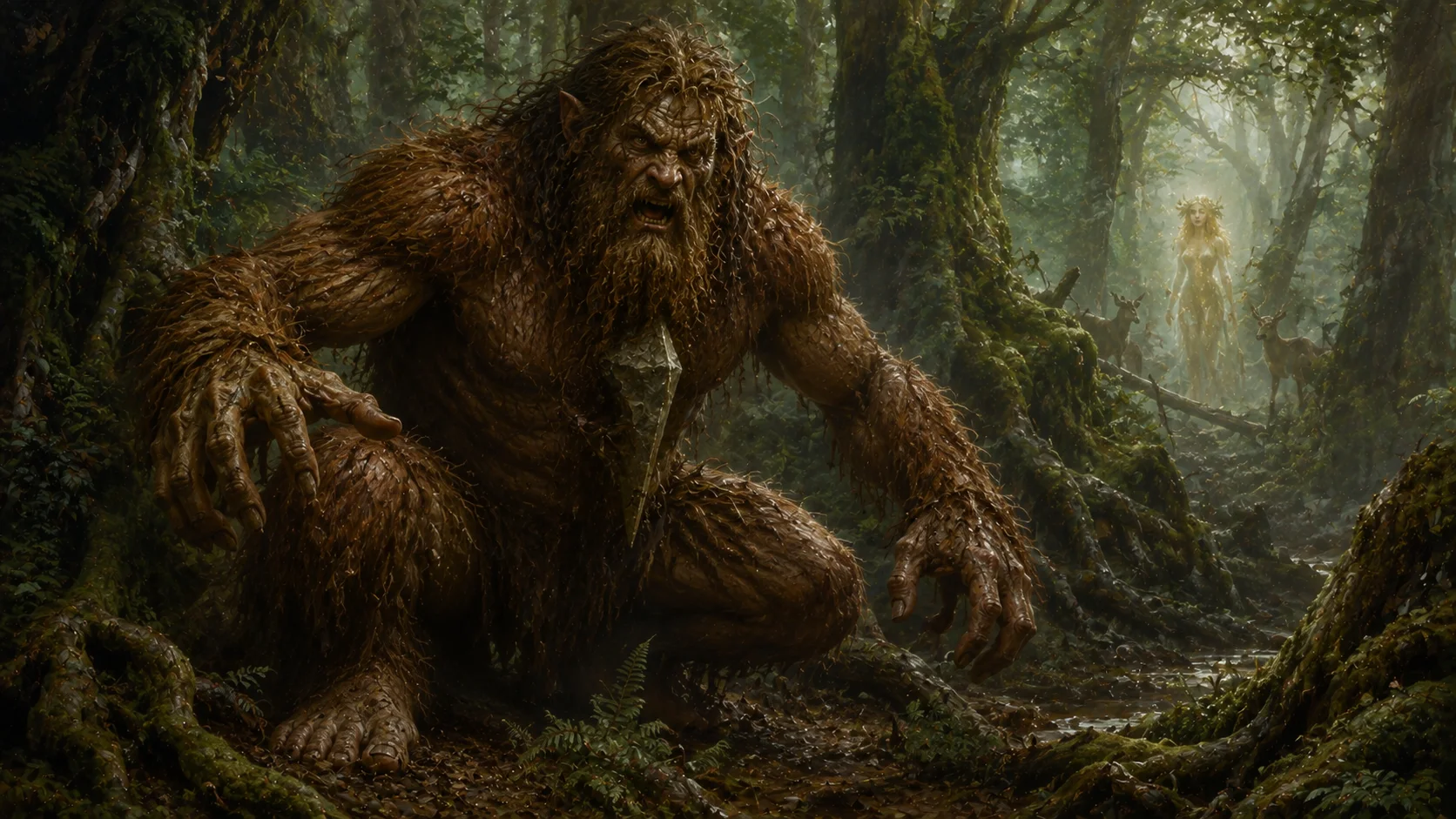
Ochokochi is described in the tradition as a being of great size and tremendous physical power, its body entirely covered in coarse, bristling hair, a figure closer to an ape or to what later observers would call a wild man or hairy hominid than to any ordinary human outlaw or bandit of the woods. It moved through the forest with the ease of something that belonged there entirely, at home among the trees and the undergrowth in a way no villager ever could be. What set Ochokochi apart from generic wild-man figures elsewhere in the world's folklore was not simply its hairiness or its strength but a single, chilling anatomical detail repeated across the tellings: a sharp, hard ridge or protrusion, described variously as axe-like or blade-like, set upon its chest or back. This was not an ornament or an incidental feature of its build. It was, in the tradition, the instrument of its killing.
The Chest of Blades
The recurring and most distinctive motif attached to Ochokochi is the manner in which it was said to kill. Rather than tearing or beating a victim as a bear or a bandit might, Ochokochi was said to seize a person in its powerful arms and draw them into an embrace — and it was the embrace itself that killed, for pressed against that sharp bony ridge upon its chest, a victim would be cut and crushed at once. It is a detail that turns the ordinary image of a monstrous hug, a crushing bear-like grip, into something stranger and more specifically terrible: an embrace that is also a blade. Georgian tellers who preserved this detail across generations of oral retelling gave Ochokochi a manner of killing found nowhere else in the wider catalogue of the world's wild-man legends, a signature as recognizable, within the tradition, as the creature's shaggy hide.
Groves Beyond the Village Path
The forests and remote mountain reaches of western Georgia — the dense, often lowland-adjacent woods of the Mingrelian region above all, though the wider motif of the Caucasian wild man is shared across highland communities of the region — were understood as Ochokochi's domain. These were not woods a villager entered lightly. They marked the boundary between the cultivated, inhabited world of field and hearth and the older, wilder world that had never been brought under human care, and Ochokochi was, in the tradition, the embodiment of everything that made that boundary dangerous to cross. Folklorists who classify Ochokochi within the broader Eurasian "wild man" or wodwo category note precisely this function: such figures across many traditions personify the forest itself as a living danger, and Ochokochi is the western Georgian regional expression of that widespread human instinct to give the wilderness a face and a name.
The Peril of the Lone Traveler
Central to the tales of Ochokochi is its danger to anyone who ventured into its forest alone, and in a number of tellings this danger was described as falling with particular weight upon women who went into the woods without company. A lone traveler, in this understanding of the tale, was not merely unlucky to encounter Ochokochi — the solitude itself was what invited the encounter, as though the creature's hunting ground began precisely where human companionship ended. Read as it was told, and as folklorists who have recorded it since generally understand it, this is a cautionary tradition as much as a monster tale: a story shaped, in part, to warn against the real practical danger of solitary travel through wild and remote country, with Ochokochi standing as the vivid, memorable figure who gave that warning its teeth.
The Mistress of the Wood and the Wild Man's Companion
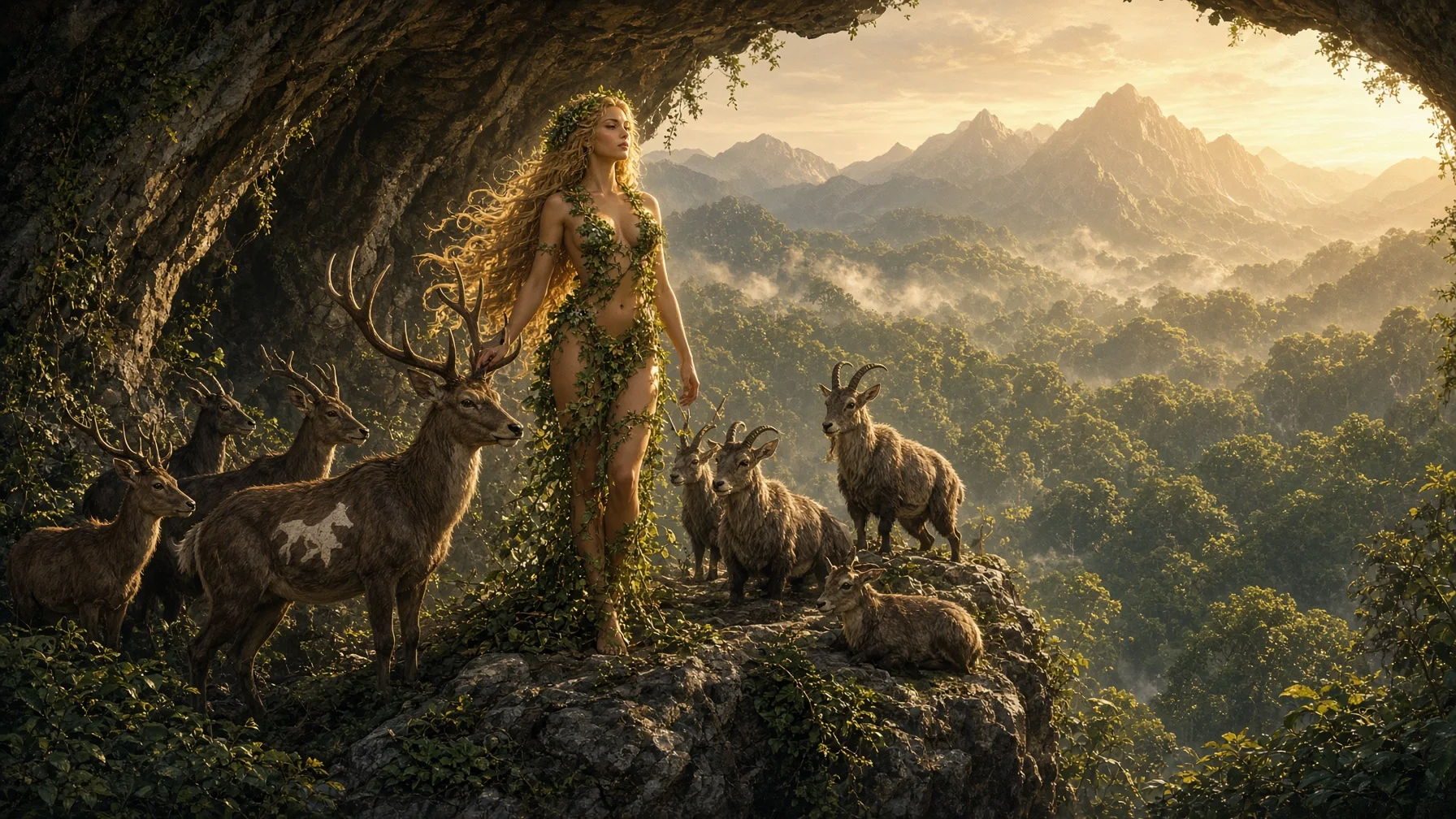
Georgian, and especially Mingrelian, folklore populates its forests with more than one guardian spirit, and among the best known is Tqashmapa, spoken of as the queen or mistress of the forest, a female spirit associated with the woods and their protection. Ochokochi is sometimes described, in the regional tradition, as standing in some relation to such forest-guardian figures — at times cast as a male counterpart to them, at times as a companion presence within the same forest spirit-world — though the precise nature of that relationship is not fixed or uniform across the surviving tellings, and different villages and different tellers have shaped it differently. It is safest, and truest to the tradition itself, to hold this connection as folklorically fluid: Ochokochi and Tqashmapa belong to the same populated forest of the Georgian imagination, kin in the sense that they share its trees and its paths, without the exact bond between them being settled canon.
A Voice Preserved Rather Than a Scripture Written
Unlike traditions anchored in ancient written scripture, Ochokochi survives almost entirely through the work of Georgian ethnographers and folklore collectors of the nineteenth and twentieth centuries, who traveled into the regions where the tale was told and set down what the villages and highland communities of western Georgia had long kept in memory. This means Ochokochi should be understood as a recorded regional oral tradition rather than a single fixed myth with one canonical telling. As is true of oral folklore everywhere, the particulars — which traveler was menaced, in which stretch of forest, in which village's telling — vary from teller to teller and from valley to valley. What holds constant across the variations is the shape of the being itself: the hair, the strength, the chest of blades, and the danger it poses to those who walk the forest alone.
A Monster Without an Ancient Icon
No standardized ancient cult image or traditional artwork of Ochokochi survives, nor would one be expected of a figure preserved through spoken storytelling rather than temple or shrine. The images by which Ochokochi is now known — illustrations in folklore collections, depictions in contemporary Georgian folklore media — are modern renderings built from the descriptive oral tradition itself: an ape-like or Bigfoot-like hairy hominid, upright and powerful, marked always by the telltale spike or ridge across its chest. These pictures are interpretations of the spoken description rather than continuations of any ancient visual lineage, a reminder that Ochokochi's true form has always lived in the words of its tellers rather than upon any wall or icon.
Kin in Kind, Not in Name, to the Almasty
Folklorists studying the Caucasus place Ochokochi within a broader comparative category of wild-man or wodwo figures found across the region, a family that also includes the almasty told of in Circassian, Abkhaz, and Chechen tradition further north and east. The kinship between these figures is thematic and ancestral — each is a hairy, humanlike being of remote wilderness, each embodies a similar cultural instinct to give the wild an inhabitant — rather than a matter of shared identity. Ochokochi is the distinct Georgian, and specifically western Georgian, regional expression of this widespread motif, carrying its own name, its own forest, and its own unmistakable chest-blade, and should not be conflated with the almasty or treated as another name for the same being, however closely the two traditions rhyme in spirit.
What the Forest Taught Through Fear
Beyond the fright of the tale itself, Ochokochi carried a social and symbolic weight within the communities that told it. As a personification of the untamed forest and the danger and unpredictability that lay beyond cultivated, inhabited land, the figure reinforced norms that mattered practically to those who lived at the forest's edge: do not travel alone into wild country, and respect the boundary between the settled world and the wood beyond it. In this, Ochokochi functioned much as wild-man figures do across many of the world's folk traditions — not simply as an entertainment but as a shared cultural memory of real hazard, given a face fearsome enough that the warning would be remembered and passed on.
A Name Still Spoken in the Highlands
Ochokochi remains, in modern Georgian folklore scholarship and in popular tradition, one of the country's most recognizable forest spirits, referenced today in heritage-folklore writing and in the kind of cryptozoology-adjacent popular interest that many old wild-man legends attract in the present day. It is cited and discussed alongside the other great wild-man traditions of Eurasia as a distinctly Georgian contribution to that shared human story: the hairy, blade-chested being of the Mingrelian and western Georgian woods, remembered in the careful records of the folklorists who gathered it from village memory, and carried forward as a living piece of regional heritage rather than a closed and finished tale. In the deep forest of the western Georgian highlands, the tradition holds, something with a blade for a heart still walks — and the story of Ochokochi endures precisely because it was never meant only to frighten, but to remind.
Sources & traditions
- EncyclopediaWikipedia — Ochokochi
- TraditionGeorgian folk and village traditions
Myths change from area to area and from time to time. This chronicle follows the most widely told versions; tellings in other villages, regions and eras may differ.