Amirani is the central hero of the Georgian, or Kartvelian, epic cycle — a Promethean culture-hero and dragon-slayer whose defiance of the sky god ends in eternal chains upon the peaks of the Caucasus. Recorded across generations of oral poetry in Svaneti, Khevsureti, Pshavi, and Mingrelia, and gathered with particular care by the folklorist Elene Virsaladze and, before her, Mikheil Chikovani, the Amirani cycle stands as the closest thing the Georgian mountains have to a national heroic epic assembled entirely from the mouths of singers rather than the pen of a court poet. Comparative mythologists, following Georges Dumezil among others, have long set Amirani beside the Greek Prometheus, beside Abrskil of Abkhazia and Artavazd of Armenia, as evidence of a shared Caucasian pattern: the bound titan who serves humankind and pays for it in chains.
Cut from a Dying Mother
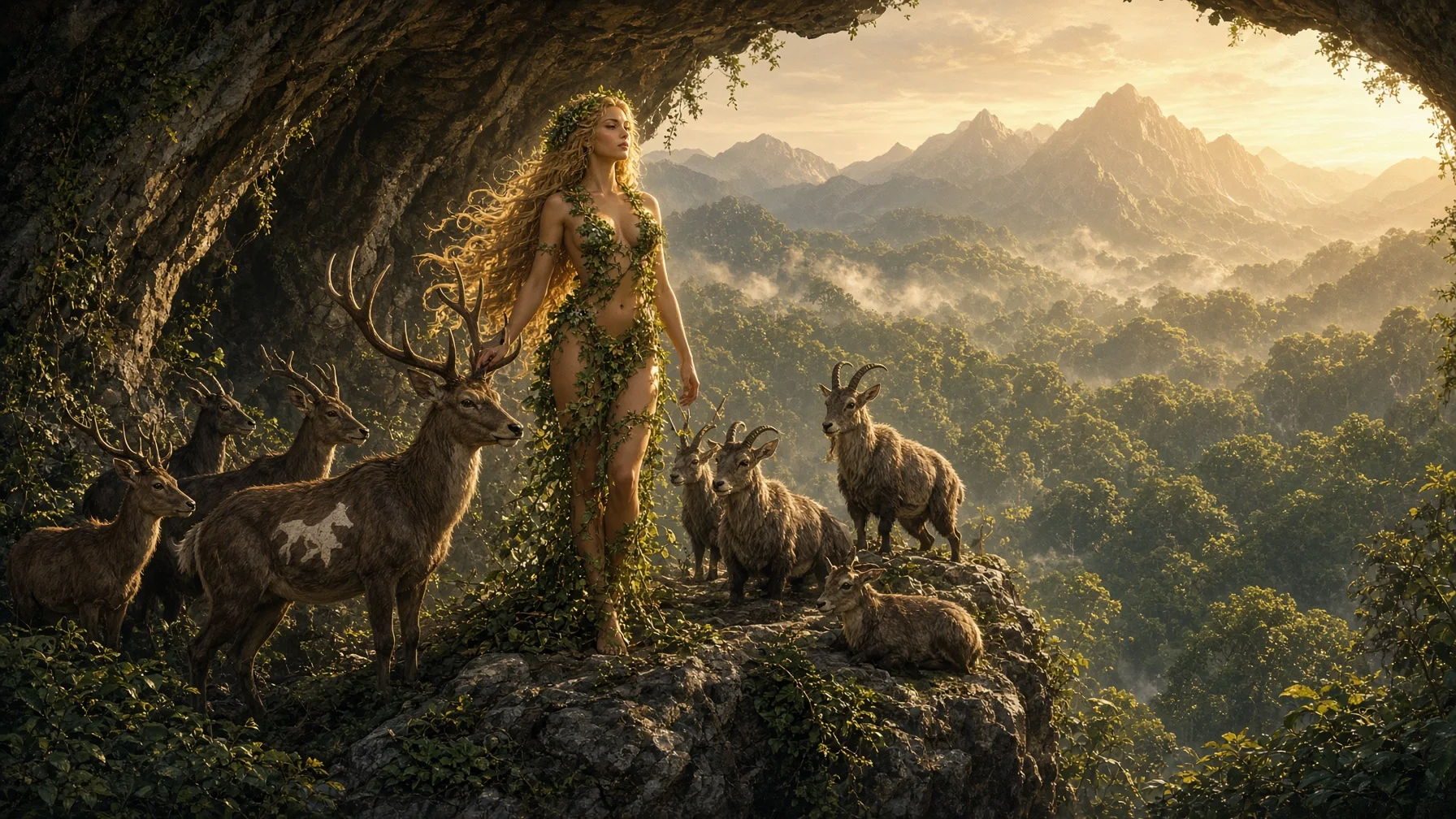
The oral variants of Amirani's birth differ from valley to valley, but they agree that it was no ordinary birth. In many tellings his mother is a mortal woman who comes into contact with Dali, the wild goddess of the high pastures and the ibex; in others his mother is named Dali herself, or a shepherd's wife touched by her power. What recurs across the sung versions, Svan and Mingrelian and Georgian alike, is the manner of his coming into the world: his mother dies before the birth can complete itself, and the child is cut from her body, drawn living out of a womb that could no longer carry him. Folklorists have long placed this beside other "extracted hero" births scattered across Eurasian epic — a hero who does not simply arrive, but is taken, already marked as someone the ordinary passage of birth could not contain.
The Goddess of the High Pastures
Dali's place in the story is not incidental ornament but the ritual heart of it, especially in Svan tradition, where she governs the wild ibex and the game of the high slopes and holds hunters to a moral economy: take only what is permitted, boast of nothing, and do not violate the terms of the hunt. Whether she is named as Amirani's mother or, in other recorded strands, as a lover and protector bound to him by older ties, the relationship between hero and goddess carries weight beyond the plot — it is tied to real taboos observed by hunters in the mountains where these songs were sung, a living belief rather than a decorative myth. Amirani's own strength and his uncanny closeness to the wild world are, in this light, inherited directly from her.
Three Brothers Bound by Oath
Amirani is not a solitary hero in most of the recorded cycle. He is raised and bound in blood-brotherhood alongside two companions — named in various tellings as Badri and Usip, or Usupi, though the Svan, Mingrelian, and Georgian variants differ on the exact names and details. This triad of foster-brothers, sworn to each other by oath, recurs as a structural backbone of the epic: their loyalty to one another shapes which battles are fought, which rescues are attempted, and what is lost when the bond is tested. The brotherhood is treated in the oral tradition as seriously as blood kinship, and Amirani's most consequential choices are frequently made in defense of these companions rather than for glory alone.
Swallowed by the Vishapi
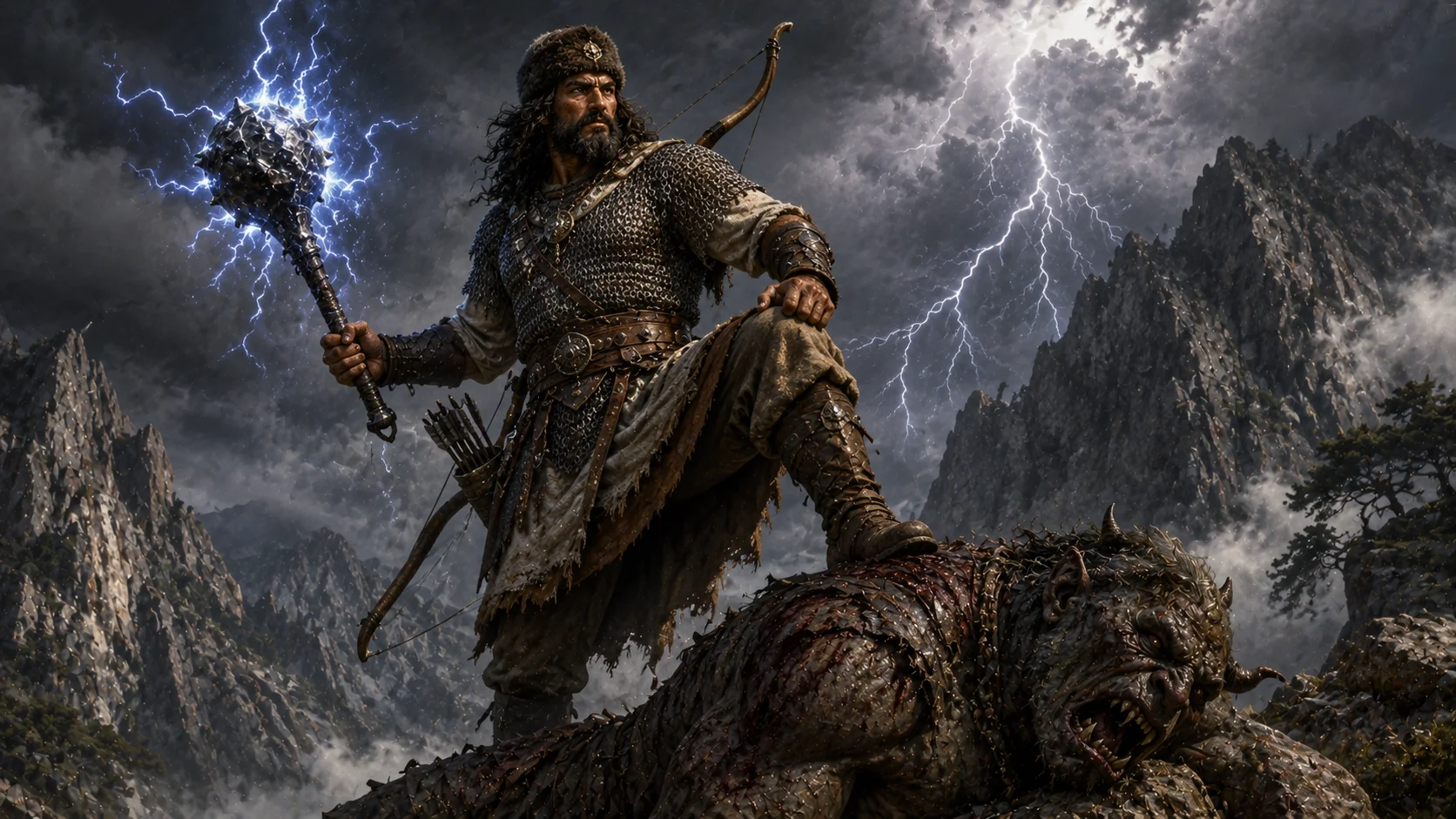
Among the most vivid episodes of the cycle is Amirani's battle with a great many-headed dragon, a vishapi, of the kind that haunts Caucasus and Iranian dragon-lore alike. In the version best remembered, the dragon has swallowed one of Amirani's companions, or in some tellings a maiden he means to rescue, whole. Rather than retreat, Amirani allows himself to be taken into the dragon's belly and there, in the dark, cuts his way back out with his own blade — emerging alive from what should have been a grave, and leaving the beast dead behind him. It is one of the oldest and most widespread dragon-slaying motifs of the region, and in Amirani's telling it becomes as much a proof of his refusal to accept defeat as a monster-slaying feat in its own right.
Against Devi and Kaji
The wider epic is thick with battles against devis, the giant ogre-demons of the mountains, and kajis, the subterranean smith-sorcerers who work uncanny metal beneath the earth. Amirani meets both again and again throughout the cycle, most often to free women held captive or to recover companions taken from him, and in several episodes he comes away from these contests with magical weapons or a wonder-horse of extraordinary speed and understanding. These battles are not incidental adventures strung loosely together; they are the proving ground on which Amirani's strength, and his refusal to leave anyone in the dark places of the world, is repeatedly tested and repeatedly confirmed.
The Gift That Angered Heaven
What fixed Amirani's name permanently beside that of Prometheus in nineteenth-century comparative mythology is the act that finally turns heaven against him. In the recorded strands of the epic, Amirani brings something transformative to humankind — fire itself in some tellings, or the culturally decisive knowledge of metallurgy and the blacksmith's craft in others — and in doing so provokes the anger of the chief sky deity. Whether the deeper offense is the stealing of what belongs to heaven, the slaying of devis outside any sanction, or simply the sheer scale of Amirani's power and pride, the sung tradition agrees on the outcome: a transgression against the order the sky god maintains, and a punishment built to last forever.
The Chaining on Kazbek
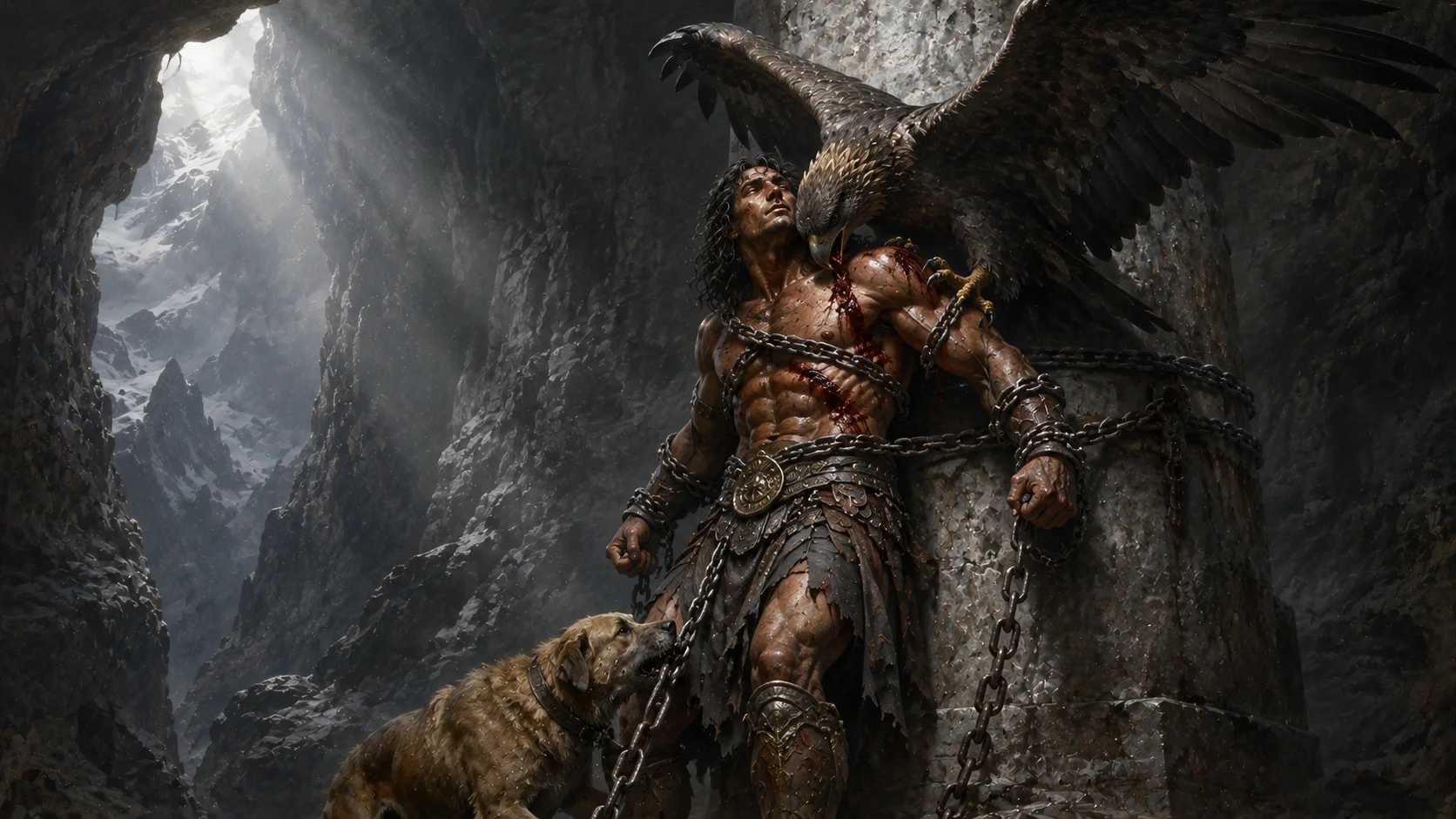
For his defiance, Amirani is bound in chains to a cliff or pillar upon Mount Kazbek — Mqinvartsveri, the ice-crowned peak of the central Caucasus — condemned to a punishment with no fixed end. An eagle, in some tellings a raven, descends to tear at his body, and what is torn regenerates so that the torment can begin again the following day, the same cruel arithmetic that holds the Greek Prometheus to his rock. Beside Amirani in his chains sits a dog of unwavering loyalty, who licks ceaselessly at the metal, working it thinner with every year that passes. But the chain is never allowed to give way entirely: in the tradition as it was sung in the mountain villages, the blacksmiths of the world strike their anvils on a set day each year and, in doing so, forge the chain anew, undoing in an instant what the dog's patient devotion achieved across twelve long months.
Thunder in the Mountain
For the communities of Khevsureti, Svaneti, and Pshavi who carried this story across generations, the chaining of Amirani was not a closed tale from a distant past but a living explanation of the world around them. Nineteenth- and twentieth-century ethnographers recorded a widespread folk belief that the thunder rolling off Kazbek and the tremors that shook the ground nearby were nothing other than Amirani straining against his bonds — a hero still fighting, still refusing his fate, whose struggle could be heard and felt by anyone standing in the right valley on the right day. The myth, in other words, did real explanatory work in the lives of the people who told it, tying a specific mountain and specific weather to a specific, named suffering.
A Freedom Always Withheld
Running through every version of the punishment is the same unbearable near-miss: each year the chain wears thinner, each year Amirani comes closer to breaking free, and each year that freedom is deferred again by the reforging. The tradition holds, in most of its tellings, that a day will eventually come when the chain is not renewed in time and Amirani breaks loose at last. Whether that day is imagined as an ending yet to come or simply as the perpetual, unfulfilled promise that gives the myth its ache, the structure itself — punishment, near-escape, renewal, punishment again — is what has made Amirani's chaining resonate as a story of resistance carried forward rather than a single moment frozen in defeat.
One Name, Two Heroes
Georgian literary history holds a second Amiran distinct from the hero of the oral cycle, and scholars are careful not to let the two blur into one another. The Amiran-Darejaniani, a chivalric prose romance attributed to Mose Khoneli and dated to roughly the twelfth century, borrows the older hero's name for a knight, son of a woman named Darejan, and develops him within a courtly narrative that owes far more to medieval romance convention than to mountain oral tradition. The two Amirans share a name and little else; the sung epic of the dragon-slayer bound on Kazbek and the literary romance of the courtly knight arose from different worlds and should be read as separate figures who happen to answer to the same call.
A Name Carried Across Valleys
As the epic passed from valley to valley and language to language within the Kartvelian family, the hero's name shifted with it — Amiran, Amirani, Amran — appearing across Georgian, Svan, Mingrelian, and Laz oral traditions, each region preserving its own details of birth, brotherhood, and battle even as the shape of the whole story held steady. It is this very variation, painstakingly gathered and compared across dialects and singers by Georgian folklorists, that gives scholars their clearest window onto how an oral epic actually lives: not as one fixed text but as a constellation of related tellings, each faithful to the hero in its own regional voice.
What the Comparison Can and Cannot Prove
The resemblance between Amirani and Prometheus — the theft or gift that offends heaven, the chaining to a Caucasian peak, the bird that returns each day to renew the wound — is close enough that the two have been read side by side since the myth first reached wider scholarly attention. What remains genuinely unsettled, and what serious comparative scholarship is careful to flag as an open question rather than a settled fact, is why the parallel exists at all: whether it reflects direct borrowing between Greek and Kartvelian tradition, entirely independent development from similar circumstances, or a shared mythological substrate older than either recorded telling. No confident claim of direct descent from the Greek myth can be made on the present evidence, and the honest scholarly position is to hold the parallel as suggestive rather than proven.
The Hero the Mountains Kept
Across every regional variant, what endures is the same figure: a hero cut early from death, raised among sworn brothers, unafraid to be swallowed whole if it means cutting his way back into the light, generous enough with what he won to anger the very order of heaven, and bound for it on a peak whose thunder his own struggle was once said to explain. The Amirani cycle occupies a foundational place in Georgian folklore studies precisely because it was never written down by a single author claiming ownership of it — it survived instead in the voices of singers across Svaneti, Khevsureti, Pshavi, and Mingrelia, each carrying their own version of a hero whose chains, in the telling, were never quite the last word.
Sources & traditions
- EncyclopediaWikipedia — Amirani
- TraditionGeorgian folk and village traditions
Myths change from area to area and from time to time. This chronicle follows the most widely told versions; tellings in other villages, regions and eras may differ.