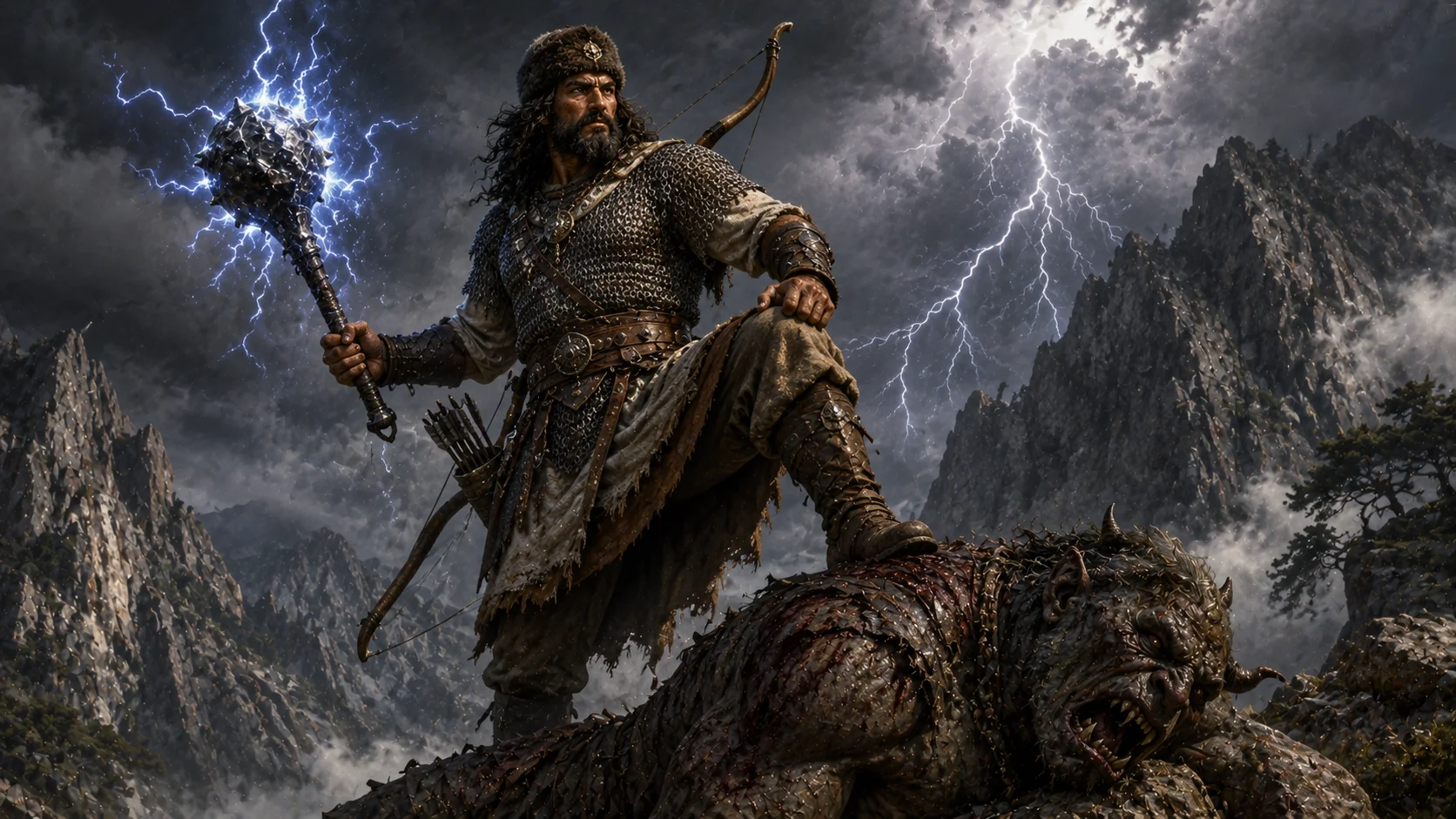
Ghmerti is the word standing at the summit of Georgian religious language: it is, at once, the ordinary Georgian noun for "God" and the name given by the highland communities of Khevsureti, Pshavi, and Tusheti to the supreme celestial being who presided over their entire pantheon before, and alongside, the coming of Christianity. In the mountain shrine system recorded by Georgian ethnographers across the nineteenth and twentieth centuries, Ghmerti sits above a crowded and vigorous divine world — father, in the idiom of that world, to a host of subordinate deities called the Khvtisshvilebi, "the children of God," who carried out in the valleys the will that Ghmerti himself rarely descended to enact in person.
The Word That Names Two Ages of Belief
Any account of Ghmerti has to begin with a caution rather than a claim, because the name itself refuses to separate two layers of history. After Georgia's Christianization in the fourth century CE, the same word, Ghmerti, became and remains the standard term for the Christian God in Georgian Orthodox usage. The pre-Christian highland deity and the God of the church are therefore named identically, and in everyday and even scholarly language they blur into one another. Georgian ethnographers working in the highlands have had to draw a deliberate line between what they call the "Ghmerti of the shrines" — the folk-religious figure encountered in Khevsur and Pshav ritual practice — and the Ghmerti of formal Orthodox theology, even though the communities themselves, by the time fieldworkers arrived, no longer experienced the two as separate. This is not a minor footnote. It shapes what can honestly be said about him: the sources available were nearly all recorded after centuries of Christian presence in Georgia, so the degree to which Christian ideas of an omnipotent, singular, moral God reshaped the older highland conception cannot be fully disentangled from the record. Scholars treat this as a live and unresolved question rather than a settled one, and any respectful account of Ghmerti has to hold that uncertainty rather than paper over it.
A Sky-Dweller Who Rules at a Distance
Within the highland system as it was recorded, Ghmerti belongs to a familiar and widespread type of religious figure: the high god who is supreme in authority but distant in presence. He was conceived as dwelling above, a sky-god whose proper domain was the heavens rather than the villages and pastures of the Caucasus. This distance was not indifference so much as a structural feature of how the whole system worked. Ghmerti did not appear at the shrine, argue a dispute, or strike down a wrongdoer with his own hand. Instead he ruled through intermediaries, delegating the direct governance of human affairs, and the direct combat against the world's chaotic forces, to the deities beneath him. The result is a pantheon organized less like a council of equals and more like a chain of delegated authority, with Ghmerti's will originating at the top and being carried out, tier by tier, by beings closer to the human world.
Father to the Khvtisshvilebi
The beings who carried out that will were the Khvtisshvilebi, literally "children of God" — a class of deities understood, in the idiom of the highland communities, as Ghmerti's own offspring and as his agents in the world. Among them were hero-deities such as Kopala and Iaqsar, figures whose function was active and interventionist in exactly the way Ghmerti's was not: they were the ones sent out to confront the demonic and chaotic forces, the devebi and kajebi, that threatened the order Ghmerti presided over. The relationship described in the sources is unambiguously hierarchical and filial at once — these were not rival gods contesting Ghmerti's supremacy but subordinates and descendants acting on his behalf, extending a single divine will down into a world too near and too disordered for Ghmerti himself to enter directly.
The Khatebi and the Local Face of a Distant God
Beneath the Khvtisshvilebi again stood the khatebi, the shrine deities attached to particular villages and communities across the highlands. Ethnographic sources, most notably the mid-twentieth-century fieldwork of Vera Bardavelidze on the pantheon of Khevsureti, describe these local khatebi as themselves frequently subordinate to, or described as children of, Ghmerti — his agents planted in specific places, tending to the specific needs of specific communities. This layered structure meant that an ordinary highlander's most immediate religious contact was rarely with Ghmerti directly. It was with the khati of their own valley, itself answerable up the chain to the Khvtisshvilebi, and through them to Ghmerti at the summit. The system let a single supreme god remain both cosmically total in authority and intensely local in practice, present in every village through deputies while remaining, in his own person, above and apart.
Invoked at the Apex of the Prayer
This hierarchy was not merely a scholar's diagram; it was recited. In the shrine, or jvari/khati, ritual practice of Khevsureti and Pshavi, prayer formulas were structured to name Ghmerti at the very top, with the local shrine-deities invoked beneath him as intercessors — voices carrying a petition upward through the same chain of delegation that carried Ghmerti's authority downward. Bardavelidze's fieldwork documented this hierarchical prayer structure directly, giving scholars a rare, recorded shape for how the highland communities understood their own cosmos to be organized: not a flat gathering of gods to be addressed indiscriminately, but a ladder, with the supreme god's name spoken first and highest, even when the practical business of the prayer concerned a much more local deity.
Ghmerto: The Vocative of the Highest Name
Highland invocation preserved a specific grammatical form for addressing Ghmerti directly: "Ghmerto," the vocative — "O God." This form marks the moments in ritual speech where the supreme deity himself, rather than one of his subordinates, was being called upon, and it sits alongside the language that named him father and progenitor of the Khvtisshvilebi. Together, the vocative address and the paternal language form the two poles of how Ghmerti was spoken to and spoken of: directly, in the rare moments the highest name was invoked outright, and indirectly, through the far more constant reference to him as the source from which the active gods of the mountains had descended.
Sun, Sky, and a Debated Solar Thread
Some regional variants of the tradition associate Ghmerti with the sun and with sky symbolism more broadly, and scholarship has at points identified him under a title such as "Mzeoba Ghmerti" in connection with this association. This solar thread, however, is not uniformly attested across the highland sources, and researchers treat it as a debated rather than a firmly established feature of his character. It is worth naming precisely because it illustrates the broader condition of the evidence: the core of Ghmerti's identity — supreme, celestial, paternal, distant — is well documented and consistent across sources, while secondary attributes like a solar association appear more unevenly, and honesty about the tradition means being as clear about what is uncertain as about what is well attested.
Guarantor of the Oath and Judge of the Council
Beyond his cosmological position, Ghmerti carried a concrete social function in highland life: he was the ultimate guarantor of oaths sworn at the shrines, the authority whose name made a sworn word binding. Communal justice in the highlands was administered through temi councils, gatherings of the community convened at the khati shrine and presided over in the deity's name, and Ghmerti stood behind these proceedings as the final judge to whom their verdicts were understood to answer. In this respect he was not only a distant cosmic ruler but the standard against which human speech and human judgment were measured — the name that turned an ordinary promise into an oath, and an ordinary village gathering into a court whose findings carried the weight of divine sanction.
Source of Order, Fate, and Fertility
The functional core of Ghmerti's role, as recorded across the highland sources, was to be the origin point of cosmic and moral order itself. He dispensed justice, fate, and fertility, the three forces that, taken together, governed whether a community's harvests grew, whether its disputes were resolved rightly, and what course an individual life would run. The local khatebi and the Khvtisshvilebi carried out the particulars, but the sources are consistent that the underlying authority for order, fate, and fertility traced back to Ghmerti as its source, not merely its distant sponsor. This is part of what distinguishes him structurally from the deities beneath him: they act, intervene, and fight; he originates the order within which their actions have meaning.
A Kartvelian Figure Among Caucasian Sky-Gods
Set against the wider religious landscape of the Caucasus, Ghmerti's position as a supreme sky-god finds parallels among neighboring pantheons — comparable high-god figures appear, for instance, in Circassian and Ossetian tradition. These parallels are useful for situating Ghmerti within a broader regional pattern of high-god belief, but the sources are equally clear that he is specifically the Georgian, Kartvelian-language figure, distinct from the separately named deities of these linguistically unrelated neighboring traditions. The comparison illuminates a shared regional shape of belief without implying any identity between the figures themselves, and care in keeping Ghmerti distinct from his Circassian or Ossetian counterparts is part of representing the tradition accurately.
A Pantheon Preserved on the Edge of Change
What survives of Ghmerti and the highland system he heads is owed almost entirely to the ethnographic and folkloric fieldwork conducted in Khevsureti, Pshavi, and Tusheti through the nineteenth and twentieth centuries, work that reached these communities before rapid modernization altered highland religious practice. Taken as a whole, the documented cult of Ghmerti and his subordinate pantheon of Khvtisshvilebi and khatebi is counted among the best-recorded survivals of pre-Christian South Caucasian folk religion — a system caught, in the written record, at a moment when it was still a living structure of prayer, oath, and shrine council rather than a reconstructed memory.
The Standing of the Name Today
Ghmerti's name never receded into the past the way the names of many highland deities eventually did, precisely because it was absorbed into the everyday and liturgical language of Georgian Christianity. This gives him an unusual continuity: the word spoken by highland communities at the head of their shrine prayers is the same word spoken in Georgian Orthodox worship today. Whether that continuity reflects an unbroken thread of meaning reaching back through the centuries, or a Christian concept that came to occupy an old and structurally similar name, is precisely the question the sources cannot fully settle. What can be said with confidence is the shape the highland evidence itself preserves: a supreme, sky-dwelling god, father to a pantheon of active intermediary deities, invoked at the apex of prayer, and standing as the final guarantor of order, oath, and justice in the world beneath him.
Sources & traditions
- TraditionGeorgian folk and village traditions
Myths change from area to area and from time to time. This chronicle follows the most widely told versions; tellings in other villages, regions and eras may differ.