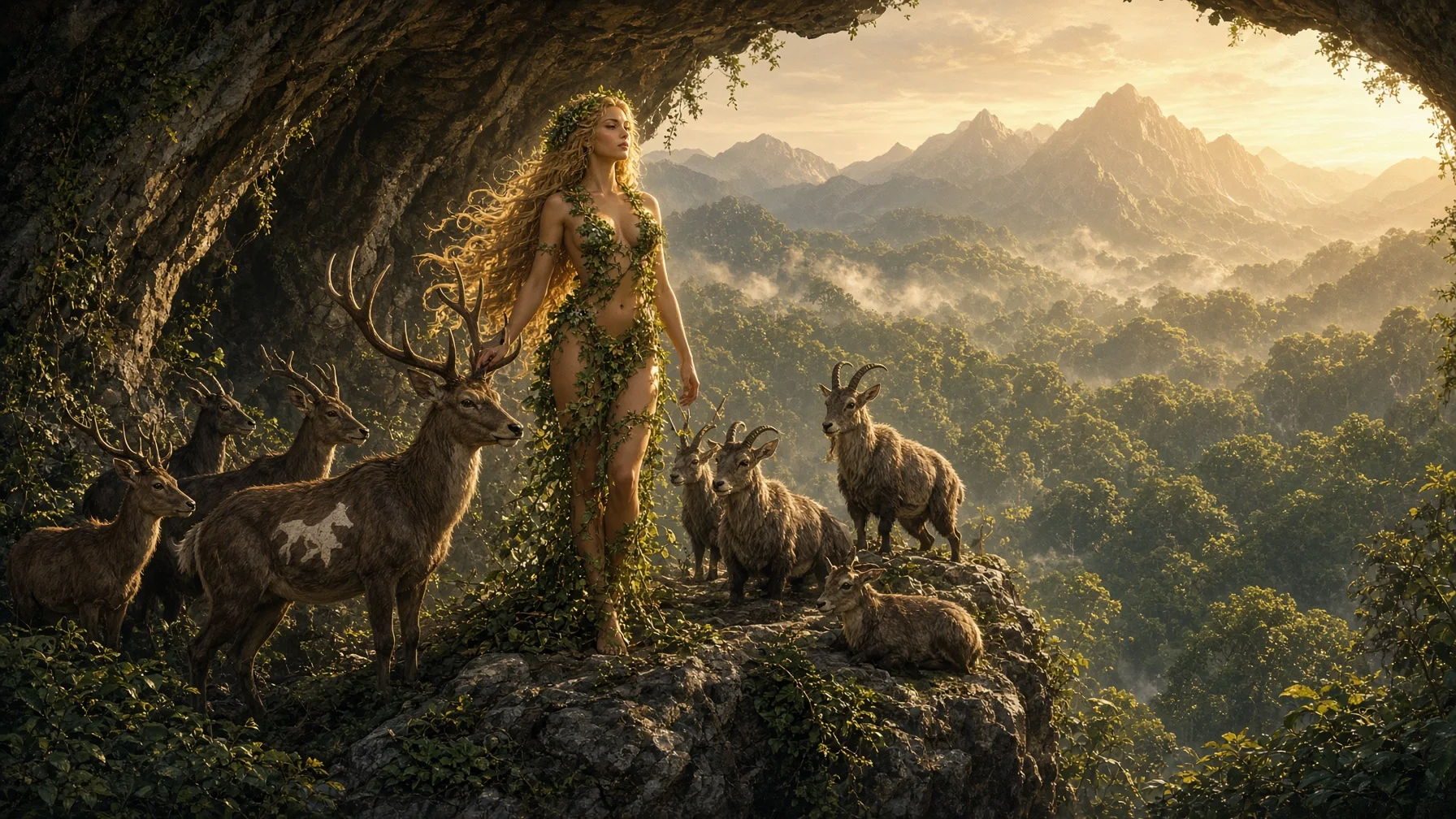
Dali is the golden goddess of the hunt and mistress of wild beasts revered in the pre-Christian mythology of the Georgian highlands, above all in Svaneti, the remote and rugged province of the Caucasus where her cult survived longest. A woman of blinding beauty with hair of gold and a body said to glow like the sun itself, she rules from the inaccessible crags and cliff-faces of the high mountains, sovereign over the ibex, the chamois, and the deer that hunters knew as her cattle. Few figures in Caucasian folk religion are as vivid, as beloved, or as feared as Dali: a goddess whose gifts and whose wrath fell on the same men, often for the same reason.
A Radiance Seen on the Rock Face
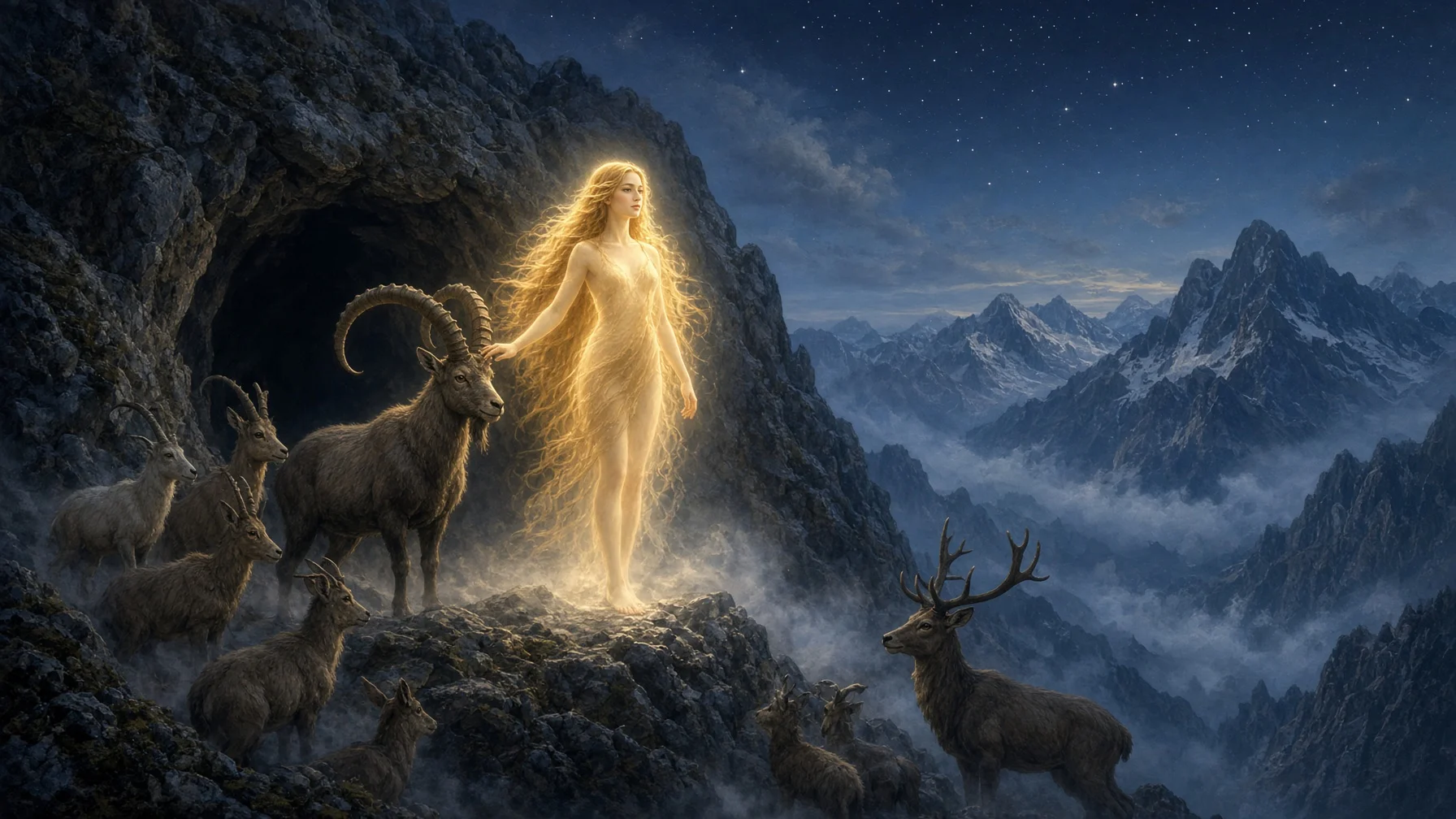
Svan hunters who told of Dali agreed on how she appeared: a woman of overwhelming beauty, her hair long and golden, her skin luminous, her whole body said to shine as though lit from within, sometimes likened directly to the sun or to gold itself. She was seen, in the tales, standing naked or scarcely clothed upon sheer crags where no mortal foot could easily follow, sunning herself on a ledge above an abyss or combing her radiant hair on a pinnacle lost in cloud. This was not incidental description. Her brightness marked her as something other than human, a being whose beauty belonged to the peaks themselves, and later students of Caucasian religion have noted the resemblance between her golden radiance and the solar and luminous imagery attached to mother-goddess figures elsewhere in the region, though this connection is understood as a comparative observation rather than a settled genealogy.
Mistress of the Wild Herds
Dali's dominion was the game of the high mountains. The ibex, the chamois, and the deer that ranged the cliffs and screes above the tree line were held to be her herds, sometimes spoken of as her cattle, sometimes as her own children, and no hunter took one of them without first entering, knowingly or not, into her domain. She was the one who decided whether a hunt would succeed. A man might climb for days and see nothing; another might be led by fortune, or by Dali's favour, directly to a herd she had chosen to reveal. This was the fundamental shape of her worship: not temples or fixed images, but the daily reckoning of hunters who depended on a power they could not see and could not command, only petition.
The Laws of the Mountain
Because the game belonged to Dali, hunting under her sky was bound by taboo, and Svan hunters observed these rules with the seriousness of oath. A man was not to take more than his rightful share in a single hunt. He was not to kill a pregnant or nursing animal, for these carried the future of Dali's herds within them. He was not to hunt with greed or excess, taking life beyond what need required. To break these laws was to invite her anger directly, and the tales are consistent about what followed: death on the mountain, a fall from a ledge that should have held, an injury that ended a hunter's career, or a fatal lure over a cliff edge by the very goddess who had once granted him fortune. The mountain did not forgive twice.
The Mark Upon the Herd
When Dali favoured a hunter, her generosity took a particular and telling form. She might reveal to him a herd he would otherwise never have found, or grant him unnatural success across many hunts in succession. But her generosity carried its own accounting: among the animals she allowed him, she would set a mark upon one beast, a lock of hair, a private sign known to her alone, to indicate the portion that belonged to him and no further. That marked animal, or the quota it represented, was the boundary of the gift. A hunter who recognized and respected the mark could return to the mountain again; one who did not, who took past the sign she had set, was understood to have crossed from favoured guest to trespasser, and the consequences followed accordingly.
Betgil and the Broken Trust
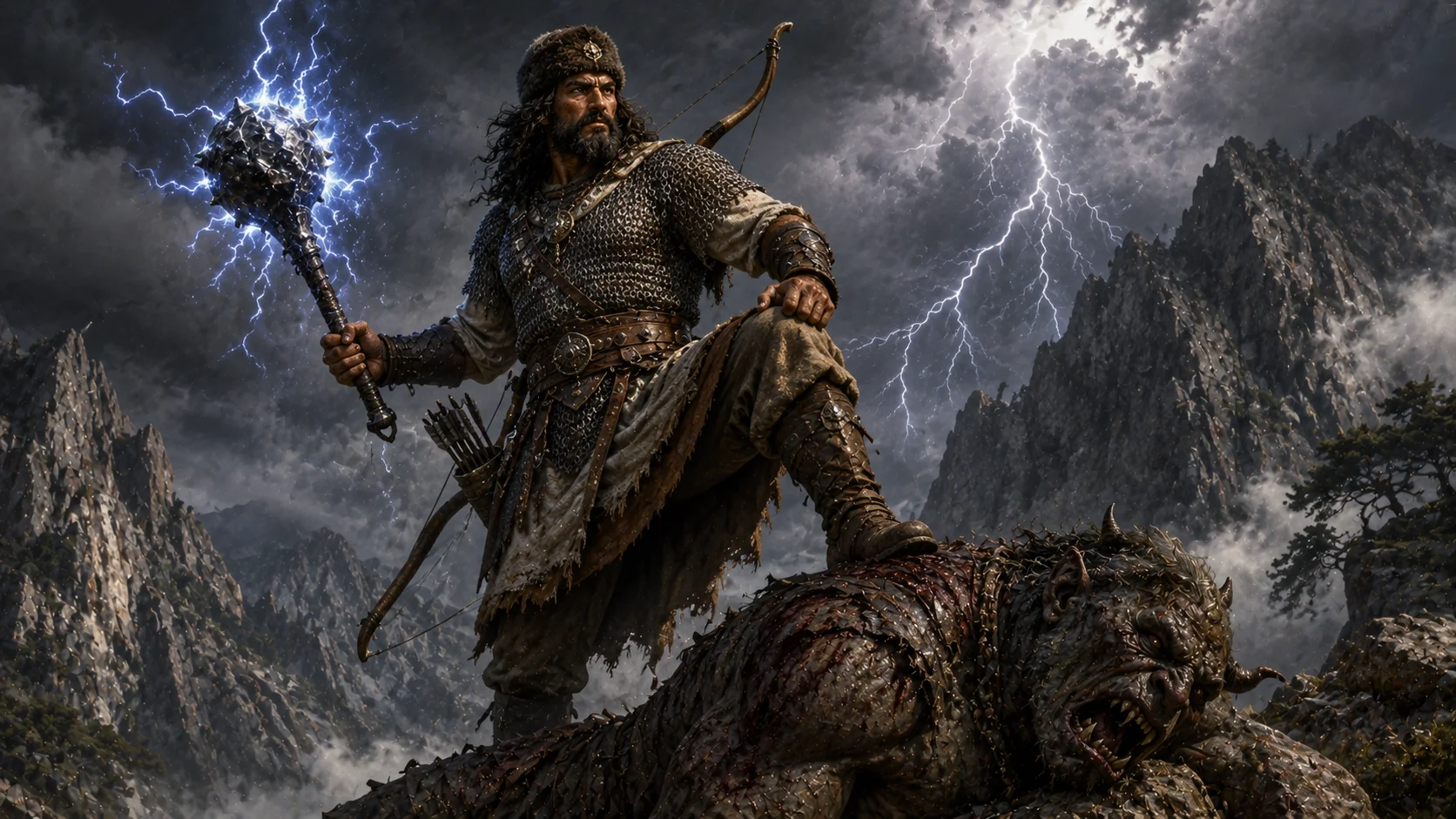
The most enduring of Dali's stories concerns her love for the hunter Betgil, sometimes rendered Betkil, a man she chose above all others and to whom she gave extraordinary fortune in the chase. As in her other unions with mortal men, her love came bound to conditions: secrecy, fidelity, obedience to what she had forbidden. Betgil prospered under her favour for a time, granted success no ordinary hunter could match. But in the tellings that have survived, he broke the trust she had placed in him, whether by revealing their union, by betraying her fidelity with a mortal woman, or by violating the purity she demanded of him. Her response was immediate and absolute. He was cast from a cliff to his death, or destroyed on the hunt itself by her own hand, the same heights that had made him a legendary hunter becoming the instrument of his end.
A Love That Answered to No Mortal Law
The Betgil story is the clearest example of a wider pattern in Dali's mythology: her recurring liaisons with favoured mortal hunters, unions that granted the men extraordinary skill and fortune but demanded absolute loyalty in return. These were not casual tales of a goddess's caprice. They reflect a deeper taboo running through Svan hunting belief, that a bond between a mortal and a divine mistress of the wild carried real weight and real danger, and that betrayal of it, whether through boastful revelation or through infidelity with a mortal woman, was answered in kind. Some versions of these stories frame her fury as jealousy pure and simple; others frame it as the enforcement of a sacred condition the hunter himself had accepted. Either way, the men who loved Dali and lost her favour did not survive the loss.
A Contested Thread to Amirani
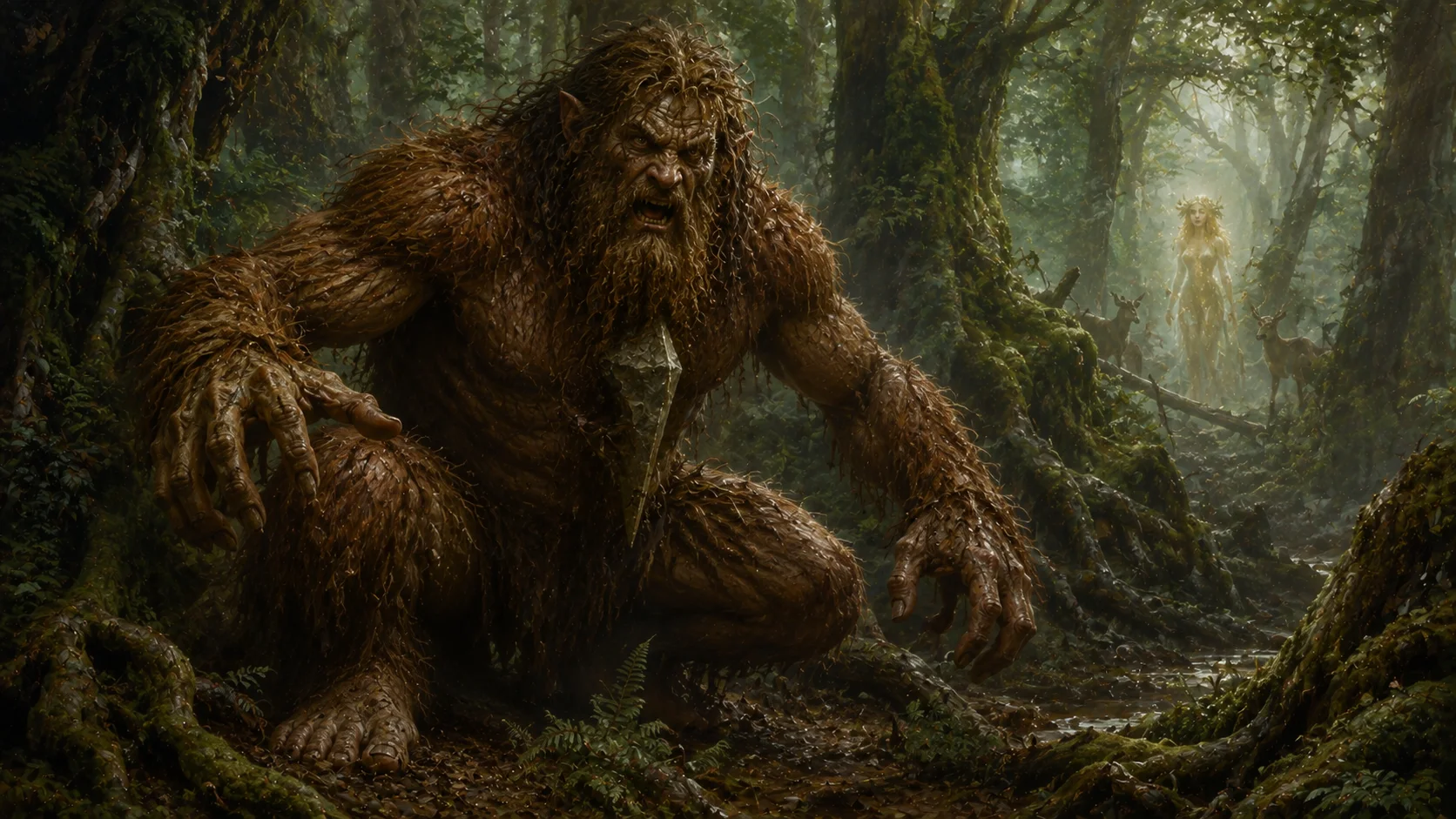
In certain regional variants of Georgian tradition, Dali is drawn into the ancestry of Amirani, the Promethean culture-hero whose epic looms large over Caucasian legend. Some tellings connect her to his birth or portray her as bound to his mother's story in ways that shape his miraculous origin. It should be said plainly that this genealogical thread is a variant tradition rather than a single fixed and universally accepted account; different Svan and Georgian tellings of Amirani's parentage exist side by side, and Dali's place within them shifts from telling to telling. What can be said with confidence is that later folk memory, in at least some regions, drew a line between the goddess of the wild crags and the hero who would go on to defy the gods themselves, binding the huntress of the mountains to the deepest hero-myth of the highland tradition.
Kin Among the Mountain Powers
Dali did not stand alone in the religious imagination of the Caucasus. Georgian ethnographers and folklorists working in Svaneti and neighbouring highland regions recorded a broader family of mountain deities who governed the hunt and the wild herds in comparable ways. Among the Ossetians, the figure of Æfsati filled a closely related role as lord of the game; among Circassian and Abkhaz traditions, other hunting deities held similar dominion over the mountain beasts. Scholars place Dali within this wider Caucasian complex of mistress-of-animals figures, a shared religious grammar across peoples who lived by the same peaks and depended on the same uncertain fortune of the chase. Some have also noted a typological resemblance between Dali and Artemis as huntress-goddesses, though this is understood as a comparison of type and function rather than any claim of direct descent or contact between the traditions.
Words Spoken Before the Climb
Dali was not approached through statues or built shrines in the manner of the great Mediterranean pantheons; no fixed cult image of her survives, because none, in the ordinary sense, was ever made. Her presence in Svan life was instead sustained through spoken practice: prayers, oaths, and ritual words offered by hunters before setting out into her territory and again after a hunt concluded, addressing her directly, asking her leave to take from her herds, and giving thanks when the mountain had been generous. Nineteenth- and twentieth-century Georgian ethnographers working in Svaneti recorded these practices as living observance, not antiquarian memory, hunters speaking to a goddess they expected to be listening on the very cliffs they were about to climb.
A Presence Carved Only in Story
Unlike the deities of traditions built around monumental sculpture and temple cult, Dali survives almost entirely through oral tale, ballad, and hunting legend, gathered by ethnographers from the mouths of Svan hunters and storytellers rather than read from stone or inscription. Some scholars have drawn tentative comparisons between her and older Bronze and Iron Age goddess imagery uncovered in the wider Caucasus, but such connections remain speculative and disputed, resting on iconographic resemblance rather than continuous documented tradition. Likewise, the very name Dali has been examined for deeper etymological roots tying her to broader South Caucasian goddess-of-the-hunt concepts, but no settled etymology has won agreement among linguists. She remains, in the most precise sense, a goddess known through the stories her people kept alive rather than through the objects they left behind.
Faith That Outlasted the Official Gods
Georgia's turn to Christianity did not erase Dali from the highlands. Scholars classify her as part of the pre-Christian Georgian pantheon that persisted in folk religion long after the official conversion of the wider kingdom, surviving with particular tenacity in Svaneti, whose isolation among the highest peaks of the Caucasus sheltered older beliefs from the currents that reshaped religious life in the lowlands. There, mountain-spirit belief and Christian practice ran alongside one another well into the modern era, and Dali's place among the cliffs and the game herds remained, for the hunters who still spoke to her, as real as anything taught in a church below.
The Huntress Who Remains
What endures of Dali is not a ruin or a relic but a way of understanding the mountain itself: a golden, radiant presence who owns the wild herds, who rewards the hunter she favours and destroys the one who betrays her trust, whose love is a gift with a price attached and whose law is written nowhere but enforced everywhere a man dares to climb above the tree line. She belongs to a family of Caucasian mountain powers who governed the hunt long before any written scripture reached these peaks, and she survives today exactly as she always did, in the words hunters once spoke to the cliffs, asking permission, and giving thanks.
Sources & traditions
- EncyclopediaWikipedia — Dali (goddess)
- TraditionGeorgian folk and village traditions
Myths change from area to area and from time to time. This chronicle follows the most widely told versions; tellings in other villages, regions and eras may differ.