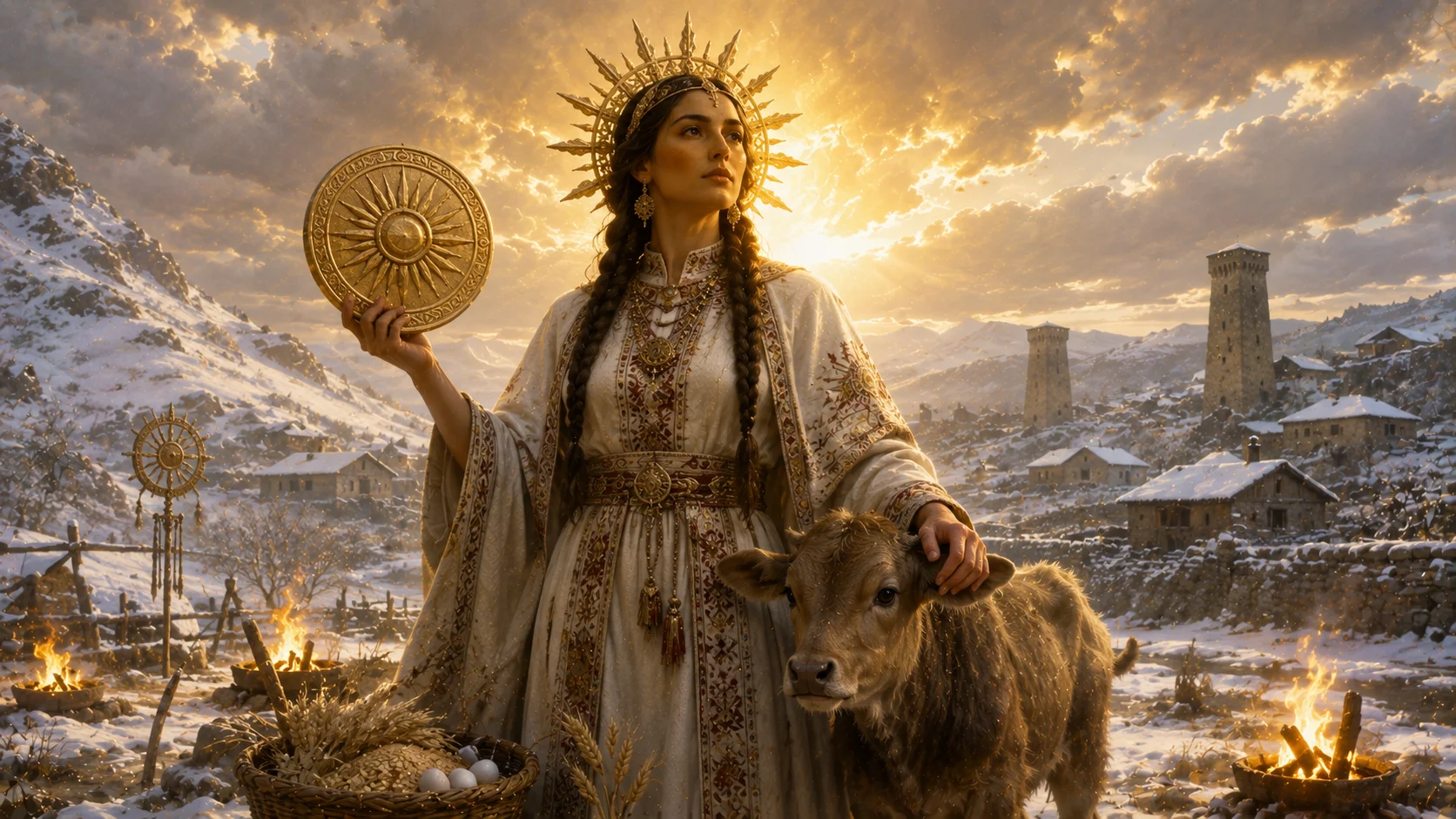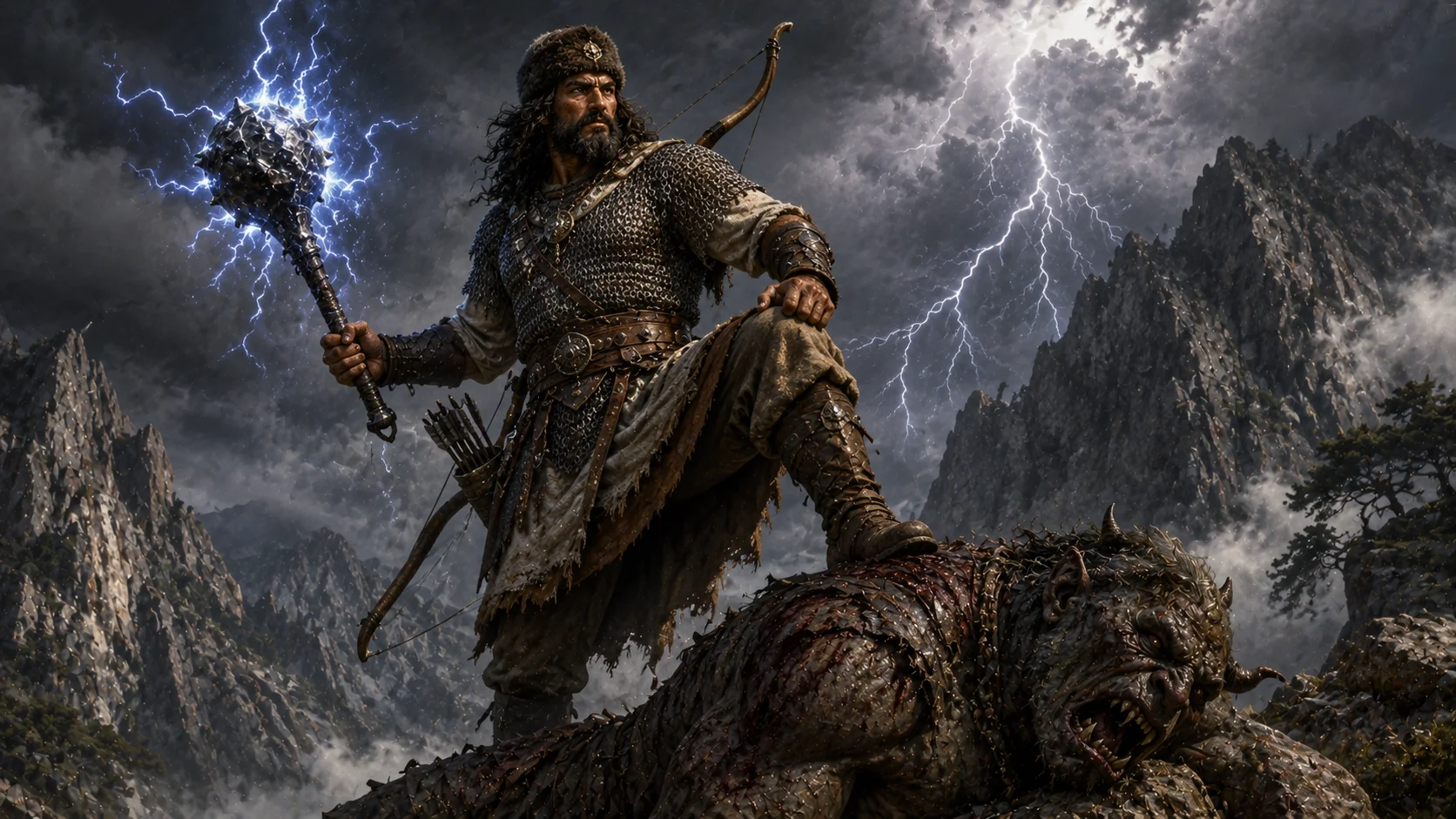
Kopala is counted among the Khvtisshvilebi, the "children of God," in the folk religion of the Georgian highlands — the mountain communities of Khevsureti, Pshavi, and Mtiuleti. He stands among the chief of these divine hero-spirits, ranked alongside figures such as Iaqsar and Pirkusha, and is remembered above all as a dragon-slayer and demon-fighter: the warrior sent to break the power of the devi and the kajebi, the supernatural beings who once made the mountains unsafe for human dwelling. Honored with dedicated shrines and annual festivals across the highlands, Kopala occupies a mediating place in this tradition, between the supreme sky god Ghmerti and the mortal communities who looked to him for protection.
A Child of God Among the Mountain Pantheon
In the religious world of the Khevsur and Pshav highlanders, Ghmerti presides as the supreme sky god, distant and sovereign, while the day-to-day defense of human communities against chaos and misfortune falls to a tier of semi-divine agents: the Khvtisshvilebi. Kopala belongs to this tier, carrying the honorific "Khvtisshvili" that marks his status as neither fully divine in the manner of Ghmerti himself nor human, but something between — an emissary charged with executing divine will on earth. This structural position is central to understanding him: he is not a remote, unreachable god but an active, intervening one, invoked directly by name at shrine and festival, expected to act in the affairs of the communities under his protection.
The Breaking of the Devi
The devi — giant, ogre-like demons of highland epic — appear throughout Georgian oral tradition as embodiments of destructive chaos, hostile to human settlement and given to terrorizing the villages of the mountains. Kopala's central mythic role is as their destroyer. The heroic poetry of the Khevsur and Pshav highlands, composed and transmitted in the oral epic form known locally as leksebi, casts him as a mounted warrior armed with weapons of more than ordinary potency, in some tellings gifted or strengthened by Ghmerti himself for precisely this purpose. Where the devi threatened, Kopala is remembered as the one who rode against them and broke their power, clearing the way for human life to continue in country that would otherwise have remained theirs.
The Kajebi and the Fortress of Kajaveti
Alongside the devi, Kopala's epic contends with the kajebi — a distinct race of supernatural beings, cast in Georgian tradition as smith-demons and underworld dwellers, whose stronghold is remembered as Kajaveti, or Kajeti: a demon fortress that recurs across Georgian heroic narrative, most famously in the Amirani cycle. Kopala's campaigns against Kajaveti follow a recognizable shape in the highland material: he goes against the fortress to free women taken captive, to recover livestock driven off by the kajebi, or to retrieve holy and ritual objects stolen from the communities he protects. The specifics of these campaigns are not fixed into a single account — Khevsur and Pshav variants differ on the particulars — but the underlying pattern, of Kopala descending on the kajebi's stronghold to undo a theft or a captivity, is a constant across the tradition.
Companion and Rival: Kopala and Iaqsar
Kopala is rarely spoken of in complete isolation from Iaqsar, also called Iakhsar, another of the great Khvtisshvilebi and himself a dragon-fighter of the highland pantheon. The relationship between the two varies by locality and by the particular oral variant being told: in some Pshav-Khevsur tellings the two heroes fight side by side against the kajebi, companions in arms against a shared demonic enemy; in others they appear instead as rival patrons, each the particular protector of a different highland community, their precedence over one another a matter of local claim rather than settled fact. Highland tradition itself does not resolve which of the two holds seniority, and this unresolved variation is not a gap to be filled but a genuine feature of how the material was — and in places still is — transmitted.
A Cousin to Amirani's Chains
Scholars of Georgian comparative mythology, following early work associated with Marr and later developed by Bardavelidze, have placed Kopala within the same broad complex of dragon- and devi-slaying heroes as Amirani, the chained Promethean giant-fighter of the wider Georgian and Caucasian tradition. The typological overlap is real: both are combatants against monstrous, chaos-bringing adversaries, and both figure in narratives involving a demon fortress. But the traditions diverge in a crucial respect. Amirani's story ends in punishment — the culture-hero bound and chained, a figure of tragic constraint. Kopala carries no such ending. He remains, in the highland tradition, an active cult deity with living shrines and an ongoing ritual relationship to the communities that honor him, not a bound figure from a completed mythic past but a protector still invoked in the present tense of festival and oath.
What the Kajebi Stole, He Returned
Kopala's campaigns against the kajebi and their fortress were not remembered by the highland communities as combat for its own sake. What gave those campaigns their meaning was what they recovered: captive women brought home, livestock driven off returned to their owners, holy and ritual objects taken from the community restored to their rightful place. It is this pattern — descent upon the stronghold of a chaos-bringing enemy, followed by restoration of what that enemy had taken — that runs through the surviving Khevsur and Pshav variants of his epic. Kopala's ferocity in battle is remembered as inseparable from this restorative purpose: he is not simply a slayer of monsters, but the one who goes after what has been stolen and brings it back to the human world it was taken from.
The Shrine Cult of Khevsureti and Pshavi
Kopala's presence in highland life was not confined to epic recitation. He was, and in places remains, a shrine deity — a khati — with dedicated sanctuaries, known as jvari or khati shrines, established across Khevsureti and Pshavi. These sites functioned as the physical center of his cult: communities gathered there for khatoba, the annual festival cycle associated with a given shrine, bringing sacrificial offerings that included brewed beer and sacrificed animals, and processing to and from the sanctuary in his honor. Early- and mid-twentieth-century Georgian ethnographic fieldwork documented these shrine centers as among the most significant in Khevsureti's highland religious landscape, giving later scholarship a detailed record of practices that were, at the time of that fieldwork, still living tradition rather than historical reconstruction.
Guarantor of the Sworn Word
Within the highland community, or temi, Kopala held a further role beyond festival and battle-epic: he served as a protector invoked against disease, disaster, and the raids of enemies, and — significantly — as the guarantor of oaths sworn in his name at his shrine. An oath taken before Kopala carried the weight of his witness; to break it was to break faith not merely with another person but with the deity who had stood surety for the promise. This function placed him at the center of highland social order in a very practical way, binding the community's own internal agreements to the same divine authority that protected it from external and supernatural threat.
A Faith Layered Beneath the Cross
The cult of Kopala, like that of the other Khvtisshvilebi, did not simply vanish with the arrival and establishment of Georgian Orthodox Christianity in the highlands. Instead, the two religious layers coexisted in a syncretic relationship characteristic of Khevsureti and Pshavi: Christian observance held its place, while the older highland deities continued to be honored at their own shrines, with their own festivals and their own claims on the community's loyalty and protection. This coexistence is part of what makes the highland material so distinctive within Georgian religious history — not a pre-Christian religion erased by a later one, but two systems of reverence persisting together, each occupying its own space in the life of the mountain communities.
A Name Without a Settled Origin
For all his prominence in highland tradition, the name Kopala itself resists confident etymology; scholarship has not settled on a secure derivation for it. This uncertainty sits alongside the broader variability already noted in his mythic material — the differing accounts of his campaigns, the shifting relationship with Iaqsar, the local disputes over which of the two heroes held precedence. None of this variability should be read as corruption or error creeping into a once-fixed story. Highland oral tradition, transmitted community by community and generation by generation without a single central authority to standardize it, produced genuine, coexisting variants rather than one canonical account — and Kopala's material preserves that plurality faithfully.
The Warrior Who Remains at the Shrine
What distinguishes Kopala within the broader company of Georgian dragon-fighting heroes is precisely that he did not pass into legend as a closed story. Where Amirani's arc ends in chains, Kopala's did not end at all in the same sense — his shrines continued to receive offerings, his festivals continued to be kept, and his name continued to be invoked over oaths long after the epic battles against the devi and the kajebi had passed into the fixed form of recited poetry. He belongs, in the memory of Khevsureti and Pshavi, less to a finished mythic past than to an ongoing relationship between a mountain people and the protector they understood to stand between them and the forces — demonic, natural, and human — that threatened their world.
Sources & traditions
- EncyclopediaWikipedia — Kopala
- TraditionGeorgian folk and village traditions
Myths change from area to area and from time to time. This chronicle follows the most widely told versions; tellings in other villages, regions and eras may differ.