Tkashi-Mapa, whose name is generally understood to join words for "mistress" or "queen" with "forest," is a woodland spirit of Georgian mountain folk belief, attested particularly among Svan and Racha-region tradition and in accounts collected near Khevsureti. She is remembered not as a minor nymph of the trees but as a tutelary ruler of the forest itself — a personification of an entire ecological zone, in keeping with a wider Georgian mountain-culture habit of assigning guardian spirits to specific domains of the wild.
A Ruler Named for Her Domain
The etymology commonly proposed for Tkashi-Mapa reads her as "queen of the forest" or "mistress of the woodland" — tqe or tkashi for the forest, mapa or dedopali for the one who rules it. This naming pattern marks her out from the ordinary run of nature-nymph figures: she is not merely a spirit who lives in the forest but one who is understood to govern it, holding authority over its resources, its safety, and the terms on which people may enter it. Scholars of Caucasus folklore have noted that this pattern of naming — mistress-of-a-place rather than simply spirit-of-a-place — recurs across the region's guardian figures, and it is this sovereign quality that distinguishes Tkashi-Mapa within her category. The precise etymology is not fully settled among those who have studied her, and some caution that recorded material may blend a standalone figure with neighboring forest-and-game spirits rather than describing one consistent, uniform tradition.
A Beauty Marked as Other
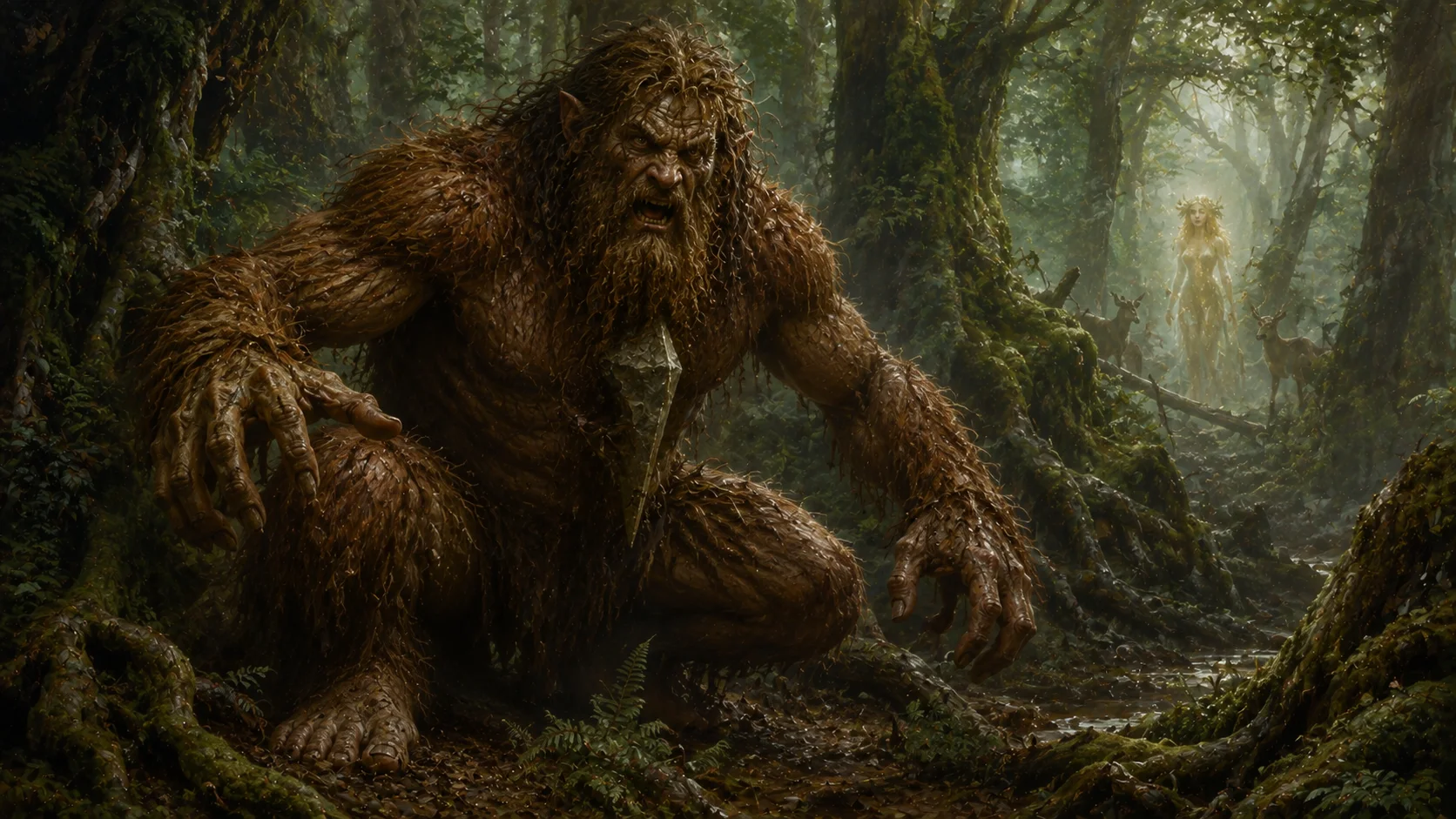
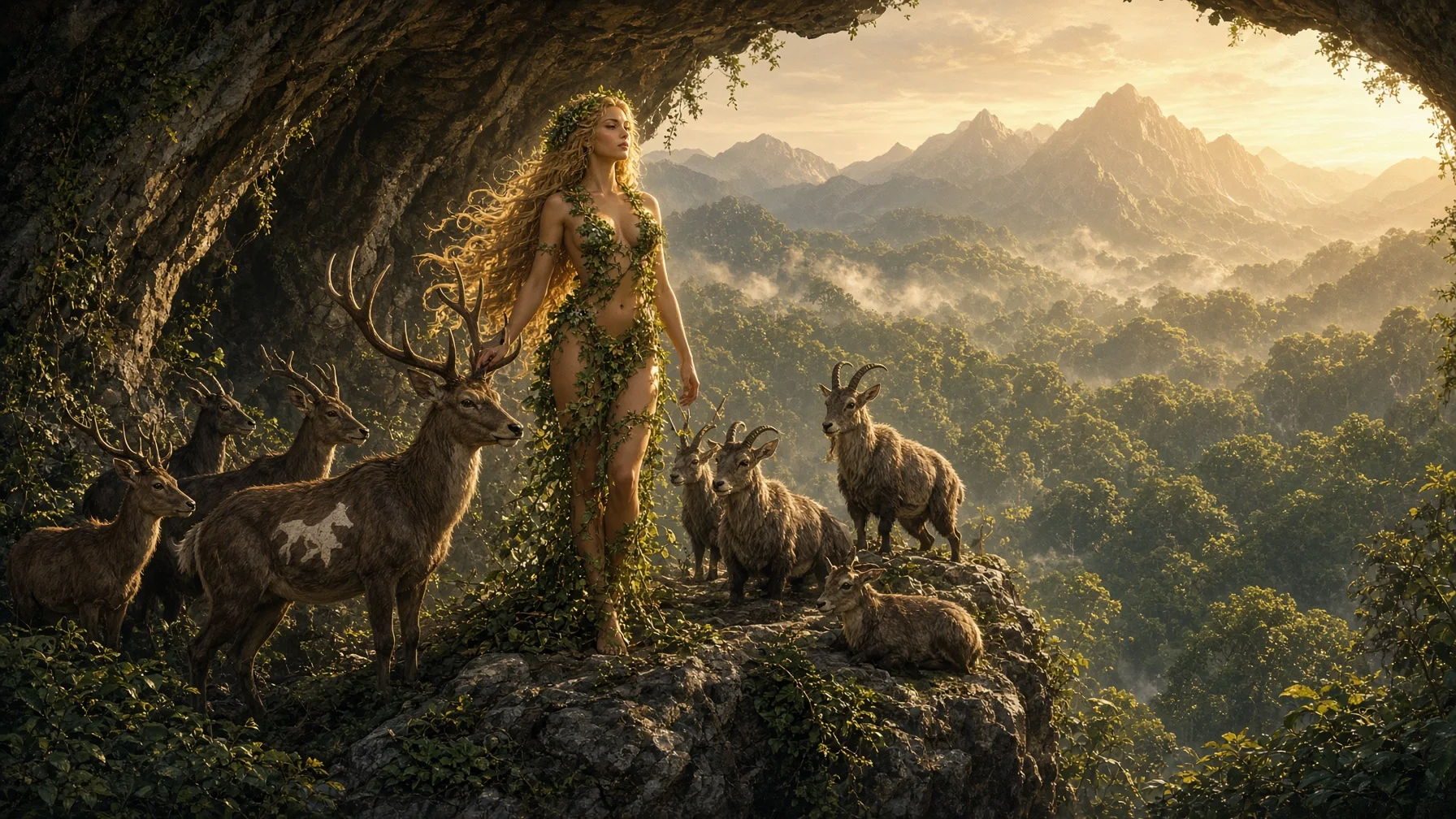
Where she is described in physical terms, Tkashi-Mapa appears as a beautiful woman carrying some telltale sign that she is not human. Recorded variants differ on the specific marker: feet that turn backward, hair of unnatural length, or a body covered in hair. This is a familiar device in the folklore of the wider region — a beauty too perfect to be entirely safe, betrayed by one detail that only the careful or the unlucky observer notices. The device does double duty. It lets her move through the forest as something like a woman, approachable enough to be encountered by a hunter or a shepherd, while reminding the listener that she belongs to the trees and not to the village, and that the ordinary rules of human company do not apply to her.
Sudden Among the Trees
Some traditions credit her with the ability to shapeshift, or simply to appear and vanish abruptly among the trunks and undergrowth, without the ordinary business of arriving or leaving. This suddenness is treated as part of her nature rather than a trick she performs: it marks her as a being of the forest edge, the liminal boundary in Georgian folk cosmology where the cultivated world gives way to something older and less governed. To meet her, in the logic of these accounts, was already to have crossed into her territory, whether or not the traveler had noticed the crossing.
The Forest's Moral Economy
Tkashi-Mapa's central function in belief is custodial. Hunters and woodcutters were understood to need her tacit permission, or at least her tolerance, before taking game or timber safely from her woods. This places her within the same moral economy of the hunt documented for Dali, the Svan mistress of wild goats and high-mountain game: taking more than a fair share, boasting of a kill, or otherwise breaking an unspoken taboo was believed to invite her displeasure. The consequences were not always dramatic — misfortune, illness, or simply bad luck in the woods thereafter were enough to mark someone as having offended her, and the belief functioned as a kind of conservation ethic long before that word existed, restraining what people took from a resource they could not fully control or replace.
The Traveler Led Astray
Among the powers most consistently attributed to her is the ability to lead travelers astray — the disorientation that sends a woodcutter or a hunter walking in circles, unable to find a path he knows well, until exhaustion or dusk forces him to stop. Ethnographers class this "forest spirit leads you in circles" motif alongside comparable beliefs recorded elsewhere in the Caucasus and across Eastern Europe, where a wood is understood to be able to close around a person and refuse, for a time, to let them find their way. For those who told these stories, getting hopelessly lost in a familiar forest was not simply bad navigation; it was a sign that the forest's mistress had taken an interest, favorable or otherwise, in the traveler's presence.
The Lure of the Encounter
Beyond simple disorientation, some accounts describe her as capable of luring or seducing the men who crossed her path — hunters, shepherds, travelers — who afterward found themselves lost, fallen ill, or otherwise marked by having met her. This motif sits structurally alongside the South Slavic vila and the water-bound rusalka of Eastern Europe, spirits who likewise draw in the unwary traveler with beauty and leave them changed by the encounter. Tkashi-Mapa's version of the motif is distinctly forest-bound rather than water-bound, tying the danger she poses to the woods themselves rather than to any river or spring, and folding the erotic charge of the encounter into the same logic of trespass and consequence that governs the taking of game or timber from her domain.
Kin Among the Guardian Spirits
Tkashi-Mapa is best understood not as a solitary figure but as one member of a set of Georgian nature spirits, each assigned to a particular ecological zone rather than gathered under a single unified pantheon head. Dali rules the high crags and the wild goats that live among them, chiefly in Svan tradition. Ochopintre, a goat-footed protector of forest animals, watches over the creatures of the woods in a role adjacent to but distinct from hers. Tkashi-Mapa's own charge is the forest as territory — its resources, its paths, its capacity to disorient or to yield. Folklorists working in the classification schemes associated with Elene Virsaladze and later compilers of Caucasus folklore group these figures together as nature or guardian spirits, set apart from ancestral or household spirits, and the degree to which any two of them blend together in a given local account is itself one of the open questions in the scholarship.
Small Offerings, Unspoken Rules
Georgian mountain communities are recorded as having observed informal propitiatory customs connected to her — leaving small offerings, refraining from boasting about a successful hunt, avoiding the felling of certain trees — all attributed to a wish not to give offense to the forest's mistress. Ethnographic accounts are careful not to overstate how formal any of this was: the record does not clearly distinguish a structured cult from a more diffuse, generalized caution that shaped everyday behavior in and around the woods. What is consistent across the accounts is the underlying logic — that the forest was not empty or ownerless, and that moving through it carried a kind of etiquette owed to its unseen ruler.
A Figure Without an Icon
Tkashi-Mapa has never been the subject of formal religious art or church iconography. She belongs to a layer of pre-Christian and folk-survival belief that runs alongside, rather than through, Georgian Orthodox Christian tradition, and no fixed pictorial canon was ever built around her. What survives of her appearance survives only in the oral narrative motifs themselves — the backward feet, the unnaturally long or covering hair, the sudden appearance among the trees — carried by the telling of belief-legends rather than fixed in paint, carving, or manuscript.
Belief Without Epic
Unlike Amirani, whose exploits were elaborated into a developed heroic epic cycle, Tkashi-Mapa is not the center of any comparable narrative tradition. What survives of her is scattered belief-legend and taboo custom — fragments of encounter, warning, and consequence rather than a continuous told story with a beginning and an end. This is itself informative: it places her among the localized, ecology-specific spirit cults that Caucasus folklore studies treat as evidence of belief anchored to a particular landscape and a particular way of living from it, rather than belief organized around the grand narrative machinery of epic.
Survival in the Mountain Record
That belief in a figure like Tkashi-Mapa persisted well into the modern ethnographic record, documented alongside an established Georgian Orthodox Christian life in the same mountain communities, is cited by scholars as evidence of how durable pre-Christian nature-spirit belief could be in regions where the forest remained a working, dangerous, and economically necessary part of daily life. She was not preserved as doctrine or formal cult but as practical caution passed between generations of hunters and woodcutters — a way of naming the forest's unpredictability and giving it a face.
The Uncertain Edges of Her Portrait
Much about Tkashi-Mapa resists final certainty. Her name's precise etymology is debated rather than fixed. It is not always clear how much recorded material describes one coherent figure as opposed to a regional or local variant that has, over time, blended with Dali or with other spirits of the forest and its game. Georgian folklore scholarship has not standardized these details across its sources, and any account of her — this one included — should be read as a gathering of the recorded motifs rather than a single settled biography. What remains steady across the variation is the shape of the belief itself: a woman-formed ruler of the woods, beautiful, marked as other, capable of guiding a traveler true or leading him hopelessly astray, whose favor the forest's people sought and whose displeasure they took care not to earn.
Sources & traditions
- TraditionGeorgian folk and village traditions
Myths change from area to area and from time to time. This chronicle follows the most widely told versions; tellings in other villages, regions and eras may differ.