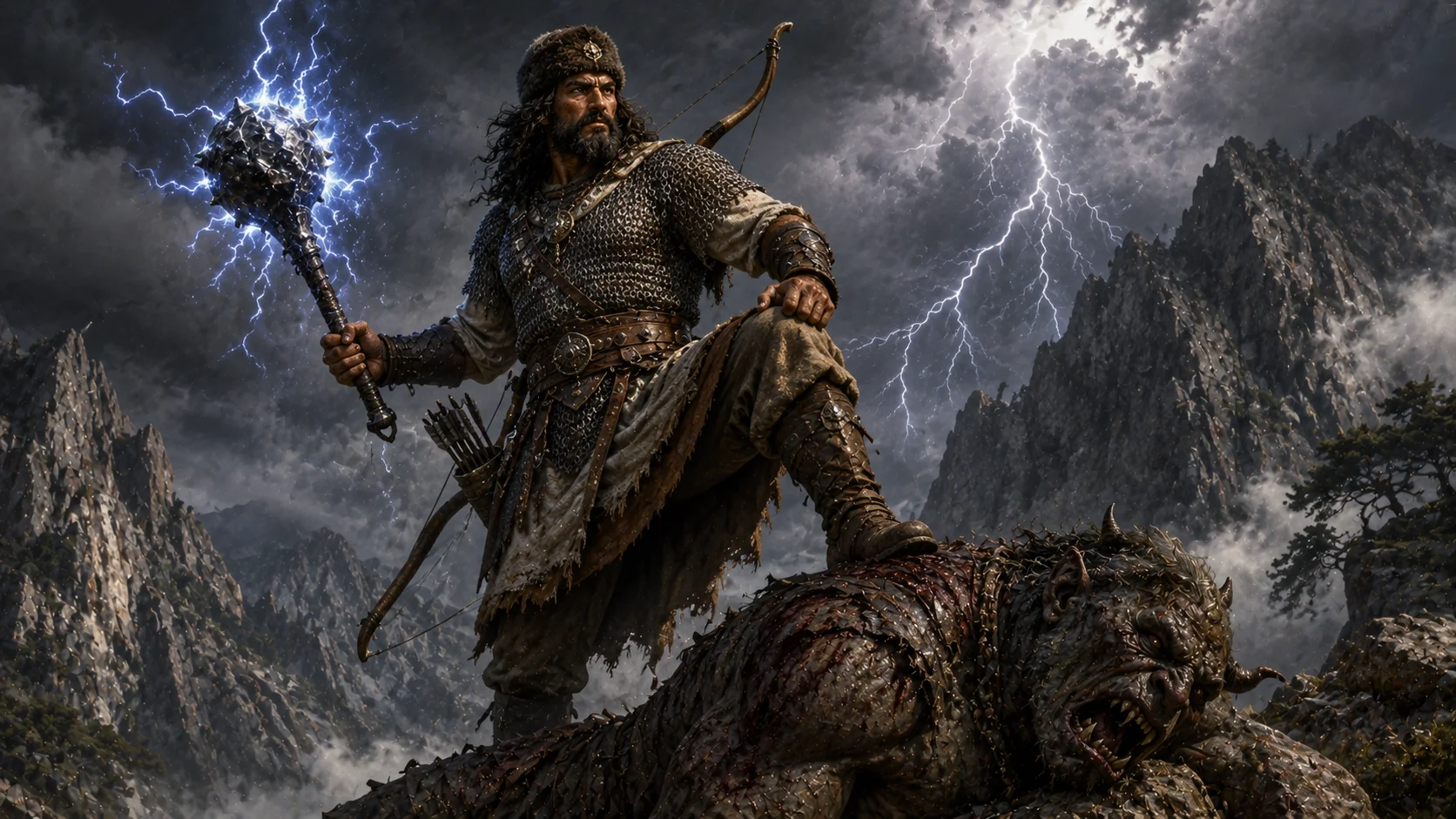
Hayk, called Hayk Nahapet, Hayk the Patriarch, is the legendary founder-hero and eponymous ancestor of the Armenian people. Preserved above all in the fifth-century History of the Armenians by Movses Khorenatsi, his story tells of a giant-archer descended from Noah who refused to bow to the tyrant Bel, led his household north out of Mesopotamia into the highlands around Lake Van, and there slew his pursuer with a single arrow from his great bow. From him, tradition holds, the Armenians take their native name for themselves, Hay, and for their land, Hayastan — the land of Hayk.
A Name Carried Down From Noah
Khorenatsi places Hayk within the great genealogical chain that Armenian Christian historiography drew from scripture: a descendant of Noah through Japheth, and through Japheth's line down to Torgom, known also as Togarmah, from whom Hayk himself springs. This framing set Armenia's origins inside the same sweeping family tree that biblical tradition used to account for the peoples of the earth after the Flood, giving the Armenian nation a place, and a name, within scriptural history itself. Scholars studying the text today generally treat this genealogical scaffolding as a literary and theological layer, laid by a Christian historian over what was very likely a far older oral epic — a hero-tale that had circulated among the Armenians long before it was given a place in the family of Noah. The overlay does not erase the tale beneath it; it gives an ancient story a home inside a newer framework of belief.
The Household That Would Not Bow
The heart of the legend is Hayk's defiance. In the age after the Flood, the narrative tells, the mighty Bel — a tyrant-king of Babylon, cast in the mould of the Mesopotamian god-king figures later ages remembered as Nimrod — sought to bring all peoples under his rule and to be honored as more than a man. Hayk would not submit. Rather than accept Bel's dominion, he gathered his household and his followers and turned north, away from Babylon and its plains, toward the highlands that would become Armenia, settling in the country near Lake Van. It is remembered as an act of principle before it was an act of war: a patriarch choosing exile and hardship in an unclaimed land over comfort under a foreign yoke.
Pursuit Out of Mesopotamia
Bel did not let the matter rest. Reading Hayk's departure as open rebellion, he raised an army and pursued the migrating household north into the mountains, intent on dragging Hayk and his people back under his rule by force. The chase itself became part of the legend's shape — a tyrant's power reaching after a household that had simply wanted to be left to live free, and the highlands of Armenia becoming, for the first time in the story, a refuge worth defending rather than merely a destination.
The Battle in Hayots' Dzor
The two forces met at last in the region that would afterward be called Hayots' Dzor, the Valley of the Armenians — a name tradition holds the land itself took from this very battle. There, in the highlands near Lake Van, Hayk's followers stood against Bel's army in the encounter that would decide whether the migration ended in freedom or in submission.
One Arrow, Loosed From a Great Bow
At the center of the battle stands a single, spare image: Hayk, the peerless archer, drawing his enormous bow and loosing one arrow at Bel himself. The shot found its mark and killed the tyrant outright. With their leader fallen, Bel's army broke, and the threat that had followed Hayk's household out of Mesopotamia ended in that one moment. Armenian legendary chronology assigns the battle a precise date — 11 August 2492 BCE — a figure that belongs entirely to the traditional reckoning of the national epic rather than to verifiable history, but which has long been kept as the symbolic marker of the nation's founding act of independence.
The Plain of the Graves
The ground where Bel fell was afterward known as Gerezmank', "the graves," a name tradition ties directly to the dead left on the field after the tyrant's defeat. Between Hayots' Dzor, where the battle was fought, and Gerezmank', where its dead were laid, the landscape itself was remembered as bearing witness to the story — a geography of legend in which valley and plain alike carry the memory of the single arrow that ended Bel's pursuit.
A Name Given to a People and a Land
From Hayk's own name, Armenian tradition derives both the people's word for themselves, Hay, and their word for their country, Hayastan. This is a native, traditional etymology rather than one linguistics has established as fact, but its hold on Armenian self-understanding has never depended on philological proof. To call oneself Hay is, within this tradition, to claim descent from the patriarch who would not kneel to Bel — the nation's name is, in this telling, also its founding story, compressed into a single word.
The Line That Followed Him
Hayk's victory did not end the story of his household; it began the story of his line. Khorenatsi records that after settling the Ararat plain, Hayk founded a dynastic seat there, and that his descendants carried the patriarchate forward — his great-grandson Aramanyak among the earliest named, and later figures such as Aram continuing a genealogy that Armenian tradition extends down toward the historical kings of Armenia. Some have argued that the name "Armenia" itself, in its Armen- form, may trace to this later figure Aram rather than to Hayk — a separate and disputed etymology, distinct from the Hay/Hayk derivation, but woven into the same unbroken line of patriarchs said to descend from the archer of Hayots' Dzor.
The Archer Among the Stars
Armenian tradition gave Hayk's name to more than a nation — it gave his name to the sky. Hayk is the traditional Armenian designation for the constellation known elsewhere as Orion, and scholars have long read this as evidence of an older layer beneath the historical narrative: an archer-hero bound to a celestial or sky-god archetype, a figure whose bow belongs as much to the heavens as to the battlefield. Such astral archer-heroes recur across Near Eastern and Indo-European mythology more broadly, though how closely Hayk's story should be read against those wider patterns remains a matter scholars continue to weigh rather than settle.
An Echo Beside Vahagn's Dragon-Slaying
Comparative mythologists have also noted a family resemblance between Hayk's single decisive arrow and the dragon-slaying, or vishap-slaying, exploits told of Vahagn elsewhere in Armenian tradition — both stories built around a warrior figure who ends a great threat in one triumphant stroke, a shape many have connected to the broader Indo-European pattern of a storm or warrior god overcoming a chaos-figure. Yet the distinction between the two matters and is carefully kept: Hayk is remembered as a patriarch and culture-hero, the father of a nation, not as a worshipped deity. No cultic devotion or temple worship of Hayk is attested, setting him apart from figures such as Anahit or Vahagn, who received the honors of active religious cult.
An Image Built Long After the Legend
Ask what Hayk looked like to the ancient Armenians who first told his story, and the honest answer is that no well-attested classical-era image survives to say. The familiar picture of Hayk today — the mighty bow-bearing warrior-patriarch of national art and statuary — belongs largely to the later centuries of national revival, when artists returned to Khorenatsi's written description and gave it visual form. What stands in bronze and paint as Hayk the archer is thus a modern reconstruction built faithfully from an ancient text, rather than an image handed down unbroken from antiquity itself.
Legend Standing Where History Cannot Reach
Because Khorenatsi is, in effect, the sole surviving source for the connected narrative of Hayk's flight and his battle with Bel — earlier oral fragments existing, if at all, beyond independent verification — modern historians are careful to treat the tale as national foundation legend and epic rather than historical record. That judgment is not a dismissal. The same scholarship recognizes the story as an authentic and ancient strand of pre-Christian Armenian oral tradition, one a Christian historian received, respected, and reshaped rather than invented outright — a legend standing confidently in the place history cannot follow it.
The Founding Symbol of a People's Freedom
Above all else, Armenian tradition has kept Hayk's defiance of Bel as the founding symbol of the nation's love of independence — a patriarch who chose exile and battle over submission to foreign domination, and whose single arrow became shorthand for a people's refusal to be ruled by outsiders. That reading did not fade with antiquity; it found new voice in the nineteenth and twentieth centuries, when Armenian national revival and revivalist literature returned again and again to Hayk's stand against Bel as the oldest expression of a theme the nation would need many times over: the choice to remain free rather than to kneel.
Sources & traditions
- EncyclopediaWikipedia — Hayk
- TraditionArmenian folk and village traditions
Myths change from area to area and from time to time. This chronicle follows the most widely told versions; tellings in other villages, regions and eras may differ.