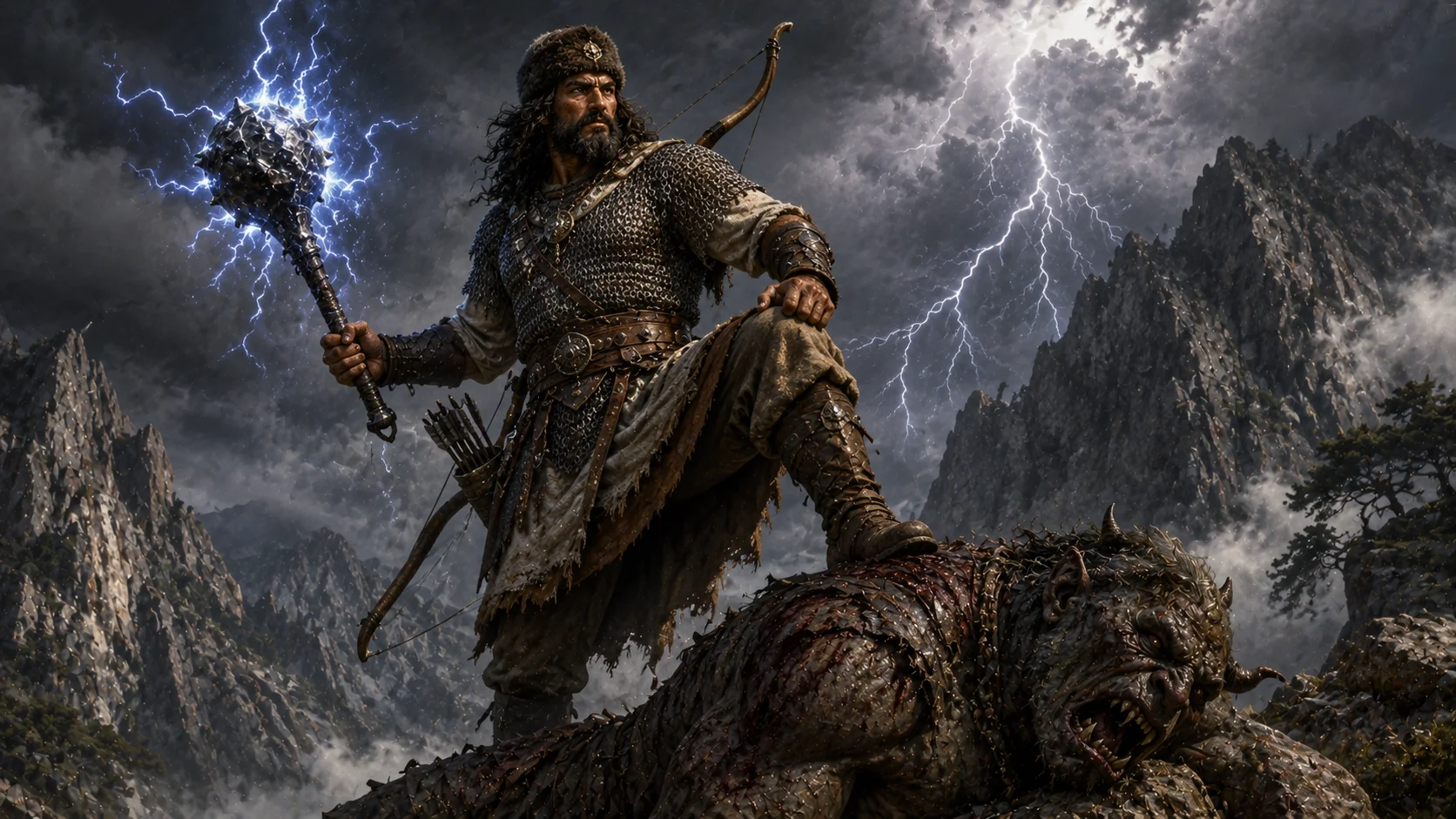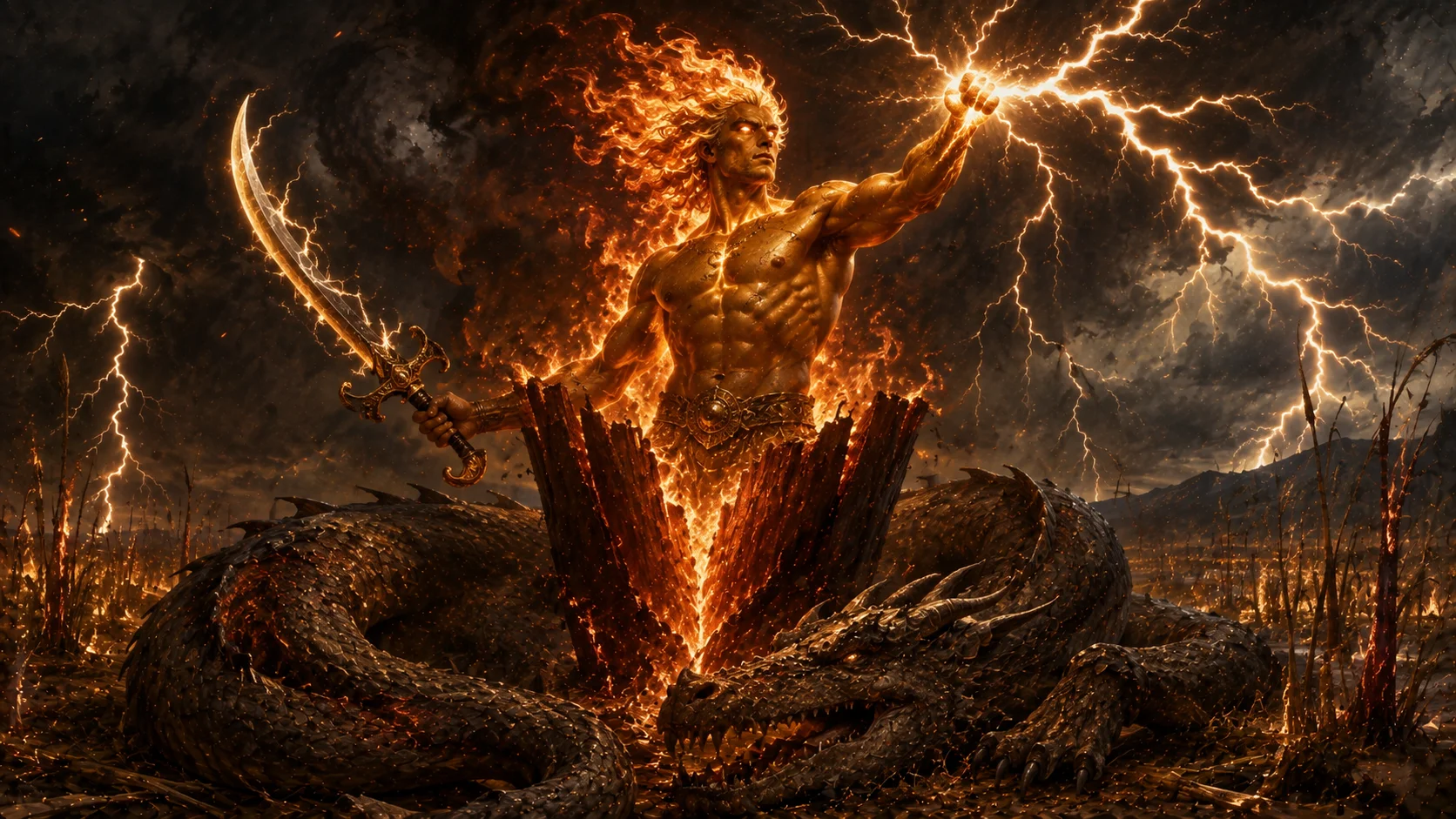
Vahagn, Vahagn Vishapakagh, the Dragon-Reaper, is the great warrior-god and dragon-slayer of ancient Armenia: the god of thunder, lightning, fire, war, and courage, born of fire in a marvellous birth-hymn, the slayer of dragons, the vishaps, the valiant champion of the gods, the Armenian counterpart of the Persian Verethragna and the Greek Heracles. He is the dragon-slayer, the fire-born warrior-god of Armenia, and one of the most vividly remembered figures of the pre-Christian Armenian pantheon.
A Hymn Older Than the Church
Almost everything known of Vahagn today survives because a single fragment of oral verse was written down by the fifth-century historian Movses Khorenatsi in his History of Armenia. Khorenatsi, writing as a Christian cleric centuries after the old gods had been formally set aside, preserved this fragment not as an act of worship but as testimony — a piece of ancient song too well known, too deeply rooted in the memory of the Armenian highlands, to pass over in silence. Scholars of Armenian literature regard it as among the oldest surviving pieces of Armenian oral poetry, and it is treated with the same reverence as any founding fragment of a people's earliest voice, because it is nearly the only place where a pre-Christian Armenian god speaks, sings, and is born in his own words rather than through the summary of a hostile later chronicler.
Heaven, Earth, and the Purple Sea in Labor
The hymn describes a birth unlike any ordinary birth: the heavens were in labor, the earth was in labor, and the purple, crimson sea was in labor also. From the sea a small reed rose up, and within the reed's hollow stalk a struggle began — first smoke, and from the smoke a flame, and from the flame a youth leapt forth. This youth was Vahagn: his hair was fire, his beard was flame, and his eyes were like two small suns. He came into being already blazing, already formed as fire given shape and will, born not from a mother's womb but from the labor of the cosmos itself — sky, ground, and sea acting together as though the whole created world had strained to bring forth a single burning child. Comparative mythologists have long set this birth beside other Indo-European fire and storm deities born in flame or from water, seeing in it a very old inheritance rather than an isolated Armenian invention.
A Name Carried on the Wind from Iran
The name Vahagn is not, philologists agree, purely native to Armenian soil. It is widely held to descend from Verethragna, the Avestan and Zoroastrian yazata of victory known in later Persian tradition as Bahram. Armenia in the centuries before Christianity sat within the orbit of Achaemenid, then Parthian and Arsacid Iran, and its religious life absorbed a great deal from that world without ceasing to be its own. Georges Dumézil and other students of comparative Indo-European religion have traced the linguistic path from Verethragna to Vahagn carefully, though the precise route of transmission — whether by direct borrowing under Iranian rule or through a shared inheritance stretching back to a common Indo-Iranian ancestor — remains an open question among specialists. What is not in doubt is that Armenians took a god of victory whose name came from the Iranian world and made him unmistakably their own, wrapping him in a birth-hymn, a temple cult, and a body of local legend that owes nothing to borrowing.
The Reaper of Vishaps
Vahagn's great title, Vishapakagh, means Dragon-Reaper or Uprooter of Vishaps, and it names the deed for which he was most honored. The vishaps of Armenian tradition are serpent-dragons bound up with storm, flood, and the menace of chaotic water — creatures that coil around mountains, dam up rivers, and threaten to unmake the ordered world. Vahagn's task was to hunt them down and destroy them, reaping them as a farmer reaps a hostile crop, uprooting them as one uproots something that should never have been allowed to take hold. In this he stands in the same company as Indra battling Vritra in the Vedic tradition and Thor contending with the Midgard Serpent in the Norse — a dragon-slaying warrior god who appears, in one form or another, wherever Indo-European peoples told stories of order struggling against the serpent that would swallow it. For Armenia, Vahagn was the one who had already won that struggle, and his victory was the guarantee that the vishaps, however often they stirred, would not overrun the world of ordinary people.
Fire Answering Fire
Because Vahagn was born of flame, his cult carried with it a strong association with fire itself as a sacred and living force. Pre-Christian Armenia, shaped as it was by centuries of Iranian religious influence, already held fire in high veneration, and Vahagn's worship sat naturally within that broader reverence for the hearth-flame and the sacrificial fire as things that were not merely useful but holy. To honor Vahagn was, in part, to honor fire in its own right — the same fire from which he had leapt as a newborn youth with a beard of flame, understood now as the visible trace of the god's presence wherever it burned.
The Temple at Ashtishat
Vahagn's principal sanctuary stood at Ashtishat in the region of Taron, remembered by the classical Armenian sources as one of the great cult centers of the old religion, with further associations recorded near Bagavan and Bagaran. It was here, before the kingdom's conversion to Christianity in 301 CE, that his rites were kept, his hymn very likely sung, and his favor sought by those who looked to him for courage and victory. Ashtishat was not his alone: it was a shared sacred landscape, home also to Anahit, and it was this grouping of temples that gave the old Armenian pantheon its lived, communal shape — gods worshipped not in isolation but side by side, at sites the whole community knew and returned to.
Kin Among the Gods
Vahagn belonged to a close cultic family at the heart of the Armenian pantheon. Aramazd stood as the chief god, later understood through the figures of Zeus and Ahura Mazda; Anahit, goddess of fertility and motherhood, appears again and again as Vahagn's companion in temple groupings and cult memory; and Astghik, goddess of love and beauty, completed a triad of divine figures whose worship overlapped and reinforced one another. Vahagn's place within this family was that of the strong one, the warrior son or companion whose fire and valor complemented Aramazd's sovereignty and Anahit's nurture — a pantheon that, like many ancient ones, understood its great powers as bound together rather than standing apart.
The Strength of Heracles, Seen Through Armenian Eyes
In the Hellenistic centuries, when Greek and Armenian religious vocabularies met and mingled, Vahagn was identified with Heracles — a natural pairing, since both were understood above all as figures of tremendous physical strength, the strongman among the gods, the one whose might was applied directly and heroically against monstrous threats. This syncretism did more than borrow a convenient Greek label; it is largely through it that later tradition and scholarship have been able to say anything about how Vahagn may have looked. Hellenistic-period Armenian coinage and reliefs, including material associated with the temple complex at Garni, show a Heracles-type figure bearing club and lion imagery, and it is by this route — through the equation with Heracles — that Vahagn is pictured as fiery-haired, fiery-bearded, with eyes like suns, a lion at his side, a club or weapon in hand. No surviving statue is inscribed with his name outright, so this picture is treated by scholars as probable and well-grounded rather than certain, a reconstruction built carefully from the hymn and from the coins rather than a settled fact carved in stone.
The Straw Path Across the Night Sky
Armenian folk memory kept Vahagn alive long after his temples had fallen silent, and one of the gentlest traces of that memory is astral rather than martial. The Milky Way itself came to be called Vahagni chanaparh, Vahagn's Straw Path, tied to a folk tale in which Vahagn, fleeing with straw he had stolen, scattered it behind him across the heavens as he ran. It is a small, almost playful story beside the grandeur of the birth-hymn and the dragon-slaying, yet it shows how thoroughly the god had woven himself into everyday explanation — into the naming of the night sky itself, carried forward by ordinary people long after the formal cult that once honored him at Ashtishat had ceased.
What Silence and Hostility Left Behind
Most of the pre-Christian Armenian pantheon survives only as a shadow, summarized briefly and often dismissively by Christian-era writers who had every reason to let the old gods fade. Vahagn is the exception that proves how much has been lost elsewhere: because his birth-hymn was thought too remarkable, too rooted in the people's memory, to omit, a fragment of genuine pre-Christian Armenian religious poetry reached later centuries essentially intact. Everything modern understanding can say with confidence about how Armenians once imagined their gods speaking and singing rests very heavily on this one preserved fragment, which is why Armenologists treat it with such particular care.
A Flame Kept for the Nation
Vahagn's afterlife did not end with the coming of Christianity. In later centuries his name and image were taken up again in Armenian poetry and in the symbolism of national revival, invoked as an emblem of martial valor, of fire and thunder as forces of resilience and defiance. This modern reception is honestly understood as a revival and a reclaiming rather than an unbroken continuation of the old cult — the temple fires at Ashtishat were not kept burning generation after generation — but it speaks to how firmly the dragon-reaping, fire-born god had lodged himself in the imagination of the people who first sang of his birth from the labor of heaven, earth, and the purple sea.
The Champion Who Remains
Vahagn endures, finally, as Armenia's clearest image of divine courage answering monstrous threat: a god born already burning, already armed with the eyes of the sun, sent out to reap the dragons that coiled around the world's rivers and mountains. In the temple groupings of Ashtishat, in the coin-struck likeness borrowed from Heracles, in the straw scattered across the Milky Way, and above all in the few surviving lines of a hymn a Christian historian could not bring himself to leave unrecorded, Vahagn Vishapakagh stands as the fire-born warrior-god of thunder, lightning, war, and courage — the valiant reaper of dragons and bringer of victory, the champion-god of ancient Armenia.
Sources & traditions
- EncyclopediaWikipedia — Vahagn
- TraditionArmenian folk and village traditions
Myths change from area to area and from time to time. This chronicle follows the most widely told versions; tellings in other villages, regions and eras may differ.