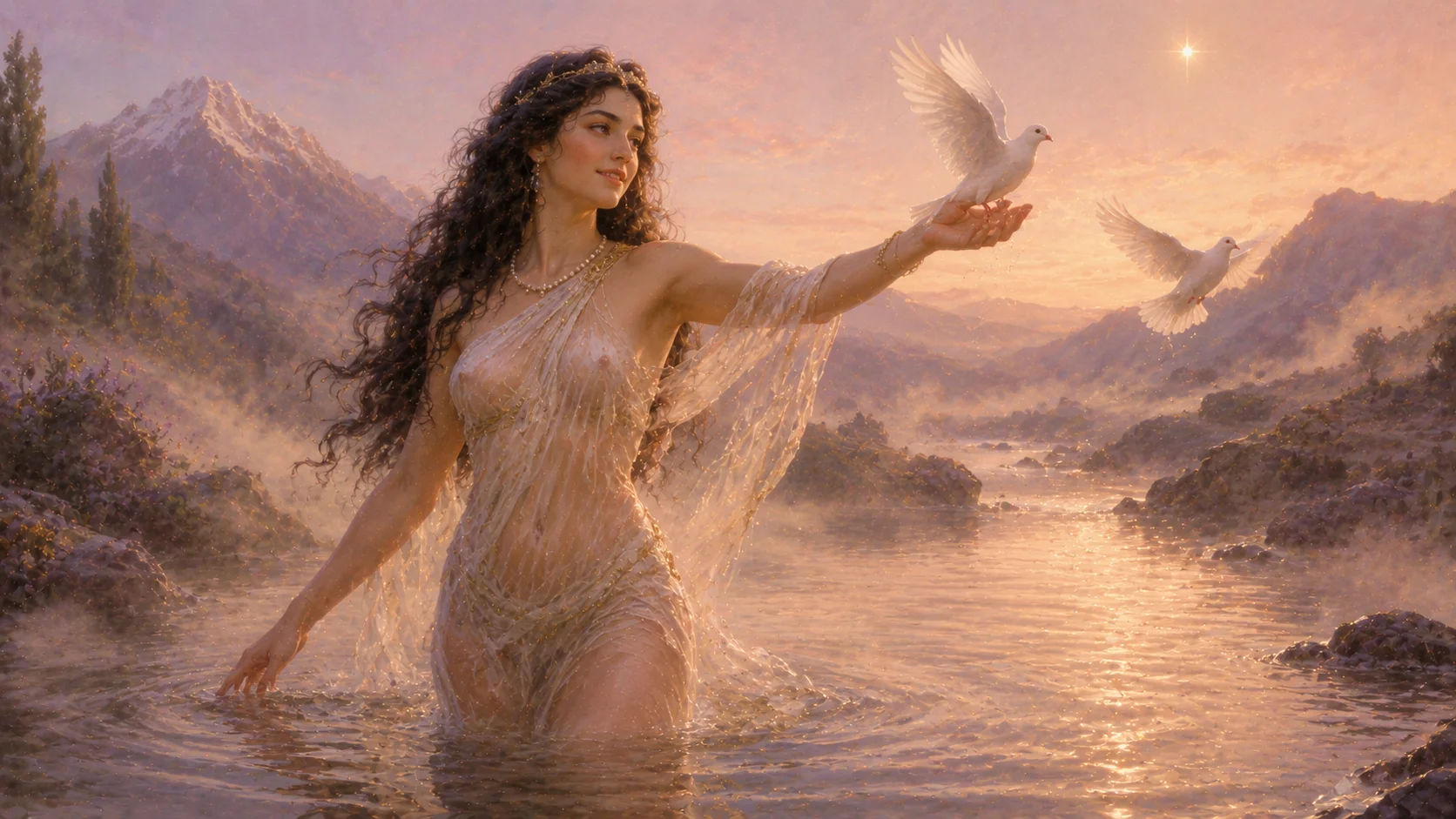
Astghik — Astlik, "Little Star" — is the goddess of love, beauty, fertility, and water in the pre-Christian Armenian pantheon, her name drawn from Armenian astgh, "star," carried by the tender diminutive suffix -ik. She was reckoned among the great deities honored at Ashtishat in the region of Taron, and her memory endures in Armenia to this day through the beloved water-and-rose festival of Vardavar, one of the clearest instances in Armenian tradition of an ancient goddess's rites surviving, transformed, inside later religious practice.
A Name Written in Starlight
To speak the name Astghik is to speak first of the sky. The root astgh means simply "star," and the affectionate -ik ending softens it into something closer to "little star" or "star-let" — a name that carries tenderness rather than grandeur, intimacy rather than distance. This is worth pausing on, because so many ancient love-and-fertility goddesses across the wider region carry names of terrible majesty, while Astghik's name suggests instead a small, warm point of light glimpsed low on the horizon at dusk or dawn. Armenian classical writers, chief among them Movses Khorenatsi, preserved her place in the pantheon alongside other testimony from Agathangelos, and it is through their words — filtered, inevitably, through the concerns of later Christian-era chroniclers looking back at a faith already receding — that her outline survives at all.
Star of the Morning, Goddess of Love
Ancient observers writing from a Greco-Roman vantage point commonly equated Astghik with Aphrodite, and by extension with Venus, recognizing in her the same governing domains: love, beauty, the generative pull that draws living things toward one another. This was the natural language of syncretism in the Hellenistic and later Artaxiad and Arsacid periods, when Armenian religious life absorbed currents from Iranian Mazdean tradition on one side and Greco-Roman civic religion on the other, weaving them into structures that remained, at their core, Indo-European. Astghik's placement within that structure is as the goddess of love and of the waters that sustain fertility — a dual portfolio that Mediterranean and Near Eastern love goddesses frequently shared, water and desire together forming the twin conditions of growth.
An Echo of Ishtar, Unproven
Because Astghik's name and function so closely parallel Ishtar and Astarte — goddesses of love whose cults spread widely across the ancient Near East — scholars have long discussed her in the same breath as those Mesopotamian figures. It is tempting, given the shared root of function if not of language, to draw a straight line of descent from Ishtar's temples to Astghik's shrine at Ashtishat. But this line is disputed rather than settled. Some scholars favor direct transmission through centuries of cultural contact between Mesopotamia and the Armenian highlands; others argue for an independent Indo-European development that simply arrived, through different roads, at a similar goddess performing a similar office. The honest position is that both readings remain live, and Astghik should not be flattened into a mere provincial copy of Ishtar when her own textual and festival evidence stands on its own.
Beloved of the Dragon-Reaper
Astghik's clearest mythic association is with Vahagn, the Armenian god of thunder, fire, and war, known by the formidable epithet vishapaqagh, "dragon-reaper," for his slaying of serpent-dragons. Tradition places her as his consort, and in some tellings as his sister, and the pairing is not incidental — Khorenatsi describes a cluster of gods, Vahagn, Astghik, and Tir, centered together on the temple precinct of Ashtishat in Taron. Whatever the precise kinship implied, the two were bound in cult and in story: the fire-and-storm god of heroic violence set beside the star-goddess of love and water, a pairing of opposites whose union was understood to matter for the world below.
The Secret Meetings on the Mountain
The best-preserved episode of Astghik's mythology concerns her nocturnal trysts with Vahagn. Their meetings were secret, conducted under cover of darkness, and yet Astghik's beauty was said to be so radiant that it lit up the night sky and the mountains around her, betraying, gently, what she wished to keep hidden. According to the tradition remembered by later generations, the young people of the villages would climb to their rooftops and to the surrounding hills and kindle bonfires there — not to expose her, but to illuminate her path, to help light the way for the goddess as she moved toward her beloved. It is a striking image: a whole countryside quietly complicit in a love story it could see written across the sky, answering divine light with human fire.
Where the Bonfires Became a Festival
This same image of hillside fires lit for Astghik is treated by Armenian folklorists as the etiological seed of Vardavar, the great Armenian festival of water and roses. The reasoning follows the logic of festival origin-myths generally: a ritual practice — bonfires lit on rooftops, later water thrown and roses scattered — becomes anchored to a story that explains why it is done. Vardavar in this reading began as Astghik's own festival, a communal expression of devotion to the star-goddess whose union with Vahagn brought fertility to the land. It survived the Christianization of Armenia by being absorbed into the Feast of the Transfiguration, keeping its joyful, drenching water-throwing and its association with roses even as its theological frame changed entirely around it.
Water Thrown in Her Honor, Even Now
What makes Vardavar remarkable is not merely its ancient pedigree but its persistence. It is a movable summer feast still celebrated across Armenia today, marked by the exuberant, good-natured dousing of family, friends, and strangers alike with water, and still carrying its old association with roses. Few pre-Christian Armenian cults can claim this kind of unbroken, living continuation — most survive only as names in a chronicler's list or as fragments reconstructed by scholars from scattered references. Astghik's festival, by contrast, is danced and splashed and laughed through every year, even by people who may never have heard her name, which is its own kind of quiet endurance. Scholars are careful to note, however, that the precise pre-Christian content of Vardavar — which elements are ancient survival and which are later reinterpretation layered on afterward — can only be partially reconstructed, and the festival should not be read as a perfectly preserved fossil of Astghik's original rites.
Roses, Water, and the Question of Doves
Astghik is remembered through a small constellation of images: water, in keeping with her fertility function; roses, bound to Vardavar's very name, which contains the Armenian word vard, "rose"; and, in comparative discussion, doves — the bird so widely associated with Aphrodite, Ishtar, and love goddesses across the ancient Mediterranean and Near East generally. The dove belongs carefully in this account, though, as a comparative inference rather than a directly attested Armenian detail. Direct Armenian textual evidence tying Astghik specifically to doves is considerably thinner than the water and rose associations, which come with firmer festival grounding. It is honest to hold the dove lightly here: plausible by family resemblance to her sister goddesses elsewhere, but not confirmed in the surviving Armenian record with the same weight.
The Temple Precinct at Ashtishat
Astghik's cult was centered at Ashtishat in the Taron region, one of the principal religious centers of Greater Armenia in the pre-Christian period, as reconstructed from the writings of Agathangelos and Movses Khorenatsi. She was honored there alongside Vahagn and alongside Anahit, the great mother-goddess of fertility, water, and wisdom — a concentration of major deities in a single sacred landscape that speaks to how central Ashtishat was to Armenian religious life under the Artaxiad and Arsacid dynasties, roughly across the second century BCE through the fourth century CE. This was a period of deep religious layering: an Indo-European Armenian foundation overlaid with substantial Iranian, specifically Zoroastrian and Mazdean, influence, and further shaped by Hellenistic contact — the very conditions that produced the Aphrodite and Ishtar comparisons discussed by outside observers.
Distinct from Anahit, Not Her Shadow
Because Astghik and Anahit share thematic ground — both connected to water, both bound up with fertility — it is easy to blur them together, and that blurring should be resisted. They are distinct deities with different domains and different places in the pantheon's genealogy. Anahit stands as the great mother-goddess, encompassing fertility together with water and wisdom in a broader, more foundational role; Astghik's domain is narrower and more particular, centered on love and beauty with fertility and water as extensions of that erotic and generative power, and her defining relationship is not maternal but the passionate, star-bright bond with Vahagn. Where Anahit is mother, Astghik is beloved — a difference of register that Armenian tradition itself preserved by giving them separate temples within the same sacred precinct rather than merging them into one.
A Goddess Without a Surviving Face
One asymmetry deserves honest notice: no securely attributed cult statue of Astghik survives. Her imagery today is reconstructed almost entirely from later folkloric memory — the star, the beauty that lights up mountains, the water, the roses of Vardavar — rather than from any surviving temple sculpture. This stands in sharp contrast to Anahit, whose striking bronze head, the so-called Anahit of Satala, remains a well-known archaeological artifact and gives that goddess a physical presence Astghik simply does not have in the material record. Astghik's presence is instead carried by story and by festival, by the shape of a name meaning "little star" and by water still thrown in her honor each summer — evidence of a different kind, no less real, but harder to hold in the hand than bronze.
A Triad Read Through Later Eyes
Scholars examining the grouping of Vahagn, Astghik, and Tir at Ashtishat have noted a resemblance to broader Indo-European and Iranian patterns of divine triads, in which one god governs fire and heroism, another love and fertility, and a third wisdom and writing — functions that map loosely onto Vahagn, Astghik, and Tir respectively. This comparison is worth holding as exactly what it is: an interpretive scholarly hypothesis about structural parallels across related religious traditions, not an attested Armenian doctrinal statement. Khorenatsi and his contemporaries never articulated the triad in these terms; the pattern is one later observers have proposed in trying to place Armenian religion within its wider Indo-European and Iranian family. It illuminates without dictating, a useful lens rather than a fixed Armenian teaching.
What Endures of the Little Star
Astghik's portrait, drawn honestly from what survives, is necessarily a portrait of fragments held together by a festival still alive today. She is the goddess of love, beauty, and water, the beloved of Vahagn whose radiance was said to outshine the night, the deity whose devotees once lit hillside fires to guide her secret path to her beloved, and whose name is remembered every summer when water is thrown and roses are scattered across Armenia in a feast that has changed its theology while keeping its joy. No bronze head preserves her features, and the precise lines connecting her to Ishtar and to Vardavar's oldest content remain matters of careful scholarly argument rather than settled fact. What is certain is that a goddess named for a small, tender star has, against considerable odds, kept a piece of her old devotion moving through the hands and laughter of people who still pour water over one another beneath the same Armenian sky she was once said to light.
Sources & traditions
- EncyclopediaWikipedia — Astłik
- TraditionArmenian folk and village traditions
Myths change from area to area and from time to time. This chronicle follows the most widely told versions; tellings in other villages, regions and eras may differ.