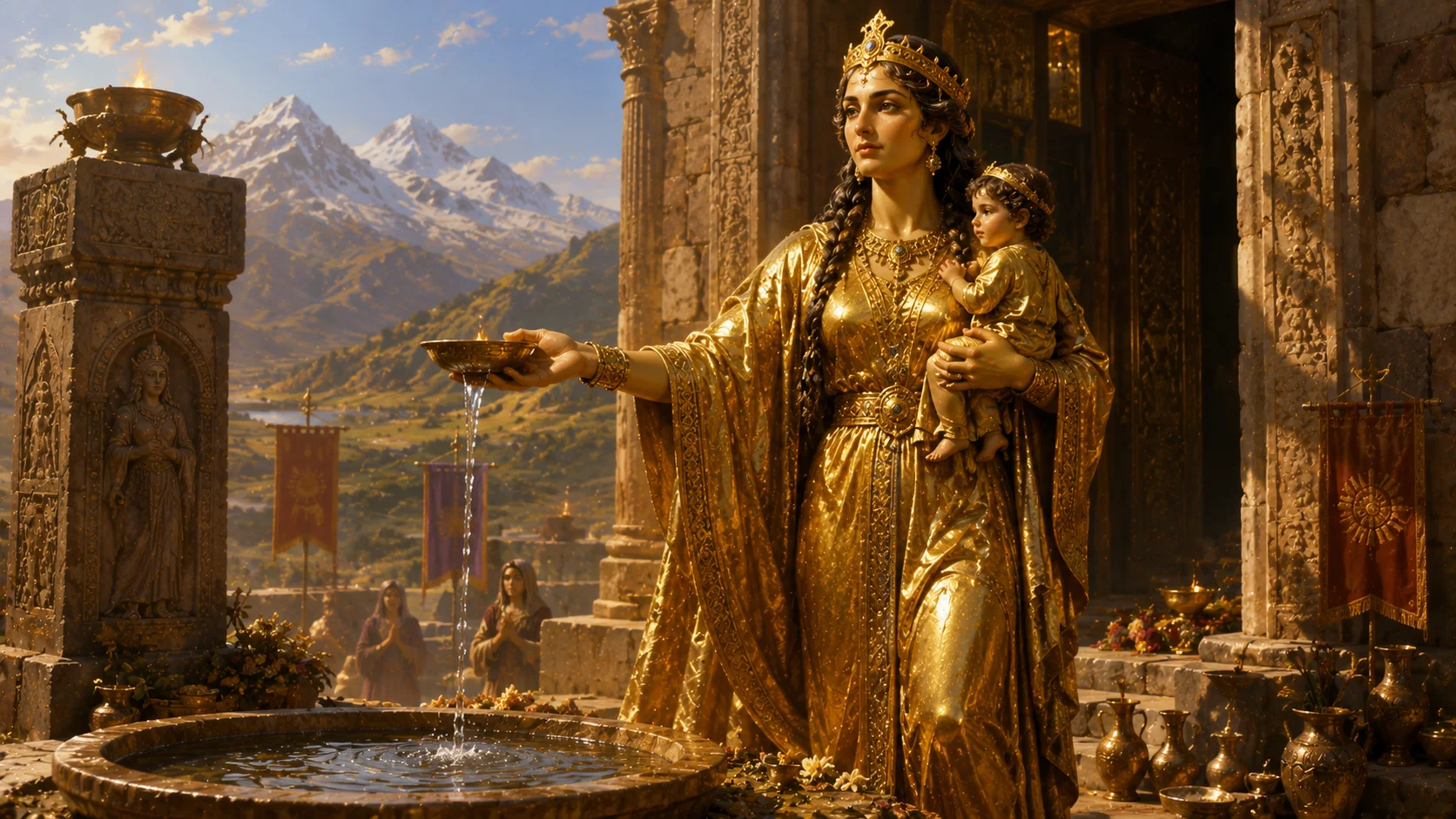
Anahit (Անահիտ) was the chief goddess of the pre-Christian Armenian pantheon — goddess of fertility, healing, wisdom, and the waters, and the most beloved figure in ancient Armenian religion. Called the Golden Mother, Voski Mayr, and Great Lady Anahit, she was venerated as the protectress of the Armenian nation and stood at the center of royal ideology for centuries before the Christianization of Armenia brought her public cult to an end.
A Name Carried on Persian Waters
Anahit's origins lie in centuries of religious exchange between Armenia and Iran. Scholars, among them James R. Russell in his study Zoroastrianism in Armenia, trace her closely to the Iranian goddess Anahita — known in fuller Avestan form as Aredvi Sura Anahita, the Zoroastrian divinity of the waters and of fertility. As Armenian religious life absorbed Iranian influence over successive centuries, this water-goddess was given local form, a local name, and, in time, a cult character distinctly her own. The genealogy she was given inside the Armenian pantheon varied between classical sources: some named her the daughter of Aramazd, the Armenian rendering of Ahura Mazda and chief god of the pantheon; others recorded her as his sister. Neither classical Armenian historians nor the Hellenistic writers who described the Armenian pantheon from outside settled the question, and the inconsistency itself is telling — it shows a cult so central that multiple traditions felt entitled to explain her position at the summit of the divine order, each in its own way.
Daughter or Sister, Never Diminished
Whatever her precise relation to Aramazd, Anahit's standing beside him was never in doubt. Armenian sources place her, Aramazd, and Vahagn — god of thunder, war, and fire — together as the three central figures of a structured pre-Christian pantheon, a triad recorded by the Armenian historian Agathangelos and by Movses Khorenatsi, traditionally known as Moses of Chorene. Where Aramazd held the sky and Vahagn embodied the violent, kindling force of storm and battle, Anahit governed the substance of life itself: water, growth, healing, and the wisdom that orders a people's world. This was not a subordinate role folded beneath two male gods but a third pillar the pantheon could not stand without, and Armenian devotion treated her accordingly, often as the most personally beloved of the three.
The Wealth of Erez
Anahit's principal cult center stood at Erez, also known as Erznka or Erzincan, in the district of Ekeghyats. The Greek geographer Strabo, writing in his Geography, described the temple there as extraordinarily wealthy, staffed by dedicated temple attendants, and a destination for major pilgrimage — a sanctuary whose riches and prestige placed it among the most significant religious sites in the ancient Armenian highlands. Pilgrims traveling to Erez were not visiting a minor regional shrine; they were approaching what Strabo's account suggests was one of the great temple complexes of the region, sustained by offerings and by the devotion of a population that regarded Anahit as their protector.
Daughters Given to the Temple at Acilisene
Strabo also recorded a second temple to Anahit, at Acilisene, and with it a striking detail of practice: Armenian noble families dedicated their daughters to a period of ritual or temple service there before marriage. Strabo, writing as an outside observer, drew a comparison to customs he associated with the Near East — a comparison that carries the ethnographic assumptions of his own time and place and should be read with that caveat rather than taken as a neutral description. What the practice meant from within Armenian religious life, in the daughters' own understanding or their families', is not something Strabo's account preserves. What it does preserve is the evident seriousness with which noble households approached the goddess: a willingness to entrust their own daughters, for a season, to her sanctuary.
The Golden Mother
Among her titles, Voski Mayr — the Golden Mother — endured longest in memory, paired with the honorific Great Lady Anahit. Both names point to the same fusion of qualities that defined her cult: maternal warmth joined to protective, national authority. She was not only a source of fertility and healing for individual worshippers but a guardian of the Armenian people as a collective, a goddess whose favor a whole nation, not merely a household, might seek or fear losing.
A Goddess Kings Could Not Rule Without
That national dimension had direct political weight. Anahit's cult was bound tightly to royal legitimacy under both the Artaxiad and Arsacid dynasties. Kings invoked her protection and drew on her sanction to secure their rule, treating her favor as something a legitimate monarchy required rather than a private devotion separate from statecraft. A goddess of water and fertility was, in this sense, also a guarantor of kingship — the line between agricultural abundance, national survival, and royal authority ran directly through her temples.
The Statue Rome Carried Away
The material splendor of her worship is preserved in a specific, dated episode. Movses Khorenatsi records that a golden cult statue of Anahit stood at Erez and that it was looted by Roman soldiers during the campaign of Mark Antony in the first century BCE. The loss of that statue was not simply the disappearance of a valuable object; for a goddess whose temple at that same site Strabo had already described as immensely wealthy, the seizure represented the violation of the nation's own protective sanctuary at the hands of a foreign army — an event significant enough that an Armenian historian writing centuries later still recorded it by name.
A Bronze Face Recovered Near Satala
Something of her image, though not certainly the statue Khorenatsi described, survives today. A Hellenistic-style bronze head, found near Satala and now held in the British Museum, is conventionally identified by scholars with a cult statue of Anahit. That identification rests on scholarly reasoning about style, provenance, and context rather than on an inscription naming her outright, and it should be understood as the leading interpretation rather than an epigraphically settled fact. Even so, the bronze head shows unmistakably how far Hellenistic artistic influence had reshaped the visual language in which Anahit was rendered by the time of its casting — a goddess with roots in Iranian religion, given form in a highland Armenian temple, sculpted in the idiom of the Greek world.
Springs, Rivers, and the Waters She Governed
Beneath the titles and the politics, Anahit's cult never lost its connection to water itself. Springs, rivers, and lakes across the Armenian landscape were held sacred to her, a direct inheritance from the Iranian Anahita tradition in which the goddess presided over the waters as the source of fertility and purification. This was the oldest layer of her identity and the one that most directly explained why farming communities, not only royal courts, turned to her — she was approached at the sources of the water that sustained the land.
The Silencing of Her Temples
The end of Anahit's public cult came with the Christianization of Armenia in the early fourth century CE, traditionally dated to 301 under King Tiridates III. Her temples, including the great sanctuaries at Erez and Acilisene, were destroyed or converted, and organized worship of her was suppressed. It was a rapid and deliberate dismantling of a religious infrastructure that had stood, by the evidence of Strabo and Khorenatsi alike, at the very center of Armenian national and royal life for generations.
What the Temples Could Not Take With Them
Suppression of the cult did not erase the name. Anahit persisted in Armenian folk memory and in the language itself — the name Anahit remains a common Armenian given name for women today, carried by families with no institutional connection to the ancient temple system that once bore it. In popular piety after Christianization, some of her maternal and protective symbolism became entwined, in folk tradition rather than in official church teaching, with devotion to the Virgin Mary. This continuity should be understood as it actually occurred: a folkloric current running beneath the surface of an officially Christian society, not a claim advanced by the Armenian Church itself, and not evidence that her ancient worship continued in any organized form.
A Mother Goddess Remembered by Name
Across the arc from an Iranian water goddess absorbed into Armenian religion, to a national protectress invoked by kings, to a golden statue carried off by Roman soldiers, to a bronze face recovered centuries later near Satala, Anahit's history is unusually well anchored for a pre-Christian Armenian deity — attested by a Greek geographer writing from outside the tradition and by an Armenian historian writing from within it, and still visible today in the simple continuity of a name given to Armenian daughters. She stood, for as long as her temples stood, as the Golden Mother at the center of a nation's sense of who protected it.
Sources & traditions
- EncyclopediaWikipedia — Anahit
- TraditionArmenian folk and village traditions
Myths change from area to area and from time to time. This chronicle follows the most widely told versions; tellings in other villages, regions and eras may differ.