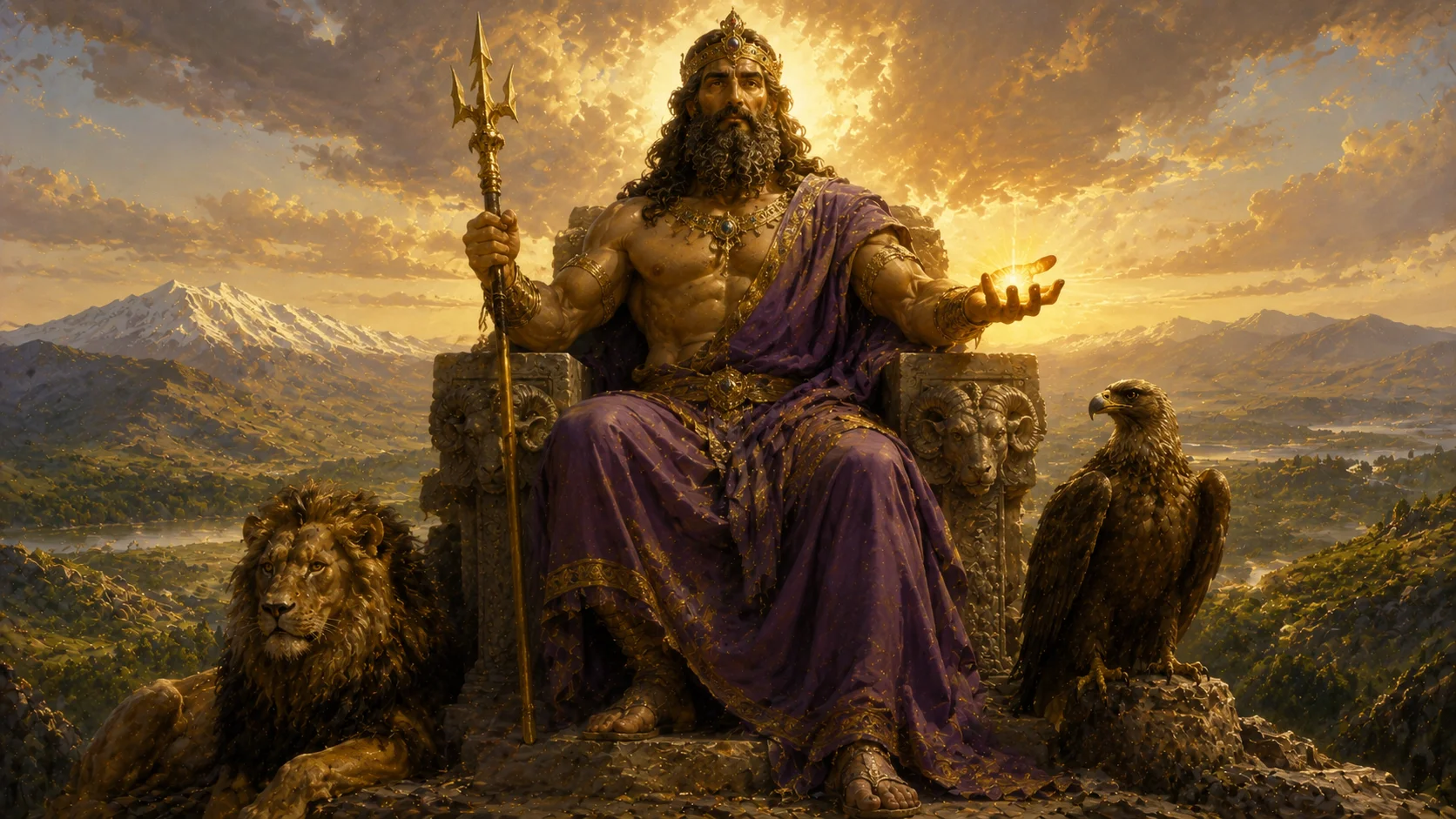
Aramazd, sometimes rendered Armazd, is the supreme creator-god and father of the gods of the pre-Christian Armenian pantheon: sky-father, lord of the heavens, and the deity to whom the Armenian sources attribute the making of heaven and earth. His name and his function are a direct Armenian adaptation of the Iranian Zoroastrian supreme god Ahura Mazda, and his cult stands as one of the clearest surviving witnesses to the long centuries of Achaemenid- and Parthian-era Iranian religious influence on Armenia.
A Wise Lord Carried Across a Frontier
The scholarly consensus is that Aramazd's name descends from Ahura Mazda, the Wise Lord of the Zoroastrian tradition, carried into Armenia through the long political and cultural contact between the Armenian highlands and the Iranian world. A popular but incorrect etymology has sometimes linked the god's name instead to Aram, a legendary patriarch-king of early Armenian foundation legend; the two names resemble one another, but they are not the same word, and the god's Iranian derivation is the position scholars hold with confidence. How much of Aramazd's character reaches back further still, into an older, pre-Zoroastrian Armenian or Urartian-influenced sky-god tradition, as against how much was a wholesale adoption of Ahura Mazda in the Hellenistic-to-Arsacid period, remains a genuinely open question among historians of religion, and one without a settled answer.
Father of Heaven and Earth
The chief written witness to Aramazd is Movses Khorenatsi's fifth-century History of Armenia, which names him father of the gods and creator of heaven and earth. It is worth holding two things in mind about this source at once: it is the fullest account that survives, and it was written after Armenia's Christianization, by a historian reinterpreting a faith that was no longer the state religion. Some of the epithets attached to Aramazd in Khorenatsi's telling, such as father of all gods and the language of abundance and generosity that echoes the older Iranian epithet tradition around Ahura Mazda as a beneficent creator, may reflect literary framing from a later, hostile vantage point rather than words once spoken in Aramazd's own temples. The core claim of his supremacy and his role as maker of heaven and earth is nonetheless the consistent thread running through the Armenian record.
Lord of the Fruitful Year
Aramazd was not worshipped as a remote sky-god alone. He was also a god of fertility, abundance, and the harvest, uniting in one figure the sovereign authority of the heavens with the earth's yearly increase. Scholars have compared this pairing of sky-sovereignty and fertility to other composite Indo-Iranian deities who likewise governed both the order above and the abundance below. For the Armenian farmer and the Armenian king alike, Aramazd's favor meant rain in its season, grain in the granary, and a land that did not fail.
The Turning of Navasard
The principal festival of Aramazd was Navasard, the Armenian new year, falling roughly in what corresponds to August in the pre-Christian calendar. At Navasard, sacrifices and offerings were brought to Aramazd's temples to secure prosperity and good harvests for the year ahead. It was the hinge of the ritual calendar, the moment when the community turned collectively toward its highest god to ask that the coming year be as generous as the one behind it, and it bound the fortunes of ordinary households to the standing of the god who governed both sky and harvest.
The Sanctuary at Ani-Kamakh
Aramazd's principal cult center stood at Ani-Kamakh, in the Bagayarij or Bagaran region of the historical province of Daranaghi, one of the great temple sites of pre-Christian Armenia. This was no ordinary shrine: it also served as a royal ancestral burial ground, the resting place of early Armenian kings, so that reverence for Aramazd was woven directly into the legitimacy of the dynasty itself. A king's line and a god's favor were bound together at Ani-Kamakh in a pattern typical of Armenian state religion, where ancestor veneration and the worship of the chief god of the heavens reinforced one another at the same sacred ground.
A Great Image in Bronze and Gold
When Armenia entered the wider world of Hellenistic religious syncretism under the Artaxiad and Arsacid dynasties, Aramazd came to be identified with the Greek Zeus, sovereign of the Greek heavens. Classical-era Armenian sources describe his cult statue at Ani-Kamakh as a great image of bronze and gold, rendered in a manner comparable to Greek cult statuary of Zeus himself. This Hellenized likeness was a later layer set over the older, Iranian-derived heart of the cult, evidence of how a single Armenian god could absorb successive waves of outside influence, first Persian, then Greek, without ever losing his place at the head of his own pantheon.
Kin of the Highest God
Aramazd stood at the center of a family of gods, though the Armenian sources do not agree with one another on every detail of how that family was arranged. What is consistently attested is his pairing with the goddess Anahit, whom Khorenatsi names as his daughter; her cult as mother-goddess of fertility and purity was closely linked to, and in the ancient telling dependent upon, Aramazd's own sovereignty. Other deities named within Aramazd's circle include Mihr, the sun and fire god who is himself an Armenian adaptation of the Iranian Mithra, Nane, a warrior and mother goddess linked to Anahit, and Vahagn, the storm and thunder god famed as a slayer of dragons. Beyond Anahit's place as his daughter, the precise lines of kinship among these figures vary from source to source, and are best treated as uncertain rather than fixed genealogy.
A Zoroastrianized State Religion
Taken together, the cults of Aramazd, Anahit, and Mihr have been read by some modern comparative-mythology scholarship as evidence of a broadly Zoroastrianized state religion in Armenia during the Hellenistic and Arsacid periods, a religious layer that scholars distinguish from older, indigenous or Urartian-influenced strata of Armenian belief beneath it. Aramazd, as the chief of this triad, represents the clearest case of an Iranian supreme god transplanted whole into Armenian soil and given an Armenian name, an Armenian temple, and an Armenian royal house to watch over.
The Silence That Followed 301
Armenia's official conversion to Christianity is traditionally dated to 301 CE, under King Tiridates III, with the active destruction of pagan temples carried out under Gregory the Illuminator. Aramazd's great sanctuary at Ani-Kamakh was among the temples demolished, and Armenian historians specifically record this destruction as marking the formal end of state-sponsored worship of Aramazd. The royal burial ground where kings had once been laid beside the god who legitimated their rule fell silent, and the sacrifices of Navasard were not offered there again.
What the Record Allows and What It Does Not
What survives of Aramazd survives through a narrow channel: a Christian-era history looking back at a faith already displaced, supplemented by classical-era descriptions of his temple and image. That record is enough to establish him firmly as the head of the Armenian pantheon, the sky-father, the creator of heaven and earth, and the god of the harvest and of Navasard, with Anahit as his daughter and Ani-Kamakh as his house. It is not enough to settle every question of ancestry, either of the god's own origins in relation to Ahura Mazda and any older Armenian sky-tradition, or of the exact kinship binding him to Mihr, Nane, and Vahagn. Both kinds of uncertainty are worth stating plainly rather than resolved into a tidier story than the sources actually tell.
The Father of the Gods Remembered
In Aramazd, ancient Armenia gave its highest place to a god who joined the authority of the sky to the generosity of the harvest, a Wise Lord carried from Iran and made thoroughly Armenian, worshipped at a royal sanctuary where kings themselves were laid to rest. He stood at the head of a pantheon that included his daughter Anahit and the wider company of Mihr, Nane, and Vahagn, was honored above all at the turning of the year at Navasard, and was pictured, in the Hellenistic centuries, in the likeness of Zeus himself. His temple fell in 301, but the record of what he was, father of the gods, creator of heaven and earth, and lord of Armenia's fruitful year, endures in the histories that outlived his sanctuary.
Sources & traditions
- EncyclopediaWikipedia — Aramazd
- TraditionArmenian folk and village traditions
Myths change from area to area and from time to time. This chronicle follows the most widely told versions; tellings in other villages, regions and eras may differ.