Ahura Mazda, called Ohrmazd in later Persian usage, the Wise Lord, is the supreme God of Zoroastrianism: the uncreated, all-wise, wholly good creator of the spiritual and physical worlds, of Asha, the truth and cosmic order that upholds all things, and of humankind's own capacity to choose between good and evil. Eternally opposed to the hostile spirit Angra Mainyu, Ahura Mazda is worshipped as the one supreme deity of one of the world's oldest continuously practiced revealed religions, and is prophesied to triumph utterly when the world is remade at the end of time.
A Name That Is Also a Claim
The name Ahura Mazda joins two Avestan words: ahura, lord, and mazda, wisdom. Together they mean Wise Lord, or Lord of Wisdom, and the name is not merely a title but a description of the God's essential nature as it is presented across the earliest Zoroastrian scripture. The name is first attested in the Gathas, the oldest layer of Avestan hymns, traditionally attributed to the prophet Zarathustra, known in later Western usage as Zoroaster. Scholars place the likely composition of the Gathas in the second millennium BCE, within an oral tradition of great antiquity that was only committed to writing many centuries later. In these hymns, Ahura Mazda is addressed directly, praised, questioned, and petitioned, in a register of intimate, reasoned devotion rather than myth-telling, and the name itself, Wise Lord, sets the tone for everything the Gathas say about him.
The Uncreated Maker of Two Worlds
In the Gathic theology, Ahura Mazda is uncreated and supreme, the creator of both the spiritual world, menog, and the physical world, getig. He is credited not only with fashioning the heavens and the earth but with establishing Asha itself, truth and cosmic order, as the measure by which all things, divine and human, are judged. Ahura Mazda is also understood as the creator of humankind's moral freedom: the capacity to choose, in thought, word, and deed, between the path of truth and the path of falsehood. This gift of choice is treated in the Gathas as central to what it means to be human, and it is Ahura Mazda who is credited with having made that choice possible in the first place, rather than compelling goodness by decree.
The Opposing Spirit and the Great Dualism
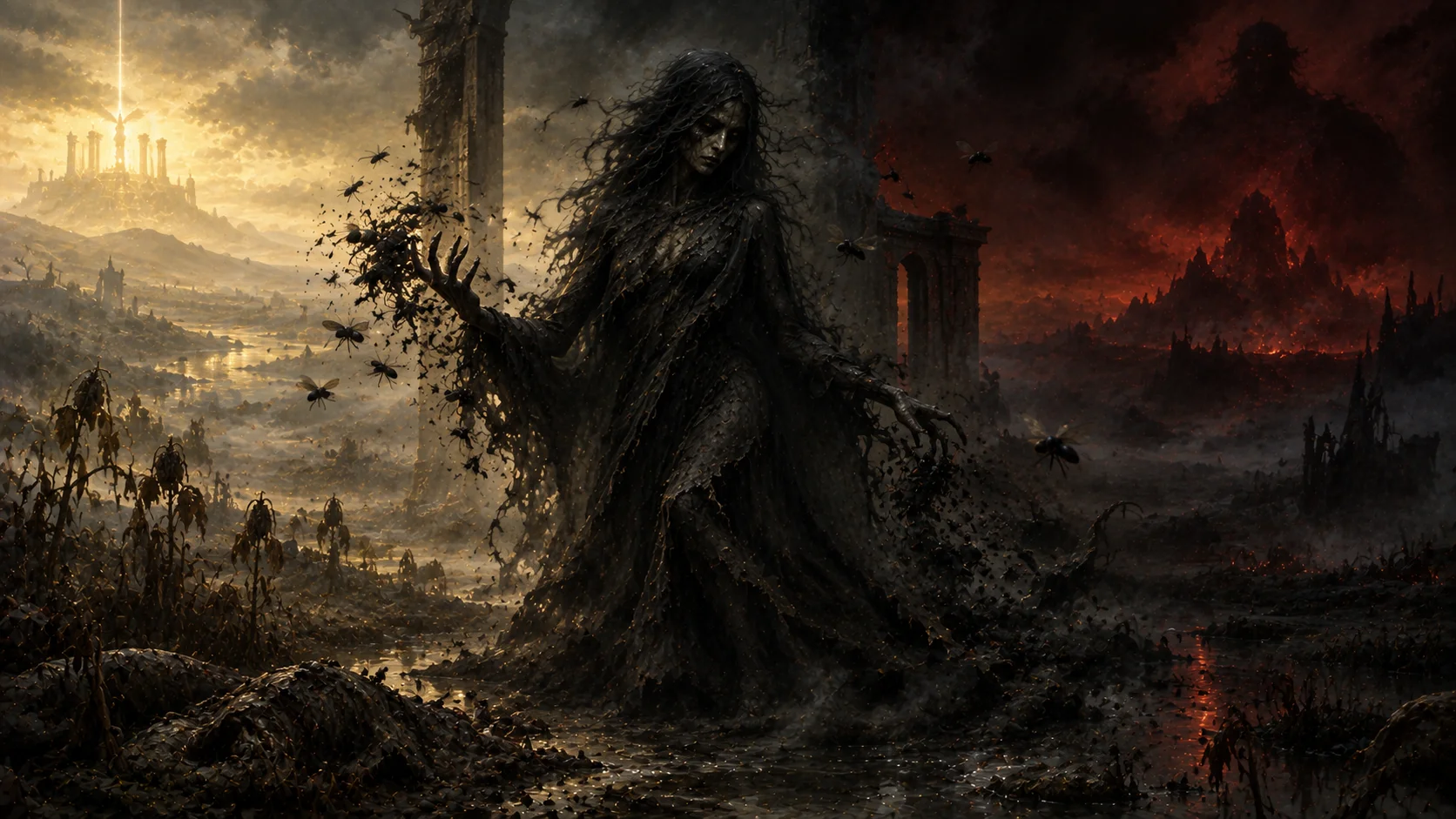
Central to Gathic theology is a moral dualism: Ahura Mazda, wholly good, stands eternally opposed to Angra Mainyu, the destructive spirit, later known in Middle Persian as Ahriman. This opposition is not a contest between equals ordained by some prior power but a confrontation between the wholly beneficent and the wholly hostile, playing out across the whole of creation and within the conscience of every person. A distinct and disputed strand of later Zoroastrian thought, known as Zurvanism, departed from this orthodox picture by treating both Ahura Mazda and Angra Mainyu as emanations of Zurvan, Infinite Time. Zurvanite theology was never accepted as orthodox and stands apart from the Gathic and mainstream Zoroastrian understanding, in which Ahura Mazda alone is uncreated and supreme.
The Bounteous Immortals Who Attend Him
Ahura Mazda is accompanied by, or generates, six great beings called the Amesha Spentas, the Bounteous Immortals: Vohu Manah, Good Mind; Asha Vahishta, Best Truth; Khshathra Vairya, Desirable Dominion; Spenta Armaiti, Holy Devotion; Haurvatat, Wholeness or Health; and Ameretat, Immortality. These are sometimes described as Ahura Mazda's own aspects or emanations rather than as separate deities in the ordinary sense, and each governs a distinct sphere of creation and of moral life. Through the Amesha Spentas, the Wise Lord's goodness and order extend into the physical world and into the daily choices of the faithful, giving abstract virtues, good thought, truth, rightful power, devotion, wholeness, and immortality, a living, almost personal presence within Zoroastrian worship and ethics.
Spenta Mainyu, the Bounteous Spirit Through Whom He Acts
In the Gathas, particularly in the hymns known as Yasna 30 and Yasna 45, Ahura Mazda's will is understood to operate in the material world through Spenta Mainyu, the Bounteous or Holy Spirit, sometimes described as his active creative agency and elsewhere as his twin spirit. The precise relationship between Ahura Mazda and Spenta Mainyu, whether the two are strictly identical or whether Spenta Mainyu is better understood as an emanation or agency of the Wise Lord, remains a genuinely debated question among scholars of the Avesta, and the Gathas themselves do not resolve it with a single formula. What is consistent across the hymns is that Spenta Mainyu stands opposed to the destructive spirit and channels Ahura Mazda's creative and moral will into the working of the world.
Ohrmazd and the Twelve Thousand Years of the Bundahishn
In the Younger Avesta and in later Pahlavi, Middle Persian, texts composed in the Sassanian and early Islamic periods, Ahura Mazda is called Ohrmazd, and the cosmic struggle against Ahriman is given a fixed shape in time. The Bundahishn, a major Zoroastrian cosmological compilation from this later period, describes the conflict between Ohrmazd and Ahriman as unfolding across a traditional span of twelve thousand years, culminating in the eschatological renovation of the world. This later cosmological elaboration builds directly on the Gathic dualism while giving it a developed narrative architecture that the earliest hymns do not themselves spell out in such detail.
The God Who Grants Kingship at Behistun
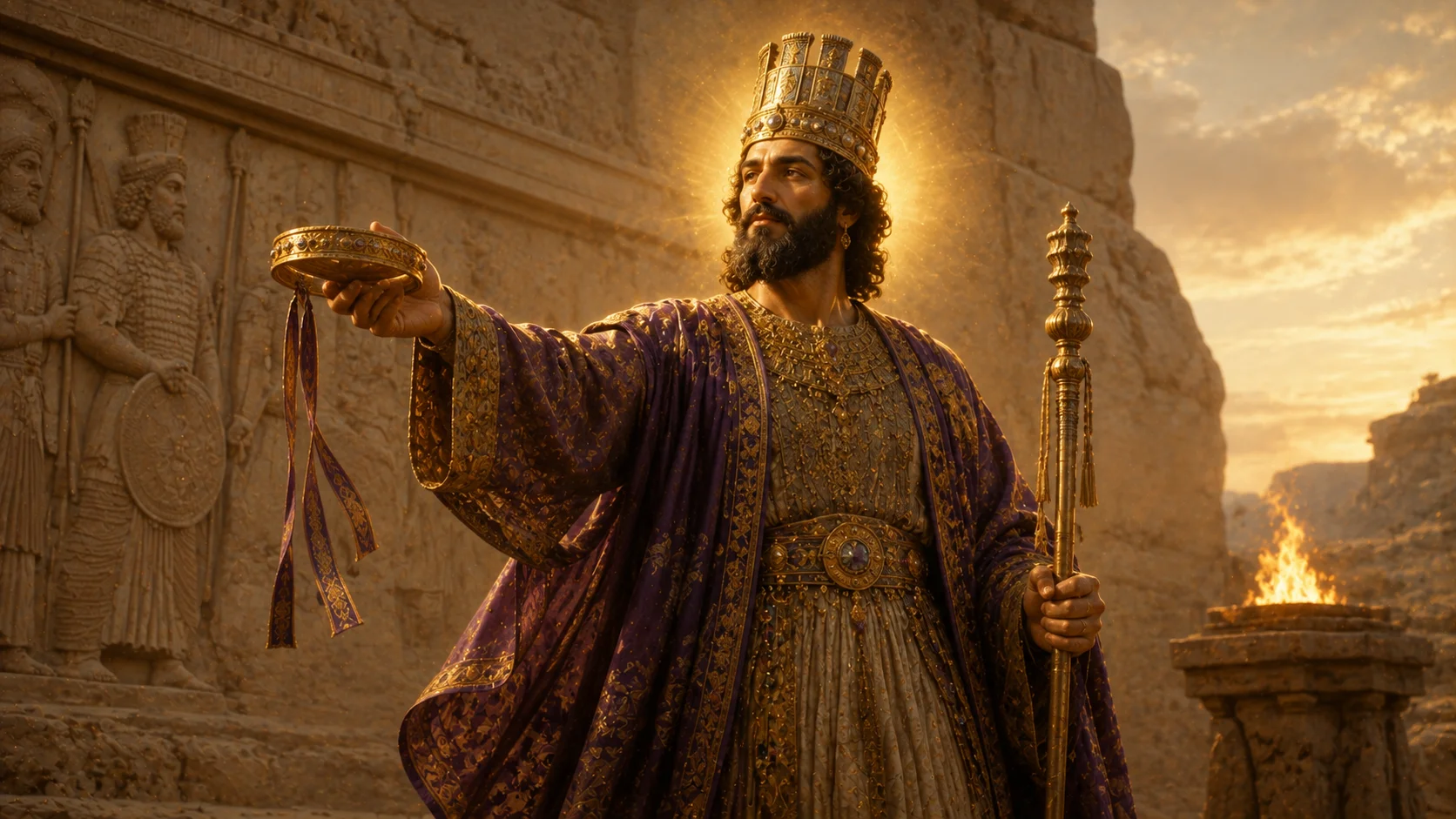
Beyond the strictly religious and cosmological texts, Ahura Mazda is attested with striking directness in the royal inscriptions of the Achaemenid kings of Persia. In the Behistun Inscription of Darius I, carved around 520 BCE, and in later inscriptions of Darius and Xerxes, Ahura Mazda is invoked as the god who grants kingship itself, and as the deity credited, though not always explicitly as the sole such deity, with creating heaven, earth, and humankind, and with establishing the legitimacy of the king's rule. This body of royal inscriptional evidence is historically distinct from the theological material of the Gathas, offering an independent, datable window onto how Ahura Mazda was invoked in the political and religious life of the Achaemenid court.
Epithets of the Creator and Fashioner
Across these different bodies of evidence, the Wise Lord is known by a consistent cluster of titles: Ahura Mazda itself, Ohrmazd in its later Middle Persian form, and descriptive titles such as Creator, rendered Dadvah, and the one who fashioned the world. These epithets, recurring across the Gathas, the Younger Avesta, and the Achaemenid inscriptions, reinforce the same essential claim made by the name itself, that this is a God defined above all by wisdom and by the act of making.
A Presence Without a Likeness
Ahura Mazda has no anthropomorphic cult image in early orthodox Zoroastrian practice, an aniconic tradition that runs through the religion's history. The winged-disc symbol commonly called the Faravahar, familiar from Achaemenid reliefs such as those at Persepolis and later adopted more broadly as a general Zoroastrian emblem, was traditionally associated with Ahura Mazda or with royal glory, khvarenah. Scholars continue to debate whether the symbol originally depicted Ahura Mazda himself, a fravashi, a guardian spirit, or royal fortune specifically, and no single interpretation commands full consensus. What is not in doubt is that Zoroastrian tradition did not represent its supreme God in the way that many other ancient religions pictured their deities.
Fire as the Visible Sign of His Truth
Fire, atar, is Ahura Mazda's principal ritual symbol, tended with great care in fire temples known as Atash Behram and Atash Adaran. Fire is not the object of worship in Zoroastrian practice but a visible representative of Asha and of divine presence, a distinction the tradition itself insists upon. In liturgical texts, the sun and fire are called sons or manifestations associated with Ahura Mazda, and the careful, unbroken tending of sacred fire remains one of the most enduring and recognizable expressions of devotion to the Wise Lord.
The Worship That Bears His Name
The Yasna, the central Zoroastrian act of worship, is addressed primarily to Ahura Mazda and is recited by priests, mobeds, using consecrated haoma and sacred fire; the word yasna itself means worship or sacrifice. This liturgy reflects and enacts Ahura Mazda's role as the ultimate recipient of devotion within the tradition. Because all other beneficent beings, the Amesha Spentas and the lesser yazatas, are understood as subordinate to and derived from him, orthodox Zoroastrianism treats Ahura Mazda as the sole proper object of worship, a structure that has led scholars to describe Zoroastrianism as among the earliest monotheistic, or by some accounts henotheistic, religious traditions in recorded history.
The Renovation That Ends the Struggle
Pahlavi eschatological texts describe a final event called Frashokereti, the renovation of the world, in which Ahura Mazda triumphs completely over Ahriman, evil is destroyed, the dead are resurrected, and creation is restored to perfect goodness. This is a doctrine of cosmic optimism distinctive within ancient religious thought, an assurance built into the very structure of Zoroastrian belief that the struggle between the Wise Lord and the destructive spirit, however real and however long, does not end in doubt. For those who honor him, Ahura Mazda remains what the Gathas first named him: the Wise Lord, uncreated, wholly good, and certain, in the end, to prevail.
Sources & traditions
- EncyclopediaWikipedia — Ahura Mazda
- TraditionZoroastrian texts, grimoires and later commentary
Myths change from area to area and from time to time. This chronicle follows the most widely told versions; tellings in other villages, regions and eras may differ.