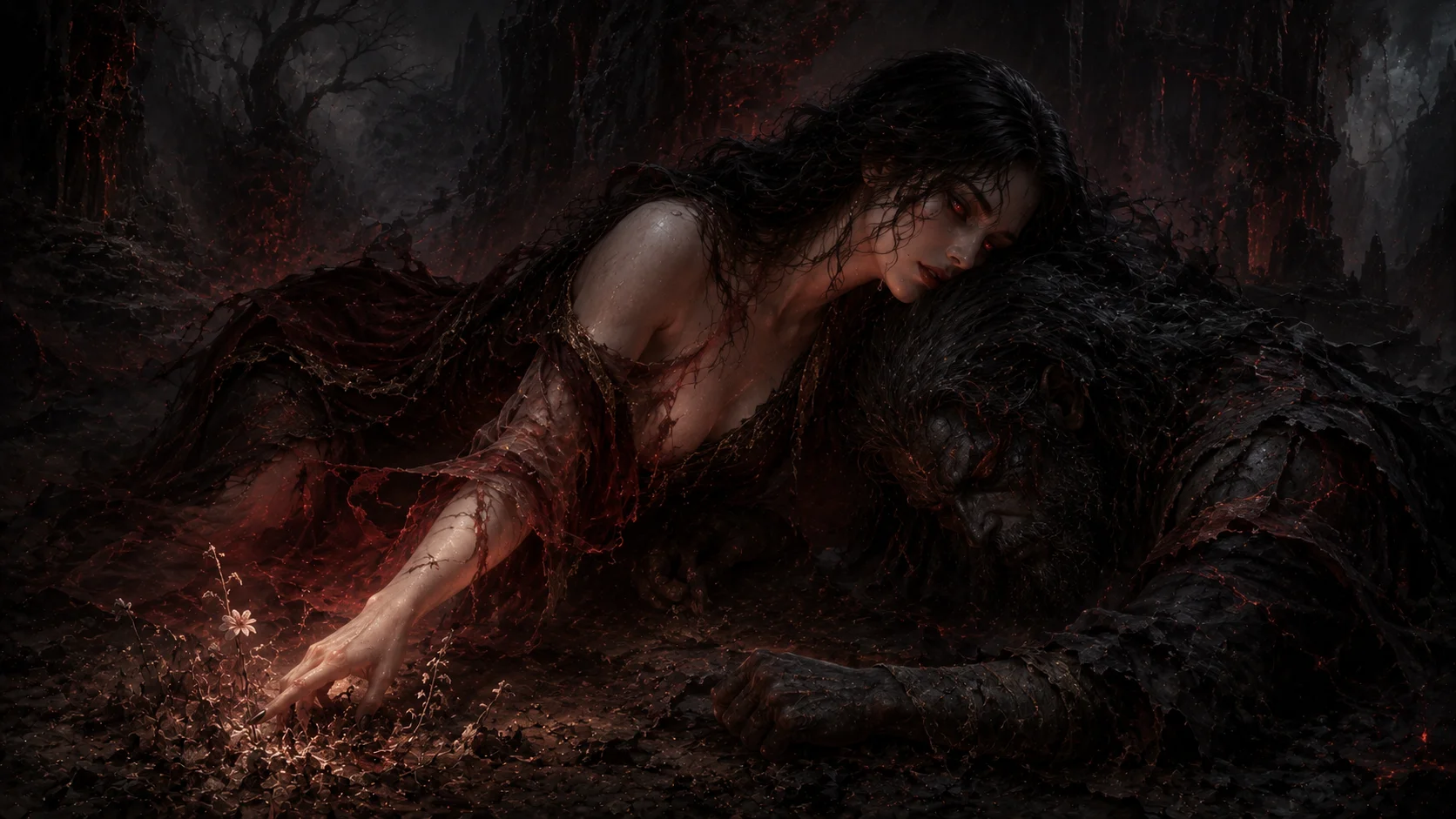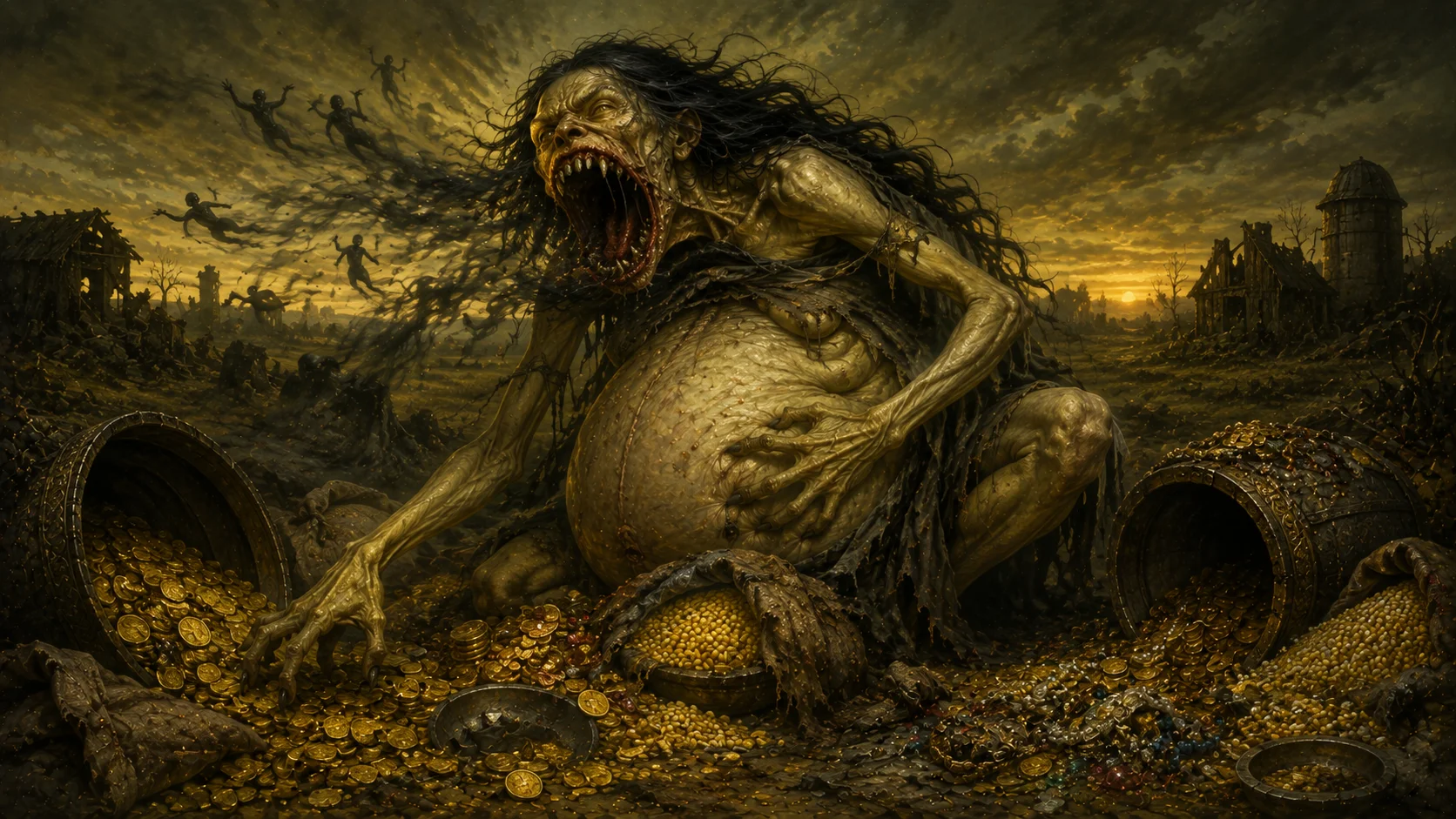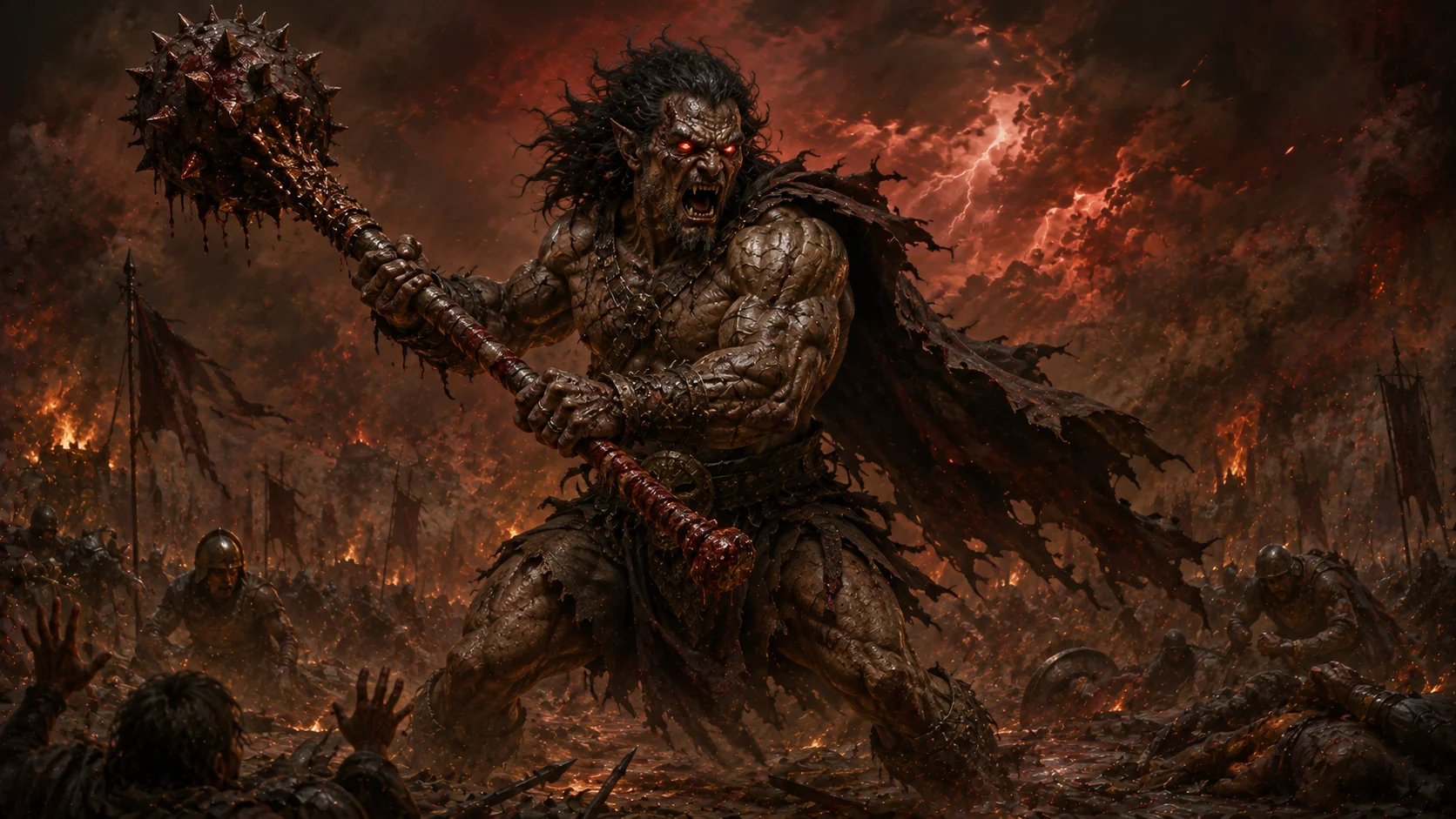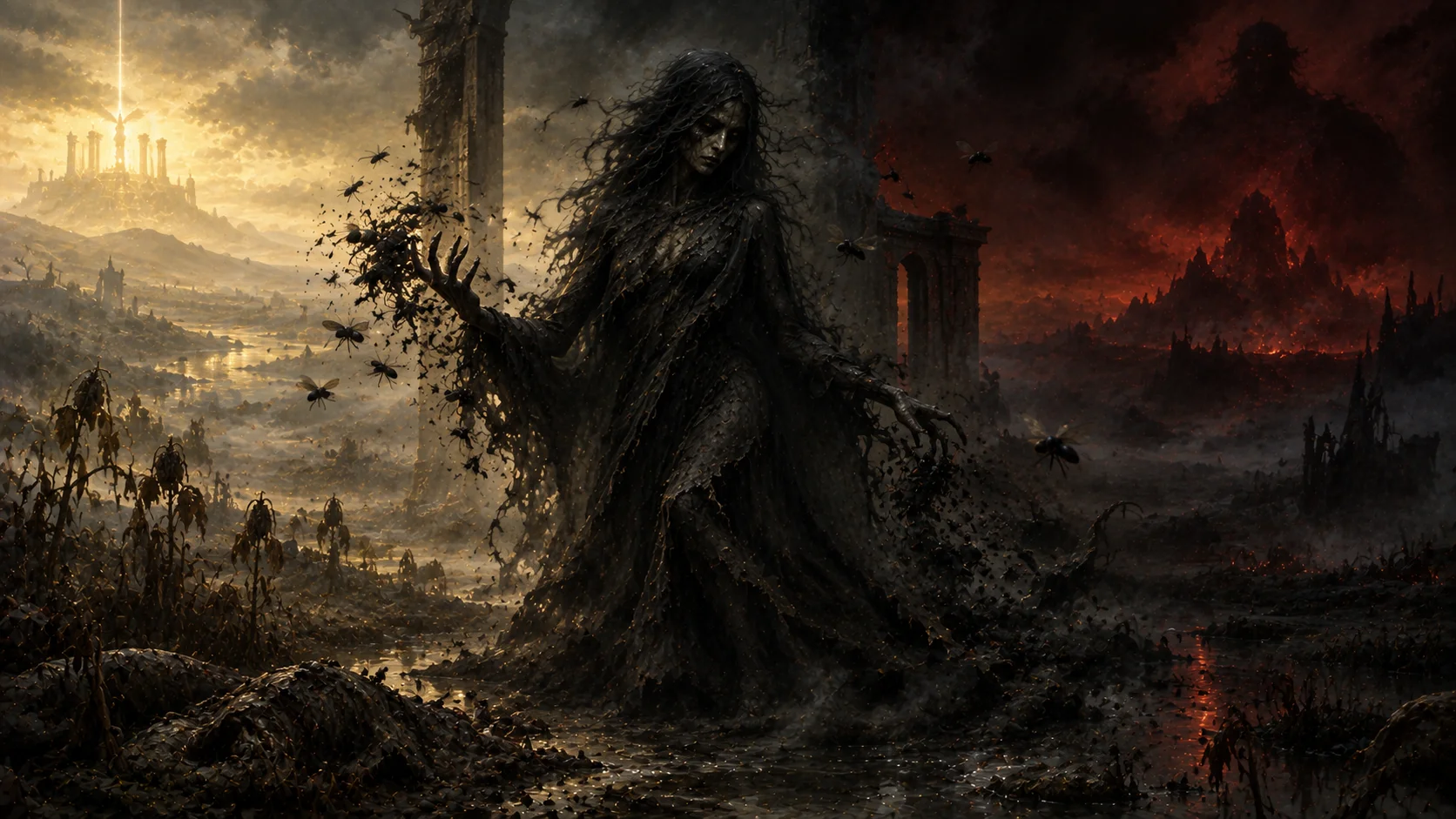
Druj, the Lie — in Avestan, the ancient sacred language of Zoroastrianism, this is the word for falsehood, deceit, and disorder in their most cosmic sense: not a lesser vice among many, but the single term the tradition uses for the entire negative pole of existence, the direct and total antithesis of Asha, Truth and right order. To speak of Druj is to speak of the shape evil takes in Zoroastrian thought — and to understand it is to understand why this tradition regards every human choice, however small, as consequential.
The Word That Names the Wrongness of the World
Long before Druj became attached to any single demon or any single story, it named a quality: the quality of being false, disordered, and corrupt, as opposed to being true, ordered, and whole. In the Gathas, the hymns attributed to Zarathustra himself, Druj appears again and again as the force set against Asha — most memorably in Yasna 30, the great hymn of the Two Spirits, where the moral structure of the universe is laid out as a choice between two primal orientations. One leads toward Asha. One leads toward Druj. There is no third path and no neutral ground. This is among the oldest religious formulations of a binary moral universe in human history, and Druj is one of its two poles — arguably the most consequential single word in the entire Zoroastrian vocabulary of evil, because unlike any individual demon, Druj is not one threat among many but the category that contains all of them.
The Twin That Is Not a Twin
It matters that Druj is described first and foremost as the opposite of Asha Vahishta, Best Truth — this is the oldest and deepest of the pairings, older than the later, more systematized scheme that would eventually array the beneficent Amesha Spentas against a matching set of demonic opposites. Asha and Druj are not equals locked in eternal balance, the way some traditions imagine light and dark as a static duality. Asha is order, structure, the way things are meant to be — the truth that the cosmos itself is built from. Druj is the corruption of that order, the crack in it, the lie that pretends to be truth and the disorder that pretends to be structure. Every ritual observance, every ethical teaching, every act of purification in Zoroastrian practice can be traced back to this single opposition: does an act serve Asha, or does it serve Druj?
Every Soul, Sorted by a Single Word
Out of this opposition the tradition built a complete ethical taxonomy. A person who lives by truth, who upholds right order in thought, word, and deed, is an ashavan — a follower of Asha. A person who lives by falsehood, who deceives, corrupts, and disorders, is a drvant — a follower of the Lie. This is not merely a label applied after death; it is understood as the defining fact of a life, built moment by moment out of the accumulated weight of thought, word, and deed. Zoroastrian ethics famously rests on this triad — good thoughts, good words, good deeds — and each of the three is, in effect, a small test of allegiance: does this thought, this word, this deed, tilt the balance toward Asha or toward Druj? The soul's ultimate reckoning at the Chinvat Bridge, the judgment that follows death, is understood as the final tally of that lifelong accounting, and the entire architecture of free will in Zoroastrian theology exists because Ahura Mazda is said to have given humanity the capacity to choose between the two.
The Source Beneath the Source
Druj's closest and most consequential association is with Angra Mainyu, later known as Ahriman, the Evil Spirit who stands opposed to Ahura Mazda. In some strands of the tradition, Ahriman is described as the very embodiment or wellspring of Druj — the Lie given a singular destructive will. In others, druj functions more as a category: a class of demonic falsehood-beings that serve under Ahriman, each a different facet of deceit and disorder let loose in the world. The tradition itself does not fully resolve which picture is correct, and it would be a mistake to force one reading onto every passage — some texts lean toward an abstract cosmic principle, others toward something closer to a personified being, and the honest position is that both readings appear, in different places, for different purposes.
A Political Echo, Centuries Later
The moral weight carried by Druj was not confined to scripture or ritual — it surfaced in the language of kingship itself. The Old Persian cognate drauga appears in the Behistun inscription of Darius I, where rival claimants and usurpers to the throne are condemned as followers of the Lie, servants of drauga rather than of truth. This is a related but historically distinct attestation, separate from the Avestan religious texts, and it shows how deeply the Truth-versus-Lie framework had penetrated Persian political thought: to call a rival king a liar was, in this world, to place him on the losing side of the entire cosmic order, not merely to question his honesty.
The Demoness Who Comes for the Dead
Where Druj as abstract principle can feel distant, one of its personified forms is described with vivid, almost physical immediacy: Druj Nasu, the demoness of death-pollution and corpse-contamination, described in the Vendidad as rushing onto a body at the very moment of death. She is imagined arriving in the form of a fly, or a swarm of corpse-flies, descending onto the newly dead and, through that contact, defiling anyone who subsequently touches the corpse. This is not presented as poetic metaphor alone — it is the theological explanation underlying a body of very concrete, very practical funerary law. Death, in this understanding, is not merely an absence of life; it is an opening through which Druj enters the world in a particularly aggressive and contagious form, and the community's response to a death is accordingly treated as a matter of real spiritual danger.
Law Written to Hold Her Back
Because Druj Nasu was understood as a genuine and present contagion of the Lie, the Zoroastrian purity code built an entire structure of ritual practice around containing her. The towers of silence, known as dakhma, kept the dead apart from the living and from the sacred elements of earth and fire, which Zoroastrian practice holds must not be defiled by contact with a corpse. The barashnum, an elaborate purification rite, was the means by which a person who had been in contact with death could be ritually cleansed of Druj Nasu's touch. And the sagdid, the "dog's gaze" — the practice of bringing a dog to look upon the body — was specifically understood as a rite meant to drive Druj Nasu off, the dog's gaze credited with a power to repel her presence. None of this was abstract theology performed once a year; it shaped the daily and generational practice of the community, which is precisely why Druj cannot be treated as a minor mythological footnote. Few concepts in the tradition translate so directly from cosmic principle into lived, repeated ritual obligation.
An Image With No Fixed Face
Unlike deities and demons who accumulated settled iconography over centuries, Druj as the abstract principle of the Lie has no single fixed cult image. There is no canonical depiction of "the Lie" the way there might be a canonical depiction of a particular yazata or a particular demon. Where Druj does take on a concrete visual form, it is through Druj Nasu specifically, and there her most attested shape is the fly — small, quick, drawn to death and decay, arriving where corruption has already begun. It is a striking choice of image: not a monstrous giant or a horned figure, but something ordinary, easily overlooked, and impossible to fully keep out — much like the Lie itself, in the tradition's own understanding, is not always a dramatic assault but often something small that slips in wherever order has already broken down.
The Guardian Set Against Her
Druj does not go uncontested. Asha Vahishta stands as her direct moral opposite, but the tradition also names a more active defender: Sraosha, the yazata of obedience, discipline, and attentive listening, who is described as guarding souls — particularly through the vulnerable hours of night and in the passage after death — against the forces of Druj. Sraosha's role gives the abstract conflict between Truth and the Lie a protective, almost pastoral dimension: it is not simply that Asha and Druj oppose one another in principle, but that specific beneficent figures are understood to actively watch over human beings in the moments when Druj's influence is thought to be strongest.
The War With an Ending
Zoroastrian eschatology does not describe an eternal, unresolved standoff between Truth and the Lie. The doctrine of Frashokereti, the final renovation of the world, holds that this conflict has a genuine conclusion: Druj, along with Ahriman and the dēws, will be permanently defeated and expelled from existence, leaving only Asha, only Truth, standing at the end of time. This matters enormously for how the whole concept should be understood — Druj is not framed as a permanent, necessary counterweight to good, the way some dualistic systems imagine darkness as eternally required for light to have meaning. Druj is understood as a genuine intrusion, a corruption of what should be, and one that the tradition insists will ultimately be undone. The moral struggle asked of every ashavan in daily life is presented as a small, personal participation in that larger, guaranteed victory.
A Concept Still Debated by Those Who Study It
One question about Druj remains genuinely open and is worth naming honestly rather than papering over: whether Druj should be understood as a single, unified personified being — a kind of dark counterpart to Asha's own quasi-personified presence — or whether the more accurate picture is of an abstract force that only crystallizes into specific, personified demons, such as Druj Nasu, in particular textual contexts, without ever cohering into one singular "goddess of the Lie" across the tradition as a whole. Both readings can point to real textual evidence, and neither should be treated as settled. What is not in doubt is Druj's centrality: whether read as principle, as category, or as intermittently personified being, it remains the term the tradition reaches for whenever it needs to name the deepest opposite of Truth — the force that every ashavan is asked, in ordinary thought and word and deed, to stand against.
Sources & traditions
- TraditionZoroastrian texts, grimoires and later commentary
Myths change from area to area and from time to time. This chronicle follows the most widely told versions; tellings in other villages, regions and eras may differ.