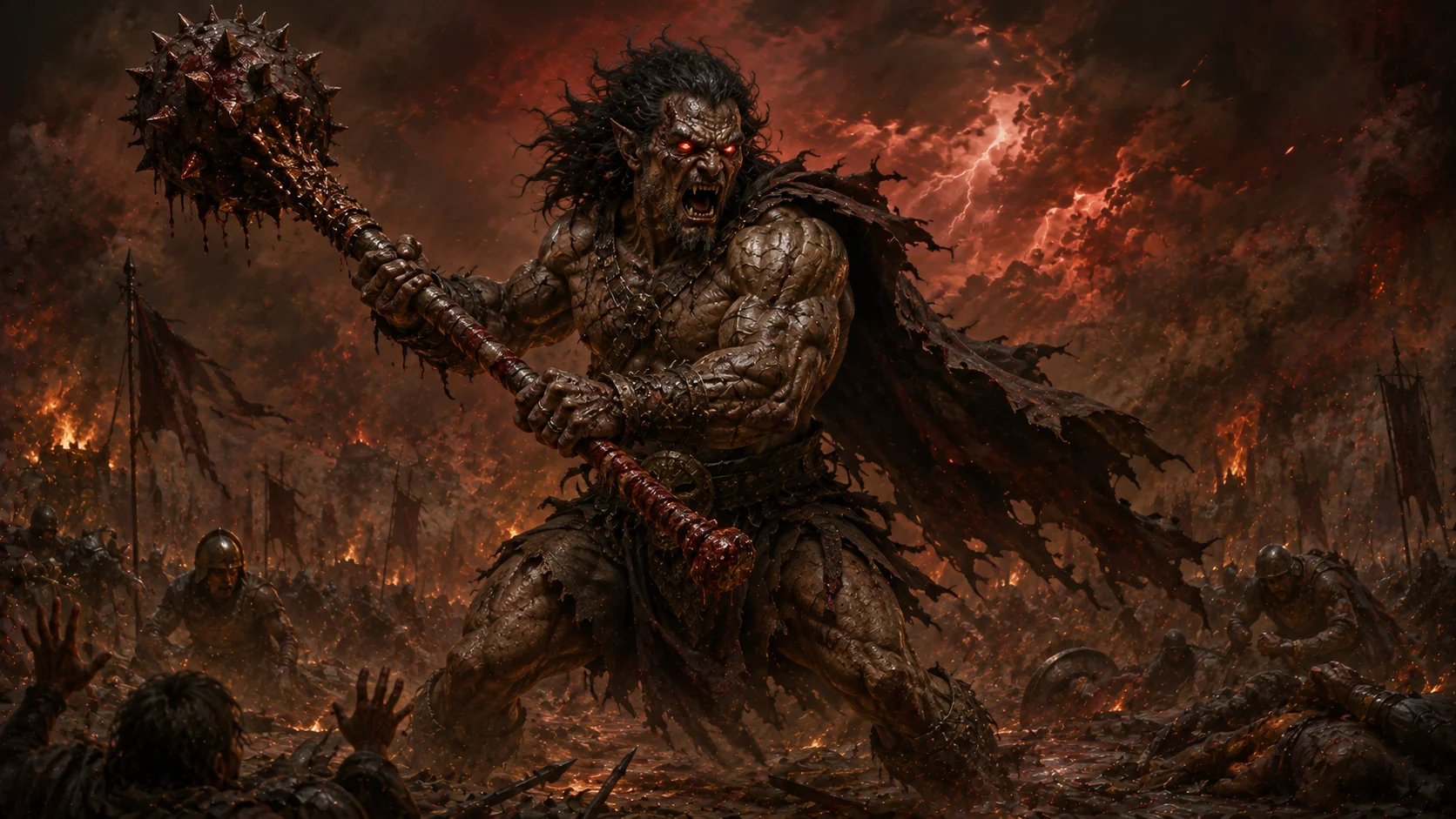
Aeshma, called in the Avesta 'Aēšma xrūra' — Aeshma the fierce, the bloody-clubbed — is among the daēvas of the Zoroastrian tradition, the personification of wrath and fury, and one of the very few demonic figures named already in the Gathas, the hymns attributed to Zarathustra himself.
A Name Older Than the Later Demon-Lists
Most of the daevas catalogued in Zoroastrian scripture belong to the Younger Avesta, the later stratum of composition. Aeshma is different. His name is invoked repeatedly in the Gathas — in Yasna 29.1, in Yasna 48.7, and in the surrounding verses of Yasna 29 — placing him in the oldest layer of Avestan religious poetry that survives. This matters doctrinally: it means that wrath, as a named cosmic adversary, was already central to Zarathustra's own vision of the struggle between order and chaos, not a concern added by later priestly generations. Aeshma's name, from the Avestan root associated with 'aēš-', to rush or assail, is the abstract noun for wrath, fury, or assault given a demonic face — a vice made into a person.
The Epithet of the Bloody One
Where Aeshma appears in the texts, he is most consistently given the epithet 'xrūra' — the fierce one, the bloody one — most often in the fixed compound Aēšma xrūra, or simply Aēšma daēva, 'the demon Wrath'. This is not a poetic flourish invented once but a recurring formula, suggesting that within the community that composed and preserved these hymns, Aeshma's violence was understood as bloody in a literal sense: the fury that spills blood, that drives raiding, killing, and the breaking of the peace among settled, cattle-keeping peoples.
The Violence Set Against the Herds
Several Gathic and Avestan passages tie Aeshma specifically to violence directed against cattle, and this detail carries real weight for understanding early Zoroastrian society, which was rooted in pastoral, cattle-herding life. Aeshma's fury is associated with 'druj', the Lie — the great moral-cosmic falsehood that Zoroastrian ethics is built to oppose — and with assaults on the herds that sustained that community. To invoke Aeshma, in this light, was to name the very real threat of raiders and violent men who broke the pastoral order through bloodshed and theft, given cosmic form as a demon working in service of the Lie.
A Vice Without a Biography
Unlike Angra Mainyu, the Evil Spirit himself, Aeshma has no birth-myth, no independent narrative arc, in any surviving Avestan or Pahlavi source. He is best understood not as a character with a story but as a personified passion — uncontrolled rage given a name and a place in the cosmic order, so that the abstract moral failing of fury could be named, resisted, and preached against. This is part of what makes Aeshma doctrinally distinctive among the daevas: he is less a mythic being with deeds to his name than the demon-shape given to a specific human failing, present wherever wrath itself is present.
Sraosha's Adversary at the Heart of the Younger Avesta
In the Younger Avesta, and especially in the Sraosha Yasht — Yasna 57 — and the Sroš Yašt Hādōxt, Aeshma is framed as the direct cosmic opponent of Sraosha, the yazata who personifies Obedience, discipline, and the hearkening to divine order. Sraosha is described wielding a mace, a vazra-like weapon called the Sraosha-varz, whose specific purpose is to smite Aeshma. This is one of the clearest and most sustained yazata-versus-daeva pairings in the entire Avesta: order armed against fury, discipline set directly against violence, rendered in a single recurring image of the weapon raised against the demon.
Guardian of the Bridge, Enemy of the Renovation
The opposition between Sraosha and Aeshma is not confined to a single hymn or a single moment; it carries eschatological weight within Zoroastrian doctrine. Sraosha is assigned a central role in guarding the soul at the Chinvat Bridge, the crossing every soul must make after death, and Sraosha is understood to have a decisive role at the Frashokereti, the final renovation of the world when the forces of the Lie are finally overcome. Because Aeshma stands as Sraosha's persistent adversary, his enmity is not local or minor — it is bound into the larger arc of the Zoroastrian cosmic struggle, present from the earliest hymns through to the anticipated end of that struggle.
A Place Debated Among the Chief Demons
Pahlavi cosmological texts, including the roster of chief demons preserved in the Bundahishn, place Aeshma — there rendered Xešm — among the small number of arch-daevas who stand opposed to the Amesha Spentas, the great beneficent beings surrounding Ahura Mazda. Tradition is not perfectly settled on exactly whom Aeshma opposes in this fixed scheme: some sources pair him against Asha Vahishta, the Amesha Spenta of Best Truth and Cosmic Order, called Ardwahišt in Middle Persian, while other, Sraosha-centred schemes retain the pairing with Sraosha described above. Both traditions are attested, and the honest account is that this assignment is tradition-dependent rather than fixed by a single authoritative text — a variation worth preserving rather than smoothing away.
Among the Named Company of Adversarial Spirits
Aeshma does not stand alone in the Pahlavi demon-catalogues. The Denkard and the Bundahishn's demon-lists name him alongside other daevas such as Akoman, the Evil Mind, along with Nanghaithya and Taromaiti, as part of a fixed roster of chief adversarial spirits ranged against the Amesha Spentas. This catalogue matters for the architecture of Zoroastrian dualism: good and evil are understood as mirrored hierarchies, spirit answering spirit, and Aeshma's fixed place in that roster marks him as one of the small number of demons considered important enough to be named individually rather than folded into an anonymous demonic host.
Fury and Corrupt Intention, Read Together
Scholars examining the ethical vocabulary of the Gathas have sometimes read Aeshma alongside Aka Manah, the daeva of Evil Mind or corrupt thought, as together representing two faces of wrongdoing — Aeshma the violent impulse, Aka Manah the corrupted intention behind it — set in contrast to Vohu Manah, the virtuous Amesha Spenta of the Good Mind. It is worth being precise about what this pairing is: an analytical framing drawn from comparative reading across the Gathic texts, not an explicit dyad fixed in any single passage. Held with that caveat, it remains a genuinely useful way of seeing how early Zoroastrian ethical thought organized the varieties of moral failure it opposed to the Good Mind.
The Discipline Asked of the Faithful
Because Aeshma personifies wrath as a moral and psychological failing rather than merely an external cosmic force to be fought in battle, Zoroastrian ethical teaching treats the resisting of Aeshma as a matter for the individual conscience. Self-mastery against fury — the refusal to let rage govern one's actions — is prescribed as a religious duty in its own right, and this duty is bound to Sraosha's virtues: obedience, calm, right conduct, and attentive discipline. Aeshma's defeat, in this framing, is not accomplished by ritual combat alone but is renewed each time a person chooses discipline over rage — the great cosmic struggle reenacted, in miniature, in every human decision to master anger rather than be mastered by it.
No Image, No Altar
No dedicated cult image or fixed iconography of Aeshma survives from Zoroastrian material culture, and none should be expected. The Avesta explicitly rejects daeva-worship — 'daeva yasna' — as contrary to right religion; the daevas, unlike the yazatas, were never objects of veneration within orthodox Zoroastrian practice. Aeshma was named in order to be resisted and preached against, not honoured with rite or image. Any visual tradition depicting a figure descended from him belongs to later, external traditions rather than to Zoroastrian religious art itself.
A Second Life in a Different Faith
Aeshma's Middle Persian form, Xešm, and his standing as a great daeva of wrath, is widely understood by scholars — Jacques Duchesne-Guillemin among them — to lie behind the demon Asmodeus of the deuterocanonical Book of Tobit, where Asmodeus kills Sarah's seven bridegrooms before being bound by the angel Raphael. This transmission most likely occurred during the era of Achaemenid Persian rule over Judea, when Second Temple Jewish demonology came into sustained contact with Zoroastrian religious thought. The precise path of that transmission remains debated among scholars, and it is worth being exact about what this connection is and is not: Asmodeus's story in Tobit is a Jewish literary composition with its own content and its own narrative, a later and separate afterlife for a borrowed name, not part of the Avestan Aeshma's own attested deeds. The two belong to different scriptures, different centuries, and different religious worlds, joined only by the descent of a single name across that boundary.
The Shape a Tradition Gave to Fury
Set beside the great mythic architecture of Ahura Mazda and Angra Mainyu, Aeshma occupies a narrower but doctrinally essential place: he is what a religion that placed truth, order, and good thought at its center chose to call the fury that breaks all three. Named already by Zarathustra, opposed across the ages by Sraosha's mace, ranked among the chief demons of the Pahlavi lists, and asked to be defeated not on any battlefield but within the discipline of an individual conscience, Aeshma stands as one of Zoroastrianism's clearest witnesses to a conviction that has outlasted the empire that first gave it voice: that the gravest violence a person must overcome is very often their own.
Sources & traditions
- EncyclopediaWikipedia — Aeshma
- TraditionZoroastrian texts, grimoires and later commentary
Myths change from area to area and from time to time. This chronicle follows the most widely told versions; tellings in other villages, regions and eras may differ.